
Core sector growth hits a series-high 10.9% in October
The Index of Core Industries grew 10.9% in October 2026 over October 2025, the Ministry of Commerce and Industry said on 20 November. It is the fastest pace in the new series, which uses 2022-23 as its base year. September's growth was revised up to 8.2%. Iron ore (26.4%), coal (23.1%), electricity (21.6%) and cement (15.4%) led the rise. A low base helped: the index had grown only 0.8% in October 2025. Crude oil, natural gas and fertilizers shrank. Read it to revise what the core index measures, the weights of its industries and why a low base can flatter a growth number.
- October growth
- 10.9%, the highest in the new series (base year 2022-23)
- September
- Revised up from 7.9% to 8.2%
- Leaders
- Iron ore 26.4%, coal 23.1%, electricity 21.6%, cement 15.4%, steel 7.3%
- Laggards
- Crude oil, natural gas and fertilizers shrank
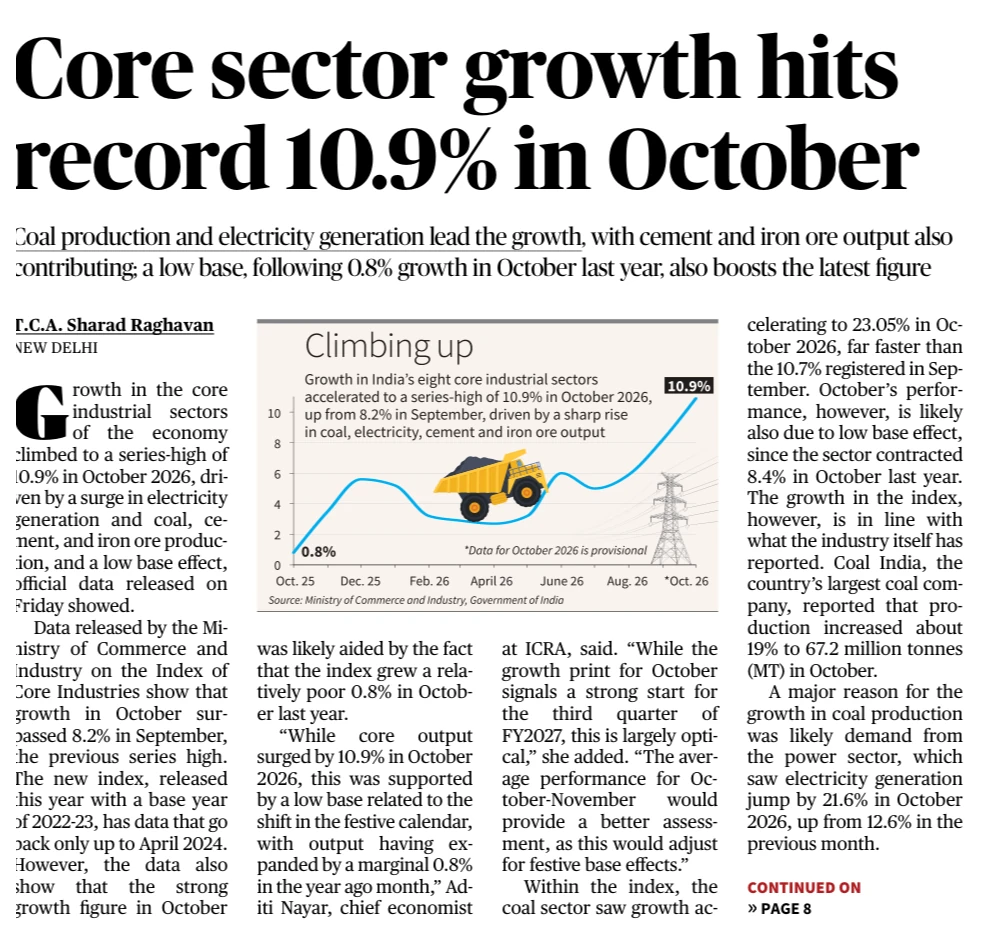
What did the October core sector data show?
The core industries are the base on which factories, roads and homes are built. Their output is the earliest clue to how the wider industrial economy is doing.
- The Index of Core Industries grew 10.9% in October 2026 over October 2025. The figure is provisional.
- It is the fastest pace in the new series, which uses 2022-23 as its base year and has data only from April 2024.
- September growth was revised from 7.9% to 8.2%, the previous series high.
- Iron ore grew 26.4%, coal 23.1%, electricity 21.6%, cement 15.4% (a series high) and steel 7.3%, its fastest in seven months.
- A low base helped: the index had grown only 0.8% in October 2025, partly because of a shift in the festive calendar.
- Crude oil fell 4.1%, its 22nd straight month of decline. Natural gas fell 7.6%, its worst showing in the new series. Fertilizers also shrank.
- Growth for April to October 2026 was 6.0%, against 2.3% a year earlier.
What is the Index of Core Industries?
The index tracks the output of the economy’s basic industries. The new series has nine: coal, crude oil, natural gas, refinery products, fertilizers, steel, cement, electricity and iron ore.
Electricity carries the biggest weight (30.932), followed by refinery products (22.572) and steel (17.584). Fertilizers carry the least (2.731).
It is released by the Office of the Economic Adviser in the Ministry of Commerce and Industry on the 20th of the following month. November data will come on 21 December 2026.
Core industries feed into the wider Index of Industrial Production, so the core index is an early signal for it.
How strong is the 10.9% growth really?
- Partly a base effect: output had grown only 0.8% in October 2025, so the jump looks bigger than it is.
- Real strength in building materials: iron ore, steel and cement grew strongly even without a low base, pointing to an infrastructure push.
- Fuel drag: crude oil and natural gas keep shrinking, which keeps import dependence high.
Previous year questions linked to this story
UPSC Prelims 2012
In India, in the overall Index of Industrial Production, the Indices of Eight Core Industries have a combined weight of 37.90%. Which of the following are among those Eight Core Industries?
1. Cement
2. Fertilizers
3. Natural gas
4. Refinery products
5. Textiles
Select the correct answer using the codes given below :
Answer: (c)
UPSC Mains 2021 (General Studies Paper 3)
"Investment in infrastructure is essential for more rapid and inclusive economic growth." Discuss in the light of India's experience.
What can Prelims ask on this story?
Prelims probability: High. The core index is a regular Prelims topic (asked in 2012). The new series adds iron ore and changes the base year to 2022-23, which makes a fresh statement question likely. Weights and the release schedule are crisp, testable facts.
- The new series has nine industries, including iron ore; base year 2022-23.
- Electricity has the largest weight; fertilizers the smallest.
- October 2026 growth: 10.9%; April to October: 6.0%.
How to write about this story in Mains
Practice question (15 marks, 250 words): Core sector growth touched a series high of 10.9% in October 2026, helped partly by a low base. Examine what the core index tells us about the health of Indian industry, and its limits as an indicator.
- Open with the October numbers and the low-base caveat.
- Explain what the index measures, its nine industries and their weights.
- Show the split: building materials strong, fuels weak.
- Conclude: read the core index with the wider industrial index, credit and investment data.
Ready lines for your answer
- Building materials grew strongly even without a low base.
- Fuel output keeps shrinking, so import dependence stays high.
Quotable data pointPIB, 20 November 2026: Index of Core Industries up 10.9% in October 2026; April to October 6.0%.
Original article clipping: The Hindu e-paper (Delhi edition), 21 Nov 2026, p1 (featured image). Source: PIB · Open original article clipping
Exam angle
Prelims: the nine industries, their weights and the base year. · Mains GS-III: infrastructure-led growth and what data can and cannot tell.
Practice MCQs
Original practice questions (not PYQs).
In the new series of the Index of Core Industries released in 2026, which one of the following carries the highest weight?
Answer (c) & explanation
Electricity has the highest weight (30.932), followed by refinery products (22.572) and steel (17.584).
Consider the following statements about the Index of Core Industries:
1. Its new series uses 2022-23 as the base year.
2. Iron ore is one of the industries covered in the new series.
3. The provisional index for a month is released at the end of the same month.
Which of the statements given above are correct?
Answer (a) & explanation
The new series has base year 2022-23 and includes iron ore. The provisional index is released on the 20th of the following month, so statement 3 is wrong.