
Government of India Act, 1935: All-India Federation, Provincial Autonomy, Three Lists and its Legacy in the Constitution (UPSC Notes + PYQs)
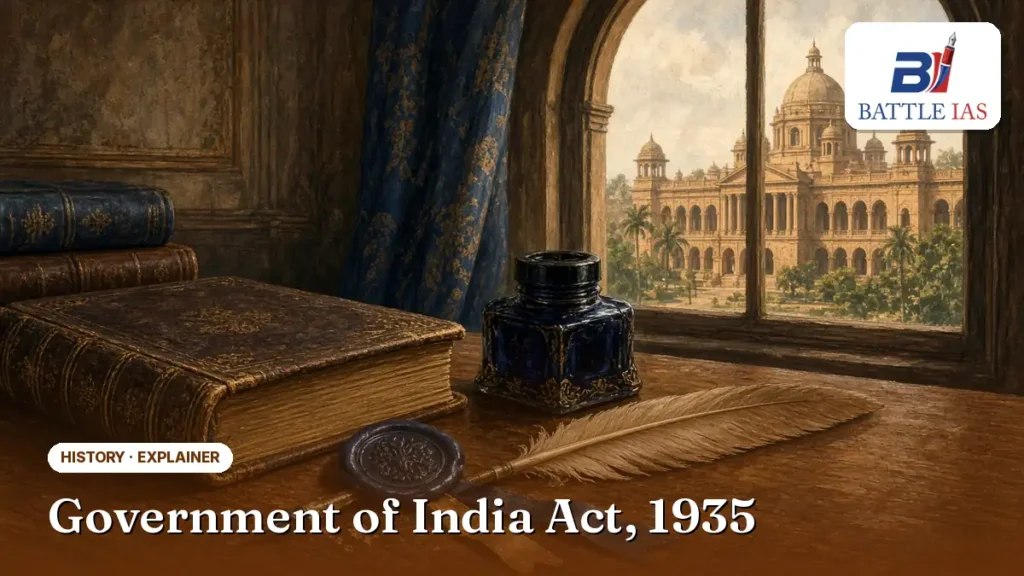
UPSC has already asked about this. Read the story with these questions in mind.
- Prelims 2018In the Federation established by The Government of India Act of 1935, residuary powers were given to theSolve it below ↓
- Prelims 2012The distribution of powers between the Centre and the States in the Indian Constitution is based on the scheme provided in theSolve it below ↓
See all 4 PYQs
Background
The Simon Commission (1927), the three Round Table Conferences (1930-32), the Communal Award and the Poona Pact (1932), and a White Paper (1933) led to the Act, which received royal assent in August 1935. Nehru called it a “charter of slavery”, a machine with strong brakes and no engine.
Main features
- Federation of British provinces and princely States; it needed half the princes to join and never came into being.
- Three lists: Federal (59 items), Provincial (54) and Concurrent (36); residuary powers with the Governor-General.
- Provincial autonomy: dyarchy ended in provinces; ministers responsible to elected legislatures from 1937.
- Dyarchy at the Centre (defence and foreign affairs reserved), which never took effect.
- Bicameral legislatures in six provinces; separate electorates extended to depressed classes, women and labour.
- Federal Court (set up 1937), Reserve Bank of India (1935), Federal and Provincial Public Service Commissions.
- Burma separated from India; Sindh and Orissa became new provinces.
- Franchise widened to about 10% of the population.
The 1937 elections
Congress won clear majorities in five provinces and formed ministries in eight by 1938, including the United Provinces. The ministries resigned in 1939 when India was dragged into the Second World War without consultation; the Muslim League observed “Day of Deliverance”.
Legacy in the Constitution
Office of Governor, emergency provisions, the federal scheme, public service commissions, the Federal Court’s design and much of the administrative detail came from the 1935 Act. The difference: residuary powers went to the Union (Art. 248), not to an appointed head, and responsibility moved to elected Indians.
Government Of India Act 1935: UPSC angle
For UPSC CSE
Prelims: features (residuary powers, provincial autonomy, Federal Court, RBI), what never came into force. Mains GS-I/II: constitutional evolution, sources of the Constitution.
Government Of India Act 1935 UPSC PYQs (Prelims)
Questions UPSC has actually asked, from the official papers. Pick an option to check yourself.
A bookseller sold 'a' number of Geography textbooks at the rate of ₹ x per book, 'a + 2' number of History textbooks at the rate of ₹ (x + 2) per book and 'a – 2' number of Mathematics textbooks at the rate of ₹ (x – 2) per book. What is his total sale in ₹?
The 1935 Act split subjects into Federal, Provincial and Concurrent lists. Residuary powers went to neither legislature: the Governor-General decided, at his discretion, which level could legislate on them. Under today’s Constitution, residuary power lies with Parliament (Article 248). Answer as per the official UPSC key · Battle IAS PYQ bankAnswer (b) & why
The distribution of powers between the Centre and the States in the Indian Constitution is based on the scheme provided in the
The Government of India Act, 1935 created three lists (Federal, Provincial and Concurrent) and provincial autonomy. The Constitution’s Union, State and Concurrent Lists in the Seventh Schedule follow this scheme closely. Answer as per the official UPSC key · Battle IAS PYQ bankAnswer (c) & why
With reference to the Government of India Act, 1935, consider the following statements :
– 1. It provided for the establishment of an All India Federation based on the union of the British Indian Provinces and Princely States.
– 2. Defence and Foreign Affairs were kept under the control of the federal legislature.
Which of the statements given above is/are correct ?
The 1935 Act planned an All-India Federation of provinces and princely states that chose to join. It never came into force because too few princes joined. Dyarchy moved to the Centre: defence, foreign affairs, ecclesiastical affairs and tribal areas were “reserved” for the Governor-General, outside the legislature’s control. Answer as per the official UPSC key · Battle IAS PYQ bankAnswer (a) & why
Consider the following statements :
– 1. The Montagu-Chelmsford Reforms of 1919 recommended granting voting rights to all the women above the age of 21.
– 2. The Government of India Act of 1935 gave women reserved seats in legislature.
Which of the statements given above is/are correct?
The 1919 reforms left women’s franchise to the provincial councils. Madras (1921) went first, and only women with property or education qualified. Votes for all adult women came only with the Constitution. The 1935 Act reserved seats for women in the legislatures and widened their franchise. Answer as per the official UPSC key · Battle IAS PYQ bankAnswer (b) & why
Mains PYQs on this topic
No UPSC Mains question from 2023-2026 is directly on this topic. Older papers (2013-2022) will be added as the Mains bank grows.
Quick quiz
Under the 1935 Act, residuary powers were vested in the
UPSC 2018.Answer (c)
Which feature of the 1935 Act never came into operation?
Princes did not join.Answer (b)
Dyarchy in the provinces was
Replaced by provincial autonomy.Answer (b)
FAQs
Why is the 1935 Act called a blueprint of the Constitution?
Because a large part of the Constitution’s administrative and federal provisions were adapted from it.
When did provincial autonomy begin?
On 1 April 1937, after the provincial elections.
Which new provinces were created?
Sindh and Orissa; Burma was separated.
Did the Federal Court come from this Act?
Yes; it was set up in 1937 and was the forerunner of the Supreme Court.
Spotted an error? Tell us. We correct within 48 hours.
How to use this in Mains
If asked: The Government of India Act, 1935 shaped India's Constitution. Discuss. (GS-I/II)
Quote: “Office of Governor, emergency provisions, the federal scheme, public service commissions, the Federal Court’s design and much of the administrative detail came from the 1935 Act.”
Use it: The perfect evidence line for the body.
In the news
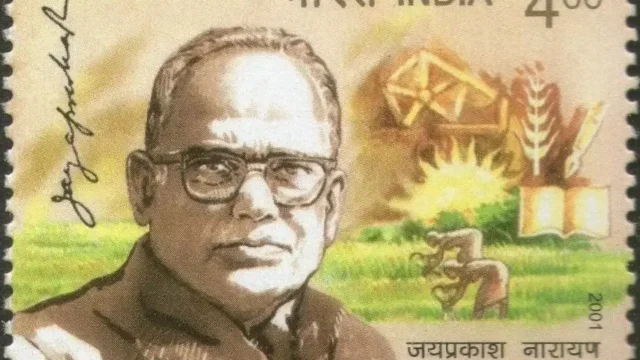
Birth anniversaries: Jayaprakash Narayan and Nanaji Deshmukh
11 October is the birth anniversary of Loknayak Jayaprakash Narayan and Nanaji Deshmukh, both Bharat Ratna awardees. The Prime Minister recalled JP's voice during the Emergency and his concern for good governance, and Nanaji's work in rural development and community participation. Treat this as a personality note for Prelims.
11 Oct 2026
ASI and Denmark museum to search for 1619 Danish shipwreck Oresund off Karaikal
The Archaeological Survey of India's Underwater Archaeology Wing and the National Museum of Denmark (Njord Centre, Copenhagen) signed an MoU to locate and document the Danish ship Oresund, wrecked off Karaikal, Puducherry, in 1619 CE. It is described as the first Danish ship known to have reached India.
15 Jun 2026
Veer Bal Diwas and the Rashtriya Bal Puraskar
The PM announced the day on 9 January 2022 and the first Veer Bal Diwas was held on 26 December 2022 [PMO].
26 Dec 2025
Stamp on Emperor Perumbidugu Mutharaiyar II
Questions on lesser-known regional dynasties are common in Prelims. Stamps and anniversaries often bring them into the news.
14 Dec 2025