
UPSC Mains 2024 GS2 Q9: model answer
‘The West is fostering India as an alternative to reduce dependence on China’s supply chain and as a strategic ally to counter China’s political and economic dominance.’ Explain this statement with examples.
What the question wants
Show with examples how the West backs India in supply chains and strategy, and India's own stance.
How to structure it
Intro: China plus one. Body: (1) Supply-chain examples; (2) Strategic examples; (3) India's stance. Conclusion: The West sees India as a counterweight.
- 1(1) Supply-chain examples
- 2(2) Strategic examples
- 3(3) India's stance
Model answer
After the US-China trade war and COVID-19 disruptions, Western countries want to 'de-risk' from China. India's size, workforce and democracy make it a natural partner.
Supply-chain examples
- Apple's suppliers (Foxconn, Pegatron, Tata) expanded iPhone manufacturing in India.
- Micron's semiconductor assembly unit at Sanand, backed by the US-India iCET (2023).
- India joined the Minerals Security Partnership (2023) and the IPEF supply chain agreement.
- Supply Chain Resilience Initiative with Japan and Australia (2021).
- India-EU Trade and Technology Council (2023).
Strategic examples
- Quad (US, Japan, Australia, India) for the Indo-Pacific.
- Defence deals: GE F414 jet engine co-production, MQ-9B drones; foundational agreements like BECA.
- India-Middle East-Europe Economic Corridor (2023) as an alternative to the Belt and Road.
India's stance: India gains investment and technology but keeps strategic autonomy, buying Russian oil and staying in BRICS and SCO.
The West sees India as a counterweight; India sees the partnership as a means to its own rise.
Keywords, cases and data to drop in
China plus one iCET Quad MSP SCRI IMEC strategic autonomy
Where most answers lose marks
- Ignoring India's autonomy.
Same theme in Prelims
Consider the following statements with respect to the AI Impact Summit, 2026 held in New Delhi :
- 1. The Summit’s intellectual framework was based on three foundational Sutras : People, Planning, and Progress.
- 2. The Preamble of the Summit stresses Democratising AI Resources, which acknowledges the Charter for Democratic Diffusion of AI as a binding framework to support locally relevant innovation and strengthen resilient AI ecosystems while respecting national laws.
- 3. The New Delhi Declaration on AI Impact was structured around seven Chakras (Pillars), which included Access for Social Empowerment, AI for Science, and Secure and Trusted AI.
Which of the statements given above is/are correct ?
Answer (d) & explanation
Only statement 3 is correct (d). Statement 3 is right: the New Delhi Declaration on AI Impact was built around seven chakras (pillars), including access for social empowerment, AI for science and secure and trusted AI. Statement 1 is wrong: the three sutras were People, Planet and Progress, not "Planning". Statement 2 is wrong: the Charter for Democratic Diffusion of AI is voluntary, not binding. So options (a), (b) and (c) fail.
Notice the event: the AI Impact Summit was held at Bharat Mandapam, New Delhi, in February 2026, the first global AI summit in the Global South. It followed the summits at Bletchley Park (2023), Seoul (2024) and Paris (2025). At home, the IndiaAI Mission (2024) funds shared GPU computing.
Statement 1 changes one word, Planet to Planning. Statement 2 changes voluntary to binding.
Answer as per the official UPSC answer key.
Which of the following connectivity projects is/are a part of cooperation between India and the ASEAN member countries ?
- 1. Kaladan Multi-Modal Transit Transport Project
- 2. IMT Trilateral Highway
- 3. Agartala-Akhaura Rail Line
Select the answer using the code given below :
Answer (a) & explanation
Projects 1 and 2 involve ASEAN members (a). Item 1 is right: the Kaladan Multi-Modal project links Kolkata to Sittwe port and on to Mizoram through Myanmar. Item 2 is right: the India–Myanmar–Thailand Trilateral Highway runs from Moreh in Manipur to Mae Sot in Thailand. Myanmar and Thailand are both ASEAN members. Item 3 is wrong: the Agartala–Akhaura rail line links Tripura with Bangladesh, which is not in ASEAN. So options (b), (c) and (d) fail.
Notice the policy: these projects are the backbone of India's Act East Policy (2014), which upgraded the Look East Policy (1991). ASEAN has 11 members since Timor-Leste joined in 2025. Bangladesh links fall under BBIN and BIMSTEC instead.
Answer as per the official UPSC answer key.
Match List I with List II and select the answer using the code given below the Lists :
| List I (Project Supported by India) | List II (Country)
| A. Mangdechhu Hydroelectric Project | 1. Maldives
| B. Restoration of Stor Palace | 2. Afghanistan
| C. District Hospital at Dickoya | 3. Bhutan
| D. Institute of Security and Law Enforcement Studies | 4. Sri Lanka
Code :
Answer (b) & explanation
The correct match is A-3, B-2, C-4, D-1 (b). Mangdechhu (720 MW) is an India-built hydro project in Bhutan (A-3). India restored the Stor Palace in Kabul, Afghanistan (B-2), opened in 2016. The Dickoya hospital is in the hill country of Sri Lanka (C-4), serving the Indian-origin Tamil community. The Institute of Security and Law Enforcement Studies was built for the Maldives police (D-1). Options (a), (c) and (d) mix these up.
Notice the pattern: India's Neighbourhood First policy relies on such development partnership projects. In Afghanistan, India also built the Parliament building and the Salma Dam (Afghan–India Friendship Dam). Bhutan's hydropower, including Chukha and Tala, sells surplus power to India.
Answer as per the official UPSC answer key.
Fresh examples from current affairs
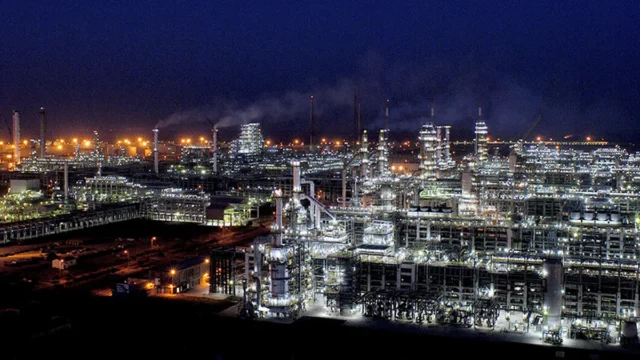
Rubio at Jamnagar: US pitches oil and Venezuelan crude to India’s ‘refining superpower’
US Secretary of State Marco Rubio visited Reliance’s Jamnagar refinery complex in Gujarat on 21 October 2026, a day after calling India a ‘refining superpower’. He wants India to buy more US oil and refine more Venezuelan crude. In Mumbai on 20 October, External Affairs Minister S. Jaishankar also held an unannounced India–US–UAE meeting on energy and connectivity, with the Strait of Hormuz blocked.
UPSC angle: Prelims: Jamnagar, Hormuz, I2U2, IMEC, SPR sites. · Mains GS-II/III: energy security vs strategic autonomy; India–US–UAE.
21 Oct 2026
US PERM freeze on Indian IT firms: what the skilled-migrant crackdown means for India
On 8 October 2026 the US Labor Department suspended Microsoft, Adobe, Infosys, TCS, Wipro, HCL, Cognizant and Capgemini from the PERM programme, the labour-certification step for most employment-based green cards. A Hindu data analysis on 21 October shows these firms filed only about 2,000 PERM applications this year, under 2% of the total. The direct hit is small, but the message to Indian talent is large.
UPSC angle: Prelims: PERM, H-1B, I-140, GATS Mode 4. · Mains GS-II: skilled migration and India–US ties; diaspora.
21 Oct 2026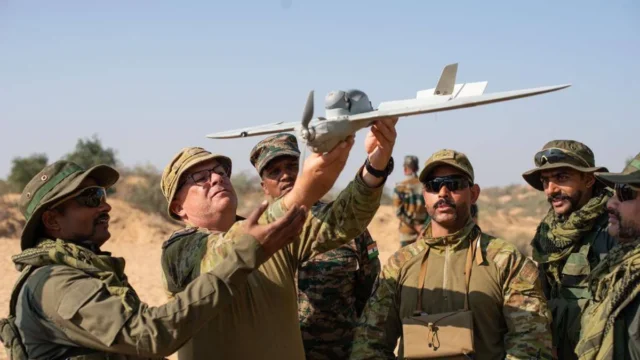
AUSTRAHIND 2026: fifth India–Australia Army exercise begins in Thiruvananthapuram
The fifth edition of the India–Australia joint military exercise AUSTRAHIND began on 19 October 2026 at the Foreign Training Node, Thiruvananthapuram, and runs till 1 November. About 120 soldiers from each army will train for sub-conventional operations in island and coastal terrain under a UN Chapter VII mandate. For the first time, New Zealand has sent observers.
UPSC angle: Prelims: exercise names, venues, partner countries, UN Chapter VII. · Mains GS-III: defence diplomacy in the Indo-Pacific.
20 Oct 2026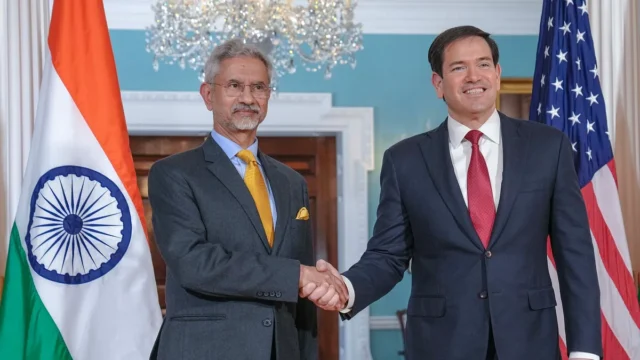
Rubio in Mumbai: India–US trade deal ‘very, very close’; energy and defence on the table
US Secretary of State Marco Rubio began his second India visit of the year in Mumbai on 20 October 2026 and met External Affairs Minister S. Jaishankar on trade, energy, technology and defence. Rubio said the two sides are ‘very, very close’ to a trade deal with ‘a small number of items left’, and praised India’s progress in diversifying energy supplies.
UPSC angle: Prelims: I2U2, Jamnagar, key office holders. · Mains GS-II: India-US partnership, tariffs and strategic autonomy.
20 Oct 2026Question text as printed in the official UPSC question paper: https://www.upsc.gov.in/sites/default/files/QP_CSM_2024_GenStud_II_03102024.pdf The model answer is original Battle IAS work; use it to learn structure, not to memorise.