
UPSC Mains 2025 GS1 Q7: model answer
What are Tsunamis? How and where are they formed? What are their consequences ? Explain with examples.
What the question wants
Four parts: definition, formation mechanism, typical locations, consequences, with examples.
How to structure it
Intro: definition. Body: causes and mechanism; zones (Ring of Fire, Sunda arc); consequences with 2004 and 2011 examples. Conclusion: warning systems.
- 1Causes and mechanism
- 2Zones (Ring of Fire, Sunda arc)
- 3Consequences with 2004 and 2011 examples
Model answer
A tsunami is a series of long-wavelength sea waves caused by a sudden displacement of a large volume of water.
How they form: most come from undersea megathrust earthquakes (usually above magnitude 7.5) where one plate slips under another and lifts the sea floor. Others come from submarine landslides, volcanic eruptions (Krakatoa 1883, Hunga Tonga 2022) or rarely meteor impacts. In deep water the wave is fast (about 700 km/h) but low; near the coast it slows and rises sharply.
Where: subduction zones, above all the Pacific Ring of Fire (Japan, Chile, Indonesia) and the Sunda arc in the Indian Ocean; also the Makran coast near Pakistan.
Consequences
- Lives: the 2004 Indian Ocean tsunami killed about 2.3 lakh people in 14 countries; over 10,000 in India (Tamil Nadu, A&N Islands).
- Infrastructure: Japan 2011 caused the Fukushima nuclear accident.
- Ecology: salt-damaged farmland, coral and mangrove loss.
India's INCOIS warning centre (2007) now gives alerts within minutes. Mangroves and community drills are cheap, effective defences.
Keywords, cases and data to drop in
seafloor displacement megathrust Ring of Fire Sunda arc 2004 Indian Ocean Fukushima 2011 INCOIS
Where most answers lose marks
- Confusing tsunamis with storm surges.
- Answering only 'what' and skipping 'where'.
- No examples.
Fresh examples from current affairs
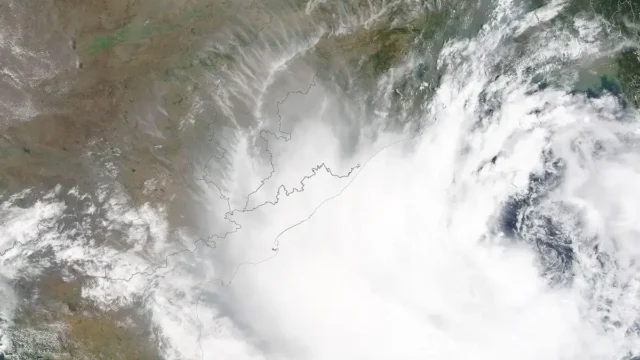
IMD launches a map-based Decision Support System for cyclone and marine warnings
On 12 October 2026 the India Meteorological Department dedicated a Cyclone Warning and Marine Weather Services Decision Support System to the nation. The WebGIS platform shows cyclone track, intensity, winds, rainfall, storm surge and district-wise warnings on one map for disaster managers and the public.
UPSC angle: Prelims: IMD, cone of uncertainty, storm surge. · Mains GS-III: early warning and disaster preparedness.
13 Oct 2026
India offers flood relief to Nepal; PM speaks to Nepal PM
On 26 August 2026 Prime Minister Narendra Modi spoke to Nepal's Prime Minister Balendra Shah and conveyed condolences on the loss of lives in floods in Nepal. He said India is ready to provide all possible humanitarian assistance, and that Indian teams are coordinating closely with Nepalese authorities on rescue and relief.
UPSC angle: Mains: India–Nepal water and flood cooperation.
26 Aug 2026
UNCCD COP17: India urges shift from drought response to drought resilience
At a ministerial dialogue on drought resilience at UNCCD COP17 in Ulaanbaatar, Mongolia, on 25 August 2026, India called for a shift from reactive drought relief to proactive, technology-enabled resilience. The Environment Minister said drought must be managed as a predictable, preventable risk, with preparedness over response and prevention over crisis management.
UPSC angle: Mains: Drought resilience strategies.
25 Aug 2026
India hosts 3rd BRICS ministerial on disaster risk reduction
Under India's BRICS Chairship 2026, NDMA hosted the 3rd BRICS Ministerial Meeting on Disaster Risk Reduction in New Delhi on 24 July 2026. Members unanimously adopted a BRICS Joint Statement on DRR and pledged to speed up the BRICS DRR Work Plan for 2025 to 2028.
UPSC angle: Prelims: Sendai; CDRI.
24 Jul 2026Learn the concept
Question text as printed in the official UPSC question paper: https://www.upsc.gov.in/sites/default/files/GENERAL-STUDIES-PAPER%20I-QP-CSM-25-010925.pdf The model answer is original Battle IAS work; use it to learn structure, not to memorise.