
UPSC Mains 2026 GS1 Q11: model answer
Vijayanagara architecture exemplifies the amalgamation of past traditions with contemporary practices. Elucidate with examples.
What the question wants
Show which features Vijayanagara inherited (Chalukya, Hoysala, Chola, Dravida tradition) and which it took from contemporary practice (Indo-Islamic elements, secular buildings, new forms), with named monuments.
How to structure it
Intro: Hampi as the capital, 1336–1565. Body: past traditions continued; contemporary practices absorbed; innovations. Conclusion: a synthesis, a UNESCO site.
- 1Past traditions continued
- 2Contemporary practices absorbed
- 3Innovations
Model answer
Vijayanagara (1336–1565), with its capital at Hampi on the Tungabhadra, built in a style that looked back to the Dravida temple tradition and sideways to the Deccan Sultanates. Hampi is a UNESCO World Heritage Site (1986).
Past traditions carried forward
- Dravida temple plan: garbhagriha, vimana and mandapa, as in Chola temples; the Virupaksha temple grew from an older Chalukya-era shrine.
- Gopurams became taller and dominant, a late-Chola trend taken to its height; the Krishnadevaraya-era raya gopurams.
- Hoysala and Chalukya sculptural detail: ornate pillars, friezes of epics.
- Temple tanks and processional chariots, an old southern practice; the stone chariot at Vitthala.
Contemporary practices absorbed
- Indo-Islamic elements in royal buildings: arches, domes and vaults in the Lotus Mahal and the Elephant Stables, from Bahmani and Bijapur builders.
- Secular architecture on a large scale: the Mahanavami Dibba platform, the Queen's Bath, aqueducts and the Kamalapura tank.
- Courtiers dressed in Persian-style tunics and caps on temple reliefs, showing a shared courtly culture.
Innovations of its own
- Kalyana mandapa for the god's marriage festival; amman shrines for the consort.
- Composite pillars with yalis and rearing horses; musical pillars at Vitthala.
- Use of hard local granite, giving bold, deep carving.
Vijayanagara did not merely preserve the past. It used inherited forms and borrowed ones to project imperial power, and its style shaped later Nayaka temples at Madurai and Srirangam.
Keywords, cases and data to drop in
raya gopuram kalyana mandapa Lotus Mahal Vitthala temple Indo-Islamic synthesis Nayaka style
Where most answers lose marks
- Only describing Hampi monuments without the past/contemporary frame
- Ignoring secular buildings
Same theme in Prelims
Which of the following statements on the Amaravati Stupa and its relief sculpture is/are correct ?
- 1. It was located in the lower Krishna valley.
- 2. In India, it was next only to the Sanchi Stupa in size.
- 3. The Amaravati school of sculpture made a lasting impact on the later South Indian sculpture, and its products were carried to Sri Lanka and South-east Asia.
Select the answer using the code given below :
Answer (b) & explanation
Statements 1 and 3 are correct (b). Statement 1 is right: Amaravati stands on the lower Krishna valley in Andhra Pradesh. Statement 3 is right: its fine limestone reliefs shaped later South Indian art, and pieces in its style reached Sri Lanka and South-east Asia. Statement 2 is wrong: Amaravati was one of the largest stupas in India, bigger than the Great Stupa at Sanchi, not second to it. So options (a), (c) and (d) fail.
Notice the patrons: the Satavahanas and later the Ikshvakus, who built Nagarjunakonda. Many Amaravati panels were taken to the British Museum and Chennai museum. Andhra Pradesh's new capital is named Amaravati after it.
Answer as per the official UPSC answer key.
Which one of the following statements with regard to the Moidams, built by the Tai-Ahom kingdom and inscribed as a World Heritage Site by UNESCO, is/are correct ?
- 1. They acted as army fortresses.
- 2. They were recreation centres of the Royals and Nobles.
- 3. They were burial grounds of the Royals and Nobles.
- 4. They were battle drill centres of the Royals and Nobles.
Select the answer using the code given below :
Answer (c) & explanation
Only statement 3 is correct (c). The Moidams of Charaideo in Assam are earthen burial mounds of Ahom kings, queens and nobles, raised over vaulted chambers from the 13th to the 19th century. Statement 3 is right. Statements 1, 2 and 4 are wrong: they were never army forts, recreation centres or battle drill grounds. So options (a), (b) and (d) fail.
Notice their status: in 2024 they became the North-East's first cultural World Heritage Site, and India's 43rd. They are often called the "pyramids of Assam". The Ahoms ruled Assam for about 600 years, and their general Lachit Borphukan defeated the Mughals at Saraighat (1671). Charaideo was their first capital.
Answer as per the official UPSC answer key.
Which of the following temples has/have a Nagara-style shikhara ?
- 1. Malegitti Shivalaya, Badami
- 2. Huchimalligudi Temple, Aihole
- 3. Dashavatara Temple, Deogarh
- 4. Virupaksha Temple, Pattadakal
Select the answer using the code given below :
Answer (b) & explanation
Huchimalligudi and Deogarh have Nagara-style shikharas (b). Item 3 is right: the Dashavatara temple at Deogarh (Gupta period) had an early northern-style shikhara. Item 2 is right: at Aihole, the Huchimalligudi temple carries a curved Nagara (rekha) tower over its sanctum. Items 1 and 4 are wrong: Malegitti Shivalaya at Badami and the Virupaksha temple at Pattadakal are Dravida temples with stepped vimanas. So options (a), (c) and (d) fail.
Notice why the Chalukya sites matter: Aihole, Badami and Pattadakal were a laboratory where both styles stood side by side. Pattadakal, a UNESCO site, has Nagara temples like Papanatha next to Dravida ones. Vesara later blended the two.
The Chalukyan sites have both styles side by side. Do not mark a temple Dravida only because it stands in Karnataka.
Answer as per the official UPSC answer key.
Fresh examples from current affairs
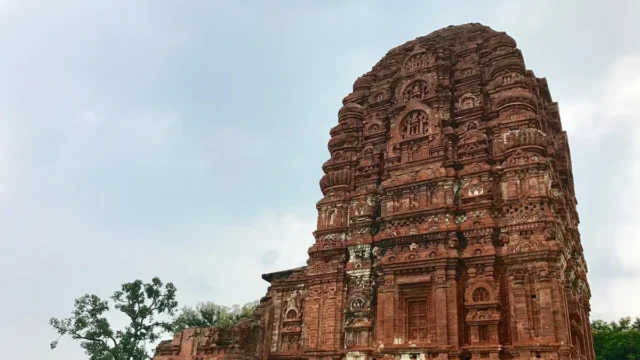
Sirpur in Chhattisgarh enters UNESCO’s Tentative List of World Heritage sites
Sirpur, an archaeological site in Chhattisgarh’s Mahasamund district with Hindu, Buddhist and Jain remains from the 5th to the 12th century CE, has been added to UNESCO’s Tentative List. The ASI now has about a year to prepare a nomination dossier proving its Outstanding Universal Value. Sirpur was once the capital of Dakshina Kosala.
UPSC angle: Prelims: Sirpur location, Lakshmana Temple, dynasties, UNESCO process. · Mains GS-I: heritage conservation and composite culture.
20 Oct 2026
Backgrounder: 75 years of rebuilt Somnath temple
Somnath, at Prabhas Patan on Gujarat's Saurashtra coast, is the first of the twelve Jyotirlingas. On 11 May 2026 it marked 75 years since the rebuilt temple was consecrated by President Dr. Rajendra Prasad in 1951. The Somnath Swabhiman Parv also marks 1,000 years since the first recorded attack in January 1026.
UPSC angle: Prelims: Somnath history.
8 May 2026
Backgrounder: ASI protects 3,686 monuments
Protecting monuments often clashes with building around them, and ASI sits in the middle.
UPSC angle: Prelims: AMASR zones.
18 Apr 2026Learn the concept
Question text as printed in the official UPSC question paper: https://www.upsc.gov.in/sites/default/files/QP-CSM-26-010926-GENERAL%20STUDIES%20PAPER%20-%20I.pdf The model answer is original Battle IAS work; use it to learn structure, not to memorise.