
UPSC Mains 2026 GS2 Q14: model answer
Examine how the separation of powers is practised in India compared to the rigid presidential model of the United States of America. In this context, compare the actual authority of the Indian Prime Minister with that of the President of the USA.
What the question wants
Contrast India's functional separation (with checks and fusion) against the US's strict separation; then compare the PM's and the US President's real authority.
How to structure it
Intro: the doctrine. Body: India vs US (table-style points); PM vs President on control of the legislature, appointments, foreign policy, tenure security. Conclusion.
- 1India vs US (table-style points)
- 2PM vs President on control of the legislature, appointments, foreign policy, tenure security
Model answer
The US applies separation of powers rigidly; India follows a functional separation inside a parliamentary system. Ram Jawaya Kapur (1955) denied rigid separation; Kesavananda (1973) and Indira Gandhi v Raj Narain (1975) made separation part of the basic structure.
| Feature | India | USA |
|---|---|---|
| Executive | Drawn from and responsible to Parliament | President separate from Congress |
| Doctrine | Not rigid; basic structure | Strict, with checks and balances |
| Judicial review | Arts. 13, 32, 226; basic structure | Marbury v. Madison |
India vs USA
- Fusion vs separation: Indian ministers sit in Parliament and answer to the Lok Sabha (Article 75(3)); US Cabinet members cannot sit in Congress.
- Tenure: an Indian government falls on losing confidence; the US President has a fixed term, removable only by impeachment.
- Law-making: the Indian executive drafts most bills and issues ordinances (Article 123); the US President can only veto, and Congress can override.
- Judiciary: both review laws; India adds the basic structure doctrine.
PM vs President: real authority
- Legislature: a majority PM controls the agenda and the whip (Tenth Schedule); a President often faces a hostile Congress.
- Security: the President is safer; the PM depends on the House and allies.
- Appointments and treaties: the President needs Senate consent; the PM does not.
- Federalism: US States are stronger; India's Centre has Article 356.
Conclusion: on paper the President is stronger. In practice a majority-backed PM wields more concentrated power because executive and legislature are fused. Committees, the opposition and the courts are India's real checks.
Keywords, cases and data to drop in
functional separation Ram Jawaya Kapur 1955 Article 75(3) Article 123 ordinances US Senate confirmation fusion of powers presidential veto override
Where most answers lose marks
- Describing both systems separately without comparing.
- Overlooking the 'actual authority' angle: majority control matters.
- Calling India's separation 'absent'; it is functional, not absent.
Same theme in Prelims
With reference to the Indian polity, consider the following statements :
- I. An Ordinance can amend any Central Act.
- II. An Ordinance can abridge a Fundamental Right.
- III. An Ordinance can come into effect from a back date.
Which of the statements given above are correct?
Answer (c) & explanation
Statements I and III are correct (c). An Ordinance under Article 123 has the same force as an Act of Parliament. Statement I is right: so it can amend any Central Act. Statement III is right: like an Act, it can be made retrospective, taking effect from a back date. Statement II is wrong: Article 13 counts an Ordinance as "law", and no law can take away or abridge Fundamental Rights. So options (a), (b) and (d) fail.
Notice the limits: an Ordinance can be issued only when Parliament is not in session, and it lapses six weeks after Parliament reassembles unless approved. In Krishna Kumar Singh (2017), the Supreme Court held that re-promulgating Ordinances again and again is a fraud on the Constitution. Governors have the same power under Article 213.
"same force as an Act" makes students think an Ordinance can do anything. It carries the same limits too.
Traps like this come back in new clothes. The PYQ Book collects all of them, topic by topic, so none catch you twice. Try the free sample
Answer as per the official UPSC answer key.
Consider the following statements :
- I. The Constitution of India explicitly mentions that in certain spheres the Governor of a State acts in his/her own discretion.
- II. The President of India can, of his/her own, reserve a bill passed by a State Legislature for his/her consideration without it being forwarded by the Governor of the State concerned.
Which of the statements given above is/are correct?
Answer (a) & explanation
Only statement I is correct (a). Statement I is right: Article 163(1) itself says the Governor acts on ministers' advice "except in so far as he is by or under this Constitution required to exercise his functions… in his discretion". Examples include Article 371 duties and the Sixth Schedule. Statement II is wrong: under Article 200, only the Governor can reserve a State Bill for the President. The President cannot pull a Bill up on their own. So options (b), (c) and (d) fail.
Notice the recent fights over Governors sitting on Bills. In State of Tamil Nadu v. Governor (April 2025), the Supreme Court set time limits for assent. On a Presidential reference, a Constitution Bench in November 2025 said courts cannot fix such deadlines, but long, unexplained delay can still be reviewed.
the President is "higher", so students assume he can act directly on State Bills. The route always runs through the Governor.
Answer as per the official UPSC answer key.
With reference to the Indian polity, consider the following statements :
- I. The Governor of a State is not answerable to any court for the exercise and performance of the powers and duties of his/her office.
- II. No criminal proceedings shall be instituted or continued against the Governor during his/her term of office.
- III. Members of a State Legislature are not liable to any proceedings in any court in respect of anything said within the House.
Which of the statements given above are correct?
Answer (d) & explanation
All three statements are correct (d). Statement I is right: Article 361 says the President and Governors are not answerable to any court for official acts. Statement II is right: under the same Article, no criminal case can be started or continued against them during their term. Statement III is right: Article 194(2) gives State legislators freedom of speech in the House, just as Article 105 does for MPs. So options (a), (b) and (c) fail.
Notice the limit on legislators: in Sita Soren (2024), a seven-judge Bench held that MPs and MLAs who take bribes to vote or speak get no immunity, overruling P.V. Narasimha Rao (1998). Civil cases against a Governor need two months' notice.
Answer as per the official UPSC answer key.
Fresh examples from current affairs

21st Maritime State Development Council: first MSDC under the Indian Ports Act, 2025
The 21st Maritime State Development Council met in Mumbai on 13 October 2026. It was the first MSDC after the Indian Ports Act, 2025 (notified 15 May 2026) made the Council a statutory body. Members adopted Vision 2030 and 2047 targets and set March 2027 deadlines for One Nation One Port Process and Maritime Single Window integration.
UPSC angle: Prelims: Ports Act 2025 date, MSDC, ONOP, Sagar Setu, SbPCP/BCSPS. · Mains GS-III: ports and shipbuilding; GS-II: cooperative federalism.
13 Oct 2026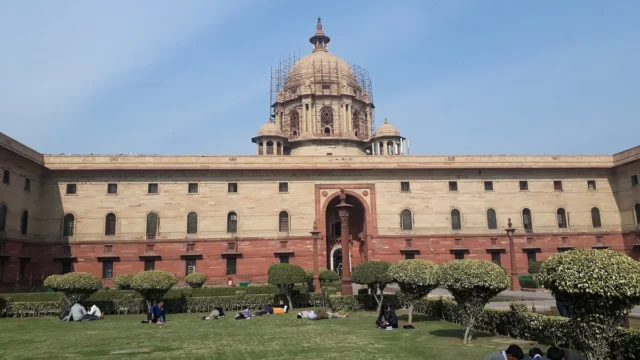
57th GST Council: arrest provisions to go, prosecution threshold raised to ₹5 crore
The 57th GST Council meeting on 8 October 2026 focused on process reform rather than rates. It recommended removing arrest powers under GST, raising the prosecution threshold from ₹1 crore to ₹5 crore, cutting the general penalty from ₹25,000 to ₹10,000, no notices below ₹10,000 tax, wider input tax credit and refunds, and limits on interception of goods in transit.
UPSC angle: Prelims: GST Council structure, Article 279A. · Mains GS-III: indirect tax reform; GS-II: fiscal federalism.
8 Oct 2026
Seven years since abrogation of Article 370
On 5 August 2026 the Prime Minister marked seven years since Articles 370 and 35(A) ceased to operate in 2019, calling 5 August 2019 a defining milestone. He said the full application of the Constitution has empowered women and marginalised communities in Jammu and Kashmir and Ladakh. The change rested on two Presidential Orders, C.O. 272 and C.O. 273.
UPSC angle: Prelims: J&K reorganisation.
5 Aug 2026
₹1,09,019 crore advance tax devolution released to States
The Union Government released an additional tax devolution instalment of ₹1,09,019 crore to the States on 1 August 2026, the Finance Ministry said. It comes on top of the normal monthly devolution due on 10 August. The aim is to help States speed up capital and development spending. Uttar Pradesh got the largest share, ₹19,208 crore.
UPSC angle: Prelims: divisible pool; FC share.
1 Aug 2026Learn the concept
Question text as printed in the official UPSC question paper: https://www.upsc.gov.in/sites/default/files/QP-CSM-26-010926-GENERAL-STUDIES-PAPER%20-%20II.pdf The model answer is original Battle IAS work; use it to learn structure, not to memorise.