
Constitution (130th Amendment) Bill, 2025: Removal of the Prime Minister, Chief Ministers and Ministers Detained for 30 Days, Articles 75, 164 and 239AA, Arguments For and Against (UPSC Notes + PYQs)
UPSC has already asked about this. Read the story with these questions in mind.
- Prelims 2020Consider the following statements: According to the Constitution of India, a person who is eligible to vote can be made a minister in a…Solve it below ↓
- Prelims 2025Consider the following statements: If any question arises as to whether a Member of the House of the People has become subject to disqualification…Solve it below ↓
The gap the Bill targets
In 2024 a sitting Chief Minister of Delhi ran the government for months from Tihar jail, signing files through his lawyers. In Tamil Nadu a Minister stayed in the Cabinet without a portfolio for over eight months while in custody. Nothing in the Constitution forced either to step down. The law of disqualification works on conviction, not on arrest: under Section 8 of the Representation of the People Act, 1951, a legislator convicted and sentenced to two years or more loses the seat, and after Lily Thomas v. Union of India (2013) this happens at once. But a Minister who is only charged and detained can stay in office, because the Constitution assumes Ministers serve at the pleasure of the President or Governor on the advice of the head of government, and that political morality will do the rest.
The government argues that this morality has worn thin, and that public trust in constitutional office requires a clear rule. The opposition argues that the cure could be worse than the disease. That debate is the heart of the topic.
What the Bill provides
| Office | Article amended | Rule |
|---|---|---|
| Union Minister | Article 75 | Removed by the President on the PM’s advice by the 31st day; if no advice, ceases to hold office automatically |
| Prime Minister | Article 75 | Must resign by the 31st day of custody; otherwise ceases to be PM |
| State Minister | Article 164 | Removed by the Governor on the CM’s advice; automatic exit otherwise |
| Chief Minister | Article 164 | Must resign by the 31st day; otherwise ceases |
| Delhi CM and Ministers | Article 239AA | Same rule applied to the NCT of Delhi |
The triggers are: arrest and detention for 30 consecutive days, for an offence punishable with imprisonment of five years or more. The person can be appointed again after release from custody. Two companion bills, the Government of Union Territories (Amendment) Bill, 2025 and the Jammu and Kashmir Reorganisation (Amendment) Bill, 2025, extend the same rule to Puducherry and Jammu and Kashmir.
- 1Arrest for offence with 5+ years jail
- 2Custody for 30 consecutive days
- 3Advice for removal or resignation by day 31
- 4Automatic exit if no action
- 5Reappointment possible after release
Procedure to pass
As a constitutional amendment under Article 368, the Bill needs a special majority in each House: a majority of total membership and two-thirds of members present and voting. The question whether it also needs ratification by half the State legislatures, given that it touches the State executive, is itself debated. The Bill was referred to a Joint Parliamentary Committee chaired by Aparajita Sarangi, which several opposition parties declined to join, arguing that the Bill was unconstitutional. In July 2026 the Committee deferred adoption of its draft report for further consultation, and its term was extended; the Bill has not been passed.
Arguments in favour
- Constitutional morality: a person running a government from jail lowers the dignity of the office and the trust of citizens.
- Governance: a jailed Minister cannot attend Cabinet meetings, travel or meet officials; administration suffers.
- Criminalisation of politics: data compiled from election affidavits show that a large share of MPs and MLAs face criminal cases, many serious. A clear rule sends a signal.
- Parity with civil servants: a government servant detained for over 48 hours is deemed suspended; why should a Minister be treated more leniently?
- Reappointment allowed: the Bill does not disqualify; it only removes from office during custody.
- Article 75PM and Union Ministers
- Article 164CMs and State Ministers
- Article 239AADelhi
- Companion billsPuducherry, J&K
Arguments against
- Presumption of innocence: arrest is not proof of guilt. Penalising an office holder before trial runs against a basic principle of criminal law.
- Misuse of agencies: courts have criticised central agencies in several cases; critics fear arrests timed to topple opposition governments, especially under laws such as the PMLA where bail is hard.
- Federalism: Chief Ministers could be removed through arrests by central agencies, upsetting the balance of power between the Union and States.
- Executive over the electorate: the voter and the legislature, through a no-confidence motion, are the proper judges of who governs.
- Basic structure: critics argue the Bill may violate democracy, federalism and the rule of law, parts of the basic structure from Kesavananda Bharati (1973).
- Asymmetry: a PM may be less exposed than Chief Ministers, since central agencies report to the Union.
- Arrest is not conviction
- Possible misuse of agencies
- Pressure on State governments
- Voter and legislature bypassed
What courts have said
In Manoj Narula v. Union of India (2014), the Supreme Court said that the PM and CMs are expected not to choose persons with criminal backgrounds as Ministers, but left it to their wisdom rather than imposing a ban. In Public Interest Foundation (2018), it asked parties and candidates to publicise criminal cases, and urged Parliament to make a law to keep criminals out of politics. In Rambabu Singh Thakur (2020), it asked parties to explain why they chose candidates with criminal records. The courts have repeatedly said that the remedy lies with Parliament, which is what the Bill claims to provide.
A balanced way forward
Many experts suggest that the purpose can be met with fewer risks. Options include: linking removal to framing of charges by a court rather than arrest; time-bound trials of cases against legislators through special courts, as the Supreme Court has pushed since 2017; independent oversight of investigating agencies so that arrests are not political; and an internal convention that a Minister steps aside when charged. A strong Lokpal and Lokayuktas and full disclosure of criminal records by parties would also help. The test for any reform is whether it cleans politics without giving the party in power at the Centre a weapon against its rivals.
PYQ trend
Prelims asks about Ministers, disqualification and the Tenth Schedule. Mains GS-II asks about the RPA, corrupt practices, limits on amending power and integrity in public life; the Bill is a strong current example.
130th Amendment Bill: UPSC angle
For UPSC CSE
Prelims: Articles 75, 164, 239AA, special majority, disqualification rules. Mains GS-II: constitutional amendments, criminalisation of politics, federalism, executive accountability.
130th Amendment Bill UPSC PYQs (Prelims)
Questions UPSC has actually asked, from the official papers. Pick an option to check yourself.
Consider the following statements :
– 1. According to the Constitution of India, a person who is eligible to vote can be made a minister in a State for six months even if he/she is not a member of the Legislature of that State.
– 2. According to the Representation of People Act, 1951, a person convicted of a criminal offence and sentenced to imprisonment for five years is permanently disqualified from contesting an election even after his release from prison.
Which of the statements given above is/are correct?
Article 164(4) allows a non-member to be a minister for six months. But that person must be able to become an MLA, which needs a minimum age of 25, not just being a voter. Under Section 8(3) of the RPA, a sentence of two years or more disqualifies for the term plus six years after release, not for ever. Answer as per the official UPSC key · Battle IAS PYQ bankAnswer (d) & why
Consider the following statements :
– I. If any question arises as to whether a Member of the House of the People has become subject to disqualification under the 10th Schedule, the President's decision in accordance with the opinion of the Council of Union Ministers shall be final.
– II. There is no mention of the word 'political party' in the Constitution of India.
Which of the statements given above is/are correct?
Under the Tenth Schedule the Speaker or Chairman decides defection cases, subject to judicial review. The President decides other disqualifications under Article 103, and then on the Election Commission’s opinion, not the Cabinet’s. “Political party” appears many times in the Tenth Schedule, added in 1985. Both statements fail. Answer as per the official UPSC key · Battle IAS PYQ bankAnswer (d) & why
Mains PYQs on this topic
Questions from the official UPSC Mains papers (2023-2026 in the Battle IAS Mains bank), newest first. Each links to a model answer.
- UPSC Mains 2025 · GS Paper II · Q12 · 15 marks
Indian Constitution has conferred the amending power on the ordinary legislative institutions with a few procedural hurdles. In view of this statement, examine the procedural and substantive limitations on the amending power of the Parliament to change the Constitution.
Quick quiz
Under the 130th Amendment Bill, removal is triggered by custody of
30 consecutive days.Answer (b)
Which article deals with the Chief Minister and State Ministers?
Article 164.Answer (b)
Which case made disqualification on conviction immediate?
Lily Thomas v. Union of India, 2013.Answer (b)
FAQs
What does the 130th Amendment Bill propose?
That a PM, CM or Minister held in custody for 30 consecutive days on a charge with 5+ years punishment must leave office on the 31st day.
Can the removed person come back?
Yes. The Bill allows reappointment after release from custody.
Is this disqualification from Parliament or the Assembly?
No. It removes the person from ministerial office only; membership of the legislature is not affected.
Why is the Bill controversial?
It acts on arrest, not conviction, and critics fear misuse of investigating agencies against opposition governments.
What majority does it need?
A special majority under Article 368 in both Houses; whether State ratification is also needed is debated.
Where is the Bill now?
It was referred to a Joint Parliamentary Committee for examination.
Spotted an error? Tell us. We correct within 48 hours.
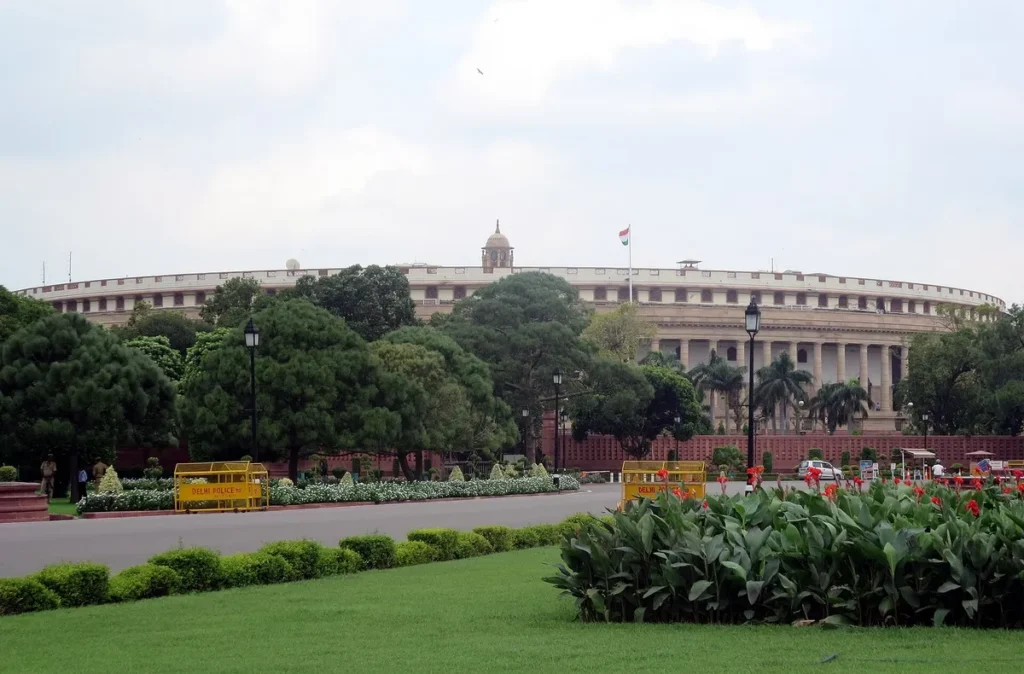
Image: Nikhilb239, Wikimedia Commons, CC BY-SA 4.0
How to use this in Mains
If asked: UPSC Mains 2025, GS-II: Indian Constitution has conferred the amending power on the ordinary legislative institutions with a few procedural hurdles. In view of this statement, examine the procedural and substantive limitations on the amending power of the Parliament to change the Constitution.
Quote: “Presumption of innocence: arrest is not proof of guilt.”
Use it: Use it as the core counter-argument; then balance with constitutional morality.
In the news
Eight constitutional amendments in the last 12 years
The Law Ministry told Lok Sabha on 25 July 2026 that the Constitution was amended eight times in the last twelve years. The list runs from the 99th Amendment Act, 2014 (NJAC) to the 106th Amendment Act, 2023 (women's reservation in the Lok Sabha and State Assemblies).
25 Jul 2026
Constitution (130th Amendment) Bill: removal of jailed PM, CMs, Ministers
The debate turns on arrest without conviction, and possible misuse of agencies.
20 Aug 2025