
UPSC Mains 2026 GS3 Q14: model answer
Discuss the different types of subsidies and supports provided by the Government of India to agricultural sector. Examine the related issues pertaining to Agreement on Agriculture of World Trade Organisation (WTO).
What the question wants
Classify subsidies and supports with examples; then WTO AoA boxes and the specific issues India faces (de minimis, public stockholding, peace clause, export subsidies).
How to structure it
Intro: why support is needed. Body: types; WTO boxes; India's issues. Conclusion: shift toward green-box support.
- 1Types
- 2WTO boxes
- 3India's issues
Model answer
Most Indian farmers hold under two hectares, so public support for inputs, prices and risk is central to farm policy. That support is also what the WTO scrutinises.
| Box | Meaning | Indian example |
|---|---|---|
| Amber | Trade-distorting; capped at de minimis 10% | MSP price support |
| Blue | Production-limiting payments | Not used |
| Green | Minimal distortion; no cap | PM-KISAN, research, extension |
| Art. 6.2 | Input subsidies for low-income farmers | Fertiliser, power |
Types of support
- Inputs: fixed-price urea, nutrient-based subsidy for P and K, free or cheap power, canal water, seeds.
- Credit: interest subvention, Kisan Credit Cards.
- Price: MSP for 22 crops, FCI procurement, PM-AASHA.
- Income: PM-KISAN, ₹6,000 a year.
- Risk: PM Fasal Bima Yojana.
- Infrastructure: Agriculture Infrastructure Fund, micro-irrigation.
WTO Agreement on Agriculture (1995) sorts support into Amber (distorting, capped), Blue (production-limiting) and Green (uncapped) boxes, plus Article 6.2 input subsidies for poor farmers in developing countries.
Issues for India
- De minimis: product-specific support is capped at 10% of output value, measured against a 1986–88 reference price that inflates India's 'subsidy'.
- Public stockholding: rice support has crossed 10%; India invoked the Bali peace clause (2013), but a permanent fix is pending.
- Asymmetry: rich countries keep large Green Box payments and historic Amber entitlements.
- Challenges to India's sugar and rice support and its export curbs.
India should keep defending food security with the G-33 while shifting support to the Green Box: income transfers, research and irrigation that help farmers without distorting prices.
Keywords, cases and data to drop in
NBS and urea subsidy interest subvention MSP and PM-AASHA PM-KISAN PMFBY Amber, Blue, Green Box Article 6.2 de minimis 10% 1986-88 external reference price Bali peace clause 2013 G-33
Where most answers lose marks
- Listing subsidies without classifying them.
- Not explaining why the 1986-88 reference price is unfair.
- Ignoring the peace clause and public stockholding, the core India issue.
Same theme in Prelims
Which among the following is/are the objective(s) of the Rainfed Area Development (RAD) initiative under the National Mission for Sustainable Agriculture (NMSA) ?
- 1. Encouraging monoculture in rainfed areas
- 2. Increasing rice cultivation in irrigated regions
- 3. Enhancing productivity and minimising climatic risks through Integrated Farming Systems (IFS)
Select the answer using the code given below :
Answer (d) & explanation
Only objective 3 belongs to RAD (d). Item 3 is right: Rainfed Area Development (RAD), an area-based part of the National Mission for Sustainable Agriculture (NMSA), promotes Integrated Farming Systems. It grows crops along with horticulture, livestock, fishery and agro-forestry, so a farmer in a dry area has more than one income source when the rain fails. Item 1 is wrong: monoculture raises risk. Item 2 is wrong: irrigated rice has nothing to do with a rainfed programme.
Notice why it matters: about half of India's net sown area is rainfed, growing much of its pulses, millets and oilseeds. NMSA is one of the eight missions under the National Action Plan on Climate Change (2008). Related: Per Drop More Crop for micro-irrigation.
statement 2 talks of "irrigated regions" in a scheme named "Rainfed". Read the scheme's own name before the statements.
Answer as per the official UPSC answer key.
Consider the following statements about turmeric during the year 2022-23 :
- I. India is the largest producer and exporter of turmeric in the world.
- II. More than 30 varieties of turmeric are grown in India.
- III. Maharashtra, Telangana, Karnataka and Tamil Nadu are major turmeric producing States in India.
Which of the statements given above are correct?
Answer (d) & explanation
All three statements are correct (d). Statement I is right: in 2022-23, India grew over 75% of the world's turmeric and had more than 62% of world trade. Statement II is right: more than 30 varieties are grown in over 20 States. Statement III is right: the major producers are Maharashtra, Telangana, Karnataka and Tamil Nadu. These lines come from the government's note on setting up the National Turmeric Board (2023).
Notice the board, based at Nizamabad in Telangana, which promotes turmeric research, exports and value addition. Turmeric's active compound is curcumin. Famous GI-tagged varieties include Erode turmeric, Lakadong turmeric of Meghalaya and Kandhamal Haladi of Odisha.
Answer as per the official UPSC answer key.
India is one of the founding members of the International North-South Transport Corridor (INSTC), a multimodal transportation corridor, which will connect
Answer (a) & explanation
INSTC links India to Central Asia and Europe via Iran (a). The International North–South Transport Corridor was agreed in 2000 by India, Iran and Russia. Goods go by sea from Mumbai to Bandar Abbas or Chabahar in Iran, then by road and rail through Iran, the Caspian region and Central Asia to Russia and on to Europe. Option (b) is wrong: it does not pass through China. Option (c) is wrong: that describes routes like the Trilateral Highway. Option (d) is wrong: Azerbaijan is one route inside the corridor, not its whole.
Notice its value: it is shorter and cheaper than the Suez route. India runs a terminal at Chabahar under a 10-year deal (2024). The IMEC corridor via the Gulf is another route.
option (d) names a real transit country. The full path in (a), via Iran, is the defining one.
Answer as per the official UPSC answer key.
Fresh examples from current affairs
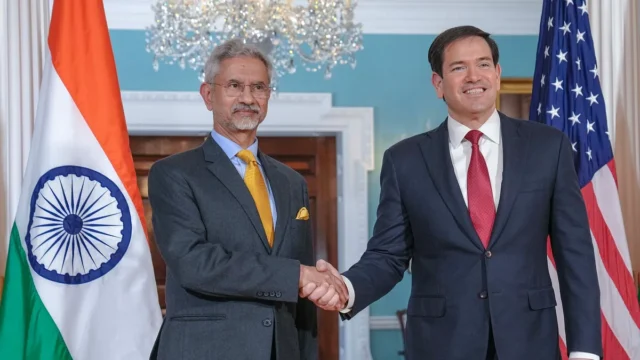
Rubio in Mumbai: India–US trade deal ‘very, very close’; energy and defence on the table
US Secretary of State Marco Rubio began his second India visit of the year in Mumbai on 20 October 2026 and met External Affairs Minister S. Jaishankar on trade, energy, technology and defence. Rubio said the two sides are ‘very, very close’ to a trade deal with ‘a small number of items left’, and praised India’s progress in diversifying energy supplies.
UPSC angle: Prelims: I2U2, Jamnagar, key office holders. · Mains GS-II: India-US partnership, tariffs and strategic autonomy.
20 Oct 2026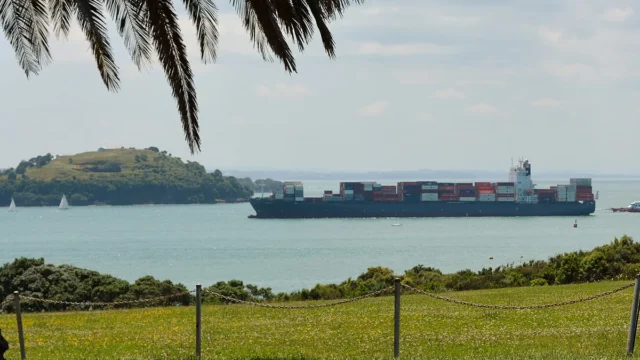
India–New Zealand FTA enters into force: zero duty on all Indian exports from day one
The India–New Zealand Free Trade Agreement came into force on 20 October 2026. From day one, New Zealand charges no customs duty on any Indian export, the first time India has got full duty-free access on all tariff lines at entry into force. New Zealand has also committed to facilitate USD 20 billion of investment into India, while dairy, sugar and edible oils stay protected.
UPSC angle: Prelims: FTA dates, Centres of Excellence, visa quotas, TRQ items. · Mains GS-II/III: FTAs with developed economies and farm safeguards.
20 Oct 2026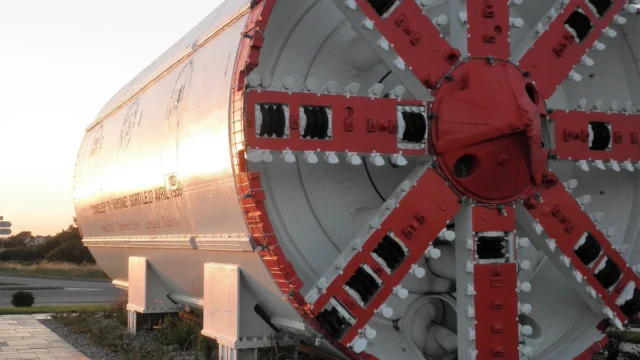
China to impose export controls on tunnel boring machines from 18 November: what it means for India
On 19 October 2026 China’s Commerce Ministry announced export controls on tunnel boring machines (TBMs) and related items from 18 November, calling them clearly dual-use. India imports TBMs for metro, rail and border tunnels and has faced customs delays on Chinese machines since 2024. China also announced controls on some drones.
UPSC angle: Prelims: export control regimes, SCOMET, Wassenaar, MTCR. · Mains GS-II/III: China dependence and supply-chain resilience.
19 Oct 2026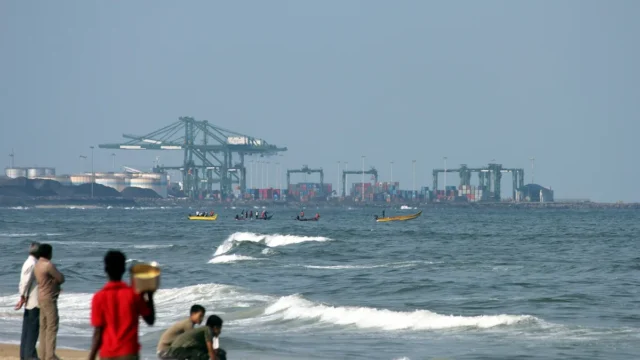
September 2026 trade data: merchandise exports up 23% to US$ 44.40 billion
India's merchandise exports rose 23.04% to US$ 44.40 billion in September 2026, data released by the Commerce Ministry on 15 October show. Imports were US$ 74.61 billion, leaving a goods trade deficit of US$ 30.21 billion. Counting services, exports reached about US$ 80.75 billion and the combined deficit was US$ 13.30 billion.
UPSC angle: Prelims: merchandise vs services trade, trade deficit vs current account deficit. · Mains GS-III: export diversification and the external sector.
15 Oct 2026Learn the concept
Question text as printed in the official UPSC question paper: https://www.upsc.gov.in/sites/default/files/QP-CSM-26-010926-GENERAL-STUDIES-PAPER-III.pdf The model answer is original Battle IAS work; use it to learn structure, not to memorise.