
Chapter 14 · Topic 14.2 · Prelims + Mains2 of 3
Ancient Indian Literature: Epics, Puranas and Sangam
Key points
- Epics (itihasa) grew over about 400 BCE–400 CE; use them carefully as history.
- Ramayana: Valmiki, about 24,000 verses, seven kandas; Mahabharata: Vyasa, about 100,000 verses, eighteen parvas.
- Puranas have five subjects (pancha lakshana); their dynasty lists help date Mauryas to Guptas.
- Sangam: Tolkappiyam, Ettuthogai, Pattupattu, Tirukkural; twin epics are post-Sangam.
Prelims box: facts and traps
- Bhagavad Gita: in the Bhishma Parva.
- Regional Ramayanas: Kamban (Tamil), Tulsidas (Ramcharitmanas).
- Silappadikaram: Ilango Adigal; Manimekalai: Sittalai Sattanar.
The epics and the Puranas
| Text | Key facts |
|---|---|
| Ramayana | Credited to Valmiki; about 24,000 verses in seven kandas; regional versions include Kamban’s Tamil Ramavataram and Tulsidas’s Ramcharitmanas |
| Mahabharata | Credited to Vyasa; about 100,000 verses in eighteen parvas; grew from the Jaya to the Bharata to the Mahabharata; contains the Bhagavad Gita in the Bhishma Parva |
| Puranas | Eighteen Mahapuranas (Vishnu, Bhagavata, Matsya, Vayu and others); final form largely in the Gupta age |
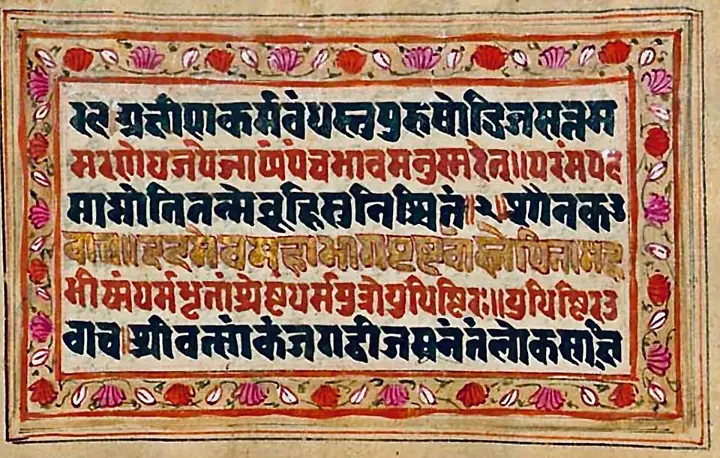
The epics were composed over several centuries, roughly 400 BCE to 400 CE, and are called itihasa (‘so it was’). Use them with care as history: they mix old memory with later additions. The Bhagavad Gita, Krishna’s teaching to Arjuna, sets out karma (action), jnana (knowledge) and bhakti (devotion) as paths to liberation.
A Purana should cover five subjects (pancha lakshana): creation, re-creation, family trees of gods and sages, the ages of Manu, and royal dynasties. That last part makes the Puranas useful sources for the Mauryas, Shungas, Satavahanas and Guptas. They also spread temple worship, pilgrimage and bhakti to Vishnu, Shiva and the Goddess.
What UPSC asks
Prelims: authors, parvas, kandas; Gita. Mains: epics and Puranas as sources. Next likely: regional Ramayanas.
Sangam literature
The oldest Tamil literature comes from the Sangam age (roughly 3rd century BCE to 3rd century CE). Tradition speaks of three assemblies (sangams) of poets at Madurai under Pandya support.
| Group | What it includes |
|---|---|
| Tolkappiyam | The earliest Tamil grammar, by Tolkappiyar |
| Ettuthogai | Eight anthologies of poems |
| Pattupattu | Ten long poems (idylls) |
| Pathinenkilkanakku | Eighteen minor works on ethics, including the Tirukkural of Tiruvalluvar |
| Twin epics (post-Sangam) | Silappadikaram by Ilango Adigal, and Manimekalai by Sittalai Sattanar |
The poems fall into akam (inner: love) and puram (outer: war, kings, giving). They describe the Cheras, Cholas and Pandyas, chiefs, ports and trade with Rome.
The Tirukkural is quoted even in the Ethics paper. Mains 2018 (GS IV) gave this line to explain: “Falsehood takes the place of truth when it results in unblemished common good. Mains 2018 ” – Tirukkural. Show how intention and outcome both matter, and add the limit: the ‘common good’ must truly be blameless.
“Falsehood takes the place of truth when it results in unblemished common good.” – Tirukkural
What UPSC asks
Prelims: Tolkappiyam, Ettuthogai, Tirukkural, twin epics. Mains: Sangam society; Tirukkural ethics (GS IV 2018). Next likely: Tamil classical language status.
Mains box: analysis and answer points
- Epics and Puranas as sources: memory plus later additions.
- Tirukkural in GS IV (2018): intention, outcome and blameless common good.
- Likely next angle: Tamil classical language status.
Practice
Practice MCQs (8)
An ancient anthology of seven hundred short love poems in Maharashtri Prakrit, many of them frank monologues by married women or young girls addressed to a friend, a mother, a lover or a husband, is attributed to a king named Hala. The anthology is the
Answer (d) & explanation
The Gaha Sattasai (Sanskrit Gatha Saptashati, 'seven hundred gathas'), also called the Gaha Kosha, is a collection of love poems in Maharashtri Prakrit, the Prakrit that was the official language of the Satavahanas and the most widely used in western and southern India. The poems are often frank monologues, usually by a married woman or an unmarried girl, voicing her feelings and longings to a friend, mother, lover or husband, or to herself, and many describe secret meetings or marriages with emotionally distant husbands. It is one of the oldest known texts of the subhashita genre and has been called the 'opposite extreme' of the Kamasutra: the one a theory of love, the other its lived emotions. The collection is attributed to King Hala, but many poems carry names of other authors and scholars doubt that Hala wrote it; the text was revised by later scribes, and its date is debated. Every manuscript has exactly 700 poems, though the poems themselves vary; Albrecht Weber's critical edition of 1881 used seventeen manuscripts and counted 964 poems in all.
With reference to the Pathinenkilkanakku (Eighteen Lesser Texts) of Tamil literature, consider the following statements:
1. Unlike the Eighteen Greater Texts, its poems are mostly short, written in the venpa metre, and largely concerned with morals and ethics.
2. The Kalavazhi Narpathu, one of its works, deals with puram themes such as war.
3. Like every other work in the collection, the Naladiyar is the composition of a single poet.
Which of the statements given above is/are correct?
Answer (d) & explanation
The Pathinenkilkanakku is a collection of eighteen poetic works composed mostly in the post-Sangam period, between about 100 and 500 CE. It differs from the earlier Eighteen Greater Texts (Pathinenmelkanakku: the Ettuthokai and Pattuppattu), the oldest surviving Tamil poetry, in that its poems are written in the venpa metre and are relatively short, and most of its books deal with morals and ethics. Statement 1 is correct. Not every work is ethical, however. The Kalavazhi Narpathu, forty poems by the poet Poigaiyar, deals with puram subjects, the 'external' themes of war, politics and wealth; statement 2 is correct. Other members include the Nanmanikkatigai, Inna Narpathu, Iniyavai Narpathu, Kar Narpathu, Tirikatukam, Acharakkovai, Pazhamozhi Nanuru, Elathi and the Tirukkural. Statement 3 is wrong: the Naladiyar is the one true anthology in the collection, sung by some 400 poets, while each of the remaining seventeen works is by a single poet.
A Tamil Jain narrative poem of about 16,000 lines in the akaval metre, by the poet Konguvelir, retells the story of King Udayana of Kaushambi and is named after Gunadhya's 'great story'. The work is the
Answer (b) & explanation
The Perunkathai ('great story') takes its name from Gunadhya's Brihatkatha, the lost work in Paishachi, and is believed to draw on it and on a Sanskrit Udayana poem ascribed to the Ganga king Durvinita. Its author, Konguvelir (Konguvel), is described as a prince of the Kongu country who lived at Vijayamankai, in the present Coimbatore region, where there were many Jains; the work is also called the Udayanan Kathai or Konguvel Makkathai. It narrates the life of Udayana, the Vatsa king of Kaushambi, who enjoys every pleasure and success of kingship before turning ascetic, and then his son Naravahanadatta. It runs to about 16,000 lines in the akaval metre and, though it praises Jain moral teaching, it attempts real characterisation rather than mere propaganda. It is noted as the first Tamil classic set in north India and for its detail on music, sports and architecture. It was edited and published by U. V. Swaminatha Iyer in 1924. Its date is disputed, and accounts differ by centuries.
A Prakrit novel in mixed verse and prose (champu), completed in 779 CE at Jabalipura (modern Jalore) in the reign of the Gurjara-Pratihara king Vatsaraja, follows five souls through many rebirths until they meet Mahavira and attain liberation. The work and its author are
Answer (d) & explanation
The Kuvalayamala ('garland of blue water lilies') is a Prakrit novel by the Jain monk Uddyotana-suri, also called Dakshinyachihna, written in the champu form of mixed verse and prose. An analysis of the text suggests it was completed on 21 March 779 CE at Jabalipura, the modern Jalore, under the Gurjara-Pratihara king Vatsaraja, also called Ranahastin. It narrates five souls, one of them the princess Kuvalayamala, through several rebirths: each is first misled by one of the five passions, anger, vanity, deceit, greed and infatuation; later, as Jain monks under the preceptor Dharmanandana, they promise to help one another, and in their final births they meet Mahavira and attain liberation. The work thus teaches Jain philosophy through a story. It also includes dialogue in Sanskrit, Apabhramsha and Paishachi, which makes it valuable for the study of languages. Uddyotana's teacher Haribhadra (fl. 750) wrote the didactic Samaraichchakaha, and a later monk of the same line, Siddharshi (fl. 906), wrote the Upamitibhavaprapancha.
Consider the following works:
1. Setubandha (Ravanavaho)
2. Gaudavaho
3. Paumachariya
4. Brihatkatha
How many of the above were composed in Maharashtri Prakrit?
Answer (c) & explanation
Maharashtri was the most widely attested Prakrit, the official language of the Satavahanas, and the Prakrit that the poet Dandin ranked highest. Several major works are in it. The Setubandha, also called Ravanavaho, describes Rama's exploits in Lanka against Ravana and is often credited to the Vakataka king Pravarasena II (c. 420-455), though its Vaishnava theme has made some scholars question this; it is in Maharashtri. The Gaudavaho, 'the slaying of the Gauda king', is the eighth-century epic of Vakpatiraja, court poet of Yashovarman of Kanauj, in a little over 1,200 verses; it too is Maharashtri. The Paumachariya of Vimalasuri, the earliest known Jain version of the Ramayana, is described as the oldest literary work in Maharashtri. The Brihatkatha of Gunadhya, by contrast, was written in Paishachi, a little- understood literary language that grammarians did not treat as a spoken Prakrit and that Dandin calls bhutabhasha; the original is lost. So three of the four are Maharashtri works.
Consider the following statements about the Sanskrit poets Bharavi and Magha:
1. Bharavi's Kiratarjuniya, in eighteen cantos, expands an episode of the Mahabharata in which Arjuna fights Shiva disguised as a mountain hunter.
2. Inscriptions of the Ganga dynasty state that King Durvinita wrote a Kannada commentary on one canto of the Kiratarjuniya.
3. A traditional verse praises Bharavi for his similes (upama) and Kalidasa for his weight of meaning (arthagaurava).
Which of the statements given above is/are correct?
Answer (b) & explanation
Bharavi's Kiratarjuniya ('of the kirata and Arjuna') has eighteen cantos and expands a minor episode of the Vana Parva of the Mahabharata: during the Pandavas' exile, Arjuna, on Indra's instruction, performs penance, and Shiva, pleased, tests him in the guise of a kirata, a mountain-dwelling hunter. The dominant mood is vira, valour, and one canto is set aside for verbal feats. Statement 1 is correct. For its date, grant inscriptions of the Ganga dynasty, such as the Gummareddipura inscription, say that King Durvinita wrote a Kannada commentary on the fifteenth canto; since Durvinita's reign ended about 580 CE, Bharavi lived around or before then. Statement 2 is correct. Statement 3 reverses a famous verse: 'upama Kalidasasya, Bharaver arthagauravam, Dandinah padalalityam, Maghe santi trayo gunah', similes are Kalidasa's, weight of meaning Bharavi's, grace of words Dandin's, and Magha has all three. Magha, of the seventh century, wrote the Shishupalavadha in twenty cantos at the court of a king at Shrimala, and is often compared with Bharavi.
With reference to Gunadhya's Brihatkatha, consider the following statements:
1. The original is lost and is known through later versions, including two Kashmiri Sanskrit recensions by Kshemendra and Somadeva.
2. The Kannada work Kavirajamarga mentions a now-lost Sanskrit version of it by Durvinita.
3. Gunadhya composed it in classical Sanskrit at the court of Harsha.
Which of the statements given above is/are correct?
Answer (b) & explanation
The Brihatkatha, 'the great narrative', is said to have been written by Gunadhya in Paishachi, a poorly understood literary language. The work no longer exists, and its loss is called one of the greatest in Indian literature. It is known through later adaptations: in Sanskrit, the Brihatkathashlokasamgraha of Budhasvamin and the two Kashmiri recensions, the Brihatkathamanjari of Kshemendra and the Kathasaritsagara of Somadeva; and in other languages, the Tamil Perunkathai and the Vasudevahindi. Statement 1 is correct. The earliest extant Kannada work on grammar and poetics, the Kavirajamarga of Nripatunga (c. 850), mentions a lost Sanskrit version by Durvinita, the Ganga king also known for his commentary on Bharavi; statement 2 is correct. Statement 3 is wrong on both counts: the language was Paishachi, not Sanskrit, and Gunadhya is linked with a Satavahana king of Pratishthana, probably between the first century BCE and the third century CE, while Dandin, Subandhu and Bana already knew the work by the sixth or seventh century. A Cambodian inscription of about 875 also mentions Gunadhya.
With reference to Patanjali, the author of the Mahabhashya, consider the following statements:
1. His Mahabhashya, dated to the mid-second century BCE, discusses Panini's rules together with the earlier varttikas of Katyayana.
2. Scholars such as Louis Renou found significant differences of language, grammar and vocabulary between the Mahabhashya and the Yoga Sutras.
3. Texts from the Gupta period onwards consistently identify the grammarian Patanjali with the author of the Yoga Sutras.
Which of the statements given above is/are correct?
Answer (a) & explanation
The Mahabhashya, the 'great commentary', is firmly dated to the mid-second century BCE by both Western and Indian scholars. It is a commentary on the Ashtadhyayi of Panini that embeds and discusses the somewhat earlier varttikas of Katyayana; Patanjali often defends Panini's positions where Katyayana had read them differently. Statement 1 is correct. Whether the grammarian also wrote the Yoga Sutras is an old question. The two works differ completely in subject, and Louis Renou showed significant differences in their language, grammar and vocabulary, so most Western scholars now regard them as different authors; statement 2 is correct. Statement 3 is wrong: no known text before the eleventh-century king Bhoja conflates the two. Bhoja's verse at the start of his Yoga Sutra commentary, the Rajamartanda, honours a single Patanjali for grammar, medicine and yoga; the well-known verse saluting the sage who removed the impurities of mind by yoga, of speech by grammar and of body by medicine is found in an eighteenth-century text, and the view became an 'article of faith' in traditional circles. So the identification is late, not Gupta.
0 / 0 correct
Write an answer
In 150 words, explain the significance of Ancient Indian Literature with one recent example.
Flashcards (6)
How many parvas in the Mahabharata?
Eighteen.
In which parva is the Gita?
Bhishma Parva.
How many Mahapuranas?
Eighteen.
Earliest Tamil grammar?
Tolkappiyam.
Who wrote the Tirukkural?
Tiruvalluvar.
Who wrote the Silappadikaram?
Ilango Adigal.
Read more: related explainers
In the news
- 20 Oct 2026Sirpur in Chhattisgarh enters UNESCO’s Tentative List of World Heritage sites
- 15 Oct 2026PM inaugurates five Ladakh projects: Nimmu–Padum–Darcha road, Leh terminal, Hanu hydro
- 14 Oct 2026HAL, NCF and ASI sign MoA for Hampi, Taj Mahal and Bekal Fort
- 11 Oct 2026Birth anniversaries: Jayaprakash Narayan and Nanaji Deshmukh
 Next topic · 14.3 →Ancient Indian Literature: The whole chapter
Syllabus: Prelims GS-I · History of India and Indian National Movement.