
Sangam Age: the Three Sangams, Tamil Literature, Chera-Chola-Pandya Kingdoms, Society and Trade (UPSC Notes + PYQs)
UPSC has already asked about this. Read the story with these questions in mind.
Background: the far south before the empires
While the Mauryas and their successors ruled the Ganga valley, the far south of the peninsula followed its own path. The region south of the Venkata hills, called Tamilakam, was home to three ruling lineages, the Cheras, Cholas and Pandyas, known together as the muvendar or three crowned kings, along with many smaller chiefs. Ashoka’s inscriptions mention the Cholas, Pandyas, Keralaputras and Satiyaputras as neighbours beyond his empire, and Kharavela of Kalinga claims to have broken a confederacy of Tamil states. Most of what we know about this society, roughly from the third century BCE to the third century CE, comes from a body of Tamil poetry later called Sangam literature, supported by archaeology at sites such as Arikamedu, Kodumanal, Keeladi and Pattanam, and by Greek and Roman accounts of trade.
What “Sangam” means
Tradition speaks of three assemblies (sangams) of poets under Pandya patronage at Madurai. Only works of the third survive. Historians treat the legend with caution but date the surviving poems to the early centuries around the turn of the era, later compiled into anthologies.
- TolkappiyamGrammar and poetics
- EttuttokaiEight anthologies
- PattuppattuTen idylls
- TirukkuralEthics, by Tiruvalluvar (later)
- SilappadikaramEpic of Kannagi (post-Sangam)
- ManimekalaiBuddhist epic (post-Sangam)
The literature
| Group | Contents |
|---|---|
| Tolkappiyam | Grammar and poetics, attributed to Tolkappiyar |
| Ettuthogai (Eight Anthologies) | Purananuru, Akananuru, Kuruntokai, Natrinai and others |
| Pattuppattu (Ten Idylls) | Long poems such as Maduraikkanchi and Pattinappalai |
| Later works | Tirukkural (ethics) and the epics Silappatikaram and Manimekalai are post-Sangam |
Kings and chiefs
- Cheras: Kerala coast; port Muziris; Senguttuvan of the Silappatikaram.
- Cholas: Kaveri delta; capital Uraiyur, port Puhar (Kaveripattinam); Karikala built the Kallanai embankment by tradition.
- Pandyas: Madurai; port Korkai, famous for pearls.
- Many smaller chiefs (velir) and patrons like the “seven patrons” of poets.
Society, landscape and economy
The poems map five landscapes (tinai), each with its people and mood: kurinji (hills), mullai (forest pasture), marutam (farmland), neytal (coast) and palai (dry land). Hero stones (nadukal) honoured warriors. Pepper, pearls, ivory and textiles went west; Roman gold coins found at Arikamedu and in Coimbatore hoards show the scale of trade, which the Periplus of the Erythraean Sea also describes.
- 1South-west monsoon carries ships from Egypt
- 2Arrival at Muziris and other ports
- 3Pepper, pearls, textiles loaded
- 4North-east monsoon for return
- 5Roman gold and silver flow into Tamilakam
The three kingdoms
| Kingdom | Capital | Port | Emblem | Famous ruler |
|---|---|---|---|---|
| Chera | Vanji (Karur) | Muziris, Tondi | Bow | Senguttuvan, linked to the Kannagi cult |
| Chola | Uraiyur, later Puhar | Puhar (Kaveripattinam) | Tiger | Karikala, credited with the Kallanai dam on the Kaveri |
| Pandya | Madurai | Korkai | Fish | Nedunjeliyan, victor at Talaiyalanganam |
New evidence
Excavations at Keeladi near Madurai since 2015 have revealed brick structures, Tamil-Brahmi inscribed potsherds and an urban settlement that the Tamil Nadu Archaeology Department dates to around the 6th century BCE on scientific dates. The dating is debated, which itself is a good Mains point on how archaeology revises literary chronology.
The five tinais
| Tinai | Landscape | Occupation | Mood in akam poetry |
|---|---|---|---|
| Kurinji | Hills | Hunting, honey gathering | Union of lovers |
| Mullai | Forest and pasture | Herding | Patient waiting |
| Marutam | Wet farmland | Rice cultivation | Quarrels, infidelity |
| Neytal | Seashore | Fishing, salt making | Anxious waiting |
| Palai | Dry wasteland | Raiding, travel | Separation |
The tinai scheme shows how closely Tamil poets tied human emotion to landscape. It is also a useful source for historians, because it records occupations, food, deities and exchange in each zone. Marutam villages produced rice and supported kings and chiefs, while neytal settlements linked the interior with sea trade.
Trade with Rome
The Periplus of the Erythraean Sea, written by an unknown Greek sailor in the first century CE, and Pliny’s Natural History describe ships sailing with the monsoon winds from Egypt to the Malabar coast. Pepper, pearls, ivory, fine textiles and gemstones went west, while gold and silver coins, wine and pottery came east. Hoards of Roman coins have been found in Tamil Nadu and Kerala, and amphorae and Arretine ware were excavated at Arikamedu near Puducherry. The Muziris papyrus, a loan contract of the second century CE, records a cargo shipped from Muziris to Alexandria worth a fortune. Sangam poems themselves speak of the Yavanas, a term for westerners, who came in fine ships and served as guards in Tamil courts. Trade enriched chiefs and kings and helped spread urban life along the coast.
Polity and society
Sangam polity centred on the ko or king, supported by chiefs called velir, and by assemblies such as the avai, the royal court, and the manram, a village gathering place under a tree where disputes were settled. Revenue came from land, tribute, war booty and customs duties on trade. Kings rewarded bards, the panar and viraliyar, who sang their praises and carried their fame. War was frequent, and hero stones, or nadukal, were raised for warriors who died in battle or cattle raids; many survive with inscriptions. Society was not yet organised on the four-varna model of the north, though Brahmins appear as priests and some status distinctions existed. Women poets such as Avvaiyar wrote in the corpus, which shows that some women had access to learning, though sati and restrictions on widows are also mentioned.
Religion combined local deities such as Murugan, the god of the hills, with Vedic gods such as Indra and Vishnu (Mayon), showing the gradual blending of northern and southern traditions that would later produce the Bhakti movement of the Alvars and Nayanars.
Writing the Sangam age in Mains
Questions often ask how far Sangam literature can be trusted as history. The poems are literary works with conventions, so they exaggerate the deeds of patrons. Yet they agree with archaeology on many points: urban sites, Tamil-Brahmi inscriptions on pottery, Roman coins and port remains. Using both kinds of evidence, and noting their limits, makes for a stronger answer. Link the period to later Tamil history too: the Kalabhra interlude that followed, and the rise of the Pallavas and Pandyas, show how Sangam traditions fed into temple-based kingship, and of the Bhakti poetry of the Alvars and Nayanars.
Sangam Age: UPSC angle
For UPSC CSE
Prelims: works and authors, ports, tinai, terms (Vattakirutal, nadukal), which works are post-Sangam. Mains GS-I: Sangam society, early urbanisation in the South, Indo-Roman trade.
Sangam Age UPSC PYQs (Prelims)
Questions UPSC has actually asked, from the official papers. Pick an option to check yourself.
Which one of the following statements about Sangam literature in ancient South India is correct ?
Sangam poets knew the varna terms (arasar, vaishiyar, anthanar), though Tamil society was arranged more by tinai (eco-zone) and kudi. The poems are full of material life: trade, food, ports and crafts. The Puram poems praise the warrior ethic and hero-stones, and treat magic and omens as real. Answer as per the official UPSC key · Battle IAS PYQ bankAnswer (b) & why
A principal P becomes Q in 1 year when compounded half-yearly with R% annual rate of interest. If the same principal P becomes Q in 1 year when compounded annually with S% annual rate of interest, then which one of the following is correct ?
Vadakkiruttal (“sitting facing north”) was the ritual fast to death by a king or warrior who had been shamed. The best-known case is the Chola king Kopperuncholan, whose friend the poet Pisirandaiyar joined him. Puram poems record it as an honourable death. Answer as per the official UPSC key · Battle IAS PYQ bankAnswer (c) & why
Mains PYQs on this topic
No UPSC Mains question from 2023-2026 is directly on this topic. Older papers (2013-2022) will be added as the Mains bank grows.
Quick quiz
Which of these is NOT part of Sangam literature proper?
It is a post-Sangam epic.Answer (c)
Korkai, a centre of pearl fishery, was a port of the
On the Tamirabarani mouth.Answer (c)
The tinai called “neytal” refers to
Five landscape types.Answer (c)
FAQs
How many Sangams were there?
Tradition says three, at Madurai under the Pandyas; only works from the third survive.
What are akam and puram poems?
Akam poems deal with love and inner life; puram poems with war, kings, and public life.
What is Keeladi?
An excavated urban site near Madurai with Tamil-Brahmi inscriptions, which pushes back dates for early urban life in Tamil Nadu.
Which port was associated with the Cheras?
Muziris, near modern Pattanam in Kerala.
Who wrote the Silappadikaram?
Ilango Adigal. It tells the story of Kannagi and Kovalan and is set across the three Tamil kingdoms.
What is the Tirukkural?
A work of 1,330 couplets on virtue, wealth and love by Tiruvalluvar, valued for its ethical teaching.
Which was the main Pandya port?
Korkai, famous for pearl fishing.
Spotted an error? Tell us. We correct within 48 hours.
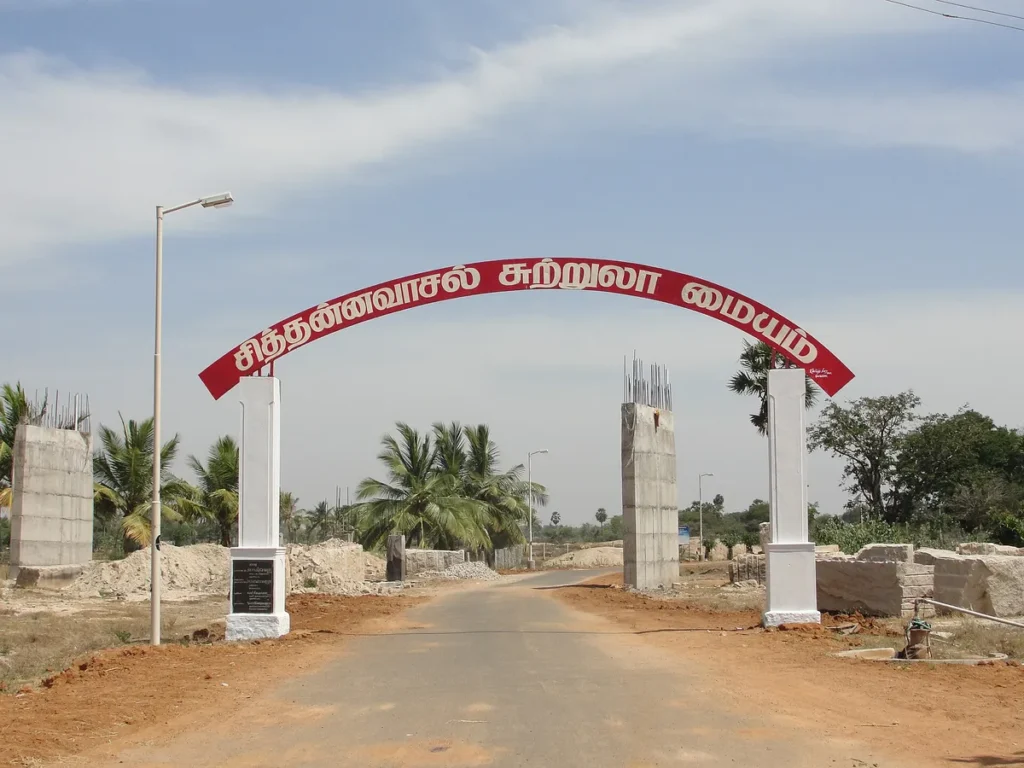
Image: Thamizhpparithi Maari, Wikimedia Commons, CC BY-SA 3.0
How to use this in Mains
If asked: What does Sangam literature tell us about early Tamil society? (GS-I)
Quote: “The tinai scheme shows how closely Tamil poets tied human emotion to landscape.”
Use it: A fine conclusion line on literature and landscape.
In the news
Pollen study links Harappan decline to weak monsoon (5100–4000 BP)
A pollen study by the Birbal Sahni Institute of Palaeosciences links the shrinking of the Harappan Civilization to a weak Indian Summer Monsoon between about 5100 and 4000 years before present, the Science Ministry said on 29 July 2026. Sediments from Deoria Tal in the Garhwal Himalaya show an abrupt dry spell, the "4.2 ka event".
29 Jul 2026
Sarnath inscribed as India’s 45th UNESCO World Heritage Site
On 25 July 2026 the 48th World Heritage Committee in Busan inscribed the "Ancient Buddhist Site of Sarnath" on the UNESCO World Heritage List. It is India's 45th property. The serial site in Varanasi covers Chaukhandi Stupa and the Archaeological Remains of Sarnath, where the Buddha gave his first sermon.
25 Jul 2026
Rakhigarhi skeletal remains handed to Anthropological Survey of India
ASI handed human skeletal remains from Rakhigarhi, Haryana, to the Anthropological Survey of India under a new MoU, the Culture Ministry said on 22 June 2026. The 2025-26 dig at Mound No. 7 found eight burials; three complete skeletons plus fragments went to AnSI's Kolkata repository. Planned work includes aDNA, isotopes and palaeopathology with partner labs.
22 Jun 2026
Relics of the Buddha’s chief disciples enshrined for exposition in Mongolia
The holy relics of Arhat Sariputra and Arhat Mahamoggallana, the Buddha's two chief disciples, were ceremonially enshrined at Gandantegchenling Monastery in Ulaanbaatar on Buddha Purnima (Vesak) 2026. Brought from India for a ten-day exposition from 31 May to 10 June 2026, they arrived on a special IAF IL-76 aircraft and had travelled abroad only once before, to Thailand in 2024.
31 May 2026