
Chapter 15 · Topic 15.1 · Prelims + Mains1 of 3
Ancient Indian Science & Technology: Numbers and mathematicians
Key points
- Place value plus zero is India's best-known gift; Arabs called the digits 'Hindu numerals'.
- Steps: Pingala's shunya, Aryabhatiya (499 CE), Bakhshali dot, Gwalior circle zero (876 CE), Brahmagupta's rules (628 CE).
- Fibonacci carried the numerals to Europe in 1202.
- Bhaskara I wrote on Aryabhata; Bhaskara II wrote Lilavati.
Prelims box: facts and traps
- Gwalior inscription (876 CE): earliest dated circle zero, writing '270'.
- Brahmagupta: Brahmasphutasiddhanta at Bhinmal.
- Aryabhata satellite: 1975.
- Kusumapura: where Aryabhata wrote.
Place value and zero
India’s best-known gift to the world is the way we write numbers: nine digits plus zero, where a digit’s value depends on its place. So the 2 in 20 means twenty, but in 200 it means two hundred. UPSC likes these ‘firsts’.
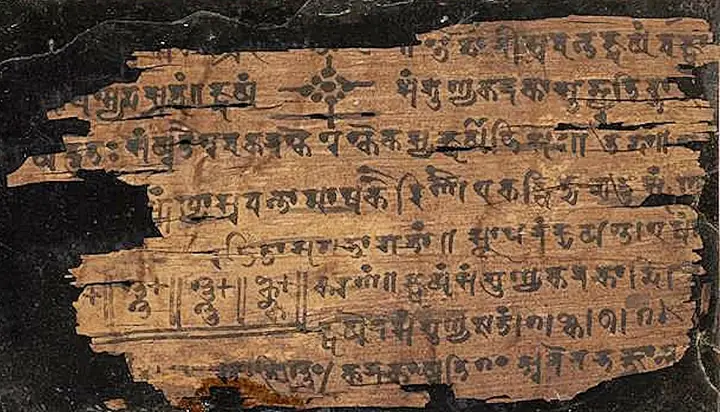
| Step | Evidence |
|---|---|
| Idea of ‘nothing’ (shunya) | Used in Pingala’s work on metre (about 3rd–2nd century BCE) |
| Place value in use | Aryabhata’s Aryabhatiya (499 CE) assumes it |
| Zero as a dot | The Bakhshali manuscript, found near Peshawar in 1881; radiocarbon tests give different dates for different leaves, some very early |
| Zero as a circle, dated | Chaturbhuj temple inscription, Gwalior (876 CE), writing ‘270’ |
| Rules for zero | Brahmagupta (628 CE): a number minus itself is zero; zero added to a number leaves it unchanged |
Arab scholars such as al-Khwarizmi (9th century) learned the system and called it ‘Hindu numerals’; Fibonacci carried it to Europe in 1202. That is why the world calls them Hindu–Arabic numerals.
What UPSC asks
Prelims: Pingala, Bakhshali, Gwalior zero, Brahmagupta. Mains: India’s role in world science. Next likely: Hindu–Arabic numerals.
Aryabhata, Varahamihira, Brahmagupta and Bhaskara
| Scholar | Main work | Remember him for |
|---|---|---|
| Aryabhata (born 476 CE) | Aryabhatiya (499 CE), written at Kusumapura (Pataliputra) | Pi as about 3.1416, called ‘approximate’; the earth spins on its axis; eclipses caused by shadows, not Rahu; a table of sines |
| Varahamihira (6th century) | Pancha Siddhantika; Brihat Samhita | Summed up five schools of astronomy, including Greek-influenced ones; an encyclopedia of weather, plants, gems and buildings |
| Brahmagupta (598–about 668) | Brahmasphutasiddhanta (628 CE), at Bhinmal | Rules for zero and negative numbers; quadratic equations; formula for a cyclic quadrilateral |
| Bhaskara II (1114–1185) | Siddhanta Shiromani (1150), with Lilavati and Bijaganita | Arithmetic and algebra; the chakravala method for indeterminate equations; ideas close to calculus; led the Ujjain observatory |
Mains 2022 asked: Discuss the main contributions of Gupta period and Chola period to Indian heritage and culture. On the Gupta side, Aryabhata and Varahamihira are your science examples, along with the Iron Pillar.
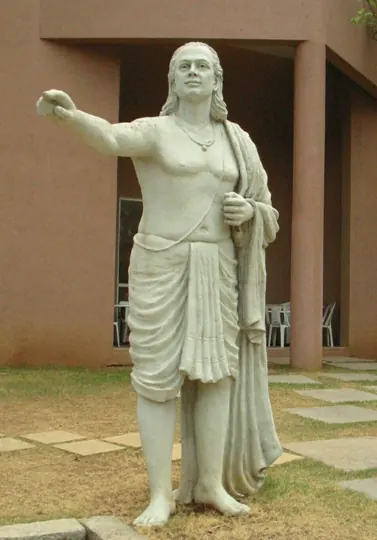
Discuss the main contributions of Gupta period and Chola period to Indian heritage and culture.
India honoured Aryabhata by naming its first satellite after him (1975). Don’t mix up Bhaskara I (7th century), who wrote commentaries (explanations) on Aryabhata, with Bhaskara II, the author of Lilavati.
What UPSC asks
Prelims: Aryabhata, Varahamihira, Brahmagupta, Bhaskara II. Mains: Gupta contributions (2022). Next likely: Aryabhata satellite.
Mains box: analysis and answer points
- Indian contribution to world science: numerals, zero, astronomy.
- Gupta heritage (Mains 2022): Aryabhata, Varahamihira, Iron Pillar.
- Likely next angle: Hindu–Arabic numerals.
Practice
Write an answer
In 150 words, explain the significance of Ancient Indian Science & Technology with one recent example.
Flashcards (10)
Where does zero appear as a dot?
Bakhshali manuscript.
Earliest dated circular zero?
Gwalior, Chaturbhuj temple, 876 CE.
Who gave rules for zero in 628 CE?
Brahmagupta.
Who carried Indian numerals to Europe?
Fibonacci (1202).
When was the Aryabhatiya written?
499 CE.
Aryabhata's value of pi?
About 3.1416.
How did Aryabhata explain eclipses?
Shadows of the earth and moon.
Who wrote the Pancha Siddhantika?
Varahamihira.
Who wrote Lilavati?
Bhaskara II.
Brahmagupta's home town?
Bhinmal.
Read more: related explainers
In the news
- 20 Oct 2026Sirpur in Chhattisgarh enters UNESCO’s Tentative List of World Heritage sites
- 15 Oct 2026PM inaugurates five Ladakh projects: Nimmu–Padum–Darcha road, Leh terminal, Hanu hydro
- 14 Oct 2026HAL, NCF and ASI sign MoA for Hampi, Taj Mahal and Bekal Fort
- 11 Oct 2026Birth anniversaries: Jayaprakash Narayan and Nanaji Deshmukh
 Next topic · 15.2 →Ancient Indian Science & Technology: Astronomy and medicine
Syllabus: Prelims GS-I · History of India and Indian National Movement.