
Chapter 7 · Topic 7.1 · Prelims + Mains1 of 3
Foreign Invasions: Persians and Alexander: The Persian (Achaemenid) conquest
Key points
- The divided north-west fell to the Persian (Achaemenid) empire: Cyrus reached Gandhara; Darius I took the Indus region.
- India was the 20th and richest satrapy, paying 360 talents of gold dust a year (Herodotus).
- Legacy: Kharoshthi script from Aramaic, Persian touches in Mauryan art, words like satrap and dipi, wider trade.
Prelims box: facts and traps
- Behistun inscription: Darius I names Gandara; Persepolis and Naqsh-i-Rustam name Hindush.
- Kharoshthi: written right to left; used in some Ashokan edicts of the north-west.
- Xerxes: used Indian soldiers against the Greeks.
- Taxila: teachers taught privately, no campus or degrees, unlike Nalanda.
The Persian (Achaemenid) conquest
While Magadha was growing in the east, the north-west of the subcontinent was split into small, quarrelling states such as Gandhara and Kamboja. No strong power held them together, so the region was an easy target for the great empire of Iran (the Achaemenids).
| Ruler | What happened |
|---|---|
| Cyrus (about 558–530 BCE) | Founder of the Achaemenid empire; Greek writers say he campaigned up to Gandhara |
| Darius I (about 522–486 BCE) | Conquered the Indus region; his Behistun inscription names Gandara, and later inscriptions at Persepolis and Naqsh-i- Rustam name Hindush (Sindh) |
| Xerxes (about 486–465 BCE) | Used Indian soldiers in his war against the Greeks |
According to the Greek historian Herodotus, the Indian province was the twentieth and richest satrapy (province run by a Persian governor) of the empire. It paid a tribute (a yearly payment to the ruler) of 360 talents of gold dust. Persian rule over the north-west lasted until Alexander defeated Darius III in the 330s BCE.
| Impact of Persian rule | Details |
|---|---|
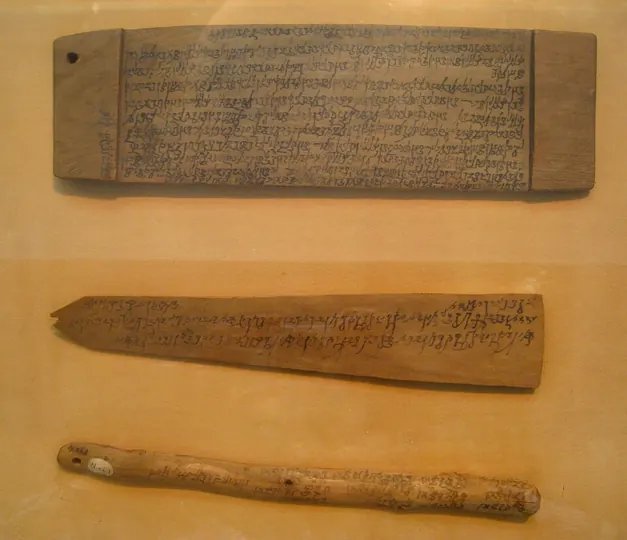
| Kharoshthi script | Developed from Aramaic, the Persian official script; written right to left; used in the north-west, including some Ashokan edicts |
| Mauryan art | Polished stone, bell-shaped capitals and the idea of royal inscriptions may owe something to Persian models |
| Words and administration | Terms such as satrap (later kshatrapa) and dipi (lipi) for writing |
| Trade | The north-west was linked to the trade routes of West Asia |
Kharoshthi, born from the Aramaic script of Persian officials, travelled far along the trade routes.
Taxila, the capital of Gandhara, stood where roads from Iran and Central Asia met those of the Ganga plain. It grew into a famous centre of learning. GS Paper I (2014) asked candidates to discuss why Taxila university was one of the oldest universities of the world with which were associated a number of renowned learned personalities, yet unlike Nalanda is not seen as a university in the modern sense. Teachers taught pupils privately, with no central campus, fixed courses or degrees. Panini, Kautilya and the doctor Jivaka are linked with it.
Taxila university was one of the oldest universities of the world with which were associated a number of renowned learned personalities of different disciplines. Its strategic location caused its fame to flourish, but unlike Nalanda, it is not considered as a university in the modern sense. Discuss.
What UPSC asks
Prelims: satrapy, Kharoshthi, Behistun; Taxila (Mains 2014). Mains: Persian influence on Mauryan art and government.
Mains box: analysis and answer points
- Persian influence: polished stone, bell-shaped capitals, royal inscriptions, satrap system, Kharoshthi.
- Asked: Mains 2014 (GS Paper I, 10 marks): on why Taxila is not seen as a university in the modern sense, unlike Nalanda.
Practice
Write an answer
In 150 words, explain the significance of Foreign Invasions with one recent example.
Flashcards (9)
Which Persian king conquered the Indus
region? Darius I.
Which satrapy was India in Herodotus'
account? The twentieth, the richest.
What tribute did the Indian satrapy pay?
360 talents of gold dust a year.
Which script came from Aramaic?
Kharoshthi.
Direction of Kharoshthi writing?
Right to left.
Which inscription of Darius I names
Gandara? The Behistun inscription.
Capital of Gandhara?
Taxila.
Where did Alexander die?
Babylon, 323 BCE.
Which art school shows Greek influence?
Gandhara art.
In the news
- 20 Oct 2026Sirpur in Chhattisgarh enters UNESCO’s Tentative List of World Heritage sites
- 15 Oct 2026PM inaugurates five Ladakh projects: Nimmu–Padum–Darcha road, Leh terminal, Hanu hydro
- 14 Oct 2026HAL, NCF and ASI sign MoA for Hampi, Taj Mahal and Bekal Fort
- 11 Oct 2026Birth anniversaries: Jayaprakash Narayan and Nanaji Deshmukh
 Next topic · 7.2 →Foreign Invasions: Persians and Alexander: Alexander’s campaign (327–325 BCE)
Syllabus: Prelims GS-I · History of India and Indian National Movement.