
Chapter 17 · Topic 17.1 · Prelims + Mains1 of 3
Foreign Travellers: Megasthenes and Fa-hien
Key points
- Megasthenes: Indica (lost), seven classes, Pataliputra boards, some errors.
- Fa-hien: Chandragupta II (Prelims 2025), Fo-kuo-ki, mild rule, chandalas.
Prelims box: facts and traps
| Topic | What Megasthenes said |
|---|---|
| His book | Indica. It is lost; we know it only from quotations in later Greek and Roman writers such as Strabo, Arrian and Diodorus |
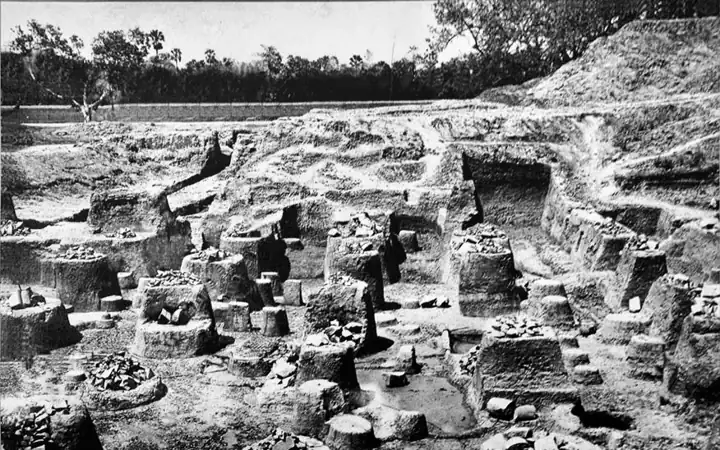
| Pataliputra | A huge city with a wooden wall, 570 towers and 64 gates |
| City government | Thirty officials in six boards of five, looking after crafts, foreigners, births and deaths, trade, goods and taxes |
| Society | Seven 'castes' (really occupational groups): philosophers, farmers, herders, artisans, soldiers, overseers and councillors |
| Mistakes | He claimed there was no slavery and no writing in India, and repeated fables of gold-digging ants. |
- Start with the earliest: Megasthenes, the Greek envoy sent by Seleucus Nicator to the court of Chandragupta Maurya at Pataliputra (about 300 BCE).
Megasthenes and the Indica
Foreign visitors saw India with fresh eyes. They noticed things Indian writers took for granted, but they also misunderstood a lot. Start with the earliest: Megasthenes, the Greek envoy sent by Seleucus Nicator to the court of Chandragupta Maurya at Pataliputra (about 300 BCE).
| Topic | What Megasthenes said |
|---|---|
| His book | Indica. It is lost; we know it only from quotations in later Greek and Roman writers such as Strabo, Arrian and Diodorus |
| Pataliputra | A huge city with a wooden wall, 570 towers and 64 gates |
| City government | Thirty officials in six boards of five, looking after crafts, foreigners, births and deaths, trade, goods and taxes |
| Society | Seven ‘castes’ (really occupational groups): philosophers, farmers, herders, artisans, soldiers, overseers and councillors |
| Mistakes | He claimed there was no slavery and no writing in India, and repeated fables of gold-digging ants |
UPSC lens: compare his seven groups with the four varnas, and his city boards with Kautilya’s Arthashastra. Deimachus, sent to Bindusara, was another Greek envoy.
Fa-hien (Faxian)
Fa-hien was a Chinese Buddhist monk who came looking for texts on monastic discipline (Vinaya). Prelims 2025 asked: ‘Fa-hien (Faxian), the Chinese pilgrim, travelled to India during the reign of Prelims 2025 ‘ which king? The answer is Chandragupta II. He was in India from about 399 to 414 CE, though he never names the king.
Fa-hien (Faxian), the Chinese pilgrim, travelled to India during the reign of
- Samudragupta
- Chandragupta II
- Kumaragupta I
- Skandagupta
Show answer
Answer: (b) · UPSC official key
| Topic | What Fa-hien said |
|---|---|
| Route | Overland through Central Asia; went home by sea via Sri Lanka |
| Book | Fo-kuo-ki, ‘A Record of Buddhist Kingdoms’ |
| Government | Mild: few punishments, mostly fines; people free to move |
| Society | People avoided meat, onions, garlic and liquor; chandalas lived outside towns and struck a piece of wood to warn others they were coming |
| Pataliputra | Spent three years learning Sanskrit there; describes free hospitals run by rich families |
UPSC lens: Fa-hien’s ‘peaceful, prosperous Madhyadesha’ supports the Gupta ‘golden age’ picture. His note on chandalas is early evidence of untouchability.
Mains box: analysis and answer points
- UPSC lens: compare his seven groups with the four varnas, and his city boards with Kautilya's Arthashastra.
- Likely next angle: India–Greece links
Practice
Write an answer
In 150 words, explain the significance of Foreign Travellers with one recent example.
Flashcards (10)
Who sent Megasthenes?
Seleucus Nicator.
Megasthenes' book?
Indica.
How many classes did Megasthenes list?
Seven.
Pataliputra's city boards?
Six boards of five members.
Greek envoy to Bindusara?
Deimachus.
Fa-hien came under which king?
Chandragupta II.
Fa-hien's book?
Fo-kuo-ki.
Why did Fa-hien come?
For texts on monastic discipline (Vinaya).
Fa-hien's route home?
By sea via Sri Lanka.
How did chandalas warn of their approach?
By striking a piece of wood.
In the news
- 20 Oct 2026Sirpur in Chhattisgarh enters UNESCO’s Tentative List of World Heritage sites
- 15 Oct 2026PM inaugurates five Ladakh projects: Nimmu–Padum–Darcha road, Leh terminal, Hanu hydro
- 14 Oct 2026HAL, NCF and ASI sign MoA for Hampi, Taj Mahal and Bekal Fort
- 11 Oct 2026Birth anniversaries: Jayaprakash Narayan and Nanaji Deshmukh
 Next topic · 17.2 →Foreign Travellers: Hiuen Tsang and I-tsing
Syllabus: Prelims GS-I · History of India and Indian National Movement.