
Chapter 16 · Topic 16.3 · Prelims + Mains3 of 3
Ancient Indian Art & Architecture: The whole chapter
Key points
- Ajanta: about 30 Buddhist caves; second phase under the Vakataka king Harishena; tempera, not true fresco.
- Ellora: 34 Buddhist, Hindu and Jain caves; Kailasa (Cave 16) under Krishna I.
- Murals (Prelims 2013): Ajanta and Lepakshi, not Sanchi.
- UNESCO: Ajanta, Ellora 1983; Mahabalipuram, Konark 1984; Sanchi 1989; Bodh Gaya 2002; Rani-ki-Vav 2014.
Prelims box: facts and traps
- Padmapani: Ajanta Cave 1.
- Maheshmurti: Elephanta.
- Sittanavasal: Jain lotus-pond paintings.
- Bagh: paintings close to Ajanta.
Ajanta, Ellora and early paintings
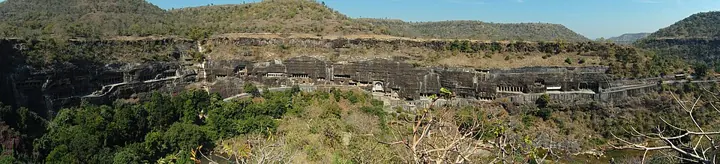
Ajanta (Maharashtra) has about 30 Buddhist caves cut into a horseshoe-shaped cliff. They date from the 2nd century BCE, and a second phase in the 5th century came under the Vakatakas, under King Harishena. The paintings show Jataka tales and court life. They were painted on dry plaster (tempera), not true fresco, which is painted on wet plaster.
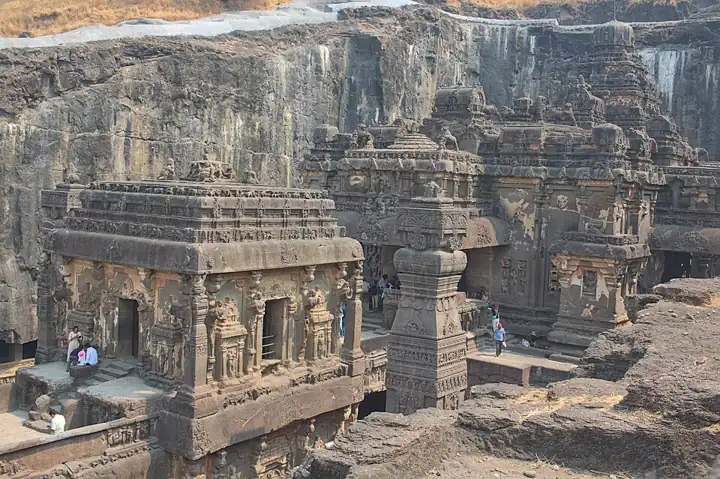
| Site | Key facts |
|---|---|
| Ajanta | Padmapani Bodhisattva (Cave 1); Mahaparinirvana (Cave 26); paintings and sculpture |
| Ellora | 34 caves: Buddhist, Hindu and Jain; Kailasa temple (Cave 16), cut from one rock under the Rashtrakuta king Krishna I |
| Elephanta (near Mumbai) | Shiva caves; the three-headed Maheshmurti |
| Bagh (Madhya Pradesh) | Buddhist caves with paintings close to Ajanta in style |
| Sittanavasal (Tamil Nadu) | Jain cave with paintings of a lotus pond |
Prelims 2013 asked which places are ‘also known for mural paintings ‘: Ajanta and Lepakshi (Vijayanagara period). Sanchi is famous for sculpture, not murals (wall paintings).
Consider the following historical places : 1. Ajanta Caves 2. Lepakshi Temple 3. Sanchi Stupa Which of the above places is/are also known for mural paintings?
- 1 only
- 1 and 2 only
- 1, 2 and 3
- None
Show answer
Answer: (b) · UPSC official key
What UPSC asks
Prelims: Ajanta, Ellora, Elephanta, Bagh, Sittanavasal. Mains: painting traditions. Next likely: mural conservation.
UNESCO World Heritage Sites
Prelims often asks which monuments are World Heritage Sites, or pairs a site with its state. Learn the ancient and early-medieval ones with their years.
| Site | State | Year inscribed |
|---|---|---|
| Ajanta Caves; Ellora Caves | Maharashtra | 1983 |
| Group of Monuments at Mahabalipuram | Tamil Nadu | 1984 |
| Sun Temple, Konark | Odisha | 1984 |
| Khajuraho Group of Monuments | Madhya Pradesh | 1986 |
| Elephanta Caves; Pattadakal | Maharashtra; Karnataka | 1987 |
| Great Living Chola Temples | Tamil Nadu | 1987, extended 2004 |
| Buddhist Monuments at Sanchi | Madhya Pradesh | 1989 |
| Mahabodhi Temple, Bodh Gaya | Bihar | 2002 |
| Rani-ki-Vav, Patan | Gujarat | 2014 |
| Nalanda Mahavihara | Bihar | 2016 |
| Sacred Ensembles of the Hoysalas | Karnataka | 2023 |
What UPSC asks
Prelims: sites, states and years. Mains: heritage management. Link these sites to current affairs: new inscriptions, India’s tentative list, and conservation by the Archaeological Survey of India (ASI).
Mains box: analysis and answer points
- Painting traditions: Ajanta to Bagh and Sittanavasal.
- Heritage management: ASI conservation, tentative list.
Practice
Practice MCQs (8)
After centuries of oblivion, the Ajanta caves were brought to the notice of the modern world in 1819 by
Answer (c) & explanation
The ASI and UNESCO records say that the Ajanta caves, in a horseshoe-shaped scarp above the Waghora river, were 'discovered' in 1819. The officer was John Smith of the Madras cavalry, who came upon them while hunting a tiger and scratched his name and the date, 28 April 1819, on a pillar painting in Cave 10. Later, Robert Gill spent years making copies of the Ajanta paintings for the East India Company.
The Buddhist cave groups known as Uparkot, Baba Pyara and Khapra Kodia are located at
Answer (a) & explanation
The ASI's Vadodara Circle protects the Buddhist cave groups of Junagadh in Gujarat: the Uparkot caves inside the old fort, the Baba Pyara caves and the Khapra Kodia caves. Carved in the early historic period, they include chaitya and vihara elements and carved pillars. Junagadh is also the site of the Girnar rock with Ashoka's edicts and Rudradaman's inscription.
Arrange the following rock-cut monuments in the chronological order of their excavation, from the earliest to the latest:
1. Kailasa temple (Cave 16), Ellora
2. Lomas Rishi cave, Barabar hills
3. Chaitya Cave 26, Ajanta
4. Chaitya hall, Bhaja
Select the correct answer using the code given below.
Answer (b) & explanation
The Lomas Rishi cave belongs to the Mauryan period (third century BCE). The Bhaja chaitya is one of the earliest chaitya halls of western India (about second century BCE). Ajanta's chaitya Cave 26 belongs to the later phase of the late fifth century CE, when Buddhabhadra was its donor. The Kailasa temple at Ellora was carved under the Rashtrakutas in the eighth century CE. So the order is 2-4-3-1.
With reference to the architecture of the Ajanta caves, consider the following statements:
1. Its chaitya caves include Cave Nos. 9 and 10 of the earlier phase and Cave Nos. 19 and 26 of the later phase.
2. All its excavations belong to a single phase of patronage under the Vakatakas.
3. The vihara caves of the later phase usually have the main Buddha shrine in the back wall of the pillared hall.
Which of the statements given above are correct?
Answer (a) & explanation
NCERT says Ajanta has four chaitya caves: Cave Nos. 10 and 9 of the earlier phase (second and first centuries BCE) and Cave Nos. 19 and 26 of the later phase (fifth century CE), the later ones with facades carved with Buddha and Bodhisattva images. The ASI notes a break of nearly four centuries between the two phases, the later one under the Vakatakas. The later caves are vihara-chaityas: a pillared veranda, a pillared hall, cells along the walls and the main Buddha shrine in the back wall.
The only chaitya hall among the Buddhist caves of Ellora, whose vaulted ceiling is carved to imitate timber ribs and which is popularly called the 'carpenter's cave', is
Answer (c) & explanation
Ellora's twelve Buddhist caves are mostly viharas; Cave 10, known as Vishvakarma or Sutar-ki-jhopdi ('carpenter's hut'), is the only chaitya hall. Its ceiling is carved with stone ribs imitating wooden beams, and a large seated Buddha sits in front of the stupa. NCERT illustrates the 'seated Buddha, chaitya hall, Cave No. 10'. Cave 12, Teen Tal, is a three- storeyed vihara, which NCERT calls a unique achievement of Ellora.
With reference to the Archaeological Site of Nalanda Mahavihara, consider the following statements:
1. It was inscribed on the UNESCO World Heritage List in 2016.
2. Its excavated remains show a row of monasteries (viharas) on the east and a row of temples (chaityas) on the west.
3. Its monasteries and temples were built mainly of dressed stone.
Which of the statements given above are correct?
Answer (d) & explanation
Nalanda Mahavihara in Bihar was inscribed by UNESCO in 2016. The excavated site, spanning the fifth to thirteenth centuries CE, has a planned layout with a row of viharas on the east and a row of temples and stupas, such as the great Sariputra stupa (Site 3), on the west. The structures are built mainly of brick, with stone and stucco sculpture and bronze images found inside.
Consider the following pairs: Cave at Ellora : Popular name
1. Cave 12 : Teen Tal
2. Cave 15 : Dashavatara
3. Cave 29 : Dhumar Lena
4. Cave 21 : Indra Sabha
How many of the pairs given above are correctly matched?
Answer (c) & explanation
At Ellora, Cave 12 (Teen Tal) is the three-storeyed Buddhist monastery with Vajrayana images; Cave 15 (Dashavatara) is a two-storeyed Brahmanical cave with Vishnu's incarnations and the Gajasura-Shiva panel; and Cave 29 (Dhumar Lena) is a large Shaiva cave whose plan NCERT likens to the main cave at Elephanta. Cave 21 is the Rameshwar cave; Indra Sabha is Cave 32, the finest of the Jain group. So three pairs are correct.
An inscription at Ajanta records that a cave-dwelling with a Buddhist shrine, a fine hall, pillars and picture-galleries was excavated and given to the Sangha by a minister of the Vakataka king Harishena, for the merit of his parents. The cave is Cave No. 16, and the minister was
Answer (b) & explanation
The inscription in Cave 16, edited by V.V. Mirashi, gives the Vakataka genealogy down to Harishena (c. 475-500 CE) and records that his minister Varahadeva, son of the minister Hastibhoja, excavated the cave and dedicated it to the Buddhist Sangha. NCERT lists Ajanta's patrons as Varahadeva (Cave 16), Upendragupta, the local king and Vakataka feudatory (Caves 17-20), Buddhabhadra (Cave 26) and Mathuradasa (Cave 4).
0 / 0 correct
Write an answer
In 150 words, explain the significance of Ancient Indian Art & Architecture with one recent example.
Flashcards (6)
Patron of later Ajanta caves?
Vakataka king Harishena.
Who built the Kailasa temple?
Rashtrakuta Krishna I.
Maheshmurti is at?
Elephanta.
Jain cave paintings in Tamil Nadu?
Sittanavasal.
Year Ajanta and Ellora were inscribed?
1983.
Hoysala temples inscribed?
2023.
Read more: related explainers
In the news
- 20 Oct 2026Sirpur in Chhattisgarh enters UNESCO’s Tentative List of World Heritage sites
- 15 Oct 2026PM inaugurates five Ladakh projects: Nimmu–Padum–Darcha road, Leh terminal, Hanu hydro
- 14 Oct 2026HAL, NCF and ASI sign MoA for Hampi, Taj Mahal and Bekal Fort
- 11 Oct 2026Birth anniversaries: Jayaprakash Narayan and Nanaji Deshmukh
 Next chapter · 17. Foreign Travellers →Foreign Travellers: Megasthenes and Fa-hien
Syllabus: Prelims GS-I · History of India and Indian National Movement.