
Chapter 2 · Topic 2.1 · Prelims + Mains1 of 2
Prehistoric India: Palaeolithic and Mesolithic
Key points
- Prehistory is the time before writing; we know it only from tools, bones, hearths and rock art.
- Palaeolithic tools got smaller over time: hand axes, then flakes, then blades. Attirampakkam tools are about 1.5 million years old.
- Mesolithic: microliths (tiny tools), first herding at Bagor and Adamgarh, first planned burials in the Ganga plain, Bhimbetka paintings.
Prelims box: facts and traps
- Pallavaram (1863): Robert Bruce Foote found India's first identified Palaeolithic tool.
- Hathnora (1982): skull cap in the Narmada valley, India's only early human fossil.
- Bhimbetka: over 700 shelters; found by V. S. Wakankar in 1957; UNESCO site in 2003.
- Trap: Bagor (Rajasthan) and Adamgarh (Madhya Pradesh) give the earliest domestication, not Mehrgarh, which is Neolithic.
- Colours: red from haematite (geru), white from limestone.
The Old Stone Age (Palaeolithic)
Prehistory is the long period before writing. Everything we know about it comes from archaeology (the study of things left behind): stone tools, bones, hearths (fireplaces), rock paintings and, later, pots and houses. Historians name each age after the main material used for tools: the Stone Age (Palaeolithic, Mesolithic, Neolithic), then the Chalcolithic, when copper came into use beside stone. (“Lithic” means stone; palaeo, meso, neo mean old, middle, new.) The dates below are rough and vary from region to region.
The Palaeolithic or Old Stone Age was the age of hunter-gatherers. With no farms, they moved with the seasons and lived near water and good stone. In 1863 Robert Bruce Foote found a hand axe at Pallavaram near Chennai, the first Palaeolithic tool identified in India. Tools from Attirampakkam in Tamil Nadu have been dated to about 1.5 million years ago, among the oldest in South Asia. The only early human fossil from India is a skull cap (the top of a skull) found at Hathnora in the Narmada valley (Madhya Pradesh) in 1982.
| Phase | Rough dates | Tools | Key sites |
|---|---|---|---|
| Lower Palaeolithic | About 1.5 million to 3 lakh years ago | Hand axes, cleavers, choppers (Acheulian) | Attirampakkam, Pallavaram (Tamil Nadu); Hunsgi–Isampur (Karnataka); Soan valley |
| Middle Palaeolithic | About 3 lakh to 40,000 years ago | Flake tools: scrapers, points, borers | Nevasa on the Pravara (Maharashtra); Narmada valley |
| Upper Palaeolithic | About 40,000 to 12,000 years ago | Blades and burins; bone tools | Belan valley (Uttar Pradesh); Bhimbetka; Kurnool caves |
Remember the pattern: tools got smaller and sharper over time, from heavy hand axes to flakes (thin chips struck off a stone) to thin blades. The Upper Palaeolithic matches the time when modern humans (Homo sapiens) spread across India, the last Ice Age ended and the first rock art appeared.
What UPSC asks
Prelims: site and tool pairs (Attirampakkam, Hathnora, Nevasa). Mains: why prehistory is known only from archaeology.
The Middle Stone Age (Mesolithic) and rock art
The Mesolithic (about 12,000 to 8,000 years ago, lasting much longer in some areas) came after the Ice Age. A warmer climate brought more grass, forests and animals. People still hunted, fished and gathered, but they began to stay longer in one place and, at a few sites, to herd animals.
The typical Mesolithic tool is the microlith: tiny stone blades, often under 5 cm, fixed into wood or bone handles to make arrows, spears and sickles. Bagor in Rajasthan, the largest Mesolithic site in India, and Adamgarh in Madhya Pradesh give the earliest evidence of animal domestication (taming animals for human use) in India. Sarai Nahar Rai, Mahadaha and Damdama in the Ganga plain (Uttar Pradesh) show the first planned burials: the dead were laid in graves with tools and ornaments.
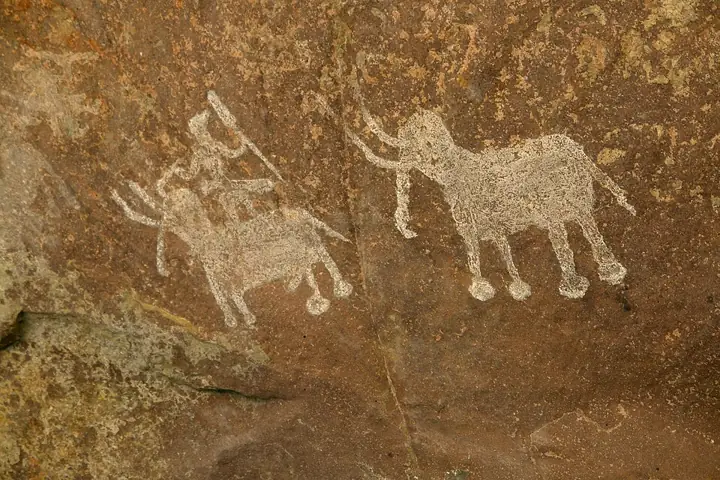
Rock paintings show us how these people thought. Bhimbetka, near Bhopal in Madhya Pradesh, has over 700 rock shelters. V. S. Wakankar discovered it in 1957, and it became a UNESCO World Heritage Site in 2003. The paintings run from the Upper Palaeolithic to the historical period, and most belong to the Mesolithic. They show hunting, dancing, honey collection, animals such as bison, deer, tigers and elephants, and, in later layers, riders and processions. Colours came from minerals: red from haematite (geru), white from limestone, green and yellow from other stones.
Mains 2015 asked candidates to critically evaluate this comment: Mesolithic rock-cut architecture of India not only reflects the cultural life of the times but also a fine aesthetic sense comparable to modern painting. The question really means the rock art of shelters such as Bhimbetka, Adamgarh and Lakhajoar. It shows daily life (hunting, gathering, dance, family scenes) and real skill: movement, X-ray style animals (bones and insides drawn as if seen through the skin) and balance. “Critically evaluate” means give both sides. Limits: figures are mostly stick-like, there is no depth (perspective), dating is uncertain, and “comparable to modern painting” is a modern judgement.
Mesolithic rock-cut architecture of India not only reflects the cultural life of the times but also a fine aesthetic sense comparable to modern painting. Critically evaluate this comment.
What UPSC asks
Prelims: microliths; Bagor and Adamgarh; Bhimbetka facts. Mains: rock art as culture and art (2015).
Mains box: analysis and answer points
- Value of rock art: hunting, dance, honey collection and family scenes; X-ray style animals; balance and movement.
- Limits: stick figures, no perspective, uncertain dates; "modern" is a modern judgement.
- Asked: Mains 2015 (GS Paper I, 12.5 marks): Mesolithic rock-cut architecture of India not only reflects the cultural life of the times but also a fine aesthetic sense comparable to modern painting. Critically evaluate this comment.
Practice
Write an answer
In 150 words, explain the significance of Prehistoric India with one recent example.
Flashcards (10)
Who found the first Palaeolithic tool in India,
and where? Robert Bruce Foote, Pallavaram near Chennai, 1863.
Which site has tools about 1.5 million years
old? Attirampakkam, Tamil Nadu.
Where was India's only early human fossil
found? Hathnora, Narmada valley, Madhya Pradesh.
Typical tools of the Lower Palaeolithic?
Hand axes, cleavers and choppers.
Typical tools of the Upper Palaeolithic?
Blades and burins.
What is a microlith?
A tiny stone blade set in a handle.
Which sites give India's earliest evidence of
animal domestication? Bagor (Rajasthan) and Adamgarh (Madhya Pradesh).
Who discovered Bhimbetka, and when?
V. S. Wakankar, 1957.
When did Bhimbetka become a World
Heritage Site? 2003.
Where did the red in rock paintings come
from? Haematite (geru).
In the news
- 20 Oct 2026Sirpur in Chhattisgarh enters UNESCO’s Tentative List of World Heritage sites
- 15 Oct 2026PM inaugurates five Ladakh projects: Nimmu–Padum–Darcha road, Leh terminal, Hanu hydro
- 14 Oct 2026HAL, NCF and ASI sign MoA for Hampi, Taj Mahal and Bekal Fort
- 11 Oct 2026Birth anniversaries: Jayaprakash Narayan and Nanaji Deshmukh
 Next topic · 2.2 →Prehistoric India: Neolithic, Chalcolithic and megalithic
Syllabus: Prelims GS-I · History of India and Indian National Movement.