
Chapter 11 · Topic 11.3 · Prelims + Mains3 of 3
The Gupta Empire: The whole chapter
Key points
- Science: Aryabhata, Varahamihira, Brahmagupta; Iron Pillar. Literature: Kalidasa, Shudraka,
- Art: Sanchi 17, Bhitargaon, Deogarh (Nagara shikhara, 2026); Sarnath and Mathura Buddhas;
1 PYQ 2010–2019
Prelims box: facts and traps
| Scholar | Work |
|---|---|
| Aryabhata | Aryabhatiya (499 CE) |
| Varahamihira | Pancha Siddhantika, Brihat Samhita |
| Brahmagupta | Brahmasphutasiddhanta (628 CE) |
| Palakapya | Hastyayurveda |
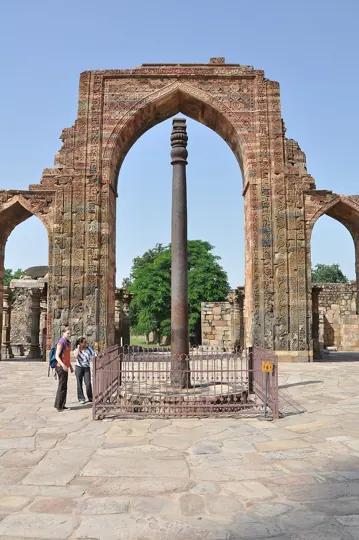
| Metalworkers | Iron Pillar, Mehrauli. |
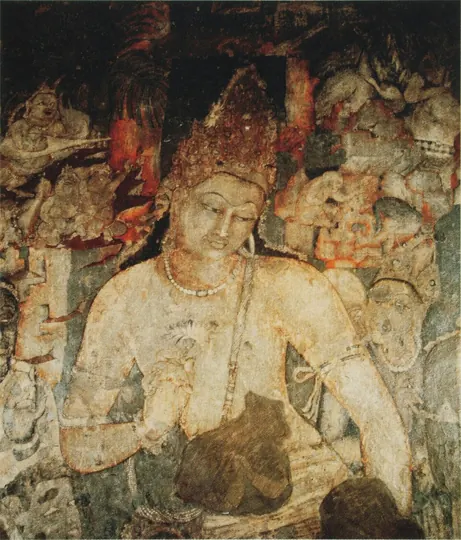
- In painting, the finest Ajanta murals, in Caves 1, 2, 16 and 17, belong to the late 5th century under the Vakataka king Harishena, a Gupta ally; the Bagh caves in Madhya Pradesh are similar.
- Trap (UPSC Prelims 2026): “Malegitti Shivalaya, Badami” is incorrect. “Virupaksha Temple, Pattadakal” is incorrect.
Science, mathematics and literature
The Gupta age saw great advances in mathematics and astronomy. Aryabhata wrote the Aryabhatiya in 499 CE. He used the place-value system, gave pi as about 3.1416, said that the earth rotates on its axis, and explained eclipses as caused by the shadows of the earth and the moon. Varahamihira (6th century) wrote the Pancha Siddhantika, a summary of five astronomical systems, and the Brihat Samhita, an encyclopaedia of astronomy, weather, plants and omens. Brahmagupta, a little later (7th century), gave rules for working with zero.
| Scholar | Work | Field |
|---|---|---|
| Aryabhata | Aryabhatiya (499 CE) | Mathematics, astronomy |
| Varahamihira | Pancha Siddhantika, Brihat Samhita | Astronomy, encyclopaedia |
| Brahmagupta | Brahmasphutasiddhanta (628 CE) | Mathematics; rules for zero |
| Palakapya | Hastyayurveda | Veterinary medicine for elephants |
| Metalworkers | Iron Pillar, Mehrauli | Rust-resistant wrought iron, still standing |
Sanskrit literature reached its classical peak. Kalidasa wrote the plays Abhijnanashakuntalam, Malavikagnimitram and Vikramorvashiyam and the poems Meghaduta, Raghuvamsha and Kumarasambhava. Shudraka wrote the Mrichchhakatika, Vishakhadatta the Mudrarakshasa and Devichandragupta, and Amarasimha compiled the Amarakosha, a Sanskrit thesaurus. The Panchatantra fables also belong to this broad period. In the plays, kings and Brahmanas speak Sanskrit, while women and common people speak Prakrit.
Gupta art, temples and coins
The Guptas mark the beginning of the structural Hindu temple. Early temples were small, flat-roofed shrines with a porch, such as Temple 17 at Sanchi and the temple at Tigawa. Later ones added a tower (shikhara): the brick temple at Bhitargaon and the stone Dashavatara temple at Deogarh, with its panel of Vishnu lying on the serpent Ananta.
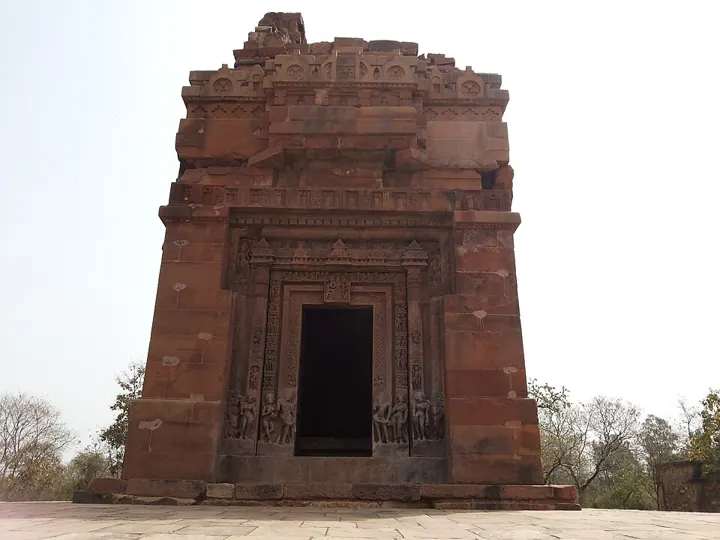
Prelims 2026 asked: Which of the following temples has/ have a Nagara-style shikhara? The options were Malegitti Shivalaya at Badami, Huchimalligudi at Aihole, the Dashavatara Temple at Deogarh and Virupaksha at Pattadakal. Deogarh and Huchimalligudi have early Nagara shikharas; Malegitti and Virupaksha are Dravida. The answer was (b), 2 and 3.
Which of the following temples has/have a Nagara-style shikhara ? 1. Malegitti Shivalaya, Badami 2. Huchimalligudi Temple, Aihole 3. Dashavatara Temple, Deogarh 4. Virupaksha Temple, Pattadakal Select the answer using the code given below :
- 1 and 2
- 2 and 3
- 3 only
- 3 and 4
Show answer
Answer: (b) · UPSC provisional key (final key awaited)
Sculpture reached a calm, inward balance. The Sarnath school made Buddhas in cream Chunar sandstone with thin, clinging robes; Mathura made standing Buddhas in red sandstone; rock-cut panels at Udayagiri show Vishnu as Varaha. In painting, the finest Ajanta murals, in Caves 1, 2, 16 and 17, belong to the late 5th century under the Vakataka king Harishena, a Gupta ally; the Bagh caves in Madhya Pradesh are similar.
Gupta coins are works of art too, which is why Mains 2017 asked: How do you justify the view that the level of excellence of the Gupta numismatic art is not at all noticeable in later times? Gupta gold coins show the king as archer, lyrist, horseman or lion-slayer, with goddesses such as Lakshmi on the back and Sanskrit verse legends. After the Guptas, trade fell, land grants replaced cash, and gold coins became rare and crude for centuries.
How do you justify the view that the level of excellence of the Gupta numismatic art is not at all noticeable in later times?
A broad Mains question (2022) said: “Discuss the main contributions of Gupta period and Chola period to Indian heritage and culture.” For the Guptas, list the temple form, classical sculpture, Ajanta, Sanskrit literature, mathematics and astronomy, and coinage; the Chola side comes in a later chapter.
Discuss the main contributions of Gupta period and Chola period to Indian heritage and culture.
Mains box: analysis and answer points
- The Gupta age saw great advances in mathematics and astronomy.
- Varahamihira (6th century) wrote the Pancha Siddhantika, a summary of five astronomical systems, and the Brihat Samhita, an encyclopaedia of astronomy, weather, plants and omens.
- Brahmagupta, a little later (7th century), gave rules for working with zero.
- Likely next angle: Aryabhata satellite; Iron Pillar's metallurgy
- Asked: Mains 2017 (GS Paper I, 10 marks): How do you justify the view that the level of excellence of the Gupta numismatic art is not at all noticeable in later times?
Practice
Practice MCQs (8)
In the eulogy composed by his court poet, which Gupta ruler is praised as 'kaviraja', a king among poets, whose many compositions were worthy of being studied by learned men?
Answer (d) & explanation
The Prayaga prashasti describes Samudragupta as a ruler of sharp intellect who earned the title kaviraja ('king of poets') through many poetical works, and who put to shame even the preceptor of the gods by his learning. NCERT's Our Pasts I quotes the prashasti's praise of him as a poet and a lover of learning, alongside his military feats.
Gupta records give the title 'maharaja' to Sri Gupta and Ghatotkacha. The first ruler of the family to assume the higher title 'maharajadhiraja' was
Answer (c) & explanation
In the Gupta genealogies the founder Sri Gupta and his son Ghatotkacha are styled only 'maharaja', a title that could be held by a subordinate chief. Chandragupta I (c. 319- 335 CE) was the first to call himself maharajadhiraja, 'great king of kings'. His reign marks the real rise of the family, and the Gupta era of 319-20 CE is generally linked with his accession.
With reference to Varahamihira, consider the following statements:
1. His Pancha-siddhantika summarises five astronomical systems, including the Romaka and Paulisha siddhantas.
2. His Brihat Samhita is an encyclopaedic work covering astrology, omens, architecture, gems and other subjects.
3. He is the author of the Aryabhatiya.
4. He lived at the court of Harshavardhana at Kanauj.
How many of the statements given above are correct?
Answer (b) & explanation
Varahamihira (died c. 587 CE) belonged to the Ujjayini region. His Pancha- siddhantika summarises five siddhantas, among them the Romaka and Paulisha, which show the influence of Greek and Roman astronomy. His Brihat Samhita is an encyclopaedia of astrology, omens, weather, architecture, iconography, gems and much else. The Aryabhatiya is Aryabhata's work, and Varahamihira lived before Harsha, whose reign began in 606 CE. Only two statements are correct.
With reference to language and literature in the Gupta age, consider the following statements:
1. Unlike the Prakrit inscriptions of Ashoka, Gupta royal inscriptions are composed in Sanskrit.
2. The Ramayana and the Mahabharata were almost completed by about the fourth century CE.
3. Several Puranas were compiled or recast in this period.
Which of the statements given above are correct?
Answer (d) & explanation
From the Gupta period Sanskrit became the language of royal inscriptions and of the court, replacing the Prakrit used by Ashoka and most earlier rulers. R.S. Sharma notes that the two epics were almost completed by the fourth century, and that the Puranas, which recount myths and dynastic lists in the style of the epics, were compiled or given their final form in Gupta times. All three statements are correct.
Consider the following works:
1. Ritusamhara
2. Meghaduta
3. Kiratarjuniya
4. Mrichchhakatika
How many of the above were written by Kalidasa?
Answer (b) & explanation
Kalidasa's accepted works are three plays (Abhijnanashakuntalam, Vikramorvashiyam, Malavikagnimitram), two epics (Raghuvamsha, Kumarasambhava) and two shorter poems, the Meghaduta and the Ritusamhara (a poem on the six seasons). The Kiratarjuniya, an epic on Arjuna's fight with Shiva in the guise of a hunter, is by Bharavi (sixth century), and the Mrichchhakatika is a play attributed to Shudraka. So only two of the four are Kalidasa's.
With reference to the relations between the Guptas and the Vakatakas, consider the following statements:
1. Chandragupta II's daughter Prabhavatigupta was married to the Vakataka king Rudrasena II.
2. After the death of her husband, Prabhavatigupta governed the Vakataka kingdom as regent for her minor sons.
3. On Rudrasena II's death, the Vakataka kingdom was annexed to the Gupta empire.
Which of the statements given above is/are correct?
Answer (a) & explanation
Chandragupta II married his daughter Prabhavatigupta to the Vakataka ruler Rudrasena II of the Deccan. When Rudrasena II died young, she ruled as regent for her minor sons, and her copper plates (such as the Poona plates) proudly give her Gupta descent. R.S. Sharma explains that this gave Chandragupta II indirect influence over the Vakataka kingdom, which helped his campaign against the Shakas. The kingdom stayed under its own dynasty and was never annexed.
Consider the following pairs of rulers of Dakshinapatha named in Samudragupta's Prayaga prashasti and their kingdoms:
1. Mahendra : Kosala
2. Vyaghraraja : Mahakantara
3. Hastivarman : Vengi
4. Svamidatta : Kanchi
How many of the pairs given above are correctly matched?
Answer (c) & explanation
The prashasti lists twelve southern rulers by name and kingdom. Mahendra of Kosala (Dakshina Kosala, the Chhattisgarh region) and Vyaghraraja of Mahakantara (a forest tract of central India) come first. Hastivarman of Vengi ruled the Krishna-Godavari delta. Kanchi, however, was ruled by Vishnugopa, while Svamidatta was the ruler of Kottura. So pairs 1, 2 and 3 are correct and pair 4 is wrong.
Consider the following statements about works of the Gupta and immediately post-Gupta periods:
1. The Pancha-siddhantika was written by Varahamihira.
2. The Amarakosha was compiled by Amarasimha.
3. The Brahmasphuta-siddhanta was written by Aryabhata.
4. The Nitisara on statecraft was written by Kamandaka.
How many of the statements given above are correct?
Answer (c) & explanation
The Pancha-siddhantika of Varahamihira (sixth century) summarises five earlier astronomical systems. The Amarakosha, the standard Sanskrit thesaurus, is by Amarasimha, whom tradition places at the court of a Vikramaditya. The Nitisara on polity is attributed to Kamandaka and draws on the Arthashastra. But the Brahmasphuta-siddhanta (628 CE) was written by Brahmagupta at Bhillamala in Rajasthan, not by Aryabhata. Three statements are correct.
0 / 0 correct
Prelims PYQs on this topic (1)
With reference to forced labour (Vishti) in India during the Gupta period, which one of the following statements is correct?
Answer (a) & explanation
Option (a) is correct. Vishti was forced, unpaid labour that the king, or the holder of a land grant, could demand from villagers. It was treated as a tax paid in labour instead of money or crops, and therefore as a source of income for the state. Option (b) is wrong because Gupta-period inscriptions from central India and the Valabhi grants in Kathiawar mention vishti. Option (c) is wrong because there is no record of weekly wages; by definition it was unpaid. Option (d) is wrong because no source says the eldest son was sent.
Notice the related trend of land grants (agrahara) to Brahmins and temples, which often passed on the right to vishti. Historians link this to the rise of Indian feudalism, an idea argued by R.S. Sharma.
Answer as per the official UPSC answer key.
Write an answer
In 150 words, explain the significance of The Gupta Empire with one recent example.
Flashcards (6)
Aryabhatiya was written in?
499 CE.
Who wrote the Brihat Samhita?
Varahamihira.
Who compiled the Amarakosha?
Amarasimha.
Who wrote the Mrichchhakatika?
Shudraka.
Gupta temple with Vishnu on Ananta?
Dashavatara temple, Deogarh.
Under whom were Ajanta Caves 16 and 17
made? The Vakataka king Harishena.
Read more: related explainers
In the news
- 20 Oct 2026Sirpur in Chhattisgarh enters UNESCO’s Tentative List of World Heritage sites
- 15 Oct 2026PM inaugurates five Ladakh projects: Nimmu–Padum–Darcha road, Leh terminal, Hanu hydro
- 14 Oct 2026HAL, NCF and ASI sign MoA for Hampi, Taj Mahal and Bekal Fort
- 11 Oct 2026Birth anniversaries: Jayaprakash Narayan and Nanaji Deshmukh
 Next chapter · 12. Harshavardhana and His Age →Harshavardhana and His Age: Rise and administration
Syllabus: Prelims GS-I · History of India and Indian National Movement.