
Chapter 9 · Topic 9.1 · Prelims + Mains1 of 3
The Post-Mauryan Period: Shungas, Indo-Greeks, Shakas and Kushanas
Key points
- Pushyamitra Shunga ended the Mauryas in about 185 BCE; Patanjali (not Panini) is linked to him (Prelims 2020).
- Indo-Greeks (Menander, Milindapanha with Nagasena), Shakas (Rudradaman's Sanskrit Junagadh inscription) and Parthians (Gondophares) ruled the north-west.
- Kushanas: Vima's gold coins; Kanishka from 78 CE (Saka era), fourth Buddhist council, Mahayana.
Prelims box: facts and traps
- Heliodorus pillar: Besnagar, envoy of Antialcidas, honours Vasudeva.
- Trap (Prelims 2023): the Milindapanha is not by Nagarjuna.
- Chaitra 1: 22 March (21 March in a leap year) (Prelims 2014).
- Eras: Vikrama 57 BCE; Saka 78 CE.
- Kharavela: Jain king of Kalinga; Hathigumpha inscription.
On this page (3 sections)
After the Mauryas: Shungas, Kanvas and Kharavela
Around 185 BCE, Pushyamitra Shunga, the army commander, killed the last Mauryan king Brihadratha and founded the Shunga dynasty. The empire broke up. The Shungas held Magadha and central India, foreign rulers came in from the north-west, and new kingdoms rose in the Deccan and Kalinga. Think of these five centuries as a time when the political map was in pieces, but trade, crafts, art and religion grew fast.
Pushyamitra performed Vedic sacrifices, including the ashvamedha (horse sacrifice). Buddhist texts call him an enemy of Buddhism, but historians are careful here, because the Bharhut and Sanchi stupas were enlarged in Shunga times. His son Agnimitra is the hero of Kalidasa’s play Malavikagnimitram. The grammarian Patanjali, author of the Mahabhashya (a big commentary on grammar), is placed in Pushyamitra’s time.
UPSC tests these scholar-king links. Prelims 2020 gave the statement “Panini is associated with Pushyamitra Shunga.” It is wrong: Panini, author of the Ashtadhyayi, lived centuries earlier; Patanjali is the one linked to Pushyamitra. Only “Kalidasa is associated with Chandra Gupta — II” was correct, so the answer was (c).
With reference to the scholars/litterateurs of ancient India, consider the following statements : 1. Panini is associated with Pushyamitra Shunga. 2. Amarasimha is associated with Harshavardhana. 3. Kalidasa is associated with Chandra Gupta — II. Which of the statements given above is/are correct ?
- 1 and 2 only
- 2 and 3 only
- 3 only
- 1, 2 and 3
Show answer
Answer: (c) · UPSC official key
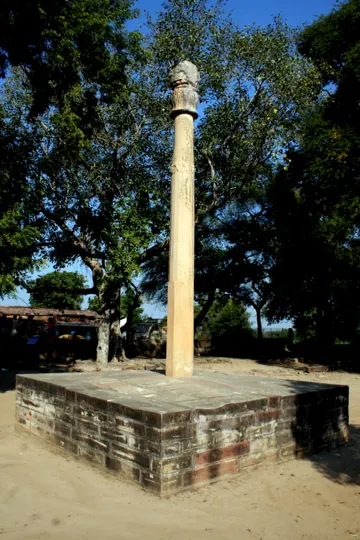
At Besnagar near Vidisha, Heliodorus, a Greek envoy of the Indo-Greek king Antialcidas of Taxila, set up a Garuda pillar in honour of Vasudeva (Krishna) at the court of King Bhagabhadra (late 2nd century BCE). It is early proof of the Bhagavata cult (worship of Vishnu-Krishna), and of a Greek taking up an Indian faith. The Kanvas replaced the Shungas around 73 BCE and were swept away by the Satavahanas.
| Kingdom | Region | Remember |
|---|---|---|
| Shungas (c. 185–73 BCE) | Magadha, central India | Pushyamitra, ashvamedha, Patanjali, Bharhut |
| Kanvas (c. 73–28 BCE) | Magadha | Vasudeva Kanva; ended by the Satavahanas |
| Chedis of Kalinga | Odisha | Kharavela, a Jain king; Hathigumpha inscription at Udayagiri near Bhubaneswar |
What UPSC asks
Prelims: Patanjali versus Panini (2020); Heliodorus pillar; Kharavela. Mains: political breakup versus cultural growth. Next likely: the Besnagar pillar and Bhagavata heritage.
Indo-Greeks, Shakas and Parthians
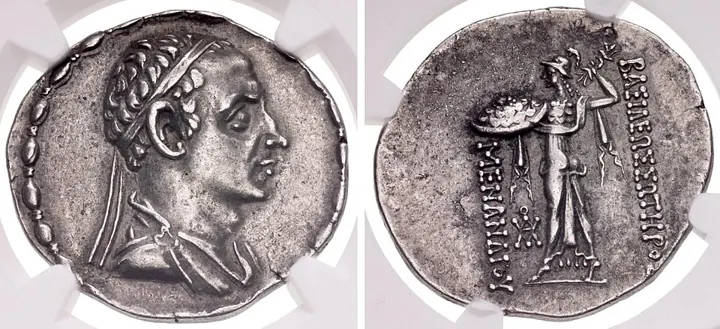
Greek rulers of Bactria (northern Afghanistan) broke away from the Seleucids and, from about 190 BCE, crossed the Hindu Kush into north-west India. The best-known Indo-Greek king is Menander (about 165–130 BCE), with his capital at Sakala (Sialkot). The Buddhist book Milindapanha (‘Questions of Milinda’) records his talks with the monk Nagasena, and tradition says he became a Buddhist.
Prelims 2023 asked how many literary work–author pairs were correctly matched, and one pair was “Milinda-panha Nagarjuna ”. That pair is wrong: the Milindapanha is a dialogue between Menander and Nagasena, not a work of Nagarjuna. The correct answer was (b), only two.
With reference to ancient Indian History, consider the following pairs : Literary work Author 1. Devichandragupta Bilhana 2. Hammira-Mahakavya Nayachandra Suri 3. Milinda-panha Nagarjuna 4. Nitivakyamrita Somadeva Suri How many of the above pairs are correctly matched?
- Only one
- Only two
- Only three
- All four
Show answer
Answer: (b) · UPSC official key
The Indo-Greeks issued fine silver and copper coins with the king’s face, name and title, often in Greek on one side and Kharoshthi Prakrit on the other. These are the first Indian coins that can be firmly linked to particular kings. Their Greek-style art fed into the Gandhara school.
The Shakas (Scythians) were herders from Central Asia, pushed south by another tribe, the Yuezhi. They set up several branches: at Taxila, at Mathura, and in western India and Malwa, where they ruled as Western Kshatrapas (governors who became kings). Nahapana (Kshaharata line) ruled Gujarat and the north Deccan until Gautamiputra Satakarni defeated him. Rudradaman I (Kardamaka line) left the Junagadh inscription (about 150 CE), the first long inscription in pure Sanskrit, recording repairs to the Sudarshana lake. The Vikrama era of 57 BCE is traditionally linked to a king of Ujjain who drove out the Shakas.
The Parthians (Pahlavas) came from Iran and ruled parts of the north-west in the 1st century CE. Their best-known king, Gondophares, appears in the Takht-i-Bahi inscription near Mardan, and Christian tradition says St Thomas visited his court.
What UPSC asks
Prelims: Milindapanha (2023); Rudradaman’s Sanskrit inscription; eras. Mains: foreign rulers and Indian culture. Next likely: Indo-Greek coins in museum news.
The Kushanas and Kanishka
The Kushanas were a branch of the Yuezhi, nomads from the borders of China. Kujula Kadphises united them and took Kabul and Gandhara. His successor Vima Kadphises issued plenty of gold coins, many showing Shiva with his bull Nandi. At its peak the empire ran from Central Asia and the Oxus to the Ganga plain, with Purushapura (Peshawar) as the main capital and Mathura as the second.
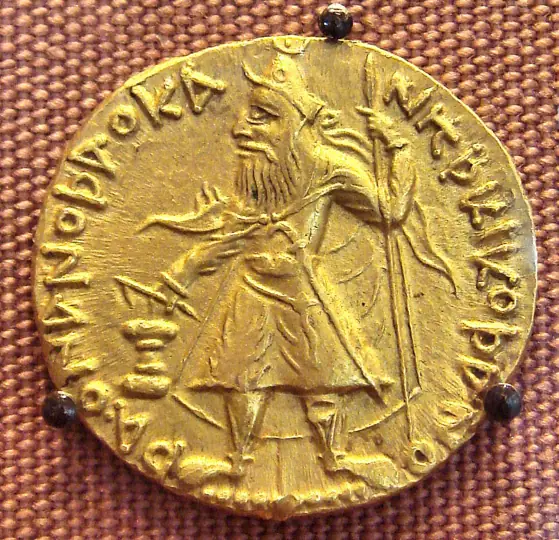
Kanishka is the greatest Kushana king. His reign is usually dated from 78 CE, the start of the Saka era. The Rabatak inscription, in the Bactrian language, lists his ancestors and the cities he held. Kanishka took grand titles such as maharaja, rajatiraja (‘king of kings’) and devaputra (‘son of god’). He supported Buddhism: the fourth Buddhist council met in Kashmir under Vasumitra, with Ashvaghosha as vice-president, and Mahayana Buddhism grew. His court is linked with Ashvaghosha (Buddhacharita), and tradition adds Nagarjuna and the doctor Charaka.
The Saka era lives on in today’s Indian national calendar, adopted in 1957. Prelims 2014 asked: Chaitra 1 of the national calendar based on the Saka Era corresponds to which date of the Gregorian calendar (the everyday January–December calendar) in a normal year of 365 days? The answer is 22nd March (21st March in a leap year), option (a).
Chaitra 1 of the national calendar based on the Saka Era corresponds to which one of the following dates of the Gregorian calendar in a normal year of 365 days?
- 22nd March (or 21st March)
- 15th May (or 16th May)
- 31st March (or 30th March)
- 21st April (or 20th April)
Show answer
Answer: (a) · UPSC official key
| Ruler | Remember |
|---|---|
| Kujula Kadphises | Founder; copper coins |
| Vima Kadphises | Large gold coins; Shiva on coins |
| Kanishka | 78 CE (Saka era); Rabatak inscription; fourth council; headless statue from Mat near Mathura |
| Huvishka, Vasudeva I | Later rulers; Kushana power fades in the 3rd century CE |
What UPSC asks
Prelims: the Saka era and the national calendar (2014); Rabatak; the fourth council. Mains: the Kushanas and the Silk Route. Next likely: national calendar debates.
Mains box: analysis and answer points
- Breakup but growth: political division alongside booming trade, coinage, art (Gandhara, Mathura) and Mahayana.
- Foreign rulers became Indian: Heliodorus, Menander, Rudradaman's Sanskrit, Kushana Shiva coins.
- Likely next angle: national calendar debates.
Practice
Practice MCQs (8)
According to the Hathigumpha inscription, when Kharavela in his eighth year sacked Gorathagiri and put pressure on Rajagriha, a Yavana king, alarmed by the noise of these deeds, withdrew with his demoralised army to
Answer (a) & explanation
The eighth-year entry of the Hathigumpha inscription describes Kharavela's raid into Magadha. He stormed Gorathagiri, a fortified hill in the Barabar range, and harassed Rajagriha. Hearing the report of these acts, the Yavana king, whose name has been read by some scholars as 'Dimita' (possibly Demetrius) though the reading is doubtful, retreated to Mathura to relieve his frightened army and transport. The passage is valuable for two reasons: it shows that Greek forces were active deep in the Ganga valley in the second or first century BCE, consistent with the Yuga Purana and Patanjali, and it shows that Mathura was a fall-back base for them. It does not mention Taxila, Sakala or Pushkalavati, though all three were Indo- Greek centres in the north-west.
The Ayodhya stone inscription of Dhana (Dhanadeva), a lord of Kosala who describes himself as the sixth in descent from Senapati Pushyamitra, is cited as evidence that Pushyamitra
Answer (b) & explanation
The Ayodhya record of Dhana is a short Sanskrit stone inscription of about the first century BCE. Dhana, lord of Kosala and son of Kausiki, calls himself the sixth (in descent) from the Senapati Pushyamitra, 'who had performed the Ashvamedha twice', and records a shrine built in honour of his father Phalgudeva. It is therefore the epigraphic proof that the general who overthrew Brihadratha kept his old military title and still performed the Vedic horse sacrifice, which historians read as his link with the Brahmanical tradition. The record also shows that Shunga authority reached Ayodhya. It says nothing about imperial titles or gold coins, and Mathura has yielded no archaeological evidence of direct Shunga rule; the Bharhut gateway was raised by Dhanabhuti 'during the rule of the Sugas', not by Pushyamitra.
With reference to the sources for the Shunga period, consider the following statements:
1. The dynastic name 'Shunga' occurs in only one inscription, a dedication on a gateway of the Bharhut stupa made 'during the rule of the Sugas'.
2. The Ashokavadana section of the Divyavadana claims that Pushyamitra offered a reward at Sakala for the heads of Buddhist monks.
3. Excavations at Mathura have yielded clear evidence that the city was under direct Shunga administration.
Which of the statements given above is/are correct?
Answer (b) & explanation
The name 'Shunga' is mainly a Puranic label (the Vishnu Purana lists ten Shunga kings from Pushyamitra to Devabhuti). In the epigraphic record it appears only once: a pillar of a Bharhut gateway says it was raised 'during the rule of the Sugas' (Suganam raje) by Vatsiputra Dhanabhuti, and even this reading is not free of ambiguity. Statement 1 is correct. Buddhist tradition is hostile to Pushyamitra: the Ashokavadana in the Divyavadana says he destroyed the Kukkutarama at Pataliputra and proclaimed at Sakala a reward for every monk's head. Statement 2 correctly reports that claim, though modern scholars treat it with great caution. Statement 3 is wrong: no archaeological trace of a Shunga presence has been found at Mathura; the Yavanarajya and Maghera inscriptions instead point to Indo-Greek control there for part of this period.
Consider the following statements about the Kanva dynasty:
1. Its founder, Vasudeva, had been a minister (amatya) of the last Shunga ruler Devabhuti.
2. According to Bana's Harshacharita, Devabhuti was killed with the help of a slave woman's daughter disguised as his queen.
3. Although the Puranas place the Kanvas at Pataliputra, their coins are found mainly in and around Vidisha.
4. The Kanva kings were Kshatriyas who claimed descent from the solar line.
How many of the statements given above are correct?
Answer (c) & explanation
The Shunga line ended with Devabhuti, who is remembered as overfond of the company of women. Bana's Harshacharita says that his minister Vasudeva had him killed with the help of the daughter of a slave woman disguised as the queen; Vasudeva then founded the Kanva dynasty around 73 BCE. Statements 1 and 2 are correct. The Puranas make the Kanvas rulers of Magadha from Pataliputra, but their copper coins (including those with the legend 'Kanvasya') come mainly from the region of Vidisha, which had also been a seat of the later Shungas, and from Kaushambi; statement 3 is correct. Statement 4 is wrong: the Kanvas were Brahmins, said to descend from the sage Saubhari, and the dynasty took its name from Vasudeva's gotra. Four Kanva kings ruled until the Satavahanas (Andhras of the Puranas) ended the line.
Consider the following statements about the Kushan state under Kanishka:
1. Its main capital was at Purushapura (Peshawar), with another major capital at Mathura and a summer capital at Kapisa near Bagram.
2. Inscriptions dated in the era of Kanishka have been found as far east as Saketa and Sarnath near Varanasi.
3. Historians now generally agree that Kanishka's accession took place in 78 CE.
Which of the statements given above is/are correct?
Answer (a) & explanation
Kanishka's empire stretched from Bactria to the Ganga valley. Its main capital was at Purushapura (Peshawar) in Gandhara, with another major capital at Mathura; the Kushans also used Kapisa (near modern Bagram) as a summer capital, where the 'Begram treasure' of Hellenistic, Roman, Chinese and Indian objects illustrates the empire's position at the junction of land and sea trade. Statement 1 is correct. Kushan territory in India reached at least Saketa and Sarnath near Varanasi, where inscriptions dated in Kanishka's era have been found, which agrees with the cities named in the Rabatak inscription; statement 2 is correct. Statement 3 is wrong. The year 78 CE, the start of the Shaka era, was long taken as Kanishka's accession, but historians no longer regard it as such; Harry Falk, for example, places the accession around 127 CE, and the date remains debated. Buddhist tradition also connects Kanishka with a council in Kashmir, which shows how far his patronage was remembered beyond Gandhara.
Consider the following statements about the Buddhist coins of Kanishka:
1. They are comparatively rare, well under one per cent of all his known coins.
2. The Shakyamuni Buddha and Maitreya types are known only in copper, and only six Kushan gold coins of the Buddha are known.
3. Like the other deities on his coins, the Buddha figures are shown in profile.
Which of the statements given above is/are correct?
Answer (b) & explanation
Kanishka is revered in Buddhist tradition, but his coinage shows a much wider pantheon. After the change of coin language to Bactrian, Iranian and Indic gods such as Ardoxsho, Pharro, Mao, Mithra (Miiro), Nana, Oado and Oesho appear on the reverses, and Buddhist subjects are only a small group. These Buddhist coins are comparatively rare, well under one per cent of all known coins of Kanishka; statement 1 is correct. Three types are known: the standing Buddha (Boddo), the Shakyamuni Buddha (Sakamano Boudo) and the bodhisattva Maitreya (Metrago Boudo). The Shakyamuni and Maitreya types are known only in copper, and only six Kushan gold coins of the Buddha are known, one of them set in an ancient piece of jewellery; statement 2 is correct. Statement 3 is wrong: unlike Kanishka's other deities, who are shown from the side, the Buddhas are shown frontally, which suggests they were copied from contemporary standing and seated statues, apparently of the Gandhara type with both shoulders covered.
Consider the following claims made in the Hathigumpha inscription of Kharavela:
1. Kharavela is described as an increaser of the lineage of the Cheti king (Chetaraja-vasa- vadhana).
2. In his second year he sent a large army to the west, disregarding Satakarni.
3. He claims to have broken up a confederacy of the Tramira (Tamil) countries.
4. As crown prince he is said to have been trained in writing, coinage, accountancy and law.
How many of the above claims are actually made in the inscription?
Answer (d) & explanation
The Hathigumpha cave inscription on Udayagiri hill near Bhubaneswar is a 17-line record set out year by year. It calls Kharavela 'Aira Maharaja Mahameghavahana' and Chetaraja-vasa-vadhana, an increaser of the line of the Cheti king, and also Kalinga- chakravartin; claim 1 is in the text. After fifteen years of boyhood he spent nine years as yuvaraja, mastering lekha (writing), rupa (coinage), ganana (accountancy) and vyavahara (law), and was crowned in his 24th year; claim 4 is in the text. In his second regnal year, 'disregarding Satakarni', he sent a large army of horse, elephants, infantry and chariots to the west, to the Kanhabemna river; claim 2 is in the text. Claim 3 is matched by the record that he broke up the confederacy of the Tramira (Tamil) countries, said to have been a threat to Kalinga for many years (the exact number of years is read differently). So all four claims appear in the inscription, which is why it is treated as the chief and almost the only source for Kharavela.
The Garuda pillar inscription at Besnagar (Vidisha) records that Heliodorus, son of Dion, a man of Taxila sent by the Indo-Greek king Antialcidas, came as envoy to an Indian king in the fourteenth year of that king's reign. The Indian king is named in the inscription as
Answer (d) & explanation
The Besnagar record is in Brahmi script and a Prakrit with some Sanskritised spellings. It says that this Garuda-standard of Vasudeva, the god of gods, was set up by the Bhagavata Heliodorus, son of Dion, of Taxila, who had come as Yona ambassador from the great king Antialkidas to king Kasiputra Bhagabhadra, the Saviour (tratara), 'son of the princess from Benares', then in the fourteenth year of his prosperous reign. Bhagabhadra is usually identified with the Bhadraka of the Puranic Shunga list and is thought to have held court at Vidisha around 113 BCE. The inscription is therefore the main evidence that the Shungas and the Indo-Greeks had moved from war to diplomatic exchange, and that a Greek envoy had become a devotee of Vasudeva.
0 / 0 correct
Write an answer
In 150 words, explain the significance of The Post-Mauryan Period with one recent example.
Flashcards (15)
Who founded the Shunga dynasty?
Pushyamitra Shunga, about 185 BCE.
Which scholar is linked to Pushyamitra?
Patanjali, author of the Mahabhashya.
Who set up the Garuda pillar at Besnagar?
Heliodorus, envoy of Antialcidas.
Which inscription records Kharavela?
Hathigumpha, Udayagiri.
Who replaced the Shungas?
The Kanvas, about 73 BCE.
Menander's capital?
Sakala (Sialkot).
Whose dialogue is the Milindapanha?
Menander and the monk Nagasena.
First long inscription in chaste Sanskrit?
Rudradaman's Junagadh inscription, about 150 CE.
Best known Parthian king?
Gondophares.
When does the Vikrama era begin?
57 BCE.
Main Kushana capital?
Purushapura (Peshawar).
Which Kushana issued large gold coins?
Vima Kadphises.
When does the Saka era begin?
78 CE.
Where did the fourth Buddhist council
meet? Kashmir, under Kanishka.
Chaitra 1 in a normal year?
22 March.
Read more: related explainers
In the news
- 20 Oct 2026Sirpur in Chhattisgarh enters UNESCO’s Tentative List of World Heritage sites
- 15 Oct 2026PM inaugurates five Ladakh projects: Nimmu–Padum–Darcha road, Leh terminal, Hanu hydro
- 14 Oct 2026HAL, NCF and ASI sign MoA for Hampi, Taj Mahal and Bekal Fort
- 11 Oct 2026Birth anniversaries: Jayaprakash Narayan and Nanaji Deshmukh
 Next topic · 9.2 →The Post-Mauryan Period: Satavahanas and art
Syllabus: Prelims GS-I · History of India and Indian National Movement.