
Vedic Period (c. 1500–600 BCE): Early vs Later Vedic Society, Polity, Religion and UPSC PYQs
UPSC has already asked about this. Read the story with these questions in mind.
- Prelims 2012The religion of early Vedic Aryans was primarily ofSolve it below ↓
- Mains 2025 · GS1Trace India’s consolidation process during early phase of independence in terms of polity, economy, education and international relations.See model answer →
See all 7 PYQs
- Prelims 2011The “dharma” and “rita” depict a central idea of ancient Vedic civilization of India. In this context, consider the following statementsSolve it below ↓
- Prelims 2017With reference to the difference between the culture of Rigvedic Aryans and Indus Valley people, which of the following statements is/are correct ?Solve it below ↓
- Prelims 2024Consider the following statements: There are no parables in Upanishads. …Solve it below ↓
- Prelims 2014The national motto of India, ‘Satyameva Jayate’ inscribed below the Emblem of India is taken fromSolve it below ↓
- Mains 2024 · GS1Underline the changes in the field of society and economy from the Rig Vedic to the later Vedic period.See model answer →
Background: who were the Vedic people?
The Vedic period roughly covers 1500-600 BCE and is named after the Vedas, the oldest texts of the subcontinent. Its people called themselves Aryas, a cultural and linguistic label rather than a racial one. Their language belongs to the Indo-European family, related to old Iranian (the Avesta), Greek and Latin, which is why most historians hold that Indo-Aryan speakers came into the north-west in stages after the decline of the Harappan cities. The Rigveda describes the land of seven rivers (Sapta Sindhu), the Indus and its tributaries plus the Saraswati. Unlike the Harappans, the Vedic people left few buildings or cities; we know them almost entirely through oral texts memorised with great precision and written down much later.
Vedic literature: the sources
There are four Vedas: Rig (hymns), Sama (melodies), Yajur (sacrificial formulae) and Atharva (charms, everyday life). Each has Brahmanas (ritual explanation), Aranyakas (forest texts) and Upanishads (philosophy of atman and brahman). The Rigveda has ten mandalas and was transmitted orally for centuries. India’s motto “Satyameva Jayate” comes from the Mundaka Upanishad. Dates are approximate and are inferred from language and archaeology.
- c. 1500 BCEIndo-Aryan speakers in Sapta Sindhu
- c. 1500-1000 BCERigveda composed
- c. 1000 BCEIron and expansion to the Ganga valley
- c. 1000-600 BCESama, Yajur, Atharva, Brahmanas, Upanishads
- c. 600 BCEMahajanapadas and new religions
Early Vedic vs Later Vedic period
| Early Vedic (Rigvedic) | Later Vedic | |
|---|---|---|
| Region | Sapta Sindhu (Punjab, Indus tributaries) | Ganga–Yamuna doab and beyond (Kuru, Panchala, Videha) |
| Economy | Pastoral; cattle = wealth (gavishti, “search for cows” = war) | Settled agriculture; iron (Painted Grey Ware sites) |
| Polity | Tribal chief (rajan); assemblies sabha, samiti, vidatha, gana; voluntary gift (bali) | Territorial kingdoms (janapadas); bigger rituals (rajasuya, ashvamedha); assemblies decline |
| Society | Varna fluid; women attend assemblies | Varna hereditary and rigid; women’s status declines |
| Religion | Nature gods: Indra, Agni, Varuna, Soma; yajna | Prajapati, Vishnu, Rudra rise; ritual elaborates; Upanishadic reaction |
Rita and dharma: core Vedic ideas
Rita is the cosmic and moral order that governs the universe; Varuna was its guardian. Dharma came to mean duties and obligations, to oneself and to others. Both ideas carry forward into later Indian thought. UPSC asked exactly this distinction in 2011.
Rigvedic vs Harappan culture
The Rigvedic people used the horse and chariot widely, while Harappan sites give little or no evidence of the domesticated horse. The Rigveda mentions armour (coat of mail, helmets), which Harappan remains do not show. The Harappans were urban and used bronze; early Vedic society was largely rural and pastoral. These contrasts are favourite statement-type questions.
- SamhitasFour Vedas
- BrahmanasRitual explanations
- AranyakasForest texts
- UpanishadsPhilosophy; Vedanta
- VedangasSix limbs: shiksha to jyotisha
How the Vedic period ended
Agrarian surplus, iron and urban growth in the middle Ganga plain led to the sixteen mahajanapadas (c. 6th century BCE) and to new religious movements, Buddhism and Jainism, that questioned Vedic ritual. That is the bridge to the next topics.
Rigvedic vs Later Vedic at a glance
| Aspect | Rigvedic (c. 1500-1000 BCE) | Later Vedic (c. 1000-600 BCE) |
|---|---|---|
| Region | Punjab and the north-west | Ganga-Yamuna doab and eastwards |
| Economy | Pastoral; cattle as wealth | Settled agriculture; iron in use (Painted Grey Ware) |
| Polity | Tribal chief (rajan); sabha and samiti strong | Territorial kingdoms (janapadas); large sacrifices |
| Society | Varna fluid; women attended assemblies | Varna rigid and hereditary; women’s status declined |
| Gods | Indra, Agni, Varuna, Soma | Prajapati, Vishnu, Rudra; rituals dominate |
Polity and assemblies
The Rigvedic rajan was a leader in war and protector of cattle, not an absolute monarch. Tribal assemblies limited him: the sabha (a smaller body of elders), the samiti (a larger popular assembly), the vidatha (perhaps the oldest, with a ritual and distributive role) and the gana. Officials included the purohita (priest) and senani (army chief). There was no regular tax; people gave voluntary offerings called bali. In the Later Vedic period kings performed the rajasuya, ashvamedha and vajapeya sacrifices to assert power, bali became a regular levy, and the role of the vidatha disappeared.
Economy and material culture
Cattle were the measure of wealth; the word gavishti (search for cows) meant war. Barley (yava) was the main crop. In the Later Vedic phase iron, called shyama ayas or krishna ayas, helped clear forests in the Ganga valley, and rice (vrihi) and wheat came into use. Archaeologically, this phase is linked with Painted Grey Ware sites such as Hastinapur and Atranjikhera in western Uttar Pradesh. Trade grew, and occupational groups multiplied, laying the base for the towns of the sixth century BCE.
Legacy for Mains
- The four ashramas (stages of life) and sixteen samskaras took shape in this era.
- The Upanishads questioned ritualism and influenced Buddhism and Jainism.
- Sanskrit, the oral tradition and ideas such as rita (cosmic order) shaped later Indian thought.
- Caste hierarchy and the decline of women’s status also have roots here, a theme Mains asks you to evaluate critically.
Vedic Period: UPSC angle
For UPSC CSE
Prelims: texts and their content, assemblies, early vs later Vedic contrasts, Rigvedic vs Harappan, rita/dharma, Upanishads. Mains GS-I: continuity of Vedic ideas in Indian culture; society and gender in the Vedic age.
Vedic Period UPSC PYQs (Prelims)
Questions UPSC has actually asked, from the official papers. Pick an option to check yourself.
The religion of early Vedic Aryans was primarily of
Early Vedic religion centred on worship of nature deities (Indra, Agni, Varuna) through yajnas. Image worship and bhakti came much later. Answer as per the official UPSC key · Battle IAS PYQ bankAnswer (c) & why
The “dharma” and “rita” depict a central idea of ancient Vedic civilization of India. In this context, consider the following statements :
– 1. Dharma was a conception of obligations and of the discharge of one’s duties to oneself and to others.
– 2. Rita was the fundamental moral law governing the functioning of the universe and all it contained.
Which of the statements given above is/are correct ?
Both are correct: dharma = obligations and duties; rita = the fundamental moral and cosmic law. Answer as per the official UPSC key · Battle IAS PYQ bankAnswer (c) & why
With reference to the difference between the culture of Rigvedic Aryans and Indus Valley people, which of the following statements is/are correct ?
– 1. Rigvedic Aryans used the coat of mail and helmet in warfare whereas the people of Indus Valley Civilization did not leave any evidence of using them.
– 2. Rigvedic Aryans knew gold, silver and copper whereas Indus Valley people knew only copper and iron.
– 3. Rigvedic Aryans had domesticated the horse whereas there is no evidence of Indus Valley people having been aware of this animal.
Select the correct answer using the code given below :
Statements 1 and 3 are correct. Statement 2 is wrong: Harappans knew gold, silver, copper and bronze, and iron was unknown to them. Answer as per the official UPSC key · Battle IAS PYQ bankAnswer (c) & why
Consider the following statements :
– 1. There are no parables in Upanishads.
– 2. Upanishads were composed earlier than the Puranas.
Which of the statements given above is/are correct ?
Upanishads predate the Puranas (2 correct). The Upanishads do contain parables and stories, so statement 1 is wrong. Answer as per the official UPSC key · Battle IAS PYQ bankAnswer (b) & why
The national motto of India, ‘Satyameva Jayate’ inscribed below the Emblem of India is taken from
“Satyameva Jayate” is from the Mundaka Upanishad. Answer as per the official UPSC key · Battle IAS PYQ bankAnswer (d) & why
Mains PYQs on this topic
Questions from the official UPSC Mains papers (2023-2026 in the Battle IAS Mains bank), newest first. Each links to a model answer.
- UPSC Mains 2024 · GS Paper I · Q1 · 10 marks
Underline the changes in the field of society and economy from the Rig Vedic to the later Vedic period.
- UPSC Mains 2023 · GS Paper I · Q11 · 15 marks
What are the main features of Vedic society and religion? Do you think some of the features are still prevailing in Indian society?
Quick quiz
Which Vedic assembly is generally described as a council of elders?
The sabha was a smaller, select body; the samiti was a wider assembly of the people.Answer (b)
Painted Grey Ware is associated with
PGW sites in the Ganga–Yamuna doab mark the Later Vedic phase.Answer (b)
The concept of “rita” in the Rigveda refers to
Varuna was its guardian.Answer (b)
FAQs
What is the Vedic period?
The phase of Indian history (c. 1500–600 BCE) known mainly from the Vedas, divided into Early (Rigvedic) and Later Vedic periods.
What is the difference between the Early and Later Vedic periods?
Early Vedic society was pastoral and tribal in the Sapta Sindhu region; Later Vedic society was agrarian, territorial and more hierarchical, centred on the Ganga plains.
How many Vedas are there?
Four: Rigveda, Samaveda, Yajurveda and Atharvaveda.
Which is the oldest Veda?
The Rigveda.
Where does “Satyameva Jayate” come from?
The Mundaka Upanishad.
What was the Battle of Ten Kings?
A Rigvedic battle in which Sudas of the Bharata tribe defeated a confederacy of ten tribes on the banks of the Parushni (Ravi).
What is Painted Grey Ware?
A fine grey pottery with black geometric designs, found at Later Vedic sites in the Ganga-Yamuna doab such as Hastinapur.
Spotted an error? Tell us. We correct within 48 hours.
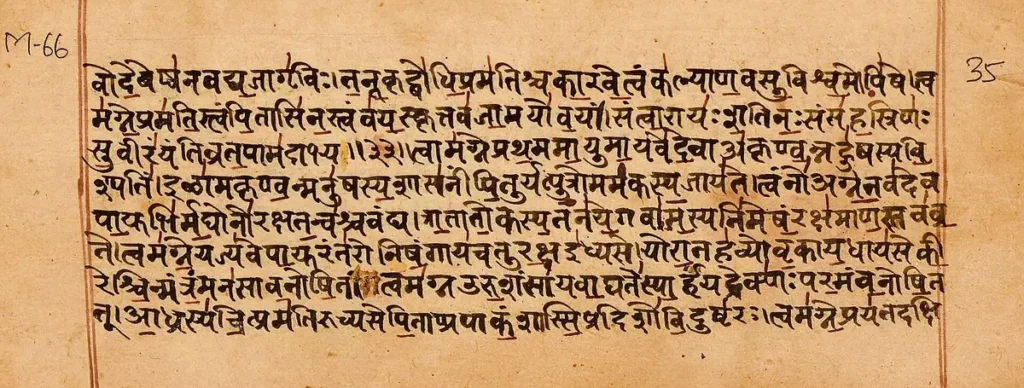
Image: Ms Sarah Welch, Wikimedia Commons, CC BY-SA 4.0
How to use this in Mains
If asked: UPSC Mains 2024, GS-I: Underline the changes in the field of society and economy from the Rig Vedic to the later Vedic period.
Quote: “The four ashramas (stages of life) and sixteen samskaras took shape in this era.”
Use it: Use as a social-change point for later Vedic times.
In the news

Pollen study links Harappan decline to weak monsoon (5100–4000 BP)
A pollen study by the Birbal Sahni Institute of Palaeosciences links the shrinking of the Harappan Civilization to a weak Indian Summer Monsoon between about 5100 and 4000 years before present, the Science Ministry said on 29 July 2026. Sediments from Deoria Tal in the Garhwal Himalaya show an abrupt dry spell, the "4.2 ka event".
29 Jul 2026
Sarnath inscribed as India’s 45th UNESCO World Heritage Site
On 25 July 2026 the 48th World Heritage Committee in Busan inscribed the "Ancient Buddhist Site of Sarnath" on the UNESCO World Heritage List. It is India's 45th property. The serial site in Varanasi covers Chaukhandi Stupa and the Archaeological Remains of Sarnath, where the Buddha gave his first sermon.
25 Jul 2026
Rakhigarhi skeletal remains handed to Anthropological Survey of India
ASI handed human skeletal remains from Rakhigarhi, Haryana, to the Anthropological Survey of India under a new MoU, the Culture Ministry said on 22 June 2026. The 2025-26 dig at Mound No. 7 found eight burials; three complete skeletons plus fragments went to AnSI's Kolkata repository. Planned work includes aDNA, isotopes and palaeopathology with partner labs.
22 Jun 2026
Relics of the Buddha’s chief disciples enshrined for exposition in Mongolia
The holy relics of Arhat Sariputra and Arhat Mahamoggallana, the Buddha's two chief disciples, were ceremonially enshrined at Gandantegchenling Monastery in Ulaanbaatar on Buddha Purnima (Vesak) 2026. Brought from India for a ten-day exposition from 31 May to 10 June 2026, they arrived on a special IAF IL-76 aircraft and had travelled abroad only once before, to Thailand in 2024.
31 May 2026