
Chapter 4 · Topic 4.2 · Prelims + Mains2 of 3
Indian Music: Carnatic music and instruments
Key points
- Carnatic Trinity: Tyagaraja, Dikshitar, Syama Sastri (Tiruvarur).
- Venkatamakhin: 72 melakarta ragas.
- Bilawal = Dheera Shankarabharanam (Prelims 2026).
- Natyashastra classes: tata, sushira, avanaddha, ghana.
1 PYQ 2017–2026
Prelims box: facts and traps
- Annamacharya: kirtanas to Venkateshwara (Prelims 2018).
- Tyagaraja kritis mostly praise Rama.
- Ghatam and jaltarang: ghana (solid).
- Recital: alap, jor, jhala, gat.
Carnatic music
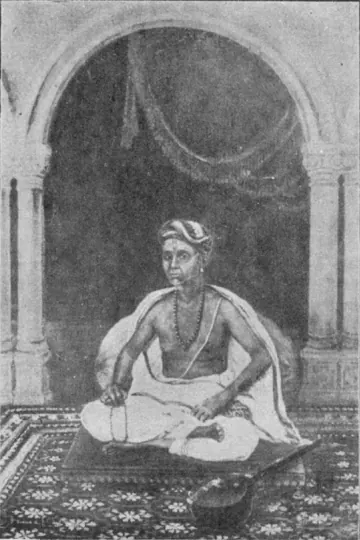
| Composer | Contribution |
|---|---|
| Annamacharya (15th century) | Telugu kirtanas to Lord Venkateshwara, Tirupati |
| Purandaradasa (16th century) | ‘Pitamaha’ of Carnatic music; set the teaching exercises |
| Venkatamakhin (17th century) | 72 melakarta scheme of parent ragas |
| Tyagaraja | Telugu kritis, mostly to Rama; Pancharatna kritis |
| Muthuswami Dikshitar | Sanskrit kritis; used Western band tunes too |
| Syama Sastri | Kritis to Goddess Kamakshi; complex rhythm |
The last three are the Carnatic Trinity, all from Tiruvarur. Main song forms: varnam, kriti, tillana, javali.
Prelims 2018: ‘Tyagaraja created several new ragas ‘ and ‘Annamacharya kirtanas are devotional songs in praise of Lord Venkateshwara’ are correct. Most Tyagaraja kritis praise Rama, not Krishna, and the two composers lived centuries apart. Answer b.
With reference to cultural history of India, consider the following statements : 1. Most of the Tyagaraja Kritis are devotional songs in praise of Lord Krishna. 2. Tyagaraja created several new ragas. 3. Annamacharya and Tyagaraja are contemporaries. 4. Annamacharya kirtanas are devotional songs in praise of Lord Venkateshwara. Which of the statements given above are correct ?
- 1 and 3 only
- 2 and 4 only
- 1, 2 and 3
- 2, 3 and 4
Show answer
Answer: (b) · UPSC official key
Prelims 2026 asked ‘Which one of the following Carnatic music ragas is similar to Raga Bilawal in Hindustani music?’ Dheera Shankarabharanam (book key d). Both use the notes of the Western major scale, like do-re-mi.
Which one of the following Carnatic music ragas is similar to Raga Bilawal in Hindustani music ?
- Nat Bhairavi
- Kamavardhini
- Hanumatodi
- Dheera Shankarabharanam
Show answer
Answer: (d) · UPSC provisional key (final key awaited)
What UPSC asks: The Trinity. Tyagaraja and Annamacharya (Prelims 2018). Bilawal (Prelims 2026).
Instruments and instrumental music
| Class (Natyashastra) | Examples |
|---|---|
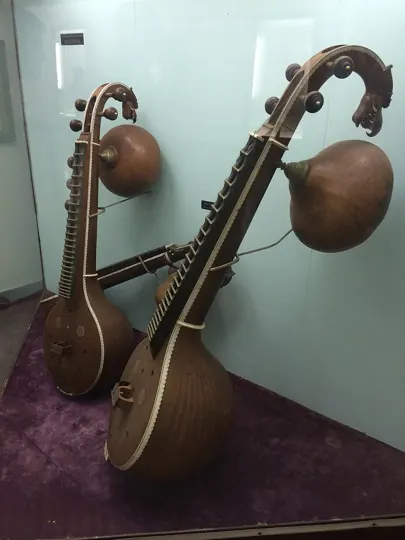
| Tata vadya (strings) | Veena, sitar, sarod, santoor, sarangi |
| Sushira vadya (wind) | Flute (bansuri), shehnai, nadaswaram |
| Avanaddha vadya (skin drums) | Tabla, pakhawaj, mridangam |
| Ghana vadya (solid) | Cymbals, ghatam, jaltarang |
Picture: a sarod from about 1885.
| Maestro | Instrument |
|---|---|
| Ravi Shankar | Sitar |
| Ali Akbar Khan | Sarod |
| Bismillah Khan | Shehnai |
| Zakir Hussain | Tabla |
| Hariprasad Chaurasia | Flute |
| Shivkumar Sharma | Santoor |
A Hindustani instrumental recital runs alap, jor, jhala and then the gat with the drum.
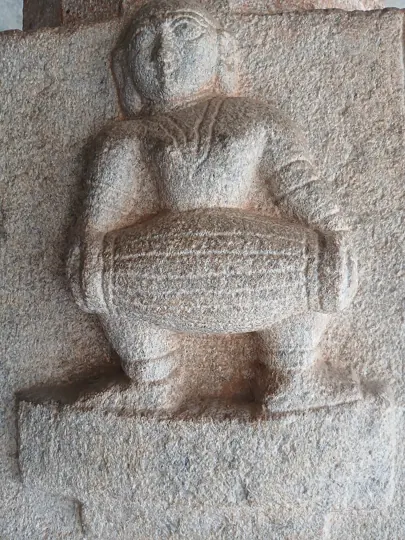
What UPSC asks: Four classes. Maestros. Recital order.
Mains box: analysis and answer points
- Bhakti and music: Annamacharya, Purandaradasa, Trinity.
- Maestros who took Indian music worldwide.
Practice
Practice MCQs (8)
Which double-headed barrel drum is the principal percussion instrument of a Carnatic music concert?
Answer (a) & explanation
The mridangam is a double-headed barrel drum played horizontally with both hands, and it is the main rhythmic accompaniment in Carnatic concerts and in Bharatanatyam. Palghat Mani Iyer and Umayalpuram K. Sivaraman are famous players. The tabla is the main drum of Hindustani music, the dholak is a folk drum, and the nagara is a large kettle drum used in temples and ceremonies.
Which instrument, a trapezoid-shaped box with many strings struck by light wooden mallets, came from the Sufiana music of Kashmir and was made a concert instrument by Pandit Shivkumar Sharma?
Answer (a) & explanation
The santoor is a hammered dulcimer: a trapezoid wooden box with many strings that the player strikes with two curved mallets. In Kashmir it accompanied Sufiana kalam, the region's Sufi devotional music. Shivkumar Sharma adapted its tuning and technique so that it could present a full raga, bringing it to the Hindustani concert stage. The sarangi is bowed, while the sarod and rabab are plucked.
Consider the following statements:
1. The Saraswati veena has frets set in wax on its neck.
2. The chitra veena (gottuvadyam) is fretless and is played by sliding a cylindrical piece along the strings.
3. The vichitra veena is mainly an instrument of Carnatic music.
Which of the statements given above is/are correct?
Answer (d) & explanation
Statement 1 is correct: the Saraswati veena, the main veena of Carnatic music, has 24 brass frets fixed on a bed of wax. Statement 2 is correct: the chitra veena, also called gottuvadyam, has no frets; the player slides a smooth cylinder over the strings, as on a slide guitar. Ravikiran is a leading player. Statement 3 is incorrect: the vichitra veena is a Hindustani instrument, a fretless slide veena related to the dhrupad tradition. Hence 1 and 2 only.
In the traditional classification of Indian instruments, consider the following pairs:
1. Sitar — Tata vadya
2. Shehnai — Sushira vadya
3. Santoor — Sushira vadya
4. Manjira — Ghana vadya
Which of the pairs given above are correctly matched?
Answer (a) & explanation
The Natyashastra groups instruments into four classes: tata (stringed), sushira (wind), avanaddha (membrane-covered drums) and ghana (solid instruments struck together). Pair 1 is correct: the sitar is a plucked string instrument. Pair 2 is correct: the shehnai is a double-reed wind instrument. Pair 4 is correct: manjira are small metal cymbals, a ghana instrument. Pair 3 is incorrect: the santoor has strings struck with light hammers, so it is tata vadya, not a wind instrument.
Consider the following instruments:
1. Sarangi
2. Esraj
3. Sarod
4. Santoor
How many of the above are played with a bow?
Answer (b) & explanation
The sarangi is the classic bowed instrument of Hindustani music. The esraj, popular in Bengal and at Santiniketan, is also played with a bow; it has frets like a sitar but is bowed like a sarangi. The sarod is plucked with a plectrum made of coconut shell or bone, and the santoor is struck with mallets. So only two are bowed.
An instrument made of a set of porcelain or metal bowls filled with different levels of water and struck with thin sticks is called:
Answer (a) & explanation
The jaltarang ('waves of water') is a set of bowls arranged in a semicircle. The amount of water in each bowl sets its pitch, and the player strikes the rims with light sticks to play a raga. It is a ghana vadya and is heard in both Hindustani and Carnatic music. The ghatam is a single clay pot, the kanjira is a small frame drum with a lizard-skin head, and the morsing is a jaw harp.
Consider the following statements about instruments of South Indian music:
1. The ghatam is a clay pot used as a percussion instrument in Carnatic concerts.
2. The nadaswaram is a double-reed wind instrument played at temple rituals and weddings.
3. The thavil is a barrel-shaped drum that traditionally accompanies the nadaswaram.
Which of the statements given above is/are correct?
Answer (d) & explanation
Statement 1 is correct: the ghatam is a specially fired clay pot played with the fingers, palms and wrists, and is a common secondary percussion instrument with the mridangam. Statement 2 is correct: the nadaswaram, a long double-reed instrument, is considered auspicious and is played in temple processions and at weddings in Tamil Nadu. Statement 3 is correct: the thavil, a barrel drum played with a stick on one side and capped fingers on the other, is the nadaswaram's standard partner. Hence all three are correct.
Consider the following pairs of instruments and their exponents:
1. Rudra veena — Asad Ali Khan
2. Sarangi — Sultan Khan
3. Bansuri (flute) — Hariprasad Chaurasia
4. Santoor — Zakir Hussain
Which of the pairs given above are correctly matched?
Answer (c) & explanation
Pair 1 is correct: Asad Ali Khan (1937–2011) was one of the last great rudra veena players of the Khandarbani dhrupad style. Pair 2 is correct: Sultan Khan (1940–2011) was a leading sarangi player and singer. Pair 3 is correct: Hariprasad Chaurasia is the best-known Hindustani flautist. Pair 4 is incorrect: Zakir Hussain was a tabla maestro; the santoor's great exponent was Shivkumar Sharma, with whom Hariprasad Chaurasia composed film music as 'Shiv–Hari'. Hence 1, 2 and 3 only.
0 / 0 correct
Prelims PYQs on this topic (1)
Which one of the following Carnatic music ragas is similar to Raga Bilawal in Hindustani music ?
Answer (d) & explanation
Dheera Shankarabharanam matches Raga Bilawal (d). Bilawal is the Hindustani thaat with all seven notes natural (shuddha), the same scale as the Western major scale. Its Carnatic twin is Dheera Shankarabharanam, the 29th melakarta. Option (a) is wrong: Nat Bhairavi matches Asavari. Option (b) is wrong: Kamavardhini (Pantuvarali) matches Purvi. Option (c) is wrong: Hanumatodi matches the Hindustani Bhairavi.
Notice the two systems: Hindustani music has ten thaats, classified by V.N. Bhatkhande, while Carnatic music has 72 melakartas, organised by Venkatamakhin. Another easy pair: Kalyan (Yaman) matches Mechakalyani (Kalyani). Trick: match the notes, not the names, since some names, like Bhairavi, mean different scales in the two systems.
Hanumatodi sounds like Todi, but the Carnatic Todi scale is the Hindustani Bhairavi thaat, not Bilawal.
Answer as per the official UPSC answer key.
Write an answer
In 150 words, explain the significance of Indian Music with one recent example.
Flashcards (7)
Who is the 'Pitamaha' of Carnatic music?
Purandaradasa.
Name the Carnatic Trinity.
Tyagaraja, Dikshitar, Syama Sastri.
Tyagaraja's kritis mostly praise whom?
Rama.
Who set the 72 melakartas?
Venkatamakhin.
Carnatic raga like Bilawal?
Dheera Shankarabharanam.
What is avanaddha vadya?
Skin-covered drums.
Bismillah Khan played which instrument?
Shehnai.
In the news
- 20 Oct 2026Sirpur in Chhattisgarh enters UNESCO’s Tentative List of World Heritage sites
- 15 Oct 2026PM inaugurates five Ladakh projects: Nimmu–Padum–Darcha road, Leh terminal, Hanu hydro
- 14 Oct 2026HAL, NCF and ASI sign MoA for Hampi, Taj Mahal and Bekal Fort
- 3 Oct 2026Centres of Excellence approved for five newer classical languages
 Next topic · 4.3 →Indian Music: Folk music
Syllabus: GS-I · Indian culture will cover the salient aspects of Art Forms, literature and Archi…