
Chapter 4 · Topic 4.3 · Prelims + Mains3 of 3
Indian Music: Folk music
Key points
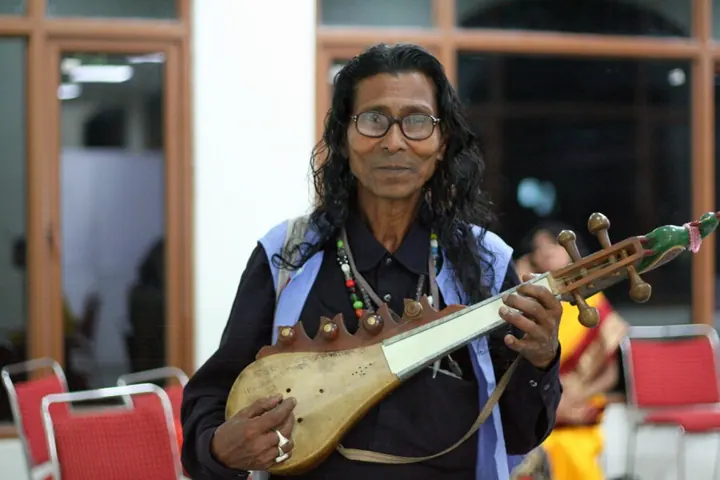
- Baul: Bengal mystics with the ektara; UNESCO intangible heritage.
- Lavani and Powada: Maharashtra. Mando: Goa.
- Pandavani: Chhattisgarh, Teejan Bai.
- Rasiya, Birha, Alha, Sohar: Uttar Pradesh.
Prelims box: facts and traps
- Bhatiyali: boatmen's songs of Bengal.
- Powada: Maharashtra, not Kerala.
- Zikir: Assam (Azan Fakir).
- Ravanhatha: Rajasthan. Tumbi: Punjab. Pena: Manipur.
Folk music
Classical music has strict rules and long training. Folk music is different. It is learnt by ear, at home and in the village, and it goes with daily work, seasons and festivals. Think of the songs sung at an Indian wedding, or the chants of workers pulling a heavy load together. That is folk music: simple tunes that everyone can join.
| Form | Region and detail |
|---|---|
| Baul | Bengal; wandering mystic singers with the ektara; UNESCO intangible heritage |
| Bhatiyali | Bengal; boatmen’s songs |
| Lavani and Powada | Maharashtra; Lavani with dance, Powada ballads of heroes |
| Pandavani | Chhattisgarh; Mahabharata tales; Teejan Bai |
| Bihu songs | Assam; spring festival songs |
| Mand | Rajasthan; court-folk songs |
| Burrakatha | Andhra Pradesh; storytelling with drums |
Bengal. Bauls are wandering mystic singers. They sing about finding God inside the human heart, not in temples or mosques. They play the ektara, a one-string drone instrument, and often a small drum. UNESCO lists the Baul songs as an intangible cultural heritage of humanity, which means a living tradition worth protecting. Bhatiyali songs are slow, sad songs of boatmen drifting downstream on the rivers. Bhawaiya songs come from North Bengal.
Maharashtra and Goa. Lavani is a lively song-and-dance form, sung to the beat of the dholki drum. Powada songs are heroic ballads, many of them about Shivaji. Ovi songs were sung by women while grinding grain. The abhang is devotional verse of the Varkari saints such as Namdev and Tukaram. In Goa, Mando songs mix Konkani words with Western tunes.
Central and eastern India. Pandavani is a way of telling Mahabharata stories through song and acting, with the hero Bhima at the centre. Teejan Bai is its best-known performer. In Assam, Bihu songs are sung at the spring festival of Rongali Bihu, while Zikir songs carry the Sufi teachings of Azan Fakir.
North and west India. Uttar Pradesh has many forms: Rasiya (Krishna songs of Braj), Birha, Alha (ballads of the warriors Alha and Udal) and Sohar (songs sung at a child’s birth). Rajasthan has Mand, a refined court-folk style, and instruments like the ravanhatha, a bowed string instrument. Punjab has the tumbi, a one-string plucked instrument. Manipur has the pena.
Devotional streams. Folk and temple music often meet. Haveli sangeet is temple music of the Pushtimarg sect founded by Vallabhacharya, with Nathdwara in Rajasthan as its main centre. In Sikh gurdwaras, kirtan is sung from the Guru Granth Sahib, whose hymns are arranged by raga. In Bengal, Chaitanya made group kirtan, singing God’s name together, a mass movement.
Why it matters today. Many folk forms survive only because a few families keep them alive. Radio, cinema and the internet have both helped and hurt them. Some singers, like Teejan Bai, have won national awards and world fame. Others fade as young people move to cities. Bodies such as the Sangeet Natak Akademi record and support these artists. In a Mains answer, use folk music as an example of living heritage that needs support, not just museum storage.
South India. Burrakatha from Andhra Pradesh is storytelling by a lead singer with a tambura and two helpers who play drums and add jokes.
Folk forms feed classical music. Thumri, tappa and many ragas (Pahadi, Mand) grew from regional songs. So when you write about classical music, show that the two streams have always borrowed from each other.
What UPSC asks: State pairs: Baul and Bhatiyali (Bengal), Lavani and Powada (Maharashtra), Bihu (Assam), Mando (Goa). Pandavani and Teejan Bai. Folk roots of classical music.
Mains box: analysis and answer points
- Folk roots of classical music: thumri, tappa, Pahadi and Mand.
- Folk music as social record: work, seasons, birth, devotion.
- Protecting living traditions: UNESCO listing of Baul.
Practice
Practice MCQs (8)
Consider the following folk song forms:
1. Rasiya
2. Birha
3. Alha
4. Sohar
How many of the above are folk song traditions of Uttar Pradesh?
Answer (d) & explanation
All four are sung in Uttar Pradesh. Rasiya comes from the Braj region around Mathura and celebrates Krishna, especially at Holi. Birha is a song of separation popular among the Ahirs of eastern UP. Alha is the heroic ballad of Mahoba, sung across Bundelkhand and beyond. Sohar is sung at the birth of a child across UP and Bihar. Hence all four.
Consider the following pairs of folk song traditions and States:
1. Lavani — Maharashtra
2. Bihu geet — Assam
3. Powada — Kerala
4. Mando — Goa
Which of the pairs given above are correctly matched?
Answer (d) & explanation
Pair 1 is correct: Lavani is a lively Marathi song-and-dance form performed to the dholki. Pair 2 is correct: Bihu geet are the songs of Assam's Bihu festivals. Pair 4 is correct: the Mando is a slow Konkani love song of Goa that blends Indian and Portuguese musical elements. Pair 3 is incorrect: the Powada is a Marathi heroic ballad, made famous by songs celebrating Shivaji's exploits, and belongs to Maharashtra, not Kerala. Hence 1, 2 and 4 only.
The folk songs of the boatmen of the river plains of Bengal, slow and melancholic, sung while drifting downstream, are called:
Answer (b) & explanation
Bhatiali gets its name from 'bhata', the ebb tide or downstream current. These songs were sung by boatmen as they drifted with the current, so they have long, free-flowing melodies without a strong beat, and their themes are longing and the meaning of life. Singers such as Abbasuddin Ahmed made them popular. The Bauls are mystic minstrels, Bhawaiya is the song of north Bengal with a jerky voice style linked to bullock-cart drivers, and kirtan is devotional group singing.
Consider the following pairs of folk song traditions and regions:
1. Bhawaiya — North Bengal
2. Zikir — Assam
3. Ovi — Tamil Nadu
Which of the pairs given above is/are correctly matched?
Answer (c) & explanation
Pair 1 is correct: Bhawaiya belongs to north Bengal (Cooch Behar and nearby areas, extending into lower Assam), with a voice style full of breaks said to echo the jolting of bullock carts. Pair 2 is correct: Zikir are Assamese devotional songs attributed to the 17th- century Sufi saint Azan Fakir, who sang Islamic teachings in Assamese folk tunes. Pair 3 is incorrect: the Ovi is a Marathi song form, traditionally sung by women at the grinding stone, and it also became a verse form used by the Varkari saints such as Jnaneshwar. Hence 1 and 2 only.
With reference to the music of the Sikh tradition, consider the following statements:
1. The hymns of the Guru Granth Sahib are arranged mainly by author, not by raga.
2. Kirtan in gurdwaras is performed by ragis, often with harmonium and tabla.
Which of the statements given above is/are correct?
Answer (b) & explanation
Statement 1 is incorrect: the main body of the Guru Granth Sahib is arranged by raga — 31 ragas — and within each raga by the Guru or poet and the type of verse. This shows how central music was to Sikh devotion; each hymn is meant to be sung in its stated raga. Statement 2 is correct: ragis (professional kirtan singers) perform Gurbani kirtan in gurdwaras, usually with harmonium and tabla, while older string instruments such as the rabab and taus are being revived. Hence 2 only.
Consider the following statements about devotional song traditions:
1. The abhang is a form of Marathi devotional verse associated with the Varkari saints such as Namdev and Tukaram.
2. Chaitanya Mahaprabhu popularised congregational singing of the names of Krishna (nama- sankirtan) in Bengal and Odisha.
3. Abhangs were composed mainly in Tamil.
Which of the statements given above is/are correct?
Answer (c) & explanation
Statement 1 is correct: the abhang is the characteristic song form of the Varkari saints of Maharashtra — Namdev, Eknath and Tukaram among them — and is sung on the pilgrimage to Pandharpur. Statement 2 is correct: Chaitanya (1486–1534) made group singing of Krishna's names, to the khol and kartal, the heart of Gaudiya Vaishnava worship. Statement 3 is incorrect: abhangs are in Marathi. Today abhangs are also popular in Carnatic concerts, which is probably why some students link them with Tamil Nadu. Hence 1 and 2 only.
Consider the following statements about Haveli sangeet:
1. It developed as temple music in the Pushtimarg tradition founded by Vallabhacharya, with Nathdwara as a major centre.
2. It is based largely on the dhrupad and dhamar styles.
3. It is sung mainly in gurdwaras as part of Sikh worship.
Which of the statements given above is/are correct?
Answer (a) & explanation
Statement 1 is correct: Haveli sangeet is the music of the Krishna temples (havelis) of the Pushtimarg sect founded by Vallabhacharya, with Shrinathji's temple at Nathdwara in Rajasthan as its main centre. Songs by the Ashtachhap poets such as Surdas are sung through the day's rituals. Statement 2 is correct: its musical idiom is that of dhrupad and dhamar, with pakhawaj accompaniment, and it helped preserve these styles. Statement 3 is incorrect: Sikh gurdwara music is Gurbani kirtan, a separate tradition. Hence 1 and 2 only.
Consider the following pairs of folk instruments and the regions with which they are chiefly associated:
1. Pena — Manipur
2. Ravanhatha — Rajasthan
3. Tumbi — Punjab
4. Bhapang — Kerala
How many of the pairs given above are correctly matched?
Answer (c) & explanation
Pair 1 is correct: the pena is a bowed instrument of the Meitei people of Manipur, made with a coconut-shell resonator. Pair 2 is correct: the ravanhatha is a bowed folk fiddle of Rajasthan, played by the Bhopas while narrating epics. Pair 3 is correct: the tumbi is a high- pitched one-string plucked instrument of Punjab, heard in bhangra and folk songs. Pair 4 is incorrect: the bhapang is a one-string instrument of the Mewat region of Rajasthan and Haryana, played by Jogi singers. Hence three pairs are correct.
0 / 0 correct
Write an answer
In 150 words, explain the significance of Indian Music with one recent example.
Flashcards (2)
Who is a famous Pandavani singer?
Teejan Bai.
Which Bengal singers carry an ektara?
The Bauls.
Read more: related explainers
In the news
- 20 Oct 2026Sirpur in Chhattisgarh enters UNESCO’s Tentative List of World Heritage sites
- 15 Oct 2026PM inaugurates five Ladakh projects: Nimmu–Padum–Darcha road, Leh terminal, Hanu hydro
- 14 Oct 2026HAL, NCF and ASI sign MoA for Hampi, Taj Mahal and Bekal Fort
- 3 Oct 2026Centres of Excellence approved for five newer classical languages
 Next chapter · 5. Indian Dance →Indian Dance: Southern classical dances
Syllabus: GS-I · Indian culture will cover the salient aspects of Art Forms, literature and Archi…