
Chapter 11 · Topic 11.1 · Prelims + Mains1 of 3
Fairs: Kumbh, Pushkar and Sonepur
Key points
- Kumbh sites: Prayagraj (Sangam), Haridwar (Ganga), Ujjain (Shipra), Nashik (Godavari).
- Each site every 12 years; Ardh Kumbh every 6 years at Prayagraj and Haridwar.
- Ujjain Kumbh = Simhastha. UNESCO list 2017.
- Pushkar and Sonepur fairs start on Kartik Purnima.
Prelims box: facts and traps
- Nashik: Godavari. Ujjain: Shipra.
- Maha Kumbh: Prayagraj, January–February 2025.
- Sonepur (Harihar Kshetra): Gandak-Ganga confluence, Bihar.
- Pushkar: rare Brahma temple, camel fair.
Kumbh Mela
Fair questions are Prelims place-and-river pairs. Learn where each fair is held, on which river or lake, and in which season. A mela is a fair: part pilgrimage, part market, part carnival. Think of a giant village fair, but with millions of people.
| Feature | Detail |
|---|---|
| Four sites | Prayagraj (Ganga-Yamuna-Saraswati Sangam), Haridwar (Ganga), Ujjain (Shipra), Nashik (Godavari) |
| Cycle | Kumbh rotates among the four; each site hosts a Kumbh every 12 years; Ardh Kumbh at Prayagraj and Haridwar every 6 years |
| Ujjain name | Simhastha |
| Timing | Set by the positions of Jupiter, the Sun and the Moon |
| UNESCO | On the intangible cultural heritage list since 2017 |
| Recent | Maha Kumbh at Prayagraj, January–February 2025 |
The story behind Kumbh. According to legend, the gods and demons churned the ocean to get amrit, the nectar of immortality. As the pot (kumbh) of nectar was carried away, drops fell at four places. Those four places are the Kumbh sites. Pilgrims believe a dip in the river there at the right time washes away sins.
How the cycle works. Each of the four cities hosts a full Kumbh once every 12 years, so somewhere in India a Kumbh is held roughly every three years. Prayagraj and Haridwar also hold an Ardh (half) Kumbh every six years. In Ujjain the fair is called Simhastha, because it is held when Jupiter is in Leo (Simha). The exact dates come from the positions of Jupiter, the Sun and the Moon.
Size and crowd management. The Kumbh is among the largest gatherings of people on earth. For the Maha Kumbh at Prayagraj in January–February 2025, the Uttar Pradesh government reported more than 66 crore holy dips over 45 days. That counts visits, not separate people, since many came more than once. A temporary city is built on the riverbanks, with roads, bridges of floating pontoons, hospitals and police posts. Even so, a stampede on 29 January 2025, the Mauni Amavasya bathing day, killed 30 people, according to official figures. That is why Kumbh is a favourite Mains example for disaster and crowd management.
UNESCO. In 2017 UNESCO added the Kumbh Mela to its list of intangible cultural heritage. It called the fair the largest peaceful gathering of pilgrims on earth. The knowledge of rituals and songs is passed down through ashrams and akharas, the orders of holy men.
What UPSC asks: The four Kumbh sites and their rivers. The 12-year cycle and Ardh Kumbh. UNESCO listing (2017). Crowd management.
Pushkar and Sonepur fairs
| Fair | Detail |
|---|---|
| Pushkar Mela (Rajasthan) | Kartik Purnima (October–November); camel and livestock trading; holy dip in Pushkar Lake; the rare Brahma temple |
| Sonepur Mela (Bihar) | Also Harihar Kshetra Mela; at the Gandak-Ganga confluence; begins on Kartik Purnima; one of Asia’s largest cattle fairs, once famous for elephants |
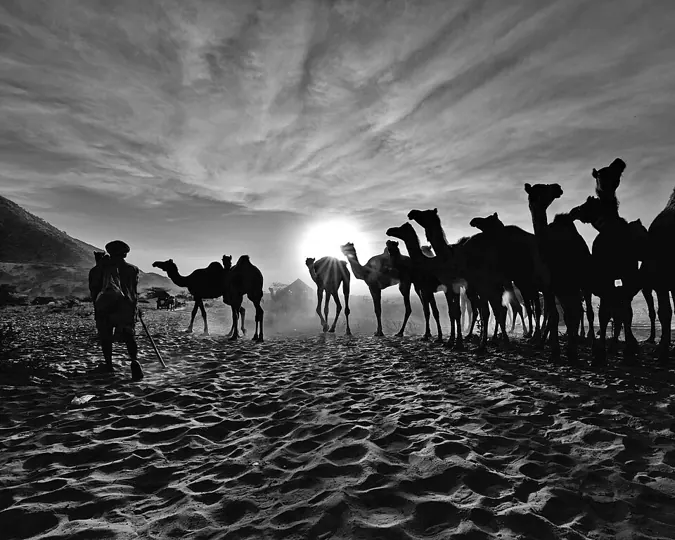
Both began as religious bathing fairs on Kartik Purnima, the full moon of the month of Kartik, and grew into trading fairs. Pushkar is famous for camels decorated with bells and beads, and for one of the very few temples of Lord Brahma in India. Sonepur’s Harihar Nath temple is linked to the legend of an elephant saved from a crocodile by Vishnu. Its cattle market was once famous for selling elephants, which today is tightly restricted by wildlife law.
What UPSC asks: Kartik Purnima. Sonepur at the Gandak-Ganga confluence. Pushkar Lake and the Brahma temple.
Mains box: analysis and answer points
- Crowd management at mass gatherings (Kumbh 2025).
- Pilgrimage and trade together at fairs.
- Soft power: UNESCO listing.
Practice
Practice MCQs (8)
The Gangasagar Mela, at which pilgrims bathe where the Ganga meets the Bay of Bengal on Makar Sankranti and worship at the Kapil Muni temple, is held at:
Answer (b) & explanation
The Gangasagar Mela is held every year around Makar Sankranti (mid-January) on Sagar Island in South 24 Parganas district of West Bengal, where the Hooghly branch of the Ganga enters the Bay of Bengal. Pilgrims take a holy dip at the confluence and visit the temple of the sage Kapil Muni, linked with the legend of King Sagara's sons and the descent of the Ganga brought by Bhagiratha. It is one of the largest annual bathing fairs in India.
Consider the following pairs: State-promoted cultural festival — State
1. Rann Utsav — Gujarat
2. Hampi Utsav — Karnataka
3. Sangai Festival — Mizoram
Which of the pairs given above are correctly matched?
Answer (a) & explanation
The Rann Utsav is Gujarat's winter festival on the white salt desert of Kutch, with a tent city at Dhordo. The Hampi Utsav (Vijaya Utsav) of Karnataka celebrates the heritage of the Vijayanagara capital with music, dance and light shows among the ruins. The Sangai Festival, held every November, is Manipur's tourism festival, named after the sangai, the brow-antlered deer of Keibul Lamjao that is Manipur's State animal; it is not Mizoram's.
Consider the following statements about the Sonepur Mela (Harihar Kshetra Mela) of Bihar:
1. It is held near the confluence of the Gandak and the Ganga.
2. It traditionally begins around Kartik Purnima, when pilgrims bathe at the confluence.
3. It is associated with the Harihar Nath temple and the legend of Gajendra Moksha, the rescue of an elephant from a crocodile.
Which of the statements given above are correct?
Answer (d) & explanation
The Sonepur Mela in Saran district, Bihar, is held at the Gandak–Ganga confluence, opposite Hajipur, and begins around Kartik Purnima (November) with a holy bath, running for about a month. It is centred on the Harihar Nath temple, where Vishnu (Hari) and Shiva (Hara) are worshipped together, and on the Puranic story of Gajendra Moksha, in which Vishnu saved the elephant king from a crocodile at this spot. Historically it was Asia's largest cattle and elephant fair. All three statements are correct.
Consider the following festivals:
1. Shigmo
2. Sao Joao
3. Losoong
4. Bhagoria
How many of the above are festivals of Goa?
Answer (b) & explanation
Shigmo is Goa's Hindu spring festival around Holi (February–March), with float parades and folk performances such as ghode modni and romta mel. Sao Joao (the feast of St John the Baptist, 24 June) is a monsoon festival of Goa's Catholics, especially at Siolim, when young men jump into wells and ponds wearing crowns of leaves and flowers. Losoong is the Bhutia–Lepcha harvest and new-year festival of Sikkim in December, and Bhagoria is the pre- Holi haat festival of the Bhils of Madhya Pradesh. So only two are Goan.
Consider the following pairs: Navaratri–Dussehra tradition — State
1. Bommai Golu (display of dolls on steps) — Tamil Nadu
2. Jamboo Savari (procession of the goddess on an elephant) — Karnataka
3. Bathukamma (floral stacks floated in water) — Telangana
4. Bastar Dussehra — Odisha
Which of the pairs given above are correctly matched?
Answer (d) & explanation
Navaratri takes many regional forms. In Tamil Nadu, homes set up Bommai Golu, an odd-numbered flight of steps with dolls of gods and scenes of daily life. The Mysuru Dasara of Karnataka ends with the Jamboo Savari, in which the image of Chamundeshwari rides on a caparisoned elephant in a golden howdah, a tradition of the Wodeyars. In Telangana, women build Bathukamma flower stacks over nine days and float them in tanks. The Bastar Dussehra, centred on Danteshwari at Jagdalpur, is in Chhattisgarh, not Odisha.
Consider the following statements about the Kullu Dussehra of Himachal Pradesh:
1. It begins on Vijayadashami, the day on which Dussehra ends in most other parts of India.
2. Its presiding deity is Raghunath, whose chariot is drawn at the Dhalpur ground, where hundreds of village deities gather.
3. A giant effigy of Ravana is burnt on its first day, as in north Indian Ramlilas.
Which of the statements given above are correct?
Answer (c) & explanation
The Kullu Dussehra is a week-long festival that starts on Vijayadashami itself. Its centre is the image of Raghunath (Rama), brought to Kullu from Ayodhya in the 17th century in the reign of Raja Jagat Singh; his chariot is pulled to the Dhalpur maidan, and hundreds of village devtas are carried in palanquins to pay homage. No effigy of Ravana is burnt; the festival ends on the last day with the Lanka Dahan ritual on the bank of the Beas. So statement 3 is wrong.
Consider the following:
1. The Pushkar camel fair
2. Dev Deepawali on the ghats of Varanasi
3. Guru Nanak Gurpurab
4. The Gangasagar Mela
How many of the above traditionally fall on or culminate at Kartik Purnima?
Answer (c) & explanation
Kartik Purnima (October–November) is one of the most crowded days of the Hindu calendar. The Pushkar fair in Rajasthan reaches its climax with a bath in the holy lake on that full moon. Dev Deepawali at Varanasi, when the ghats are lit with lakhs of lamps, is held on Kartik Purnima, fifteen days after Diwali. Guru Nanak's birth anniversary (Prakash Purab) is also celebrated on Kartik Purnima by tradition. The Gangasagar Mela, however, is tied to Makar Sankranti in January.
The Chandrabhaga Mela, at which devotees take a holy dip before dawn on Magha Saptami and then offer prayers to the rising Sun, is held on the sea coast near:
Answer (b) & explanation
The Chandrabhaga Mela is held on Magha Saptami (Magha Shukla Saptami, January–February), traditionally the birthday of Surya, at Chandrabhaga beach near Konark in Puri district, Odisha. Pilgrims bathe in the pool left in the bed of the old Chandrabhaga river and in the sea, then greet the rising Sun and visit the Navagraha shrine at the Konark temple. Legend says Samba, son of Krishna, was cured of leprosy here by worshipping the Sun, which is also the founding story of Konark.
0 / 0 correct
Write an answer
In 150 words, explain the significance of Fairs with one recent example.
Flashcards (9)
Ujjain Kumbh is on which river?
Shipra.
Nashik Kumbh is on which river?
Godavari.
Ujjain Kumbh is also called?
Simhastha.
Where is Ardh Kumbh held?
Prayagraj and Haridwar.
When did Kumbh enter the UNESCO list?
2017.
Pushkar fair is held on?
Kartik Purnima.
Pushkar has a rare temple of?
Brahma.
Sonepur fair is at which confluence?
Gandak and Ganga.
Other name of Sonepur Mela?
Harihar Kshetra Mela.
In the news
- 20 Oct 2026Sirpur in Chhattisgarh enters UNESCO’s Tentative List of World Heritage sites
- 15 Oct 2026PM inaugurates five Ladakh projects: Nimmu–Padum–Darcha road, Leh terminal, Hanu hydro
- 14 Oct 2026HAL, NCF and ASI sign MoA for Hampi, Taj Mahal and Bekal Fort
- 3 Oct 2026Centres of Excellence approved for five newer classical languages
 Next topic · 11.2 →Fairs: Hornbill and other fairs
Syllabus: GS-I · Indian culture will cover the salient aspects of Art Forms, literature and Archi…