
Chapter 5 · Topic 5.2 · Prelims + Mains2 of 4
Indian Dance: Kathak, Odissi, Manipuri, Sattriya
Key points
- Kathak: from kathakars; Lucknow, Jaipur, Banaras gharanas.
- Odissi: Maharis and Gotipuas; chauka and tribhanga.
- Manipuri: Raas Leela, Lai Haraoba roots, potloi skirt.
- Sattriya: Sankaradeva; classical in 2000.
Prelims box: facts and traps
- Sattriya uses Sankaradeva's borgeets, not Tulsidas or Kabir (Prelims 2014).
- Pung Cholom: Manipuri drum dance.
- Odissi revival: Kelucharan Mohapatra.
- Kathak master: Birju Maharaj.
Kathak and Odissi
These four dances come from the north and the east. Each one grew in a different setting: Kathak in royal courts, Odissi in temples, Manipuri in village festivals and Sattriya in monasteries. Think of four rivers that start in different hills but all reach the same sea of classical dance.
| Dance | Features |
|---|---|
| Kathak (north India) | From the kathakars (storytellers); grew in Mughal and Rajput courts; spins (chakkars) and footwork; Lucknow, Jaipur and Banaras gharanas; Birju Maharaj |
| Odissi (Odisha) | From temple Maharis and boy dancers (Gotipua); chauka (square stance) and tribhanga; Gita Govinda themes; Kelucharan Mohapatra |
Kathak. The name comes from katha, meaning story. Long ago, kathakars travelled from temple to temple telling epic stories with songs and gestures. In the Mughal and Rajput courts, the dance became faster and more showy. Dancers wear about a hundred small bells on each ankle and can make them ring one at a time. The Lucknow gharana grew under the Nawab Wajid Ali Shah and stresses graceful expression. The Jaipur gharana stresses strong, fast footwork. Pandit Birju Maharaj of the Lucknow line was its most famous modern master.
Odissi. Some of the oldest proof of dance in India comes from Odisha. The Udayagiri caves, carved in the time of King Kharavela, show dancing figures. Later, Maharis (temple dancers) danced in the Jagannath temple at Puri. When this declined, young boys called Gotipuas, dressed as girls, kept the dance alive. Odissi has two key poses. The chauka is a square stance with bent knees, linked to Lord Jagannath. The tribhanga bends the body at three points. Many dances use verses from Jayadeva’s Gita Govinda. In the 1950s, gurus such as Kelucharan Mohapatra rebuilt the dance for the stage.
What UPSC asks: Kathak gharanas. Gotipua boys. The chauka stance.
Manipuri and Sattriya
| Dance | Features |
|---|---|
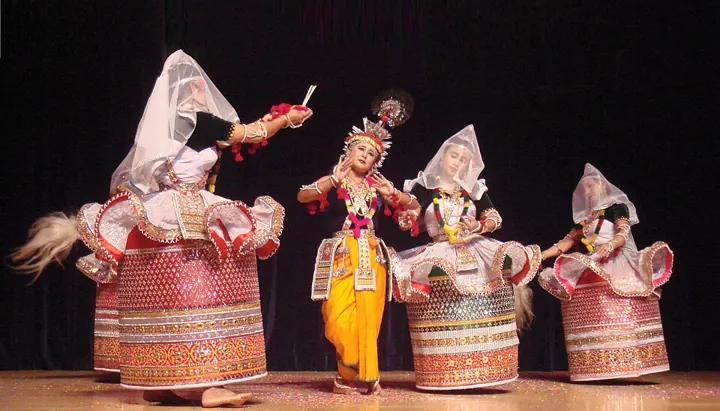
| Manipuri (Manipur) | Raas Leela on Krishna; gentle, no facial exaggeration; stiff cylindrical skirt (potloi); Lai Haraoba roots; Pung Cholom drum dance; Tagore took it to Santiniketan |
| Sattriya (Assam) | Created by Sankaradeva (15th–16th century) in Vaishnava monasteries (sattras); recognised as classical in 2000 |
| Sattriya, Assam. |
Manipuri. This dance grew from Lai Haraoba, an old festival for the local gods of Manipur. Later, Vaishnavism, the worship of Krishna, brought the Raas Leela, which shows Krishna dancing with Radha and the gopis. The movements are soft and rounded, and faces stay calm, without bold expressions. Men play the pung, a drum, while leaping and spinning in the Pung Cholom. Rabindranath Tagore invited Manipuri teachers to Santiniketan and helped make it known across India.
Sattriya. The saint Sankaradeva created it in the 15th–16th centuries as part of the Vaishnava faith in Assam. It was performed by monks in the sattras, the monasteries. It went with his one-act plays, called Ankiya Naat, and his devotional songs, the borgeets. For centuries it stayed inside the monasteries. In 2000 the Sangeet Natak Akademi recognised it as a classical dance.
Prelims 2014 on Sattriya: it ‘is a combination of music, dance and drama ‘ and ‘a centuries-old living tradition of Vaishnavites of Assam’. Both are true. It is based on Sankaradeva’s borgeets, not on songs by Tulsidas, Kabir and Mirabai. Answer b.
With reference to the famous Sattriya dance, consider the following statements : 1. Sattriya is a combination of music, dance and drama. 2. It is a centuries-old living tradition of Vaishnavites of Assam. 3. It is based on classical Ragas and Talas of devotional songs composed by Tulsidas, Kabir and Mirabai. Which of the statements given above is/are correct?
- 1 only
- 1 and 2 only
- 2 and 3 only
- 1, 2 and 3
Show answer
Answer: (b) · UPSC official key
What UPSC asks: Sattriya (Prelims 2014). Raas Leela. Classical status in 2000.
Mains box: analysis and answer points
- Temple, court and monastery: how setting shaped each dance.
- Bhakti and dance: Gita Govinda, Raas Leela, Sankaradeva.
- Revival: Gotipuas and 1950s gurus kept Odissi alive.
Practice
Practice MCQs (8)
The Ras Lila of Manipuri dance, with its forms such as the Maha Ras and Vasanta Ras, was introduced in the eighteenth century by:
Answer (b) & explanation
Maharaja Bhagyachandra (Ching-Thang Khomba), a devout Vaishnava ruler of Manipur, introduced the Ras Lila in 1779, composing its forms and costumes according to tradition after a vision of Krishna. The Maha Ras, Vasanta Ras and Kunja Ras became the heart of Manipuri classical dance.
The name of the classical dance Kathak is derived from:
Answer (d) & explanation
Kathak takes its name from the kathakars, communities of storytellers (katha = story) attached to temples of north India who narrated the Ramayana, Mahabharata and Puranas with mime and music. Through the Bhakti period it absorbed Krishna themes and the raslila of Braj, and in the Mughal courts it gained Persian costume and an emphasis on virtuoso rhythm.
Consider the following statements about Manipuri dance:
1. Its dancers do not wear ankle bells, and the footwork is soft and restrained.
2. The female costume in the Ras Lila includes the kumil, a stiff, barrel-shaped embroidered skirt.
3. The Pung Cholom is performed by women dancers playing cymbals.
Which of the statements given above are correct?
Answer (d) & explanation
Manipuri is marked by rounded, flowing movement; the feet press the ground softly and dancers wear no ankle bells. The Ras costume features the kumil, a stiff cylindrical skirt with mirror work, and a fine veil. The Pung Cholom is a vigorous dance by male performers who play the pung drum while leaping and spinning; the cymbal dance is the kartal cholom. So statement 3 is wrong.
Consider the following statements about Sattriya dance:
1. It originated in the Vaishnava movement led by Srimanta Sankardev in the fifteenth and sixteenth centuries.
2. It was traditionally performed in the sattras by male monks (bhakats).
3. It developed as a court dance under the patronage of the Ahom kings at their capital.
Which of the statements given above are correct?
Answer (b) & explanation
Sattriya grew from the neo-Vaishnava movement of Srimanta Sankardev (1449– 1568), who created dance and drama to spread devotion to Krishna. It was nurtured in the sattras (monasteries), such as those of Majuli, where celibate male monks performed it as ritual for centuries. It is a monastic, not a court, tradition, so statement 3 is wrong.
The one-act Vaishnava plays composed by Srimanta Sankardev in Brajavali, which Sattriya dance grew up to accompany, are known as:
Answer (c) & explanation
Sankardev wrote one-act plays, the Ankiya Naat (anka = act), in Brajavali, an artificial literary language mixing Assamese with Maithili and Brajabuli forms, to present episodes of Krishna and Rama. Their staging is called Bhaona, and the dances within them became Sattriya. Borgeet are his devotional songs, and Ojapali is an older Assamese chorus- narrative tradition.
Consider the following items:
1. Mangalacharan
2. Batu
3. Moksha
4. Alarippu
How many of the above are items of a traditional Odissi recital?
Answer (c) & explanation
A classic Odissi recital opens with Mangalacharan, an invocation with offering of flowers and salutation to the earth, then Batu (Sthayi or Batu Nritya), a pure-dance piece of sculptural poses dedicated to Shiva as Batukeshwar, then Pallavi and abhinaya items, and ends with Moksha, the dance of liberation. Alarippu is the opening item of the Bharatanatyam margam. So three.
Consider the following statements about Manipuri dance:
1. Its Ras Lila has several forms, including the Maha Ras, Vasanta Ras and Kunja Ras.
2. Its Vaishnava repertoire centres on the love of Radha and Krishna.
3. The Jhaveri sisters were noted exponents who popularised it beyond Manipur.
Which of the statements given above are correct?
Answer (d) & explanation
The Ras Lila of Manipur has several forms, among them the Maha Ras (in Kartik), Vasanta Ras (spring), Kunja Ras and Nitya Ras. Their theme is the devotion of the gopis and the love of Radha and Krishna. The Jhaveri sisters (Nayana, Ranjana, Suverna and Darshana) of Mumbai, disciples of Guru Bipin Singh, carried Manipuri to national and international stages. All three statements are correct.
Consider the following pairs: Term in the Sattriya tradition — Meaning
1. Sutradhari Nach — dance of the sutradhar, the narrator-conductor of the play
2. Bhaona — the dramatic performance of an Ankiya Naat
3. Namghar — the double-headed drum of the sattras
Which of the pairs given above are correctly matched?
Answer (c) & explanation
In the sattras the sutradhar opens and links the play, and his dance became the Sutradhari Nach, a core Sattriya item. Bhaona is the staging of an Ankiya Naat, Sankardev's one-act Vaishnava play. The namghar is the prayer and performance hall of a sattra or village, not a drum; the drum of the tradition is the khol. Pair 3 is wrong.
0 / 0 correct
Write an answer
In 150 words, explain the significance of Indian Dance with one recent example.
Flashcards (6)
Kathak's three gharanas?
Lucknow, Jaipur, Banaras.
Who are Gotipuas?
Boy dancers of Odisha.
What is chauka?
Odissi square stance.
Who took Manipuri to Santiniketan?
Rabindranath Tagore.
Who created Sattriya?
Sankaradeva.
When was Sattriya made classical?
2000.
In the news
- 20 Oct 2026Sirpur in Chhattisgarh enters UNESCO’s Tentative List of World Heritage sites
- 15 Oct 2026PM inaugurates five Ladakh projects: Nimmu–Padum–Darcha road, Leh terminal, Hanu hydro
- 14 Oct 2026HAL, NCF and ASI sign MoA for Hampi, Taj Mahal and Bekal Fort
- 3 Oct 2026Centres of Excellence approved for five newer classical languages
 Next topic · 5.3 →Indian Dance: Folk dances and state pairs
Syllabus: GS-I · Indian culture will cover the salient aspects of Art Forms, literature and Archi…