
Chapter 5 · Topic 5.1 · Prelims + Mains1 of 4
Indian Dance: Southern classical dances
Key points
- Nritta: pure dance; nritya: expressive; natya: drama.
- Tribhanga: three-bend pose of Odissi (Prelims 2013).
- Bharatanatyam revived by Rukmini Devi Arundale (Kalakshetra, 1936).
- Kerala Kalamandalam: Vallathol, 1930.
Prelims box: facts and traps
- Kuchipudi: village in Krishna district; Tarangam on a brass plate.
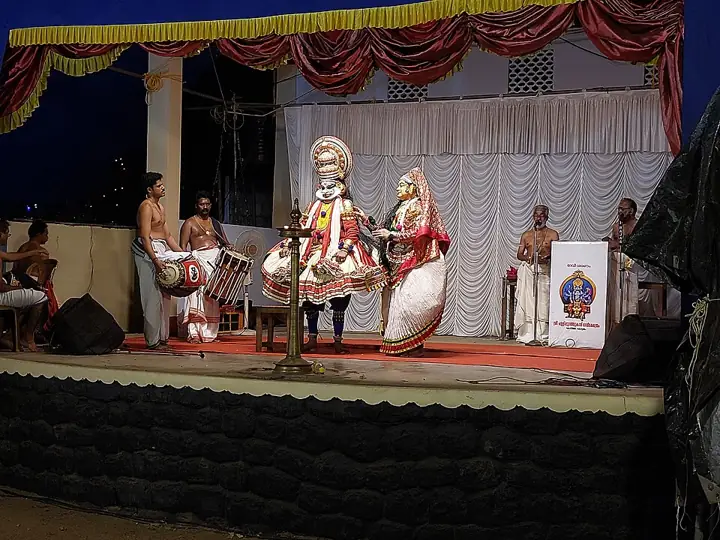
- Kathakali: green pacha make-up for noble heroes.
- Mohiniyattam: lasya, white and gold costume.
On this page (3 sections)
Basics of Indian dance
Dance questions test a state, a feature or a term. Start with the theory in Bharata’s Natyashastra. Here is an easy way to remember it. Nritta is like a drum solo: pure rhythm. Nritya is like acting out a song with your hands and face. Natya is a full play.
| Term | Meaning |
|---|---|
| Nritta | Pure dance: rhythm and movement, no story |
| Nritya | Expressive dance: gestures and faces tell a meaning |
| Natya | Drama: the full story |
| Tandava and lasya | Vigorous (Shiva) and graceful (Parvati) styles |
| Rasa and bhava | The mood felt by the viewer and the emotion shown |
Prelims 2013 asked about ‘a pose in dance and dramatics called ‘Tribhanga’ ‘. Answer a: one leg is bent and the body curves the opposite way at waist and neck, making three bends. It is the signature pose of Odissi and of much Indian sculpture.
In the context of cultural history of India, a pose in dance and dramatics called ‘Tribhanga’ has been a favourite of Indian artists from ancient times till today. Which one of the following statements best describes this pose?
- One leg is bent and the body is slightly but oppositely curved at waist and neck
- Facial expressions, hand gestures and make-up are combined to symbolize certain epic or historic characters
- Movements of body, face and hands are used to express oneself or to tell a story
- A little smile, slightly curved waist and certain hand gestures are emphasized to express the feelings of love or eroticism
Show answer
Answer: (a) · UPSC official key
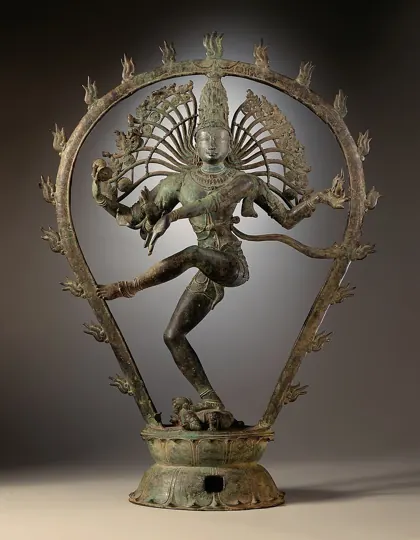
Mains 2013 asked candidates to ‘Discuss the ‘Tandava’ dance as recorded in early Indian inscriptions ‘. Use the Chola and Pallava records and temple sculpture of Shiva’s dances, such as the Nataraja image and the 108 karanas carved at Chidambaram and Thanjavur.
(a) Discuss the ‘Tandava’ dance as recorded in early Indian inscriptions. (100 words)
What UPSC asks: Tribhanga (Prelims 2013). Tandava (Mains 2013). Nritta, nritya, natya.
Bharatanatyam and Kuchipudi
| Dance | Features |
|---|---|
| Bharatanatyam (Tamil Nadu) | Grew from the temple sadir of the devadasis; revived by Rukmini Devi Arundale (Kalakshetra, 1936) and E. Krishna Iyer; fire symbolism; half-sitting araimandi |
| Kuchipudi (Andhra Pradesh) | Named after a village in Krishna district; shaped by Siddhendra Yogi; dance-drama once by male Brahmin troupes; Tarangam: dancing on the rim of a brass plate |
A Bharatanatyam recital: alarippu, jatiswaram, shabdam, varnam, padam, tillana.
What UPSC asks: Revival. Tarangam. States.
Kathakali and Mohiniyattam
| Dance | Features |
|---|---|
| Kathakali (Kerala) | Dance-drama from Ramanattam and Krishnanattam; colour-coded make-up (green pacha for noble heroes); male dancers; Kerala Kalamandalam founded by Vallathol (1930) |
| Mohiniyattam (Kerala) | Solo, graceful (lasya); white and gold costume; patronised by Swathi Thirunal; revived by Vallathol |
What UPSC asks: Make-up codes. Kalamandalam. Lasya.
Mains box: analysis and answer points
- Tandava in inscriptions and sculpture (Mains 2013): Nataraja, 108 karanas.
- Revival of classical dance in the 20th century.
Practice
Practice MCQs (8)
The Khajuraho Dance Festival, a week-long festival of classical dance held against the backdrop of the Chandela temples, is organised in:
Answer (c) & explanation
The Khajuraho Dance Festival, begun in 1975, is held every year, usually in February, in the open air before the Chandela temples of the Western Group at Khajuraho in Chhatarpur district of Madhya Pradesh. It is organised by the State's culture department through the Ustad Alauddin Khan Sangeet evam Kala Akademi and features all the classical forms.
The Kerala Kalamandalam, set up in 1930 to revive Kathakali, Mohiniyattam and other performing arts of Kerala, was founded by the poet:
Answer (b) & explanation
The Malayalam poet Vallathol Narayana Menon, with Manakkulam Mukunda Raja, founded the Kerala Kalamandalam in 1930; it later moved to Cheruthuruthy on the Bharathapuzha. It rescued Kathakali from decline and revived Mohiniyattam, which had almost disappeared. It is now a deemed university for art and culture.
Consider the following artists:
1. Kalamandalam Kalyanikutty Amma
2. Bharati Shivaji
3. Kanak Rele
4. Guru Gopinath
How many of the above are known principally as exponents of Mohiniyattam?
Answer (c) & explanation
Kalamandalam Kalyanikutty Amma (1915–1999) was among the first students of Mohiniyattam at the Kerala Kalamandalam and is called the mother of modern Mohiniyattam. Bharati Shivaji of Delhi and Kanak Rele of Mumbai (founder of the Nalanda Dance Research Centre) were leading Mohiniyattam dancers and scholars. Guru Gopinath was a Kathakali artist who created the 'Kerala Natanam' style. So three.
Consider the following statements about classical dance festivals:
1. The Konark Dance Festival is held in December at an open-air auditorium near the Sun temple.
2. The Natyanjali festival at the Nataraja temple of Chidambaram is held around Mahashivratri.
3. The Mamallapuram Dance Festival is staged against the backdrop of the rock relief known as Arjuna's Penance.
Which of the statements given above are correct?
Answer (d) & explanation
The Konark Dance Festival is held from 1 to 5 December at an open-air auditorium facing the Sun temple in Odisha. Natyanjali, begun in 1981, brings dancers to offer their art to Nataraja at Chidambaram around Mahashivratri (February–March). The Mamallapuram Dance Festival, organised by Tamil Nadu Tourism in the winter months, uses the great relief of Arjuna's Penance (the Descent of the Ganga) as its backdrop. All three are correct.
Arrange the following events in chronological order:
1. Recognition of Sattriya as a classical dance by the Sangeet Natak Akademi
2. Founding of the Kerala Kalamandalam
3. Enactment of the Madras Devadasis (Prevention of Dedication) Act
4. Introduction of Manipuri dance at Santiniketan by Rabindranath Tagore
Select the correct answer using the code given below:
Answer (d) & explanation
Tagore brought Manipuri teachers to Santiniketan after his 1919 visit to Sylhet. Vallathol founded the Kerala Kalamandalam in 1930. The Madras Devadasis (Prevention of Dedication) Act was passed in 1947. The Sangeet Natak Akademi recognised Sattriya as classical on 15 November 2000. So the order is 4-2-3-1.
Consider the following statements about Uday Shankar:
1. He partnered the Russian ballerina Anna Pavlova in ballets on Indian themes in the 1920s.
2. He set up the India Culture Centre at Almora in 1938.
3. He trained from childhood under a single guru in Kathakali and performed only in that form.
Which of the statements given above are correct?
Answer (a) & explanation
Uday Shankar (1900–1977), trained as a painter in London, created Indian-themed works such as Radha-Krishna for Anna Pavlova in 1923 and danced with her. He then built his own troupe and, in 1938, opened the India Culture Centre at Almora, with teachers of several classical forms. His style was a 'creative' or modern synthesis, not the practice of a single classical form, so statement 3 is wrong.
Consider the following pairs: Dancer — Classical form
1. Sitara Devi — Kathak
2. Madhavi Mudgal — Kathakali
3. Shovana Narayan — Kathak
4. Sanjukta Panigrahi — Kuchipudi
How many of the pairs given above are correctly matched?
Answer (b) & explanation
Sitara Devi (1920–2014), hailed by Tagore as 'Nritya Samragini', was a celebrated Kathak dancer of the Banaras tradition. Shovana Narayan is a leading Kathak dancer of Delhi. Madhavi Mudgal is an Odissi dancer and teacher of the Gandharva Mahavidyalaya, Delhi. Sanjukta Panigrahi (1944–1997), a disciple of Kelucharan Mohapatra, was one of the great Odissi dancers. So only pairs 1 and 3 are right.
Consider the following statements about Kuchipudi:
1. In the tarangam, the dancer performs on the rim of a brass plate, sometimes with a pot of water balanced on the head.
2. It was traditionally performed as dance-drama by all-male troupes of Brahmin families of Kuchipudi village.
3. Unlike Bharatanatyam, Kuchipudi has no vachika element; the dancers never speak or sing.
Which of the statements given above are correct?
Answer (c) & explanation
Kuchipudi is a dance-drama of Andhra Pradesh. Its showpiece, the tarangam, set to Tirtha Narayana Yati's Krishna Leela Tarangini, has the dancer moving on the rim of a brass plate, at times with a water pot on the head. It was traditionally the preserve of Brahmin male families (Bhagavatulu) of the village; women entered in the 20th century. Because it grew as theatre, dancers may speak or sing their own lines, so statement 3 is wrong.
0 / 0 correct
Write an answer
In 150 words, explain the significance of Indian Dance with one recent example.
Flashcards (10)
What is nritta?
Pure dance with no story.
What is lasya?
Graceful, feminine dance.
Describe tribhanga.
One leg bent; body curved oppositely at waist and neck.
Who founded Kalakshetra?
Rukmini Devi Arundale.
Bharatanatyam grew from which temple
form? Sadir of the devadasis.
What is Tarangam?
Kuchipudi dancing on a brass plate rim.
Who shaped Kuchipudi?
Siddhendra Yogi.
Green make-up in Kathakali shows?
Noble heroes (pacha).
Who founded Kerala Kalamandalam?
Vallathol Narayana Menon.
Mohiniyattam is which style?
Lasya, solo female.
In the news
- 20 Oct 2026Sirpur in Chhattisgarh enters UNESCO’s Tentative List of World Heritage sites
- 15 Oct 2026PM inaugurates five Ladakh projects: Nimmu–Padum–Darcha road, Leh terminal, Hanu hydro
- 14 Oct 2026HAL, NCF and ASI sign MoA for Hampi, Taj Mahal and Bekal Fort
- 3 Oct 2026Centres of Excellence approved for five newer classical languages
 Next topic · 5.2 →Indian Dance: Kathak, Odissi, Manipuri, Sattriya
Syllabus: GS-I · Indian culture will cover the salient aspects of Art Forms, literature and Archi…