
Chapter 7 · Topic 7.1 · Prelims + Mains1 of 3
Indian Literature: Vedic, Buddhist, Jain and Sangam texts
Key points
- Upanishads came before the Puranas and use parables (Prelims 2024).
- Tripitaka: Vinaya, Sutta, Abhidhamma.
- Jain Agamas compiled at Valabhi.
- Vattakirutal: ritual starvation by a defeated king (Prelims 2023).
Prelims box: facts and traps
- Six Vedangas: shiksha, kalpa, vyakarana, nirukta, chhanda, jyotisha.
- Buddhacharita: Ashvaghosha.
- Silappadikaram: Ilango Adigal. Manimekalai: Sattanar.
- Tolkappiyam: oldest Tamil grammar.
On this page (3 sections)
Vedic and later Sanskrit religious texts
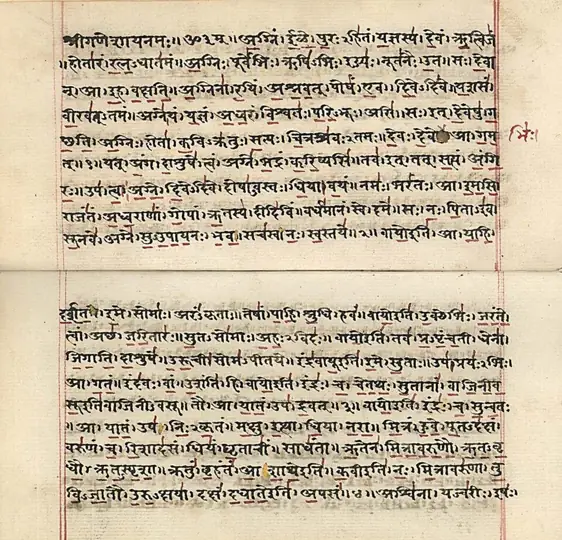
Literature questions ask who wrote what, in which language and under which ruler, and what a text tells us about its age.
| Group | Contents |
|---|---|
| Four Vedas | Rig (hymns), Sama (melodies), Yajur (sacrificial formulas), Atharva (charms, daily life) |
| Brahmanas, Aranyakas | Ritual explanations; forest texts |
| Upanishads | Philosophy of atman and brahman; often taught through dialogues and parables |
| Vedangas | Six aids: shiksha, kalpa, vyakarana, nirukta, chhanda, jyotisha |
| Epics, Puranas | Ramayana, Mahabharata; 18 Puranas compiled mainly in the Gupta age |
| Smritis | Manusmriti, Yajnavalkya Smriti: law and social duty |
Prelims 2024 said ‘There are no parables in Upanishads’. That is wrong: the Chandogya and Katha Upanishads teach through stories with a lesson (parables). ‘Upanishads were composed earlier than the Puranas ‘ is right. Answer b.
Consider the following statements : 1. There are no parables in Upanishads. 2. Upanishads were composed earlier than the Puranas. Which of the statements given above is/are correct ?
- 1 only
- 2 only
- Both 1 and 2
- Neither 1 nor 2
Show answer
Answer: (b) · UPSC official key
What UPSC asks: Text groups. Upanishads vs Puranas (Prelims 2024). Vedangas.
Buddhist and Jain literature
| Tradition | Key texts |
|---|---|
| Buddhist (Pali) | Tripitaka: Vinaya, Sutta, Abhidhamma; Jatakas; Milindapanha; Dipavamsa and Mahavamsa (Sri Lanka) |
| Buddhist (Sanskrit) | Ashvaghosha’s Buddhacharita; Mahayana sutras |
| Jain (Prakrit) | Agamas compiled at Valabhi; Bhadrabahu’s Kalpasutra |
| Jain (Sanskrit) | Hemachandra’s Parishishtaparvan; Jain Puranas |
These texts give social history: trade, guilds, towns and the lives of ordinary people, which court texts often leave out.
What UPSC asks: Tripitaka. Agamas at Valabhi. Social history.
Sangam literature
| Text | Detail |
|---|---|
| Tolkappiyam | Oldest Tamil grammar and poetics |
| Ettuthogai and Pattuppattu | Eight anthologies and Ten Idylls; akam (love) and puram (war) poems |
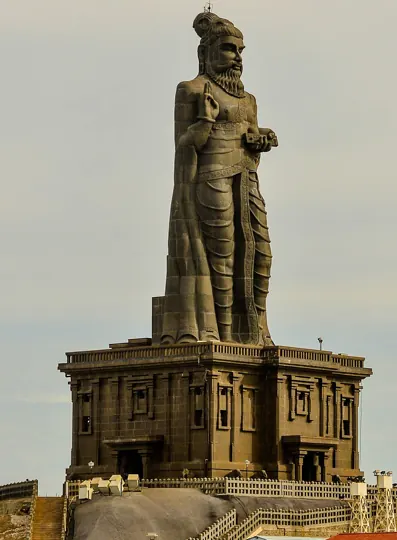
| Tirukkural | Tiruvalluvar’s couplets on virtue, wealth and love |
| Silappadikaram | Ilango Adigal’s epic of Kannagi |
| Manimekalai | Sattanar’s Buddhist sequel |
Mains 2013: ‘Though not very useful from the point of view of a connected political history of South India, the Sangam literature portrays the social and economic conditions of its time with remarkable vividness.’ Cite the five tinais (landscapes), trade at Puhar and Muziris, crafts and the warrior ethic.
Though not very useful from the point of view of a connected political history of South India, the Sangam literature portrays the social and economic conditions of its time with remarkable vividness. Comment.
Prelims 2023 asked about ‘the practice of ‘Vattakirutal’ as mentioned in Sangam poems’. It is a defeated king’s ritual suicide by starvation (answer d).
Which one of the following explains the practice of ‘Vattakirutal’ as mentioned in Sangam poems?
- Kings employing women bodyguards
- Learned persons assembling in royal courts to discuss religious and philosophical matters
- Young girls keeping watch over agricultural fields and driving away birds and animals
- A king defeated in a battle committing ritual suicide by starving himself to death
Show answer
Answer: (d) · UPSC official key
Sangam poems also name the early kings of Tamilakam: Senguttuvan and Udiyanjeral (Chera), Karikala (Chola) and Nedunjeliyan (Pandya).
What UPSC asks: Social picture (Mains 2013). Vattakirutal (Prelims 2023). Early Tamil kings.
Mains box: analysis and answer points
- Sangam texts as social history (Mains 2013).
- Buddhist and Jain texts on trade and towns.
Practice
Practice MCQs (8)
The Pali text Milindapanha ('Questions of Milinda') is cast as a dialogue on Buddhist doctrine between:
Answer (d) & explanation
The Milindapanha records a debate between Milinda, identified with the Indo- Greek king Menander (2nd century BCE, capital Sagala, modern Sialkot), and the monk Nagasena. Using analogies such as the chariot, Nagasena explains anatta (no permanent self), rebirth and karma; tradition says the king became a follower of the Buddha. It is a key example of Greek–Indian intellectual contact.
The Therigatha, included in the Khuddaka Nikaya of the Pali canon, is notable as:
Answer (d) & explanation
The Therigatha ('Verses of the Elder Nuns') gathers poems attributed to early bhikkhunis such as Mahapajapati Gotami, Patacara and Ambapali, who describe their lives, sorrows and liberation. It is one of the earliest known anthologies of women's religious poetry anywhere. Its companion, the Theragatha, holds the verses of the elder monks.
Consider the following Buddhist texts:
1. Dhammapada
2. Suttanipata
3. Udana
4. Lalitavistara
How many of the above belong to the Khuddaka Nikaya of the Pali canon?
Answer (c) & explanation
The Khuddaka Nikaya ('minor collection') is the fifth Nikaya of the Sutta Pitaka and includes the Dhammapada, the Suttanipata, the Udana, the Itivuttaka, the Jatakas and the Thera- and Therigatha. The Lalitavistara, a richly embellished life of the Buddha up to the first sermon, is a Sanskrit text of the Sarvastivada-Mahayana tradition and is not part of the Pali canon; it inspired the Borobudur reliefs.
With reference to the Jain canonical literature, consider the following statements:
1. The Shvetambara canon was finally redacted and written down at a council held at Valabhi under Devarddhi Kshamashramana in the fifth century CE.
2. The Digambaras accept the Shvetambara Agamas as fully authoritative scripture.
3. The Kalpasutra is traditionally recited by Shvetambara Jains during the Paryushana festival.
Which of the statements given above is/are correct?
Answer (b) & explanation
After earlier recensions at Pataliputra and Mathura, the Shvetambara Agamas were fixed in writing at the Valabhi council (Gujarat) presided over by Devarddhi Kshamashramana in the fifth century CE. The Digambaras hold that the original canon (the Purvas and Angas) was lost, so they do not accept the Shvetambara Agamas; they treat texts such as the Shatkhandagama as their scripture. The Kalpasutra, with the life of Mahavira, is read aloud during Paryushana.
With reference to the Pali Tipitaka of Theravada Buddhism, consider the following statements:
1. The Vinaya Pitaka contains the rules of discipline for monks and nuns.
2. The Jataka stories form part of the Khuddaka Nikaya of the Sutta Pitaka.
3. The Abhidhamma Pitaka is a biography of the Buddha in verse.
Which of the statements given above are correct?
Answer (a) & explanation
The Tipitaka ('three baskets') has the Vinaya Pitaka (monastic discipline, with the Patimokkha rules and the stories behind them), the Sutta Pitaka (discourses, in five Nikayas: Digha, Majjhima, Samyutta, Anguttara and Khuddaka) and the Abhidhamma Pitaka (systematic analysis of mind and matter). The Jatakas, stories of the Buddha's former births, sit in the Khuddaka Nikaya, along with the Dhammapada and the Theragatha-Therigatha. The Abhidhamma is scholastic philosophy, not a biography.
The Dipavamsa and the Mahavamsa, Pali chronicles that describe the Buddhist councils and the mission of Mahinda sent in Ashoka's time, were composed in:
Answer (b) & explanation
The Dipavamsa (c. 4th century CE) and the Mahavamsa (attributed to the monk Mahanama, c. 5th–6th century CE) are chronicles of the Theravada monks of Sri Lanka, written in Pali verse. They narrate the Buddha's visits to the island, the three councils, Ashoka's patronage, and the coming of Mahinda and Sanghamitta, and then the history of the Sri Lankan kings. They are a major, though partisan, source for Ashoka and the spread of Buddhism.
Consider the following pairs of Jain works and the authors to whom they are attributed:
1. Tattvarthasutra — Umasvati
2. Adipurana (Sanskrit) — Jinasena
3. Kalpasutra — Hemachandra
4. Shatkhandagama — Pushpadanta and Bhutabali
Which of the pairs given above are correctly matched?
Answer (c) & explanation
The Tattvarthasutra of Umasvati is the first systematic Jain work in Sanskrit sutras and is accepted by both sects. The Sanskrit Adipurana, on the first tirthankara Rishabha, was begun by Jinasena (9th century, Rashtrakuta period) and completed by his pupil Gunabhadra. The Kalpasutra, with the lives of the tirthankaras, is traditionally attributed to Bhadrabahu, not to Hemachandra (12th century). The Shatkhandagama, the earliest Digambara scriptural text, is attributed to Pushpadanta and Bhutabali.
With reference to Ashvaghosha, consider the following statements:
1. He composed the Buddhacharita, a life of the Buddha in the form of a Sanskrit mahakavya.
2. Buddhist tradition associates him with the court of the Kushana king Kanishka.
3. His Saundarananda narrates the conversion of the Buddha's son Rahula.
Which of the statements given above are correct?
Answer (a) & explanation
Ashvaghosha (c. 1st–2nd century CE) is the first great Buddhist poet in Sanskrit. His Buddhacharita is a court-epic life of the Buddha, and tradition (including Chinese sources) places him at the court of Kanishka. His second kavya, the Saundarananda, tells how the Buddha led his half-brother Nanda, attached to his beautiful wife Sundari, to monkhood — not Rahula. Fragments of his drama Shariputraprakarana were also found in Central Asia.
0 / 0 correct
Write an answer
In 150 words, explain the significance of Indian Literature with one recent example.
Flashcards (9)
Which Veda has charms and daily life?
Atharvaveda.
Were Upanishads earlier than Puranas?
Yes.
Name the three pitakas.
Vinaya, Sutta, Abhidhamma.
Who wrote Buddhacharita?
Ashvaghosha.
Where were Jain Agamas compiled?
Valabhi.
Oldest Tamil grammar?
Tolkappiyam.
Who wrote Silappadikaram?
Ilango Adigal.
What is Vattakirutal?
Ritual starvation by a defeated king.
Udiyanjeral belonged to which dynasty?
Chera.
In the news
- 20 Oct 2026Sirpur in Chhattisgarh enters UNESCO’s Tentative List of World Heritage sites
- 15 Oct 2026PM inaugurates five Ladakh projects: Nimmu–Padum–Darcha road, Leh terminal, Hanu hydro
- 14 Oct 2026HAL, NCF and ASI sign MoA for Hampi, Taj Mahal and Bekal Fort
- 3 Oct 2026Centres of Excellence approved for five newer classical languages
 Next topic · 7.2 →Indian Literature: Sanskrit, Persian and regional literature
Syllabus: GS-I · Indian culture will cover the salient aspects of Art Forms, literature and Archi…