
Chapter 14 · Topic 14.2 · Prelims + Mains2 of 3
Economic Planning: NITI Aayog and aspirational districts
Key points
- NITI Aayog and cooperative federalism.
- Aspirational districts and blocks.
3 PYQs 2016–2026
Prelims box: facts and traps
| Planning Commission | NITI Aayog |
|---|---|
| Top-down plans | Bottom-up, 'Team India' approach with States |
| Allocated funds to States and ministries | No power to allocate funds; a policy think tank |
| Five-Year Plans | Vision, strategy and action-agenda documents |
| States had a limited role in the NDC | Governing Council of all Chief Ministers and UT Lieutenant Governors |
| One-size-fits-all | Competitive and cooperative federalism, with State rankings and indices. |
- Structure: Chairperson (Prime Minister), Vice-Chairperson, full-time and part-time members, ex-officio Union ministers, CEO, Governing Council, regional councils, and the Development Monitoring and Evaluation Office (DMEO).
- NITI Aayog ranks districts on a real-time dashboard; the 3 Cs (convergence, collaboration, competition) are the programme's core idea.
- The Composite Water Management Index was first released in 2018, the Export Preparedness Index in 2020, and the Fiscal Health Index (first edition released on 24 January 2025) ranks 18 major States on fiscal indicators.
- Trap: “Under it, a State's development strategy must be approved by NITI Aayog before the State Budget can be passed” is wrong. The mission is advisory and voluntary; State Budgets are passed by State Legislatures under Article 202 onwards and need no NITI Aayog approval.
- Trap: “The Development Monitoring and Evaluation Office is a statutory body created by an Act of Parliament” is wrong. The DMEO is an attached office of NITI Aayog, with its own budget and functional autonomy, but it was not created by any Act.
NITI Aayog and cooperative federalism
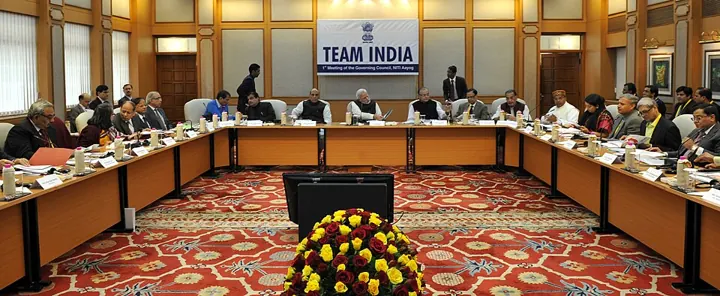
| Planning Commission | NITI Aayog |
|---|---|
| Top-down plans | Bottom-up, ‘Team India’ approach with States |
| Allocated funds to States and ministries | No power to allocate funds; a policy think tank |
| Five-Year Plans | Vision, strategy and action-agenda documents |
| States had a limited role in the NDC | Governing Council of all Chief Ministers and UT Lieutenant Governors |
| One-size-fits-all | Competitive and cooperative federalism, with State rankings and indices |
Structure: Chairperson (Prime Minister), Vice-Chairperson, full-time and part-time members, ex-officio Union ministers, CEO, Governing Council, regional councils, and the Development Monitoring and Evaluation Office (DMEO).
Mains 2018: How are the principles followed by the NITI Aayog different from those followed by the erstwhile Planning Commission in India? Mains 2018 Mains 2015: The concept of cooperative federalism has been increasingly emphasized in recent years. Mains 2015 NITI, the GST Council and Finance Commission devolution are its main tools.
How are the principles followed by the NITI Aayog different from those followed by the erstwhile Planning Commission in India?
The concept of cooperative federalism has been increasingly emphasized in recent years. Highlight the drawbacks in the existing structure and the extent to which cooperative federalism would answer the shortcomings.
Aspirational districts and blocks
| Point | Detail |
|---|---|
| Aspirational Districts Programme | Launched January 2018 for 112 of the most backward districts |
| Method | Convergence of schemes, collaboration of Centre, State and district, competition through monthly ranking |
| Themes | Health and nutrition, education, agriculture and water, financial inclusion and skills, basic infrastructure |
| Aspirational Blocks Programme | Launched 7 January 2023: 500 blocks in 329 districts, tracked on 40 indicators in 5 themes |
NITI Aayog ranks districts on a real-time dashboard; the 3 Cs (convergence, collaboration, competition) are the programme’s core idea.
Mains box: analysis and answer points
- Likely next angle: Governing Council
- Asked: Mains 2018 (GS Paper III, 15 marks): How are the principles followed by the NITI Aayog different from those followed by the erstwhile Planning Commission in India?
- Asked: Mains 2015 (GS Paper II, 12.5 marks): The concept of cooperative federalism has been increasingly emphasized in recent years. Highlight the drawbacks in the existing structure and the extent to which cooperative federalism would answer the shortcomings.
Practice
Practice MCQs (6)
With reference to the Aspirational Districts Programme anchored by NITI Aayog, consider the following statements:
1. It was launched in January 2018.
2. Agriculture and water resources carry the highest weight among its themes.
3. Districts are ranked on their incremental progress ('delta ranking') on a public dashboard.
Which of the statements given above is/are correct?
Answer (d) & explanation
Statements 1 and 3 are correct. The Aspirational Districts Programme, launched in January 2018, works on convergence, collaboration and competition. It tracks 49 key performance indicators under five themes, and districts are ranked every month on incremental progress on the Champions of Change dashboard. Statement 2 is wrong: the weights are health and nutrition 30 per cent, education 30 per cent, agriculture and water resources 20 per cent, and financial inclusion with skill development and basic infrastructure 10 per cent each.
With reference to the Aspirational Blocks Programme, consider the following statements:
1. It was launched in January 2023.
2. At its launch, it covered 500 blocks spread across 27 States and 4 Union Territories.
3. It replaced the Aspirational Districts Programme, which was wound up when it began.
Which of the statements given above is/are correct?
Answer (b) & explanation
Statements 1 and 2 are correct. The Aspirational Blocks Programme was launched by the Prime Minister on 7 January 2023. An inter-ministerial committee, in consultation with States, identified 500 blocks in 329 districts across 27 States and 4 Union Territories, tracked on 40 indicators under five themes. Statement 3 is wrong: the programme builds on the Aspirational Districts Programme, which continues; at least one block was chosen from each aspirational district.
Within NITI Aayog, the 'Team India Hub' is mainly responsible for
Answer (a) & explanation
NITI Aayog's work is organised around two hubs. The Team India Hub leads the engagement of States with the Central Government, the channel for cooperative federalism. The Knowledge and Innovation Hub builds NITI's think-tank capacity, with a resource centre, research repository and partnerships with institutions and experts. Programme evaluation is the job of the Development Monitoring and Evaluation Office, and NITI Aayog does not allocate assistance to States.
Consider the following indices/reports:
1. Composite Water Management Index
2. Export Preparedness Index
3. Fiscal Health Index
4. Logistics Ease Across Different States (LEADS)
How many of the above are brought out by NITI Aayog?
Answer (c) & explanation
Three are NITI Aayog products. The Composite Water Management Index was first released in 2018, the Export Preparedness Index in 2020, and the Fiscal Health Index (first edition released on 24 January 2025) ranks 18 major States on fiscal indicators. LEADS is brought out by the Ministry of Commerce and Industry, not by NITI Aayog. Ranking States on outcomes is how NITI Aayog promotes competitive federalism.
With reference to NITI Aayog's State Support Mission, consider the following statements:
1. It supports States in setting up State Institutions for Transformation or in reimagining their existing Planning Departments and Planning Boards.
2. Under it, a State's development strategy must be approved by NITI Aayog before the State Budget can be passed.
3. State Institutions for Transformation are meant to combine government officials with domain experts to provide strategy, monitoring and data analytics.
Which of the statements given above is/are correct?
Answer (b) & explanation
Statements 1 and 3 are correct. Under the State Support Mission, NITI Aayog helps States set up a State Institution for Transformation or revamp their planning departments and boards. These are meant to be multidisciplinary policy units that bring together officials and domain experts to prepare State strategies, identify growth drivers, and run monitoring, evaluation and data analytics. Statement 2 is wrong: the mission is advisory and voluntary; State Budgets are passed by State Legislatures under Article 202 onwards and need no NITI Aayog approval.
Consider the following statements:
1. The Programme Evaluation Organisation was set up in 1952, initially to evaluate the Community Development Programme and other intensive area development schemes.
2. The Development Monitoring and Evaluation Office was formed in 2015 by merging the Programme Evaluation Organisation with the Independent Evaluation Office.
3. The Development Monitoring and Evaluation Office is a statutory body created by an Act of Parliament.
Which of the statements given above is/are correct?
Answer (a) & explanation
Statements 1 and 2 are correct. The Programme Evaluation Organisation was set up in October 1952 as a division of the Planning Commission to evaluate the Community Development Programme and similar schemes. The Independent Evaluation Office followed in November 2010. On 18 September 2015 the two were merged into the Development Monitoring and Evaluation Office. Statement 3 is wrong: the DMEO is an attached office of NITI Aayog, with its own budget and functional autonomy, but it was not created by any Act.
0 / 0 correct
Prelims PYQs on this topic (3)
Consider the following statements about Multidimensional Poverty Index (MPI) :
- 1. MPI is calculated using Alkire-Foster methodology.
- 2. MPI calculated by NITI Aayog has a total of twelve indicators.
- 3. Maternal Health and Bank Account are common indicators in the MPI of NITI Aayog and MPI of United Nations Development Programme (UNDP).
Which of the statements given above is/are correct ?
Answer (a) & explanation
Statements 1 and 2 are correct (a). Statement 1 is right: both the global MPI (UNDP and Oxford's OPHI) and NITI Aayog's national MPI use the Alkire-Foster method, across health, education and standard of living. Statement 2 is right: NITI Aayog's MPI has 12 indicators. Statement 3 is wrong: the global MPI has 10 indicators; NITI Aayog added two of its own, maternal health and bank account, so these are not common. So options (b), (c) and (d) fail.
Notice the headline: NITI Aayog estimated that about 24.8 crore people escaped multidimensional poverty between 2013-14 and 2022-23. A person is MPI-poor if deprived in at least one-third of the weighted indicators.
statement 3 names the exact two indicators that make NITI's index different. They are extras, not shared ones.
Answer as per the official UPSC answer key.
With reference to 'National Investment and Infrastructure Fund', which of the following statements is/are correct ?
- 1. It is an organ of NITI Aayog.
- 2. It has a corpus of ₹4,00,000 crore at present.
Select the correct answer using the code given below :
Answer (d) & explanation
Neither statement is correct (d). The National Investment and Infrastructure Fund (NIIF), set up in 2015, is a fund manager registered with SEBI as an Alternative Investment Fund. It was set up by the Ministry of Finance (Department of Economic Affairs), not NITI Aayog, so statement 1 is wrong. Its planned corpus was ₹40,000 crore, with the government putting in up to 49% and the rest coming from investors such as Abu Dhabi's ADIA, Temasek and AIIB. Statement 2 adds an extra zero.
It runs a Master Fund, a Fund of Funds and a Strategic Opportunities Fund. Notice the other infrastructure-finance bodies: NaBFID (2021) is a development finance institution, and the National Infrastructure Pipeline listed the projects.
the extra zero. Count the digits in big figures.
Answer as per the official UPSC answer key.
With reference to 'Financial Stability and Development Council', consider the following statements :
- 1. It is an organ of NITI Aayog.
- 2. It is headed by the Union Finance Minister.
- 3. It monitors macroprudential supervision of the economy.
Which of the statements given above is/are correct?
Answer (c) & explanation
Statements 2 and 3 are correct (c). The Financial Stability and Development Council (FSDC) was set up in 2010 by executive order after the global financial crisis. It is chaired by the Union Finance Minister (2). Its members include the heads of the RBI, SEBI, IRDAI, PFRDA and IBBI. It oversees macroprudential supervision of the economy and also looks after inter-regulator coordination and financial literacy and inclusion (3). Statement 1 is wrong because it sits under the Ministry of Finance, not NITI Aayog.
Note that it is not a statutory body. Its sub-committee is chaired by the RBI Governor. Notice the difference between the two kinds of supervision: macroprudential looks at risk to the whole system, while microprudential looks at one bank at a time.
"organ of NITI Aayog" also appeared for NIIF in 2017 Q55. Both are Finance Ministry bodies.
Answer as per the official UPSC answer key.
Write an answer
In 150 words, explain the significance of Economic Planning with one recent example.
Flashcards (4)
NITI's evaluation office?
DMEO.
Aspirational Districts Programme launched?
January 2018, 112 districts.
Aspirational Blocks Programme?
January 2023, 500 blocks.
3 Cs of ADP?
Convergence, collaboration, competition.
Read more: related explainers
- NITI Aayog: Why It Replaced the Planning Commission, Structure, Functions, Indices and Criticism
- PM Dhan-Dhaanya Krishi Yojana: Convergence of 36 Schemes in 100 Low-Productivity Districts, Selection Criteria, Monitoring and the Aspirational Districts Model
- Economic Survey of India: Meaning, History, Who Prepares It, How It Differs from the Budget, Big Ideas from Past Surveys and How to Use It for UPSC
In the news
- 23 Oct 2026PLFS changes from January 2027: new stratum for platform workers and unpaid work questions
- 21 Oct 2026Core sector grows 7.9% in September 2026; iron ore, electricity and coal lead
- 20 Oct 2026Financial inclusion saturation campaign in 2.70 lakh panchayats and ULBs from 21 October
- 15 Oct 2026PLFS September 2026: unemployment steady at 5%; urban women’s participation highest since October 2025
 Next topic · 14.3 →Economic Planning: Mobilising resources for development
Syllabus: GS-III · Indian Economy and issues relating to planning, mobilization, of resources, grow…