
Chapter 15 · Topic 15.2 · Prelims + Mains2 of 2
Current Environment: Reports: Living Planet, forests, biodiversity and
Key points
- Living Planet Report: WWF with ZSL, every two years since 1998.
- LPR 2026: 73% average decline in tracked vertebrate populations (1970–2022), freshwater −85%.
- The index shows average population change, not species lost.
- ISFR: FSI, biennial since 1987. ISFR 2023 is the 18th edition.
- Forest and tree cover 25.17% (forest 21.76%, tree 3.41%). Goal: 33% (National Forest Policy 1988).
- IPBES: set up 2012, secretariat in Bonn.
Prelims box: facts and traps
| Report | Publisher |
|---|---|
| Living Planet Report | WWF (index with ZSL) |
| India State of Forest Report | Forest Survey of India |
| State of India’s Environment | Centre for Science and Environment |
| Biodiversity assessments | IPBES |
- Trap: a 73% LPI decline is not 73% of animals lost.
- Trap: forest cover counts all land with canopy above 10%, not only notified forests.
Reports: Living Planet, forests, biodiversity and
Environment reports are the report cards of nature. UPSC often asks which body publishes which report, so match each report to its publisher. The table below lists the main ones:
| Report | Latest edition | Key figure | Type |
|---|---|---|---|
| Living Planet Report (WWF, with ZSL index) | 2026 (7 Oct 2026) | 73% average decline in monitored vertebrate populations, 1970–2022; freshwater −85% | Measured index |
| India State of Forest Report (Forest Survey of India) | 2023 (released Dec 2024) | Forest and tree cover 8,27,357 sq km = 25.17% of area (forest 21.76%, tree 3.41%) | Measured survey |
| National forest goal | National Forest Policy 1988 | 33% of area under forest or tree cover | Target |
WWF press release 7 Oct 2026, ISFR 2023 (PIB).
Living Planet Report
The Living Planet Report is the flagship study of WWF (World Wide Fund for Nature). It is released every two years, and the first edition came out in 1998 (WWF). Its core is the Living Planet Index, built with the Zoological Society of London (ZSL).
Living Planet Report 2026: the index covers 35,803 population trends of 5,790 species. A population here means a group of one species in one place, such as the elephants of one forest. The index measures the average change in population size, not the number of animals or species lost.
An everyday example makes this clear. Suppose three villages had 100 sparrows each in 1970. Today one village has 10, one has 50 and one has 100. The average fall is 47%, even though no village lost all its birds. So a 73% decline does not mean 73% of all animals have died. It means tracked populations shrank by 73% on average.
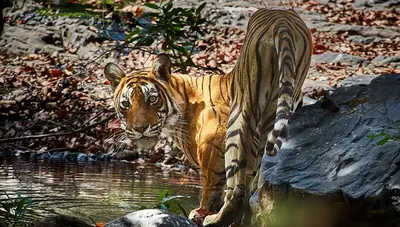
The worst fall is in freshwater life (−85%), because rivers and lakes face dams, pollution and over-fishing at once. Not all news is bad. About half the populations tracked are stable or increasing. Tigers, green turtles, southern African elephants and bluefin tuna are cited as recoveries, which shows that protection works.
India State of Forest Report
The India State of Forest Report (ISFR) is published by the Forest Survey of India (FSI), Dehradun, under the Environment Ministry. It has come out every two years (biennially) since 1987. ISFR 2023, released in December 2024, is the 18th edition (PIB, December 2024).
FSI uses two tools. Satellite images map forest cover from space. A field survey, the National Forest Inventory, counts trees on the ground to estimate growing stock (the volume of wood) and carbon stock (FSI, ISFR 2023).
Two terms matter here:
- Forest cover is all land over 1 hectare with tree canopy density above 10%, whoever owns it.
- Tree cover is small patches and scattered trees outside forests, such as trees along roads and on farms.
Per ISFR 2023, total forest and tree cover is 8,27,357 sq km, which is 25.17% of India’s geographical area. Forest cover is about 7,15,343 sq km (21.76%) and tree cover 1,12,014 sq km (3.41%) (PIB, December 2024). The National Forest Policy 1988 wants 33% of the area under forest or tree cover, so India is still about 8 percentage points short of that goal.
Biodiversity and state of environment reports
Biodiversity reports: IPBES (the Intergovernmental Science-Policy Platform on Biodiversity and Ecosystem Services) is to nature what the IPCC is to climate. It was set up in April 2012 in Panama City as an independent intergovernmental body, with its secretariat in Bonn, Germany (IPBES). In December 2024 it assessed the nexus (close link) of biodiversity, water, food and health, and also transformative change, meaning deep changes in how societies work.
State of environment: the Centre for Science and Environment (CSE), a Delhi-based research group, publishes an annual ‘State of India’s Environment’ report.
What UPSC asks: Prelims: report-publisher match (LPR by WWF, ISFR by FSI, IPBES assessments). Mains: limits of the LPR method, forest cover vs the 33% target.
Mains box: analysis and answer points
- LPR method: what an average index can and cannot show.
- Forest cover: 25.17% vs the 33% goal.
- Freshwater crisis: why the steepest decline.
Practice
Write an answer
In 150 words, explain the significance of Current Environment with one recent example.
Flashcards (5)
LPR 2026 decline?
73% (1970–2022).
Steepest LPR decline?
Freshwater, 85%.
ISFR 2023 forest+tree cover?
25.17% of area.
National forest goal?
33% of area.
Living Planet Index compiled by?
ZSL, for WWF.
In the news
- 25 Oct 2026₹1.04 crore of access and benefit-sharing money from crops shared with 27 States and 2 UTs
- 22 Oct 2026GRAP Stage I invoked in Delhi-NCR as AQI turns ‘Poor’: the 25 actions and what comes next
- 20 Oct 2026National Red List of birds: 1,211 species under assessment, 107 done in first review
- 16 Oct 2026CAQM orders PTZ cameras at all polluting industries in NCR by 30 November 2026
 Environment and Ecology →All Environment and Ecology topics
Syllabus: GS-III · Conservation, environmental pollution and degradation, environmental impact asse…