
Chapter 2 · Topic 2.3 · Prelims + Mains3 of 3
Ecosystem: Chapter test
Key points
- Carbon and nitrogen cycles.
- Phosphorus and water cycles.
9 PYQs 2016–2026
Prelims box: facts and traps
| Carbon cycle | Process |
|---|---|
| Removes CO2 from air | Photosynthesis; dissolving in oceans; formation of carbonate rocks |
| Adds CO2 to air | Respiration, decay of organic matter, burning of fossil fuels and wood, volcanic action. |
- Gaseous cycles (carbon, nitrogen) have their main reservoir in the air or ocean; sedimentary cycles (phosphorus, sulphur) have it in the Earth's crust.
- Volcanic action, respiration and decay of organic matter add carbon dioxide to the carbon cycle; photosynthesis removes it (Prelims 2014: 1, 2 and 4 only).
- A.G. Tansley coined the term 'ecosystem' in 1935, Lindeman developed the trophic-dynamic concept and the 10 per cent law in 1942, and Eugene Odum popularised ecosystem ecology through his textbooks.
- Trap (UPSC Prelims 2022): “Amaranth” is incorrect. “Purslane (Kulfa)” is incorrect. “Spinach” is incorrect.
- Trap (UPSC Prelims 2013): “Burning of coal by man” is incorrect.
Carbon and nitrogen cycles
Nutrient (biogeochemical) cycles move elements between living things and the air, water and rocks. Gaseous cycles (carbon, nitrogen) have their main reservoir in the air or ocean; sedimentary cycles (phosphorus, sulphur) have it in the Earth’s crust.
| Carbon cycle | Process |
|---|---|
| Removes CO2 from air | Photosynthesis; dissolving in oceans; formation of carbonate rocks |
| Adds CO2 to air | Respiration, decay of organic matter, burning of fossil fuels and wood, volcanic action |
Volcanic action, respiration and decay of organic matter add carbon dioxide to the carbon cycle; photosynthesis removes it (Prelims 2014: 1, 2 and 4 only).
Which of the following adds/add carbon dioxide to the carbon cycle on the planet Earth? 1. Volcanic action 2. Respiration 3. Photosynthesis 4. Decay of organic matter Select the correct answer using the code given below.
- 1 and 3 only
- 2 only
- 1, 2 and 4 only
- 1, 2, 3 and 4
Show answer
Answer: (c) · UPSC official key
The same idea was asked in 2011 with the list reordered: respiration, decay of organic matter and volcanic action (Prelims 2011: 2, 3 and 4 only).
Consider the following : 1. Photosynthesis 2. Respiration 3. Decay of organic matter 4. Volcanic action Which of the above add carbon dioxide to the carbon cycle on Earth ?
- 1 and 4 only
- 2 and 3 only
- 2, 3 and 4 only
- 1, 2, 3 and 4
Show answer
Answer: (c) · UPSC official key
The nitrogen cycle.
Nitrogen cycle
What happens Agents step
Fixation N2 → ammonia Rhizobium (legume nodules), Azotobacter, cyanobacteria (Anabaena, Nostoc); lightning; Haber–Bosch industry
| Nitrogen cycle step | What happens | Agents |
|---|---|---|
| Ammonification | Dead matter and urea → ammonia | Decomposer bacteria and fungi |
| Nitrification | Ammonia → nitrite → nitrate | Nitrosomonas, then Nitrobacter |
| Assimilation | Nitrate taken up by plants | Plant roots |
| Denitrification | Nitrate → N2 back to air | Pseudomonas and other bacteria |
Excretion of urea by animals and death of vegetation add nitrogen to the soil (Prelims 2013: 1 and 3 only).
Which of the following adds/add nitrogen to the soil? 1. Excretion of urea by animals 2. Burning of coal by man 3. Death of vegetation Select the correct answer using the codes given below.
- 1 only
- 2 and 3 only
- 1 and 3 only
- 1, 2 and 3
Show answer
Answer: (c) · UPSC official key
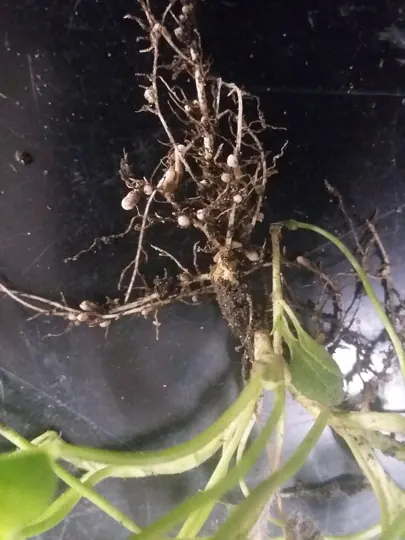
Alfalfa, chickpea and clover are nitrogen-fixing legumes; amaranth, purslane and spinach are not (Prelims 2022: 1, 3 and 4 only).
Which of the following are nitrogen-fixing plants ? 1. Alfalfa 2. Amaranth 3. Chickpea 4. Clover 5. Purslane (Kulfa) 6. Spinach Select the correct answer using the code given below:
- 1, 3 and 4 only
- 1, 3, 5 and 6 only
- 2, 4, 5 and 6 only
- 1, 2, 4, 5 and 6
Show answer
Answer: (a) · UPSC official key
Phosphorus and water cycles
| Phosphorus cycle | Detail |
|---|---|
| Reservoir | Phosphate rocks in the Earth’s crust |
| Release | Weathering of rocks; mining for fertilisers |
| Uptake | Plants absorb phosphate from soil; animals get it from plants |
| Return | Decomposition; much is lost to ocean sediments |
| Gaseous phase | None of any importance, so the cycle is slow |
Phosphorus is often the nutrient that limits plant growth in fresh water. Fertiliser and sewage run-off rich in phosphates and nitrates feeds algal blooms that use up oxygen: eutrophication.
| Water cycle process | Meaning |
|---|---|
| Evaporation and transpiration | Water vapour rises from water bodies and from leaves |
| Condensation | Vapour cools to form clouds |
| Precipitation | Rain, snow and hail fall back to Earth |
| Infiltration and run-off | Water soaks into the ground or flows to streams, rivers and seas |
Mains box: analysis and answer points
- Phosphorus is often the nutrient that limits plant growth in fresh water.
- Nutrient (biogeochemical) cycles move elements between living things and the air, water and rocks.
- Likely next angle: Nitrification
Practice
Practice MCQs (8)
In a forest, trees occupy the top layer, shrubs the second layer, and herbs and grasses the bottom layers. This vertical distribution of species at different levels is called
Answer (d) & explanation
NCERT describes the physical structure of an ecosystem through two features. Identifying and counting the species present gives its species composition, while the vertical layering of species at different heights is called stratification. In a forest, trees form the top stratum, shrubs the middle and herbs and grasses the lowest.
The concept of the 'pyramid of numbers', along with the idea of food chains linking animals in a community, was introduced in his 1927 book 'Animal Ecology' by
Answer (b) & explanation
Charles Elton, the British ecologist, described food chains, the 'food cycle' (now called the food web) and the pyramid of numbers in 'Animal Ecology' (1927); ecological pyramids are therefore often called 'Eltonian pyramids'. A.G. Tansley coined the term 'ecosystem' in 1935, Lindeman developed the trophic-dynamic concept and the 10 per cent law in 1942, and Eugene Odum popularised ecosystem ecology through his textbooks.
In ecosystem studies, the amount of nutrients such as carbon, nitrogen, phosphorus and calcium present in the soil at any given time is referred to as the
Answer (d) & explanation
NCERT defines the standing state as the amount of nutrients, such as carbon, nitrogen, phosphorus and calcium, present in the soil at any given time; it varies between ecosystems and with the seasons. The standing crop, by contrast, is the mass of living material at each trophic level at a particular time, measured as biomass or number per unit area. Net primary productivity is a rate, not an amount present at one moment.
With reference to the phosphorus cycle, consider the following statements:
1. The natural reservoir of phosphorus is rock, which holds it in the form of phosphates.
2. Unlike in the carbon cycle, there is no respiratory release of phosphorus into the atmosphere.
3. Atmospheric inputs of phosphorus through rainfall are much larger than the atmospheric inputs of carbon.
Which of the statements given above are correct?
Answer (a) & explanation
Statements 1 and 2 are correct. NCERT calls the phosphorus cycle a sedimentary cycle whose natural reservoir is rock; when rocks weather, minute amounts of phosphate dissolve in the soil solution and are taken up by roots, and phosphate-solubilising bacteria release phosphorus from wastes and dead organisms. Unlike carbon, there is no respiratory release of phosphorus into the atmosphere. NCERT adds that atmospheric inputs of phosphorus through rainfall are much smaller than carbon inputs, and gaseous exchanges of phosphorus are negligible; so statement 3 is wrong.
With reference to the producers of an ecosystem, consider the following statements:
1. Nitrifying bacteria such as Nitrosomonas are autotrophs because they fix carbon dioxide using energy released by oxidising inorganic compounds.
2. Cuscuta (dodder) is a producer because it is a flowering plant.
3. The pitcher plant remains a producer even though it digests insects.
Which of the statements given above is/are correct?
Answer (b) & explanation
Statements 1 and 3 are correct. A producer is any organism that makes its own organic food from inorganic carbon. Chemosynthetic bacteria such as Nitrosomonas do this with energy from oxidising ammonia, so they are autotrophs. The pitcher plant is green and photosynthesises; it traps insects only to obtain scarce nitrogen, so it stays a producer. Statement 2 is wrong: Cuscuta has almost no chlorophyll and draws food from its host through haustoria, so it is a consumer (a parasite), not a producer.
Consider the following pairs: Ecosystem or food chain — Shape of the pyramid
1. Grassland — Pyramid of numbers upright
2. Parasitic food chain on a host plant — Pyramid of numbers inverted
3. Open sea — Pyramid of energy inverted
4. A single large tree with its insects and birds — Pyramid of biomass inverted
How many of the pairs given above are correctly matched?
Answer (b) & explanation
Only pairs 1 and 2 are correct. In a grassland, producers are far more numerous than herbivores, which outnumber carnivores, so the numbers pyramid is upright. In a parasitic chain, numbers rise at higher levels, so it is inverted. Pair 3 is wrong because the pyramid of energy is never inverted, in the sea or anywhere else (it is the biomass pyramid that is inverted in the sea). Pair 4 is wrong: one tree has a far greater mass than the insects and birds it supports, so the biomass pyramid is upright, even though the numbers pyramid is narrow at the base.
Consider the following statements about ecological pyramids:
1. They assume a simple food chain, which seldom exists in nature, and do not accommodate a food web.
2. They cannot show a species that belongs to two or more trophic levels.
3. Saprophytes are not given any place in them, even though they play a vital role in the ecosystem.
4. The pyramid of energy cannot be used to compare the functioning of different ecosystems.
How many of the above are limitations of ecological pyramids?
Answer (c) & explanation
Statements 1, 2 and 3 are the limitations listed in NCERT: pyramids assume a simple food chain, they cannot place a species that feeds at two trophic levels, and saprophytes (decomposers) are left out. Statement 4 is wrong: the pyramid of energy, expressed in common energy units per area per time, is in fact the best basis for comparing different ecosystems and the relative importance of populations within them.
Consider the following conditions:
1. Detritus rich in lignin and chitin
2. Detritus rich in nitrogen and water-soluble substances such as sugars
3. A warm and moist environment
4. Waterlogged soil with little oxygen
How many of the above conditions speed up the decomposition of detritus?
Answer (b) & explanation
Only two, conditions 2 and 3, speed up decomposition. NCERT says the rate of decomposition is controlled by the chemical composition of detritus and by climatic factors. Under the same climate, decomposition is slower if detritus is rich in lignin and chitin and quicker if it is rich in nitrogen and water-soluble substances like sugars. Temperature and soil moisture are the key climatic factors: a warm and moist environment favours decomposition, while low temperature and anaerobiosis inhibit it and lead to a build-up of organic matter.
0 / 0 correct
Prelims PYQs on this topic (8)
Which of the following best explain(s) the rationale for protecting mangrove ecosystems in the context of climate resilience ?
- 1. Mangroves reduce tidal energy and store freshwater, making them ideal sites for paddy cultivation in saline estuarine belts.
- 2. Their salt-sensitive roots filter seawater, making mangroves key to converting coastal land into freshwater aquaculture zones.
- 3. By withstanding tidal surges and offering biomass resources, mangroves function both as natural bio-shields and livelihood bases for rural communities.
Select the answer using the code given below :
Answer (d) & explanation
Only statement 3 explains the rationale (d). Statement 3 is right: by withstanding tidal surges and cyclones, mangroves act as natural bio-shields, and they offer biomass, such as fish, crabs, honey and fuel, for coastal villages. Statement 1 is wrong: mangroves do not store fresh water for paddy. Statement 2 is wrong: they are salt-tolerant, not salt-sensitive. Clearing them for farms or aquaculture ponds is exactly what harms them. So options (a), (b) and (c) fail.
Notice the proof: mangroves cut deaths in the 1999 Odisha super-cyclone and the 2004 tsunami. They also store much blue carbon. India's largest mangrove forest is the Sundarbans; the MISHTI scheme (2023) aims to plant more along the coast.
statement 2 says "salt-sensitive". Mangroves live in salt water because they tolerate it.
Answer as per the official UPSC answer key.
Which of the following statements in relation to NIRANTAR (National Institute for Research and Application of Natural Resources to Transform, Adapt and Build Resilience), a platform of institutions under the Ministry of Environment, Forest and Climate Change, is/are correct ?
- 1. Ecosystem Survey and Analysis is a vertical under this platform, the lead institute of which is Botanical Survey of India, Kolkata.
- 2. Research and Management of Ecosystem Service is a vertical under this platform, the lead institute of which is Central Zoo Authority, New Delhi.
- 3. Capacity Development Support is a vertical under this platform, the lead institute of which is Indian Institute of Forest Management, Bhopal.
Select the answer using the code given below :
Answer (b) & explanation
Statements 1 and 3 are correct (b). NIRANTAR groups the Environment Ministry's institutes into verticals. Statement 1 is right: Ecosystem Survey and Analysis is led by the Botanical Survey of India, Kolkata, with bodies like the FSI and ZSI. Statement 3 is right: Capacity Development Support is led by the Indian Institute of Forest Management, Bhopal. Statement 2 is wrong: Research and Management of Ecosystem Service is led by ICFRE, Dehradun; the Central Zoo Authority is only a member. So options (a), (c) and (d) fail.
Notice the purpose: pooling institutes avoids duplicate work and links research to climate adaptation and resilience. Other Ministry bodies include the Wildlife Institute of India (Dehradun) and GBPNIHE for the Himalaya.
the Central Zoo Authority does sit in that vertical, but as a member, not the lead.
Answer as per the official UPSC answer key.
What is blue carbon?
Answer (a) & explanation
Blue carbon is carbon captured by oceans and coastal ecosystems (a). Blue carbon is the carbon stored by ocean and coastal ecosystems, mainly mangroves, salt marshes and seagrass meadows. Area for area, they lock away carbon much faster than land forests and keep it in their waterlogged soils for centuries. Option (b) describes green carbon, held in land forests and soils. Option (c) describes fossil carbon in petroleum and natural gas, sometimes called brown or black carbon. Option (d) describes carbon already in the atmosphere, mostly as CO₂.
Notice the MISHTI scheme (2023) for planting mangroves along India's coasts. Sundarbans is the world's largest mangrove forest. Losing these habitats releases their stored carbon.
Answer as per the official UPSC answer key.
If a particular plant species is placed under Schedule VI of The Wildlife Protection Act, 1972, what is the implication ?
Answer (a) & explanation
A licence is needed to cultivate that plant (a). Schedule VI of the Wild Life (Protection) Act, 1972 listed specified plants, such as the red vanda, blue vanda, ladies' slipper orchid and pitcher plant. They could be grown, but only with a licence from the Chief Wildlife Warden, so that plants taken from the wild could not be passed off as cultivated ones. Option (b) is wrong: cultivation is allowed under licence. Option (c) is wrong: GM crops are regulated by the GEAC. Option (d) is wrong: the schedule protects rare plants, it does not list invasive ones.
Notice the 2022 amendment, which cut the schedules from six to four: specified plants are now in Schedule III, and CITES species in Schedule IV.
Answer as per the official UPSC answer key.
Why is there a great concern about the ‘microbeads’ that are released into environment?
Answer (a) & explanation
Microbeads harm marine ecosystems (a). Microbeads are tiny plastic balls, under 5 mm and often under 1 mm, that were added to face scrubs, toothpaste and cosmetics. They are too small to be caught by sewage plants, so they flow into rivers and seas. Fish, plankton and shellfish swallow them, and they soak up toxic chemicals, which move up the food chain to humans. They are not known to cause skin cancer (b), are not absorbed by crop plants (c), and are not food adulterants (d).
Notice the rules: the USA banned them in 2015, and India's BIS declared them unsafe for cosmetics (2017). India banned single-use plastic items from July 2022, and global talks on a plastics treaty continue.
Answer as per the official UPSC answer key.
The term “sixth mass extinction/sixth extinction” is often mentioned in the news in the context of the discussion of
Answer (d) & explanation
Option (d) best describes it. Earth has gone through five mass extinctions. The last, about 66 million years ago, wiped out the dinosaurs after an asteroid struck. Scientists warn that a sixth is under way, this time caused by humans: overuse of resources, habitat loss and fragmentation, pollution, invasive species and climate change. Species are vanishing at many times the natural background rate. Options (a) and (c) name only one cause each: monoculture or GM crops. Option (b) is wrong because the term is not about a coming meteorite.
Notice the IPBES report (2019), which warned that about one million species face extinction. The Kunming–Montreal Framework (2022) responded with the 30x30 target: protect 30% of land and sea by 2030.
Answer as per the official UPSC answer key.
Mains PYQs on this topic (1)
Write an answer
In 150 words, explain the significance of Ecosystem with one recent example.
Flashcards (5)
Ammonia → nitrite is done by?
Nitrosomonas.
Nitrite → nitrate is done by?
Nitrobacter.
Nitrogen-fixing plants (2022 PYQ)?
Alfalfa, chickpea, clover.
Phosphorus cycle type?
Sedimentary, with no important gaseous phase.
Eutrophication is caused by?
Excess nitrates and phosphates feeding algal blooms.
In the news
- 23 Oct 2026Carbon capture: how India can make its ₹20,000 crore CCUS push count, in three phases
- 22 Oct 2026Emissions Gap Report 2026 ‘The Point of Return’: 1.5°C will be crossed, but can be regained by 2100
- 22 Oct 20261% green jet fuel for international flights from 2027: India’s SAF plan and ICAO’s CORSIA
- 22 Oct 2026Agrivoltaics World Conference in Delhi: PM-KUSUM’s next phase and the small-farmer test
 Next chapter · 3. Biodiversity →Biodiversity: Levels, hotspots and threats