
Carbon capture: how India can make its ₹20,000 crore CCUS push count, in three phases
UPSC has already asked about this. Read the story with these questions in mind.
Union Budget 2026 set aside ₹20,000 crore over five years for carbon capture, utilisation and storage (CCUS). An expert piece in the Indian Express (23 October 2026) suggests spending it in three phases: about ₹4,000 crore on research, pilots and mapping storage sites; about ₹9,000 crore on public–private plants; and ₹6,000–7,000 crore on scale-up. The aim is to help steel, cement and refineries cut emissions they cannot easily avoid.
- Budget
- ₹20,000 crore, 5 years
- Phase 1
- About ₹4,000 crore
- Phase 2
- About ₹9,000 crore
- Cost goal
- Under ₹2,000/tonne
CCUS plan: what happened?
Some factories cannot simply switch to solar. A cement kiln releases carbon dioxide from the limestone itself. That is where carbon capture comes in.
- 23 Oct 2026: experts in the Indian Express propose a phased plan for the ₹20,000 crore CCUS budget.
- Phase 1 (~20%): research, AI-led screening of sorbents, pilots of 30,000–1,00,000 tonnes a year, and mapping storage in the Cauvery basin, Cambay, Mahanadi valley and Deccan Traps.
- Phase 2 (~₹9,000 crore): PPPs, two large capture-and-use units of about 2 lakh tonnes a year, pilot storage injection and Direct Air Capture tests.
- Phase 3 (₹6,000–7,000 crore): units above 10 lakh tonnes a year, linked to carbon markets and the hydrogen plan.
What is CCUS?
- Carbon capture, utilisation and storage traps CO₂ from chimneys of power plants and industries.
- The CO₂ is either stored deep underground in rock formations or used to make chemicals, fuels or building materials.
- Basalt rocks like the Deccan Traps can turn CO₂ into stable minerals.
- UNEP’s Emissions Gap Report 2026 says crossing 1.5°C is now unavoidable, so removal tools matter more.
How do capture, use and storage compare?
| Route | What happens to CO₂ | Example |
|---|---|---|
| Capture and use (CCU) | Turned into products | Urea, methanol, concrete curing |
| Capture and storage (CCS) | Locked underground | Saline aquifers, old oil fields, basalt |
| Direct Air Capture (DAC) | Pulled from open air | Costly; tests proposed |
| Blue hydrogen | CCS added to gas-based hydrogen | Bridge till green hydrogen |
What is the policy and legal angle?
- Paris Agreement (2015): India’s updated NDC and net-zero target for 2070.
- Energy Conservation (Amendment) Act, 2022 enabled the Carbon Credit Trading Scheme, 2023.
- There is no Indian law yet on CO₂ ownership, liability for leaks or post-injection monitoring.
- Article 48A (Directive Principle) and Article 51A(g) (Fundamental Duty) on protecting the environment.
What are the challenges?
- High cost: ₹10,000–20,000 per tonne of CO₂ today.
- Storage sites are not mapped in detail.
- No clear rules on liability and carbon accounting.
- Critics warn CCUS can prolong fossil fuel use.
What should be done?
- Fund geological mapping first so investors know where to store CO₂.
- Use PPPs, learning from the UK’s East Coast Cluster and the Netherlands’ Porthos.
- Frame a legal regime for CO₂ transport, storage and liability.
- Link CCUS credits to the carbon market and pay only for verified outcomes.
What can Prelims ask on CCUS?
- CCUS = carbon capture, utilisation and storage.
- Hard-to-abate sectors: steel, cement, chemicals, refining.
- Deccan Traps basalt can mineralise CO₂.
- Carbon Credit Trading Scheme notified in 2023 under the Energy Conservation Act.
- India’s net-zero target year: 2070.
How to write about CCUS in Mains
Practice question (15 marks, 250 words): Carbon capture, utilisation and storage is essential for India’s net-zero path but faces cost and policy hurdles. Discuss. (GS-III)
- Intro: ₹20,000 crore Budget 2026 allocation.
- Why needed: hard-to-abate sectors; 1.5°C overshoot.
- Phased plan: research, PPP plants, scale-up.
- Hurdles: cost, storage maps, law, fossil lock-in.
- Conclusion: fund outcomes, not announcements.
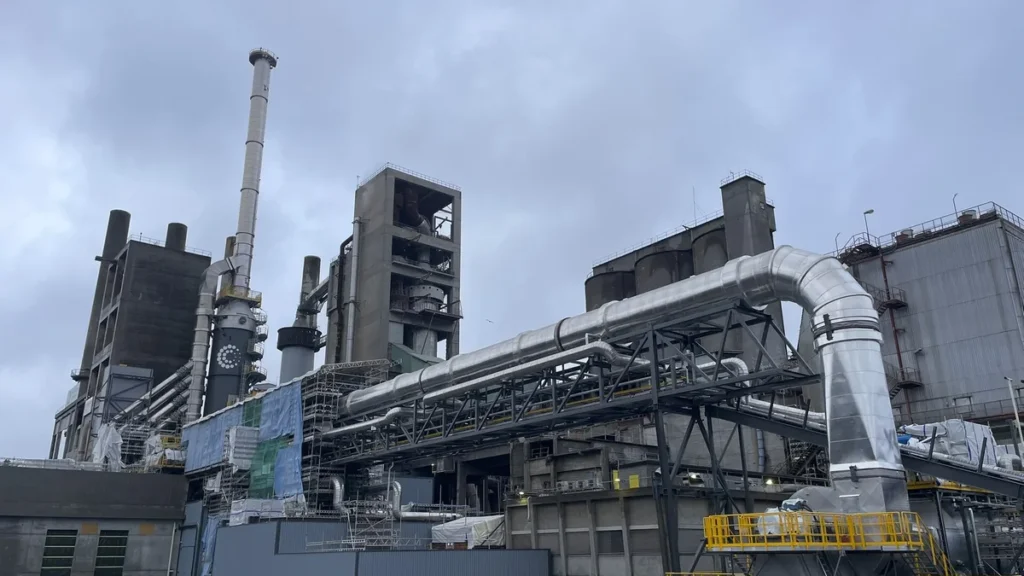
Image: Carbon capture installation at the Heidelberg cement plant in Brevik, Norway. PutTheKettleOn, Wikimedia Commons, CC BY 4.0
How to use this in Mains
If asked: Why are hard-to-abate sectors central to India’s climate goals? (GS-III)
Quote: “These technologies are particularly relevant for industries where cutting emissions is difficult, even with a shift to cleaner energy.”
Use it: Use it to define the problem in one line.
If asked: Discuss the role of public–private partnerships in clean technology. (GS-III)
Quote: “PPPs offer the best of both worlds — avoiding the inefficiencies attributed to the public sector and mitigating the risk-aversion of private financing for frontier technologies.”
Use it: Quote it while proposing a delivery model.
Exam angle
Prelims: CCUS, DAC, Deccan Traps basalt, CCTS 2023. · Mains GS-III: decarbonising industry; climate finance.
Practice MCQs
Original practice questions (not PYQs).
Which of the following rock formations in India is considered suitable for permanently mineralising carbon dioxide?
Answer (b) & explanation
Basalt reacts with CO₂ to form stable carbonate minerals; the Deccan Traps are vast basalt formations.
Consider the following statements:
1. CCUS can be used for cement and steel plants.
2. Direct Air Capture removes CO₂ from the open atmosphere.
3. Blue hydrogen is produced by electrolysis using renewable power.
Which of the statements given above are correct?
Answer (a) & explanation
Blue hydrogen is made from natural gas with carbon capture; green hydrogen uses renewable-powered electrolysis.
India’s Carbon Credit Trading Scheme, 2023 was notified under which law?
Answer (b) & explanation
The scheme was notified under the Energy Conservation Act, 2001, as amended in 2022.
Questions students ask about this
How much has India set aside for CCUS?
₹20,000 crore over five years in Budget 2026.
What is the proposed first phase?
About ₹4,000 crore for research, pilots and mapping storage sites.
Where could CO₂ be stored?
Cauvery basin, Cambay, Mahanadi valley and Deccan Traps are proposed for study.
What is the cost target?
Under ₹2,000 per tonne of CO₂, from ₹10,000–20,000 now.
Keep studying
Go deeper
facts from cited sources only; faculty review pending