
Chapter 9 · Topic 9.2 · Prelims + Mains2 of 3
Human Geography: Migration and settlements
Key points
- Migration: streams, push and pull, labour migration trends (2015), portability of rights.
- Settlements: four rural types; census town tests; Changpa (2014) and nomadic herders (2013);
Prelims box: facts and traps
- Census 2011 counted 7,933 towns, of which 3,892 were census towns.
- Census 2011 counted about 45.6 crore internal migrants by last residence, about 37% of the people.
- Census 2011 defines an urban area in two ways.
- Census towns have no such body but meet three tests: a population of at least 5,000, at least 75% of male main workers outside agriculture, and a density of at least 400 per sq km.
- Trap (UPSC Prelims 2014, ‘Changpa’ community of India): “They live mainly in the State of Uttarakhand” is incorrect.
Migration: streams, causes and consequences
Migration is a change of usual residence. Census records it by place of birth and by place of last residence. Census 2011 counted about 45.6 crore internal migrants by last residence, about 37% of the people. There are four streams: rural to rural (the largest, mostly women moving on marriage), rural to urban, urban to urban and urban to rural.
Push factors drive people out: poverty, small farms, floods and droughts, and lack of jobs. Pull factors draw them in: jobs, wages, schools, health care and city life. For women, marriage is the main reason; for men, work. The big work streams run from Bihar, Uttar Pradesh, Odisha, Jharkhand and Rajasthan to Maharashtra, Gujarat, Delhi, Punjab, Karnataka and Kerala.
Mains 2015 asked about the changes in the trends of labour migration within and outside India in the last four decades. Within India, migration has moved from seasonal farm work in Punjab towards construction, factories and services in cities, and more women now migrate for work. Abroad, the stream moved from unskilled workers to the Gulf after the 1970s oil boom, to skilled IT and health workers to the USA, UK, Canada and Australia. India is the world’s largest recipient of remittances.
Discuss the changes in the trends of labour migration within and outside India in the last four decades.
Consequences cut both ways. Areas of origin gain remittances and skills but lose young men, leaving women and the old to run farms. Destinations gain labour but face slums and strain on services. Migrants often lose ration, voting and welfare rights when they move; One Nation One Ration Card (portable ration cards) and the e-Shram portal for unorganised workers try to fix this.
Settlements: rural types, towns and pastoral
communities A settlement is any cluster of homes. Rural settlements depend on land; urban ones on secondary and tertiary work. Site factors matter: water, flat land, defence and freedom from floods. Many north Indian villages sit on raised land above flood level; desert villages sit near wells and ponds.
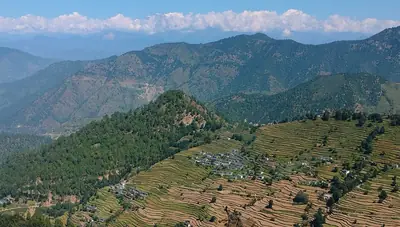
NCERT names four types of rural settlement. Clustered villages are compact, in fertile plains (the northern plains) and in the north-east where defence mattered. Semi-clustered ones grow when a group splits off, often by caste. Hamleted villages are broken into units called panna, para, palli, nagla or dhani, as in the middle and lower Ganga plain and Chhattisgarh. Dispersed homes appear in hills and forests (Meghalaya, Uttarakhand, Himachal Pradesh) and on the Kerala plain.
Census 2011 defines an urban area in two ways. Statutory towns have a municipal body or cantonment. Census towns have no such body but meet three tests: a population of at least 5,000, at least 75% of male main workers outside agriculture, and a density of at least 400 per sq km. Census 2011 counted 7,933 towns, of which 3,892 were census towns.
Some communities still move with their herds. Prelims 2014 asked about the Changpa community: they rear the Pashmina goats that yield a fine wool and are listed as Scheduled Tribes, but they live in Ladakh, not Uttarakhand (option b). Prelims 2013 matched a region where the climate is extreme, rainfall is scanty and the people used to be nomadic herders to the Central Asian Steppe (option b). In India, the Gaddis of Himachal, the Bakarwals and Gujjars of Jammu and Kashmir, the Raikas of Rajasthan and the Bhotiyas of Uttarakhand practise transhumance.
With reference to ‘Changpa’ community of India, consider the following statements : 1. They live mainly in the State of Uttarakhand. 2. They rear the Pashmina goats that yield a fine wool. 3. They are kept in the category of Scheduled Tribes. Which of the statements given above is/are correct?
- 1 only
- 2 and 3 only
- 3 only
- 1, 2 and 3
Show answer
Answer: (b) · UPSC official key
“Climate is extreme, rainfall is scanty and the people used to be nomadic herders.” The above statement best describes which of the following regions?
- African Savannah
- Central Asian Steppe
- North American Prairie
- Siberian Tundra
Show answer
Answer: (b) · UPSC official key
Mains 2015 argued that smart cities in India cannot sustain without smart villages. Villages feed cities with food, water and workers; if they stay poor, migrants pour into city slums. The answer is rural–urban integration: roads, broadband, rural industry and services (as the Shyama Prasad Mukherji Rurban Mission tried with clusters of villages), so that people can earn without leaving.
Smart cities in India cannot sustain without smart villages. Discuss this statement in the backdrop of rural- urban integration.
Mains box: analysis and answer points
- Census records it by place of birth and by place of last residence.
- There are four streams: rural to rural (the largest, mostly women moving on marriage), rural to urban, urban to urban and urban to rural.
- Push factors drive people out: poverty, small farms, floods and droughts, and lack of jobs.
- Likely next angle: Portable ration cards; e-Shram; remittances
- Asked: Mains 2015 (GS Paper I, 12.5 marks): Discuss the changes in the trends of labour migration within and outside India in the last four decades.
Practice
Practice MCQs (8)
Consider the following pairs: Type of consequence of migration : Example
1. Economic : Remittances sent to the source region
2. Demographic : Imbalance in the age and sex composition of source and destination areas
3. Social : Diffusion of new ideas from urban to rural areas
4. Environmental : Anonymity and a sense of social vacuum among migrants in cities
How many of the pairs given above are correctly matched?
Answer (c) & explanation
Three pairs are correct. NCERT groups the consequences of migration as economic, demographic, social, environmental and others. Remittances are economic, age-sex imbalances are demographic, and diffusion of ideas is social. Pair 4 is wrong: anonymity and social vacuum are listed under social consequences; environmental consequences are slums, groundwater depletion, air pollution, sewage and solid waste.
Consider the following types of villages:
1. Lumberjack villages
2. Pastoral villages
3. Fishermen's villages
4. Plateau villages
How many of the above are types of rural settlements classified on the basis of their functions?
Answer (c) & explanation
Three are functional types. NCERT classifies rural settlements on several bases: on the basis of setting (plain, plateau, coastal, forest and desert villages), on the basis of functions (farming, fishermen's, lumberjack and pastoral villages) and on the basis of forms or shapes (linear, rectangular, circular and others). A plateau village is named after its setting, not its function.
Consider the following statements about the social consequences of migration as described by NCERT:
1. Migrants act as agents of social change, through whom ideas about new technologies, family planning and girls' education spread from urban to rural areas.
2. Intermixing of people from diverse cultures can lead to the evolution of a composite culture.
3. The social consequences of migration are wholly positive, since migration always widens people's mental horizons.
Which of the statements given above is/are correct?
Answer (b) & explanation
Statements 1 and 2 are correct. NCERT calls migrants agents of social change who diffuse new ideas (technology, family planning, girls' education) from cities to villages, and says intermixing helps the evolution of a composite culture and breaks narrow considerations. Statement 3 is wrong: NCERT also lists serious negatives such as anonymity, which creates a social vacuum and dejection that may push some into crime or drug abuse.
In a type of rural settlement in India, the land-owning and dominant community occupies the central part of the village, while people of the lower strata and menial workers live a little away on its outer flanks. Such settlements are widespread in the Gujarat plain and parts of Rajasthan. This type is known as
Answer (c) & explanation
NCERT describes semi-clustered or fragmented settlements as resulting either from a tendency of clustering in a restricted area of dispersed settlement or, more often, from segregation or fragmentation of a large compact village, in which one or more sections of village society choose or are forced to live a little away from the main cluster. The dominant community occupies the centre and lower strata the outer flanks; such settlements are widespread in the Gujarat plain and parts of Rajasthan.
Consider the following statements about the demographic consequences of male-selective rural-to-urban migration:
1. It tends to lower the sex ratio in the destination cities.
2. It tends to raise the proportion of women, children and the elderly in the source villages.
3. It increases the share of the working-age population in the source villages.
Which of the statements given above is/are correct?
Answer (d) & explanation
Statements 1 and 2 are correct. NCERT explains that age- and skill-selective out- migration from rural areas harms the rural demographic structure and creates imbalances in age and sex composition in both source and destination. Destination cities receive many young men, so their sex ratio falls; source villages are left with relatively more women, children and older people. Statement 3 is wrong: the migrants are mostly young adults, so the working-age share in the source area falls.
Consider the following statements: Statement-I: The amount of remittances sent by internal migrants in India is meagre compared with that sent by international migrants. Statement-II: Remittances from internal migrants play no significant role in the economy of the source areas.
Which one of the following is correct in respect of the above statements?
Answer (c) & explanation
Statement I is correct and Statement II is incorrect. NCERT notes that internal remittances are meagre compared with international remittances, but they play an important role in the economy of source areas; for thousands of poor villages of Bihar, UP, Odisha and other States, remittances work as their life blood, paying for food, debts, treatment, marriages, schooling, farm inputs and houses. The Economic Survey 2016-17 estimated the domestic remittance market at over Rs 1.5 lakh crore.
Consider the following statements about the consequences of migration for destination areas and for women:
1. The Working Group on Migration (2017) observed that, even in large cities such as Delhi and Mumbai, migrants are an integral part of the urban economy and are not confined to low- income occupations.
2. NCERT cites the development of slums in industrially developed States such as Maharashtra, Gujarat, Karnataka, Tamil Nadu and Delhi as a negative consequence of unregulated migration.
3. NCERT holds that migration of women for education or employment reduces their vulnerability.
Which of the statements given above is/are correct?
Answer (a) & explanation
Statements 1 and 2 are correct. The Working Group (2017), examining Delhi and Mumbai, found migrants to be an integral part of the cities' economic engine, contrary to the stereotype that they are mostly in low-income work. NCERT lists slums in Maharashtra, Gujarat, Karnataka, Tamil Nadu and Delhi as a negative result of unregulated migration. Statement 3 is wrong: NCERT says women's migration for education or employment enhances their autonomy and economic role but also increases their vulnerability.
With reference to domestic (internal) remittances in India as discussed in the Economic Survey 2016-17, consider the following statements:
1. The domestic remittance market was estimated to exceed Rs 1.5 lakh crore.
2. Domestic remittances serve about one-tenth of households in rural India.
3. In remittance-receiving households, they finance over 30 per cent of household consumption.
Which of the statements given above is/are correct?
Answer (d) & explanation
All three are correct. The Survey extrapolated an estimate of about Rs 50,000 crore for 2007-08 (Tumbe, 2011), growing at around 15 per cent a year, to put the domestic remittance market above Rs 1.5 lakh crore. It added that domestic remittances serve 10 per cent of rural households and finance over 30 per cent of consumption in the households that receive them, and suggested leveraging this market for financial inclusion of migrants' families.
0 / 0 correct
Write an answer
In 150 words, explain the significance of Human Geography with one recent example.
Flashcards (6)
Largest migration stream in India?
Rural to rural, mostly women on marriage.
Main reason women migrate?
Marriage.
Three tests for a census town?
5,000 people; 75% male main workers non- farm; 400 per sq km.
Where do the Changpa live?
Ladakh.
Region of extreme climate, scanty rain and
nomadic herders? Central Asian Steppe.
Example region of dispersed settlement?
Meghalaya, Uttarakhand, Himachal Pradesh, Kerala.
In the news
- 4 Oct 2026CAQM flying squads find 17 road-dust violations along Delhi’s Ring Road
- 26 Sep 2026‘She-Mart’ cooperative outlets launched in Keralam to link women SHGs to markets
- 20 Sep 20269 lakh Community Resource Persons: the frontline of rural service delivery
- 15 Sep 2026Varuna Elevated Corridor: ₹10,998-crore, 43.2-km road project for Varanasi
 Next topic · 9.3 →Human Geography: Urbanisation: growth, problems and smart cities
Syllabus: GS-I · Role of women and women’s organization, population and associated issues, povert…