
Chapter 4 · Topic 4.3 · Prelims + Mains3 of 3
Oceanography: Coral reefs
Key points
- Corals: needs, types, Darwin's atoll theory, Indian reefs, facts (2018), bleaching (2019),
- Ocean resources (2014), seabed nodules and the Deep Ocean Mission; UNCLOS zones (2022).
- Phytoplankton and oxygen (2025, 2012); dead zones (2018); oil pollution (2023); island nations
1 PYQ 2005–2014
Prelims box: facts and traps
| Type | Description |
|---|---|
| Fringing reef | Attached to the coast, with a narrow, shallow lagoon or none |
| Barrier reef | Parallel to the coast, separated from it by a wide, deep lagoon |
| Atoll | A ring of reef around a central lagoon, with no land in the middle. |
- global warming on the coral life system with examples: mass bleaching of the Great Barrier Reef (2016, 2017, 2020, 2022, 2024), Lakshadweep and the Gulf of Mannar; acidification weakening skeletons.
- The Deep Ocean Mission (approved in 2021) includes Samudrayaan, which aims to take three people to 6,000 m in the submersible Matsya 6000, and work on deep-sea mining and ocean climate services.
- The UN Convention on the Law of the Sea (UNCLOS, 1982) sets these zones.
- Trap (UPSC Prelims 2012): “The density of ocean water would drastically decrease” is incorrect.
- Trap (UPSC Prelims 2022, the United Nations Convention on the Law of Sea): all the statements are correct.
Coral reefs
Corals are tiny animals (polyps) that build skeletons of calcium carbonate. They live in partnership with algae called zooxanthellae inside their tissues: the algae make food by photosynthesis and give the coral its colour; the coral gives them shelter. Over thousands of years, the skeletons pile up into reefs.
Conditions corals need: warm water (about 20 °C or more, ideally 23–29 °C), so they are found mainly between 30° N and 30° S; clear, shallow, sunlit water (usually less than about 50 m); normal salinity; and little mud, which is why there are no reefs at the mouths of big rivers such as the Ganga or the Amazon, and few on the west coasts of continents, where cold currents flow.
| Type | Description | Examples |
|---|---|---|
| Fringing reef | Attached to the coast, with a narrow, shallow lagoon or none | Gulf of Mannar, Gulf of Kutch, Andaman Islands |
| Barrier reef | Parallel to the coast, separated from it by a wide, deep lagoon | Great Barrier Reef, Australia (about 2,300 km); parts of the Andaman and Nicobar Islands |
| Atoll | A ring of reef around a central lagoon, with no land in the middle | Lakshadweep, Maldives |
India has four main reef areas: the Gulf of Mannar, the Gulf of Kutch, the Andaman and Nicobar Islands, and Lakshadweep. Prelims 2018 tested three statements: Most of the world’s coral reefs are in tropical
waters; more than one-third are in the territories of Australia, Indonesia and Philippines; and Coral reefs host far more number of animal phyla than those hosted by tropical rainforests. All three are correct (option d). Reefs cover well under 1% of the sea floor but shelter about a quarter of all marine species.
Consider the following statements : 1. Most of the world’s coral reefs are in tropical waters. 2. More than one-third of the world’s coral reefs are located in the territories of Australia, Indonesia and Philippines. 3. Coral reefs host far more number of animal phyla than those hosted by tropical rainforests. Which of the statements given above is/are correct ?
- 1 and 2 only
- 3 only
- 1 and 3 only
- 1, 2 and 3
Show answer
Answer: (d) · UPSC official key
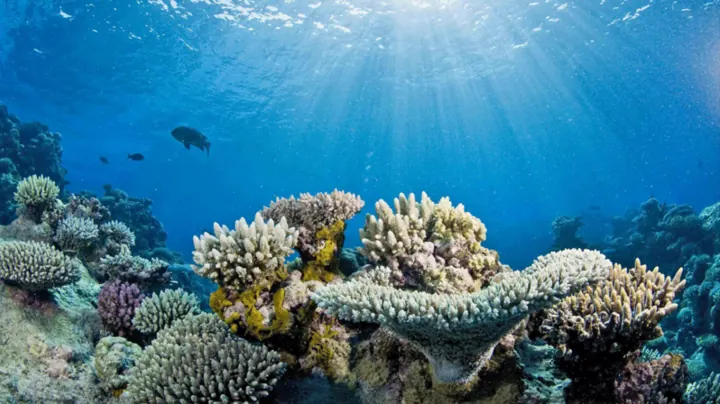
When the water stays too warm for weeks, corals expel their algae and turn white: coral bleaching. They can recover if the heat passes; if not, they starve and die. Mains 2019 asked to assess the impact of
global warming on the coral life system with examples: mass bleaching of the Great Barrier Reef (2016, 2017, 2020, 2022, 2024), Lakshadweep and the Gulf of Mannar; acidification weakening skeletons; sea-level rise outpacing growth; stronger storms breaking reefs; and the loss of fisheries, tourism and coastal protection that follows. Prelims 2012 began: The acidification of oceans is increasing. Why is this phenomenon a cause of concern? It harms calcareous phytoplankton, coral reefs, and animals with phytoplanktonic larvae (option a: 1, 2 and 3 only), but not cloud seeding.
Assess the impact of global warming on the coral life system with examples.
The acidification of oceans is increasing. Why is this phenomenon a cause of concern? 1. The growth and survival of calcareous phytoplankton will be adversely affected. 2. The growth and survival of coral reefs will be adversely affected. 3. The survival of some animals that have phytoplanktonic larvae will be adversely affected. 4. The cloud seeding and formation of clouds will be adversely affected. Which of the statements given above is/are correct?
- 1, 2 and 3 only
- 2 only
- 1 and 3 only
- 1, 2, 3 and 4
Show answer
Answer: (a) · UPSC official key
Marine resources, the law of the sea and ocean
pollution Mains 2014 asked: Critically evaluate the various resources of the oceans which can be harnessed to meet the resource crisis in the world. Biotic: fish (a key protein source for over three billion people), seaweed and medicines. Mineral: oil and gas on the shelves; polymetallic nodules rich in manganese, nickel, cobalt and copper on the deep floor; sand and placer deposits (monazite on the Kerala coast). Energy: tidal, wave, offshore wind and ocean thermal energy. Water: desalination. The critical part: overfishing, the high cost and ecological damage of deep-sea mining, and unclear rules beyond national waters.
Critically elucidate the various resources of the oceans which can be harnessed to meet the resource crisis in the world.
India is one of the pioneer investors with the International Seabed Authority, holding a contract to explore polymetallic nodules over 75,000 sq km in the Central Indian Ocean Basin. The Deep Ocean Mission (approved in 2021) includes Samudrayaan, which aims to take three people to 6,000 m in the submersible Matsya 6000, and work on deep-sea mining and ocean climate services.
The UN Convention on the Law of the Sea (UNCLOS, 1982) sets these zones. Prelims 2022 tested three statements: a coastal state has the right to establish the breadth of its territorial sea up to a limit not exceeding 12 nautical miles; ships of all states enjoy innocent passage through it; and the Exclusive Economic Zone shall not extend beyond 200 nautical miles from the baseline. All three are correct (option d). In the contiguous zone (up to 24 nm) a state can enforce customs, tax, immigration
and sanitary laws; in the EEZ it controls fishing and seabed resources but other ships may pass freely. India’s EEZ is about 2 million sq km.
With reference to the United Nations Convention on the Law of Sea, consider the following statements : 1. A coastal state has the right to establish the breadth of its territorial sea up to a limit not exceeding 12 nautical miles, measured from baseline determined in accordance with the convention. 2. Ships of all states, whether coastal or land-locked, enjoy the right of innocent passage through the territorial sea. 3. The Exclusive Economic Zone shall not extend beyond 200 nautical miles from the baseline from which the breadth of the territorial sea is measured. Which of the statements given above are correct ?
- 1 and 2 only
- 2 and 3 only
- 1 and 3 only
- 1, 2 and 3
Show answer
Answer: (d) · UPSC official key
The ocean also gives us oxygen. Prelims 2025 tested the statement that Marine phytoplankton and photosynthetic bacteria produce about 50% of world’s oxygen: correct, and the only correct one (option b); rainforests do not produce more than the oceans, and surface water holds far less oxygen than air. Prelims 2012 asked what would happen if phytoplankton of an ocean is completely destroyed: the ocean as a carbon sink and its food chains would suffer (option a: 1 and 2 only); the density of water would not change.
With reference to the planet Earth, consider the following statements : I. Rain forests produce more oxygen than that produced by oceans. II. Marine phytoplankton and photosynthetic bacteria produce about 50% of world’s oxygen. III. Well-oxygenated surface water contains several folds higher oxygen than that in atmospheric air. Which of the statements given above is/are correct?
- I and II
- II only
- I and III
- None of the above statements is correct
Show answer
Answer: (b) · UPSC official key
What would happen if phytoplankton of an ocean is completely destroyed for some reason? 1. The ocean as a carbon sink would be adversely affected. 2. The food chains in the ocean would be adversely affected. 3. The density of ocean water would drastically decrease. Select the correct answer using the codes given below :
- 1 and 2 only
- 2 only
- 3 only
- 1, 2 and 3
Show answer
Answer: (a) · UPSC official key
Mains 2018 asked: What are the consequences of spreading of ‘Dead Zones’ on marine ecosystem? Mains 2018 Dead zones are areas with too little oxygen (hypoxia) for most marine life, mostly at river mouths where fertiliser and sewage cause algal blooms whose decay uses up the oxygen: the Gulf of Mexico and the Baltic are famous; the Arabian Sea has one of the largest natural low-oxygen zones. Consequences: fish kills or flight, loss of bottom-dwelling life, collapse of fisheries and release of greenhouse gases such as nitrous oxide. Mains 2023 (GS III) asked: What is oil pollution? What are its impacts on the marine ecosystem? Mains 2023 Oil from tanker spills, offshore wells and ship discharge forms a film that blocks light and oxygen, coats birds and mammals, poisons fish larvae and smothers mangroves and corals; it hurts India especially because of its long coastline, fishing communities and heavy tanker traffic.
What are the consequences of spreading of ‘Dead Zones’ on marine ecosystem?
What is oil pollution? What are its impacts on the marine ecosystem? In what way is oil pollution particularly harmful for a country like India?
Mains 2025 asked: How are climate change and the sea level rise affecting the very existence of many island nations? Mains 2025 Global sea level has risen about 20 cm since 1900 and the rise is speeding up. Low atolls such as Tuvalu, Kiribati, the Marshall Islands and the Maldives, mostly only 1–2 m above the sea, face flooding, salty groundwater, coastal erosion and dying reefs. Tuvalu’s 2023 Falepili Union treaty with Australia offers its citizens a path to move; the Maldives is building raised land at Hulhumalé; and Vanuatu led the push for the 2025 International Court of Justice advisory opinion on states’ climate obligations.
How are climate change and the sea level rise affecting the very existence of many island nations? Discuss with examples.
Mains box: analysis and answer points
- Corals are tiny animals (polyps) that build skeletons of calcium carbonate.
- Over thousands of years, the skeletons pile up into reefs.
- India has four main reef areas: the Gulf of Mannar, the Gulf of Kutch, the Andaman and Nicobar Islands, and Lakshadweep.
- Likely next angle: Global bleaching events
- Asked: Mains 2019 (GS Paper I, 10 marks): Assess the impact of global warming on the coral life system with examples.
Practice
Prelims PYQs on this topic (1)
Which of the following have coral reefs?
- 1. Andaman and Nicobar Islands
- 2. Gulf of Kachchh
- 3. Gulf of Mannar
- 4. Sunderbans
Select the correct answer using the code given below.
Answer (a) & explanation
Coral reefs are found in the Andaman and Nicobar Islands, the Gulf of Kachchh and the Gulf of Mannar, so the answer is (a). Lakshadweep is the fourth major reef area. The Sundarbans delta has muddy, low-salinity water full of sediment, which suits mangroves but not corals, so options with 4 fail.
Corals need warm, clear, shallow salt water. They are threatened by bleaching when sea temperatures rise, and India's reefs suffered in the global bleaching events. Notice how corals and mangroves are neighbours in many places, yet each needs very different water.
Answer as per the official UPSC answer key.
Write an answer
In 150 words, explain the significance of Oceanography with one recent example.
Flashcards (6)
Why is the Red Sea so salty?
Little rain and no rivers.
Why do corals bleach?
Warm water makes them expel their algae.
Reef type of Lakshadweep?
Atolls.
Why no coral reefs at the mouth of the
Ganga? Mud and fresh water.
Breadth of the territorial sea?
Up to 12 nautical miles.
Share of world oxygen from marine
phytoplankton and bacteria? About 50%.
Read more: related explainers
In the news
- 16 Oct 2026Neyveli, Tiruchirappalli and Atacama: Indian scientists identify Martian analogue sites
- 14 Oct 2026India to accede to the Southern Indian Ocean Fisheries Agreement (SIOFA)
- 13 Oct 2026IMD launches a map-based Decision Support System for cyclone and marine warnings
- 1 Oct 2026Auction launched for two offshore polymetallic nodule blocks in the Andaman Sea
 Next chapter · 5. Biogeography →Biogeography: Ecosystems, biomes and biodiversity
Syllabus: GS-I · Salient features of world’s physical geography.