
Chapter 1 · Topic 1.2 · Prelims + Mains2 of 3
Early Medieval India: Tripartite struggle and feudalism
Key points
- Tripartite struggle (about 750–950 CE): Palas, Pratiharas and Rashtrakutas fought for Kanauj.
- Pratiharas held Kanauj under Mihira Bhoja; all three were worn out by the 10th century.
- Rajput clans: Chahamanas, Paramaras, Chandellas, Chaulukyas, Gahadavalas, Tomaras.
- Feudal features: land grants, samantas, sub-infeudation, heavier burdens on peasants.
Prelims box: facts and traps
- Agnikula legend: Pratiharas, Chaulukyas, Paramaras, Chahamanas from a fire at Mount Abu.
- Chronology (Prelims 2020): Mahendravarman I, Gopala, Bhoja, Parantaka I.
- Tomaras: founded Dhillika (Delhi).
The tripartite struggle for Kanauj
Kanauj had been Harsha’s capital. Whoever held it could claim to rule north India. For about two centuries (roughly 750–950 CE), the Palas, Pratiharas and Rashtrakutas fought for it. That struggle is called the tripartite (three-sided) struggle.
| Phase | Events |
|---|---|
| First | Dharmapala (Pala) and Vatsaraja (Pratihara) clash; the Rashtrakuta Dhruva defeats both |
| Second | Dharmapala puts his nominee on the throne of Kanauj; Nagabhata II captures it; Govinda III (Rashtrakuta) raids the north |
| Result | The Pratiharas hold Kanauj under Mihira Bhoja; all three are worn out by the 10th century |
| Aftermath | Rajput states rise in the north; the Rashtrakutas give way to the later Chalukyas; the north-west lies open to Mahmud of Ghazni |
Prelims 2020 tested the order of events: Pallava power under Mahendravarman I (about 600), the Pala dynasty founded by Gopala (about 750), ‘Rise of Pratiharas under King Bhoja ‘ (about 836), and Chola power under Parantaka I (907). So the order was 2-4-1-3.
Consider the following events in the history of India: 1. Rise of Pratiharas under King Bhoja 2. Establishment of Pallava power under Mahendravarman — I 3. Establishment of Chola power by Parantaka — I 4. Pala dynasty founded by Gopala What is the correct chronological order of the above events, starting from the earliest time ?
- 2-1-4-3
- 3-1-4-2
- 2-4-1-3
- 3-4-1-2
Show answer
Answer: (c) · UPSC official key
What UPSC asks
Prelims: Kanauj; order of dynasties. Mains: why the struggle mattered. Next likely: Kannauj heritage.
Rajputs, samantas and feudalism
From the 8th century the Rajput clans came to rule much of north and west India. Bards later told the Agnikula legend: four clans (Pratiharas, Chaulukyas, Paramaras and Chahamanas) were born from a fire at Mount Abu. Historians see the Rajputs as a mix of local ruling groups, tribes and some newcomers who were given Kshatriya status.
| Rajput dynasty | Region | Remember |
|---|---|---|
| Chahamanas (Chauhans) | Ajmer and Delhi | Prithviraj III |
| Paramaras | Malwa (Dhar) | Bhoja, a scholar king |
| Chandellas | Bundelkhand | Khajuraho temples |
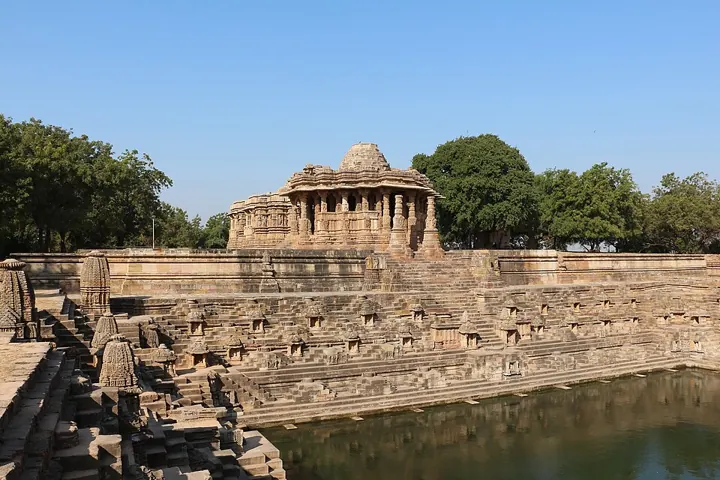
| Chaulukyas (Solankis) | Gujarat | Modhera Sun temple |
| Gahadavalas | Kanauj and Varanasi | Jayachandra |
| Tomaras | Delhi | Founded Dhillika (Delhi) |
| Feature of ‘feudalism’ | Meaning |
|---|---|
| Land grants | Kings gave villages with revenue and sometimes police and judicial rights |
| Samantas | Subordinate chiefs who paid tribute and sent troops |
| Sub-infeudation | Grantees gave land on to others in turn |
| Peasants | More burdens: forced labour (vishti) and many new taxes |
What UPSC asks
Prelims: Rajput clans, Agnikula, samantas. Mains: the Indian feudalism debate. Next likely: Rajput heritage forts.
Mains box: analysis and answer points
- Why the struggle mattered: it exhausted the big powers and left the north-west open to Mahmud.
- Indian feudalism debate.
- Likely next angle: Rajput heritage forts.
Practice
Practice MCQs (8)
Which one of the following was NOT one of the three powers in the tripartite struggle for Kanauj?
Answer (d) & explanation
The three contenders were the Palas of Bengal, the Gurjara-Pratiharas of western India and the Rashtrakutas of the Deccan. The Chalukyas of Badami had already been overthrown by the Rashtrakuta Dantidurga in the mid-eighth century, before the contest for Kanauj began in earnest.
The 'tripartite struggle' among the Gurjara-Pratiharas, the Palas and the Rashtrakutas in the eighth and ninth centuries was mainly a contest for control over
Answer (b) & explanation
Our Pasts II explains that rulers of the Gurjara-Pratihara, Rashtrakuta and Pala dynasties fought for control over Kanauj for several generations; historians call this the tripartite struggle. Kanauj, Harsha's former capital in the Ganga valley, was a symbol of paramountcy over north India and controlled a rich agricultural and trading region.
With reference to the Pala dynasty of Bengal, consider the following statements:
1. According to the Khalimpur copper plate, Gopala was raised to the throne by the leading men of the land to end a period of anarchy.
2. Dharmapala held a court at Kanauj where he installed his nominee Chakrayudha on the throne.
3. The Pala kings were patrons mainly of Jainism.
Which of the statements given above is/are correct?
Answer (a) & explanation
Dharmapala's Khalimpur plate says the people (prakritis) made Gopala king to end matsyanyaya, the 'law of the fishes' in which the strong devoured the weak. Dharmapala later held a grand court at Kanauj and placed Chakrayudha on its throne with the assent of the northern rulers. Statement 3 is wrong: the Palas were great patrons of Buddhism and its monasteries.
With reference to the Rashtrakutas, consider the following statements:
1. Dantidurga established Rashtrakuta power by overthrowing the Chalukyas of Badami.
2. Krishna III was defeated by the Cholas in the battle of Takkolam.
3. Under Amoghavarsha I, Manyakheta (Malkhed) became the Rashtrakuta capital.
Which of the statements given above is/are correct?
Answer (c) & explanation
Dantidurga overthrew the Chalukya Kirtivarman II around 752-53 CE. Amoghavarsha I built up Manyakheta (Malkhed in Karnataka) as the capital. Statement 2 reverses the result: at Takkolam (949 CE) Krishna III defeated the Chola king Parantaka I's forces, killing the crown prince Rajaditya, and held northern Tamil country for some years.
The Nalanda copper plate records that a Pala king granted five villages for the upkeep of a monastery at Nalanda built by the Shailendra ruler Balaputradeva of Suvarnadvipa. This Pala king was
Answer (b) & explanation
The Nalanda copper plate of Devapala records that, at the request of Balaputradeva, the Shailendra king of Suvarnadvipa (Sumatra-Java), Devapala granted villages to support the vihara Balaputradeva had built at Nalanda. It shows the Pala kingdom's close cultural and commercial links with Southeast Asia in the ninth century.
Rajashekhara, the author of Karpuramanjari and Kavyamimamsa, was the teacher of a king and lived at the court of
Answer (d) & explanation
Rajashekhara, the Sanskrit and Prakrit poet-critic, was the guru of the Gurjara- Pratihara king Mahendrapala I and continued at the court of his son Mahipala at Kanauj. His Karpuramanjari is a play wholly in Prakrit, and the Kavyamimamsa is a treatise on poetics.
With reference to the Gurjara-Pratiharas, consider the following statements:
1. Nagabhata I is credited with checking the advance of the Arabs from Sindh into western India.
2. Mihira Bhoja issued coins bearing the title 'Adivaraha'.
3. Nagabhata II captured Kanauj and made it the Pratihara capital.
Which of the statements given above is/are correct?
Answer (d) & explanation
All three are correct. Nagabhata I (mid-eighth century) is remembered for resisting the Arab governors of Sindh. Nagabhata II took Kanauj from Chakrayudha early in the ninth century and made it the capital. Mihira Bhoja, the greatest Pratihara king, was a devotee of Vishnu and issued coins with the title 'Adivaraha', the primeval boar incarnation.
Around 800 CE a Rashtrakuta king marched north, defeated the Pratihara Nagabhata II, and received the submission of the Pala king Dharmapala and of Chakrayudha of Kanauj. This king was
Answer (a) & explanation
Satish Chandra records that Govinda III defeated Nagabhata II and that Dharmapala and Chakrayudha submitted to him; his armies are said to have reached the Himalayan foothills. Like earlier Rashtrakuta raids, the campaign brought prestige and plunder but no lasting rule in the north, and Govinda returned to the Deccan.
0 / 0 correct
Write an answer
In 150 words, explain the significance of Early Medieval India with one recent example.
Flashcards (8)
Prize of the tripartite struggle?
Kanauj.
Pratihara who captured Kanauj?
Nagabhata II.
Order: Gopala, Bhoja, Parantaka I,
Mahendravarman I? Mahendravarman I, Gopala, Bhoja, Parantaka I.
Where were the Agnikula clans said to be
born? Mount Abu.
Dynasty that built Khajuraho?
Chandellas.
Scholar king of the Paramaras?
Bhoja.
Dynasty that founded Delhi (Dhillika)?
Tomaras.
Who built Modhera Sun temple?
The Chaulukyas (Solankis).
Read more: related explainers
In the news
- 20 Oct 2026Sirpur in Chhattisgarh enters UNESCO’s Tentative List of World Heritage sites
- 15 Oct 2026PM inaugurates five Ladakh projects: Nimmu–Padum–Darcha road, Leh terminal, Hanu hydro
- 14 Oct 2026HAL, NCF and ASI sign MoA for Hampi, Taj Mahal and Bekal Fort
- 11 Oct 2026Birth anniversaries: Jayaprakash Narayan and Nanaji Deshmukh
 Next topic · 1.3 →Early Medieval India: Society, economy and culture
Syllabus: Prelims GS-I · History of India and Indian National Movement.