
Chapter 12 · Topic 12.1 · Prelims + Mains1 of 3
Medieval Literature: Persian and Sanskrit
Key points
- Persian court histories: Minhaj (Tabaqat-i-Nasiri), Barani, Isami, Abul Fazl, Badauni, Nizamuddin Ahmad, Khafi Khan.
- Memoirs: Baburnama (Chagatai Turkish), Tuzuk-i-Jahangiri.
- Sanskrit: Gita Govinda, Rajatarangini (1148), Mitakshara, Dayabhaga, Jain prabandhas.
- Persian translations: Razmnama, Lilavati (Faizi), Sirr-i-Akbar (Dara Shikoh, 1657), Zain-ul-Abidin's translations.
Prelims box: facts and traps
- Prelims 2022: Yogavasistha put into Persian by Nizamuddin Panipati under Akbar.
- Muntakhab-ut-Tawarikh (Badauni) was critical of Akbar.
- Mitakshara vs Dayabhaga: two schools of inheritance law.
Persian literature and histories
Persian was the language of the court from the Sultanate to the Mughals. It gave India many histories, memoirs (life stories written by the person himself) and poems. These are our main sources for the period.
| Author | Work and period |
|---|---|
| Minhaj-us-Siraj | Tabaqat-i-Nasiri: early Delhi Sultanate, up to 1260 |
| Amir Khusrau | Poetry and histories (Khazain-ul-Futuh); wrote in Persian and Hindavi |
| Ziauddin Barani | Tarikh-i-Firuz Shahi and Fatawa-i-Jahandari (on kingship) |
| Isami | Futuh-us-Salatin, a verse history |
| Babur | Baburnama (in Chagatai Turkish; put into Persian by Abdur Rahim Khan-i-Khanan) |
| Abul Fazl | Akbarnama and Ain-i-Akbari |
| Badauni | Muntakhab-ut-Tawarikh, critical of Akbar |
| Nizamuddin Ahmad | Tabaqat-i-Akbari |
| Jahangir | Tuzuk-i-Jahangiri (memoirs) |
| Khafi Khan | Muntakhab-ul-Lubab, on Aurangzeb’s age |
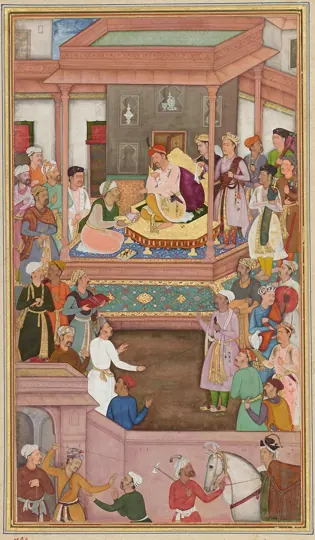
Mains 2020 gave the statement: ‘Persian literary sources of medieval India reflect the spirit of the age. Comment.’ Show how court histories reflect ideas of kingship, religious debates (Abul Fazl against Badauni), administration (the Ain) and cultural blending. Note the bias of court writers too: a court historian praised his patron, like a company brochure.
Persian literary sources of medieval India reflect the spirit of the age. Comment.
What UPSC asks
Prelims: authors and works. Mains: Persian sources (2020). Next likely: using sources critically.
Sanskrit works and Persian translations
| Sanskrit work | Key facts |
|---|---|
| Gita Govinda | Jayadeva, 12th century, court of Lakshmana Sena of Bengal; love of Radha and Krishna |
| Rajatarangini | Kalhana, 1148; a verse history of Kashmir, the closest thing to critical history in Sanskrit |
| Mitakshara | Vijnaneshwara (Chalukya court); Hindu law of joint family property |
| Dayabhaga | Jimutavahana (Bengal); a different school of inheritance law |
| Prabandhas | Jain chronicles, such as those of Hemachandra in Gujarat |
Rulers had Sanskrit classics put into Persian so the court could read them.
| Persian translation | Patron |
|---|---|
| Mahabharata and Rajatarangini | Zain-ul-Abidin of Kashmir (15th century) |
| Razmnama (Mahabharata) | Akbar’s Maktab Khana |
| Lilavati (mathematics) | Faizi, for Akbar |
| Sirr-i-Akbar (Upanishads) | Dara Shikoh, 1657 |
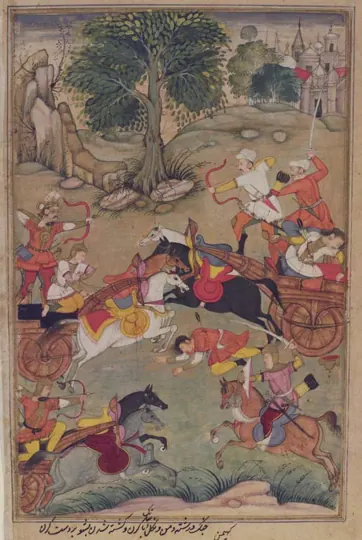
Prelims 2022 asked in whose reign the ‘Yogavasistha’ was translated into Persian by Nizamuddin Panipati. Read the stem closely: the answer was Akbar.
“Yogavasistha” was translated into Persian by Nizamuddin Panipati during the reign of :
- Akbar
- Humayun
- Shahjahan
- Aurangzeb
Show answer
Answer: (a) · UPSC official key
What UPSC asks
Prelims: Yogavasistha (2022), Rajatarangini. Mains: cultural exchange. Next likely: translation as a meeting of cultures.
Mains box: analysis and answer points
- Mains 2020 (15 marks): Persian sources reflect the spirit of the age; note court bias.
Practice
Practice MCQs (8)
The Vedartha Prakasha, an influential commentary on the Vedas written at the request of King Bukka of Vijayanagara, is the work of
Answer (b) & explanation
Sayana (died 1387), also called Sayanacharya, was a Mimamsa scholar of the early Vijayanagara kingdom who flourished under Bukka I and his successor Harihara II, serving as minister and later prime minister at Bukka's court. More than a hundred works are attributed to him, including commentaries on nearly every part of the Vedas and writings on medicine, morality, music and grammar; some were actually written by his pupils or jointly with his elder brother Madhava. His major work is the Vedartha Prakasha, 'the meaning of the Vedas made manifest', written at Bukka's request, in the words of one scholar, 'to invest the young kingdom with the prestige it needed'. The core is probably Sayana's own, with contributions from his brother and additions by students and later writers using his name. His brother Madhava is usually identified with Vidyaranya, the Sringeri pontiff, which is why the two names are often confused.
Akbar's Maktab Khana, a 'house of translation' established about 1574, where the Mahabharata, the Ramayana and the Rajatarangini were rendered from Sanskrit into Persian, was located at
Answer (b) & explanation
In about 1574 Akbar set up a Maktab Khana, a 'house of translation' or writing bureau, in his new capital at Fatehpur Sikri. He assigned a group of scholars to translate Sanskrit books into Persian, the literary language of the Mughal court; the Rajatarangini, the Ramayana and the Mahabharata were among the first. The work was organised as a team effort: Hindu scholars explained the meaning, Muslim scholars such as Naqib Khan drafted the Persian, and Faizi was asked to polish the text into elegant prose or verse. The Persian Mahabharata, named the Razmnama ('book of war'), was the largest of these projects. The bureau was part of a wider effort to make the learning of India available in the language of the court, and in the same city Akbar built the Ibadat Khana (1575) for religious debate. The capital itself, founded in 1569 some 23 miles from Agra, was abandoned when Akbar moved back to Agra in 1599.
The Rasagangadhara, an important Sanskrit work on poetic theory, and the Bhamini-vilasa, a collection of verse, were written by a Telugu Brahmin scholar, known by the title 'Panditaraja', who was patronised at the court of Shah Jahan. He is
Answer (a) & explanation
Jagannatha Panditaraja (c. 1590-1670), a Telugu Brahmin of the Upadrasta family, was poet, musician and literary critic, and a junior contemporary of Akbar. As a theorist he is known for the Rasagangadhara, a major work on poetic theory; as a poet, for the Bhamini- vilasa ('The Sport of the Beautiful Lady'). He is best known by the title Panditaraja, and he received other titles from Shah Jahan, at whose court he was patronised. His career shows that Sanskrit learning found patrons at the Mughal court itself, not only in Hindu kingdoms. Indeed, the historian G. S. Sardesai suggested that the popular tradition of Akbar's 'Navaratnas', which has no historical basis, may have been started by Sanskrit pandits at the court of Shah Jahan or Dara Shikoh, Jagannatha or Kavindracharya. The other options lived in other times and places: Bhanudatta in Mithila around 1500, Srivara in fifteenth-century Kashmir, and Sayana at Vijayanagara.
The Purusha-Pariksha, a Sanskrit work in the katha (story) genre on political ethics and the ideal man, and the Kirtilata, a verse praise-biography in Avahattha, were composed by a poet of Mithila better known for his love songs in Maithili. He is
Answer (b) & explanation
Vidyapati (c. 1352-1448), the 'poet-cuckoo of Maithili', was born to a Maithil Brahmin family at Bisapi in the Madhubani district of Mithila. He worked at the courts of seven kings and two queens of the Oiniwar dynasty and wrote in Sanskrit, Prakrit, Apabhramsha and Maithili, at a time when late Avahattha was turning into the early eastern languages. His first commission, from Kirttisimha, produced the Kirtilata, a verse praise-biography in Avahattha of his patron's victory. In Sanskrit he wrote, among other works, the Purusha-Pariksha, a treatise on political ethics and ideal manhood cast in the form of stories. His friendship with the prince, later king, Sivasimha turned him to love songs: he wrote some five hundred, mostly between 1380 and 1406, later followed by devotional songs to Shiva, Vishnu, Durga and Ganga. Bengali Vaishnavas, Chaitanya among them, adopted his Radha-Krishna songs, and in the sixteenth century an artificial literary language, Brajabuli, developed from his Maithili.
The Hammira Mahakavya, a fifteenth-century Sanskrit epic by the Jain scholar Nayachandra Suri, is a legendary biography of
Answer (d) & explanation
The Hammira Mahakavya is a Sanskrit epic of about 1,500 verses in fourteen cantos by the Jain scholar Nayachandra Suri. Its hero is the thirteenth-century Chahamana king Hammira of Ranthambore, who had given asylum to rebel leaders and was besieged by Alauddin Khalji's forces in 1301; the fort fell after Alauddin himself took charge of the siege. The poem describes Hammira's ancestry and his wars with neighbouring Hindu kingdoms, and its later part tells of the conflict with Alauddin, attributing Hammira's defeat to the betrayal of his own officers. Nayachandra was not a contemporary; he says Hammira appeared to him in a dream a hundred years after his death, which suggests that work began about 1401, and he may have written at the Tomara court of Virama in response to a challenge that no living poet could match Kalidasa. Not wholly accurate as history, it still gives valuable information on medieval north-western India.
Consider the following statements about the Sanskrit chronicles of Kashmir:
1. Jonaraja's Dvitiya Rajatarangini brings the chronicle down to the reign of his patron Zain-ul- Abidin, but was left unfinished at his death in 1459.
2. Srivara's Tritiya (Jaina) Rajatarangini covers the years 1459 to 1486, written largely as an eyewitness account.
3. Shuka's Chaturthi Rajatarangini carries the record down to 1597, shortly before Akbar's third visit to Srinagar.
4. Kalhana composed the original Rajatarangini at the court of Zain-ul-Abidin.
How many of the statements given above are correct?
Answer (c) & explanation
Kalhana wrote the Rajatarangini ('River of Kings') in Sanskrit verse in 1148-49, and the chronicle was continued by a line of later Sanskrit historians under the Shahmiri Sultans. Jonaraja (died 1459) wrote the Dvitiya ('second') Rajatarangini, bringing the record down to his patron Zain-ul-Abidin (r. 1418-1419 and 1420-1470); he died in the Sultan's thirty-fifth regnal year, so the reign was left half-told. His pupil Srivara wrote the Tritiya ('third'), or Jaina, Rajatarangini for 1459 to 1486; unlike his predecessors, who wrote in retrospect, he recorded what he himself had witnessed at the courts of four Sultans, and his work is the richest source for everyday life in fifteenth-century Kashmir. Shuka continued Prajyabhatta's lost work in the Chaturthi ('fourth') Rajatarangini, which runs from 1513 to 1597, ending with the building of the Naganagari city fort just before Akbar's third visit to Srinagar. Only statement 4 is wrong.
Consider the following works:
1. Madalasa Charita
2. Jambavati Kalyana
3. Parijatapaharanam
4. Nyayamrita
How many of the above are Sanskrit works composed by the Vijayanagara ruler Krishnadevaraya himself?
Answer (b) & explanation
Krishnadevaraya ruled a multilingual empire and was fluent in Kannada, Sanskrit, Telugu and Tamil; his reign is remembered as a golden age of Telugu literature, and he patronised poets in all four languages. He was an author in two of them. In Telugu he wrote the Amuktamalyada; in Sanskrit his works include the Madalasa Charita, the Satyavadhu Parinaya, a Rasamanjari and the Jambavati Kalyana. His court also produced Sanskrit and Telugu works by others. Among the eight Telugu poets of his assembly, the Ashtadiggajas, Nandi Timmana wrote the Parijatapaharanam and dedicated it to the emperor. In Sanskrit, the Madhva philosopher Vyasatirtha, whom Krishnadevaraya called his rajaguru in a manuscript of his own, wrote the Nyayamrita, a polemic against Advaita, along with other works. So two of the listed works are the emperor's own Sanskrit compositions; one is a Telugu work by a court poet and one a Sanskrit work by his guru.
With reference to Bhanudatta Misra, the author of the Rasamanjari and the Rasatarangini, consider the following statements:
1. By his own account he was a Maithil Brahmin from the Videha country, and his father was the poet Ganeshvara.
2. Sheldon Pollock has connected the 'King Nijama' named in his works with Ahmad Nizam Shah I of Ahmadnagar.
3. He composed the Rasamanjari in Braj Bhasha for a Rajput court.
Which of the statements given above is/are correct?
Answer (a) & explanation
Bhanudatta Misra was a Sanskrit poet of the late fifteenth and early sixteenth centuries. In a verse about himself he says that his father was Ganeshvara, 'brightest jewel in the crown of poetry', and that his land was the Videha country, that is Mithila in north Bihar; he belonged to the Maithil Brahmin community. Like many poets he travelled for patronage, and several of his works were probably written for a Muslim ruler he calls 'King Nijama', whom Sheldon Pollock identifies with Malik Ahmad Nizam Shah I, founder of the Ahmadnagar Sultanate. His works continued to be studied in the Deccan and in Golconda. Both the Rasamanjari ('Bouquet of Rasa') and the Rasatarangini are in Sanskrit, and they drew commentaries until the eighteenth century. Pollock judges that no other Sanskrit poet had anything like Bhanudatta's influence on Hindi literature between 1600 and 1850, and his verses were illustrated in Mewar, the Deccan, Chamba and Nurpur.
0 / 0 correct
Write an answer
In 150 words, explain the significance of Medieval Literature with one recent example.
Flashcards (9)
Tabaqat-i-Nasiri?
Minhaj-us-Siraj.
Tarikh-i-Firuz Shahi?
Ziauddin Barani.
Muntakhab-ut-Tawarikh?
Badauni.
Who put the Baburnama into Persian?
Abdur Rahim Khan-i-Khanan.
Ain-i-Akbari?
Abul Fazl.
Gita Govinda?
Jayadeva, 12th century.
Rajatarangini?
Kalhana, 1148.
Mitakshara?
Vijnaneshwara.
Who translated the Yogavasistha into
Persian? Nizamuddin Panipati, under Akbar.
Read more: related explainers
In the news
- 20 Oct 2026Sirpur in Chhattisgarh enters UNESCO’s Tentative List of World Heritage sites
- 15 Oct 2026PM inaugurates five Ladakh projects: Nimmu–Padum–Darcha road, Leh terminal, Hanu hydro
- 14 Oct 2026HAL, NCF and ASI sign MoA for Hampi, Taj Mahal and Bekal Fort
- 11 Oct 2026Birth anniversaries: Jayaprakash Narayan and Nanaji Deshmukh
 Next topic · 12.2 →Medieval Literature: Regional, Bhakti and Sufi literature
Syllabus: Prelims GS-I · History of India and Indian National Movement.