
Chapter 7 · Topic 7.3 · Prelims + Mains3 of 5
Mughal Empire: The whole chapter
Key points
- Offices: wakil/wazir, diwan, mir bakhshi, sadr-us-sudur, mir saman; subahdar, faujdar, kotwal.
- Mansab ranks: zat (personal) and sawar (horsemen); jagirs were transferable pay, khalisa went to the emperor.
- Zabt/dahsala (1580): Todar Mal's ten-year average, paid in cash.
- Decline: Farrukhsiyar's 1717 farman, Hyderabad 1724, Nadir Shah 1739, Panipat 1761, Buxar 1764.
Prelims box: facts and traps
- Prelims 2018: Buland Darwaza is red sandstone, marble only as inlay.
- Prelims 2019: Jahangir shifted to albums and portraits.
- Land classes: polaj, parauti, chachar, banjar.
On this page (3 sections)
Administration, army and economy
| Office | Work |
|---|---|
| Wakil / Wazir | Chief minister |
| Diwan | Finance and revenue |
| Mir Bakhshi | Army, mansabdars and intelligence |
| Sadr-us-sudur | Religious grants and justice |
| Mir Saman | Royal household and workshops (karkhanas) |
| Subahdar, faujdar, kotwal | Province governor, district military officer, town police chief |
| Mansabdari system | Meaning |
|---|---|
| Mansab | A rank held by every officer, civil or military |
| Zat | Personal rank and pay |
| Sawar | Number of horsemen the officer had to keep |
| Jagir | Land revenue assigned as pay; transferred often so no one grew roots |
| Khalisa | Land whose revenue went straight to the emperor |
| Du-aspa sih-aspa | Jahangir’s higher rank for selected nobles |
A simple way to remember it: zat is like an officer’s grade and salary, sawar is how many horsemen he must bring, and the jagir is the area whose revenue pays him. The jagir was not his land; it was only his pay packet, and it moved every few years.
| Revenue system | Meaning |
|---|---|
| Zabt / dahsala (1580) | Raja Todar Mal’s system: land measured, revenue fixed on the average produce and prices of the past ten years, paid in cash |
| Land classes | Polaj (cultivated every year), parauti (rested a year or two), chachar, banjar (long fallow) |
| Other methods | Batai (crop sharing) and kankut (estimating the crop) |
The economy was rich: cotton and silk cloth from Gujarat, Bengal and the Coromandel coast; Surat as the great port; silver from the Americas paying for Indian goods; sarrafs (bankers) and hundis (bills of exchange).
What UPSC asks
Prelims: mansabdari, zabt, offices. Mains: Mughal state structure. Next likely: roots of district administration.
Art, architecture and culture
| Ruler | Architecture |
|---|---|
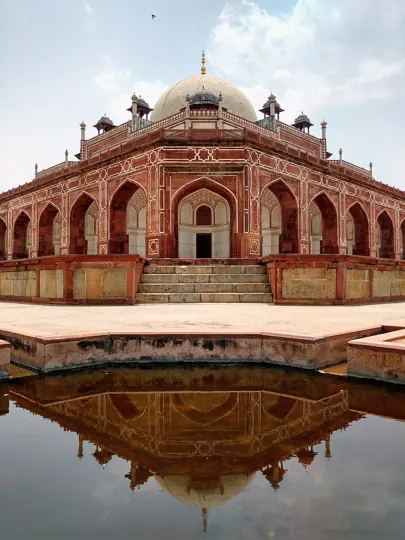
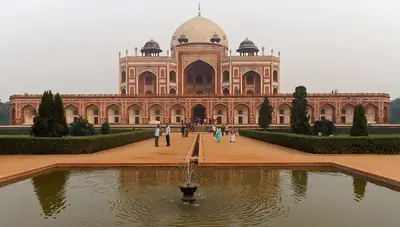
| Humayun’s tomb (1560s) | First great garden tomb (charbagh) in India; built by his widow Haji Begum; a model for the Taj Mahal |
| Akbar | Agra fort, Fatehpur Sikri (Buland Darwaza, Panch Mahal, Diwan-i-Khas), red sandstone |
| Jahangir | Akbar’s tomb at Sikandra; Itimad-ud-Daulah’s tomb (pietra dura inlay), built by Nur Jahan |
| Shah Jahan | White marble: Taj Mahal, Red Fort, Jama Masjid, Moti Masjid |
| Aurangzeb | Badshahi Mosque, Bibi ka Maqbara |
Prelims 2018 tested the materials: ‘White marble was used in making Buland Darwaza and Khankah at Fatehpur Sikri.’ The key marked this wrong, since these are mainly red sandstone with marble used only as inlay (pieces set into the surface). The Lucknow buildings in the second statement are of small lakhauri bricks and lime plaster. So the answer was neither.
With reference to the cultural history of India, consider the following statements : 1. White marble was used in making Buland Darwaza and Khankah at Fatehpur Sikri. 2. Red sandstone and marble were used in making Bara Imambara and Rumi Darwaza at Lucknow. Which of the statements given above is/are correct?
- 1 only
- 2 only
- Both 1 and 2
- Neither 1 nor 2
Show answer
Answer: (d) · UPSC official key
| Painting | Key points |
|---|---|
| Humayun | Brought Mir Sayyid Ali and Abdus Samad from Persia |
| Akbar | Hamzanama and illustrated histories; Daswanth and Basawan |
| Jahangir | Portraits, nature studies (Ustad Mansur’s birds), albums; Abul Hasan, Bichitr |
Prelims 2019 asked: Who among the following Mughal Emperors shifted emphasis from illustrated manuscripts to album and individual portrait? The answer was Jahangir.
Who among the following Mughal Emperors shifted emphasis from illustrated manuscripts to album and individual portrait?
- Humayun
- Akbar
- Jahangir
- Shah Jahan
Show answer
Answer: (c) · UPSC official key
What UPSC asks
Prelims: Fatehpur Sikri (2018), Jahangir’s albums (2019). Mains: Mughal art. Next likely: UNESCO sites.
Later Mughals and decline
| Year | Event |
|---|---|
| 1707–12 | Bahadur Shah I; the slide begins |
| 1713–19 | Farrukhsiyar, a puppet of the Sayyid brothers; his 1717 farman gave the English duty-free trade in Bengal |
| 1724 | Nizam-ul-Mulk founds Hyderabad; Bengal and Awadh also become virtually free |
| 1739 | Nadir Shah of Persia defeats Muhammad Shah at Karnal, sacks Delhi, takes the Peacock Throne and the Koh-i-Noor |
| 1761 | Third battle of Panipat: Ahmad Shah Abdali defeats the Marathas |
| 1764–65 | Shah Alam II loses at Buxar and grants the Diwani of Bengal to the Company |
| 1857 | Bahadur Shah Zafar, the last emperor, exiled to Rangoon |
| Cause of decline | Explanation |
|---|---|
| Jagirdari crisis | Too many nobles chasing too little revenue |
| Wars of succession | No fixed rule of succession |
| Aurangzeb’s policies | Deccan wars, revolts, loss of Rajput support |
| Regional powers | Marathas, Sikhs, Jats, Hyderabad, Bengal, Awadh |
| Invasions and Europeans | Nadir Shah, Abdali, then the East India Company |
Mains 2014: ‘The third battle of Panipat was fought in 1761. Why were so many empire-shaking battles fought at Panipat? Mains 2014 ‘ Point to its place on the route from the north-west passes to Delhi, the open plain suited to cavalry, the closeness to the capital, and the result of each battle (1526, 1556, 1761).
The third battle of Panipat was fought in 1761. Why were so many empire-shaking battles fought at Panipat?
What UPSC asks
Prelims: Farrukhsiyar 1717, Nadir Shah 1739. Mains: Panipat (2014); causes of decline. Next likely: rise of regional states.
Mains box: analysis and answer points
- Mughal state structure: mansab, jagir, zabt.
- Why Panipat (Mains 2014): route, open plain, near Delhi.
- Causes of decline.
Practice
Practice MCQs (8)
Nadir Shah of Persia defeated the Mughal army at Karnal in 1739, sacked Delhi and carried away the Peacock Throne and the Koh-i-noor. The Mughal emperor at that time was
Answer (c) & explanation
Nadir Shah invaded India in 1738-39 and routed the Mughal army at Karnal in February 1739. In Delhi a rumour of his death led to attacks on his soldiers, and he ordered a massacre of the inhabitants. He left with an enormous treasure, including Shah Jahan's Peacock Throne and the Koh-i-noor, and the territories west of the Indus were ceded to him. The emperor was Muhammad Shah (1719-48), whose authority never recovered.
The autonomous state of Hyderabad in the Deccan was founded in 1724 by
Answer (d) & explanation
Nizam-ul-Mulk Asaf Jah (Chin Qilich Khan), a leading noble who had helped overthrow the Sayyid brothers and briefly served as wazir, left Delhi in disgust and defeated the Mughal governor Mubariz Khan at Shakar Kheda in 1724. He then ruled the Deccan from Hyderabad, never formally breaking with the emperor but acting independently. Murshid Quli Khan and Alivardi Khan were rulers of Bengal, and Saadat Khan founded the autonomous state of Awadh.
The Sayyid brothers, Abdullah Khan and Husain Ali Khan, whose control of the court earned them the name 'king-makers', helped which emperor to the throne in 1713 and then deposed him in 1719?
Answer (a) & explanation
The Sayyid brothers backed Farrukhsiyar against Jahandar Shah in 1713 and held the real power as wazir and mir bakhshi. When Farrukhsiyar plotted against them, they deposed and killed him in 1719, set up two short-lived puppet emperors, and then placed Muhammad Shah on the throne. In 1720 a group of nobles led by Nizam-ul-Mulk turned against them; Husain Ali Khan was murdered and Abdullah Khan defeated, and Muhammad Shah ruled until 1748.
Which historian of Akbar's reign wrote the Muntakhab-ut-Tawarikh, a history sharply critical of Akbar's religious policy that was kept hidden during the emperor's lifetime?
Answer (d) & explanation
Abdul Qadir Badauni, an orthodox scholar who worked in Akbar's translation bureau, wrote the Muntakhab-ut-Tawarikh in secret. It attacks the influence of Abul Fazl and Faizi, the Ibadat Khana debates and the drift from orthodoxy, and gives a view of the court very different from the official Akbarnama. Nizamuddin Ahmad wrote the Tabaqat-i-Akbari, a more neutral general history.
With reference to the Tauhid-i-Ilahi (Din-i-Ilahi) of Akbar, consider the following statements:
1. It had no sacred book and no priestly class.
2. Raja Man Singh declined to become a disciple.
3. Enrolment in it was made compulsory for all mansabdars.
Which of the statements given above is/are correct?
Answer (b) & explanation
The Tauhid-i-Ilahi (about 1582), usually called the Din-i-Ilahi, was a discipleship of select nobles who pledged devotion to the emperor; it had no scripture, no priests and no places of worship. Membership was voluntary and small: Abul Fazl, Faizi and Birbal joined, while Raja Man Singh politely declined, and Akbar did not press him. Most historians treat it as an order of personal loyalty rather than a new religion, and it faded away after Akbar's death.
Consider the following statements about the Ain-i-Akbari:
1. It forms the third volume of the Akbarnama of Abul Fazl.
2. It was completed in 1598, after going through five revisions.
3. It was written in Chaghatai Turkish.
4. It deals only with the court and the army and gives no information about the provinces or the peasantry.
How many of the statements given above are correct?
Answer (b) & explanation
The Akbarnama of Abul Fazl has three volumes; the first two are a chronicle, and the third is the Ain-i-Akbari, an account of the institutions and resources of the empire. NCERT notes that it was completed in 1598, the forty-second regnal year, after five revisions. It was written in Persian. Far from being only about the court, its books cover the imperial household, the army and officials, the fiscal data of the provinces (mulk-abadi), and the religious, literary and cultural traditions of the people. NCERT uses it as the main source for agrarian history.
With reference to historians' explanations of the decline of the Mughal Empire, consider the following statements:
1. Jadunath Sarkar laid great stress on Aurangzeb's religious policy and personal rule.
2. Satish Chandra traced the decline to a crisis of the jagirdari system, in which the revenue available for assignment fell short of the claims of a growing body of mansabdars.
3. Irfan Habib emphasised an agrarian crisis, in which heavy revenue demands drove peasants to flight and revolt.
Which of the statements given above are correct?
Answer (d) & explanation
Three influential explanations are often contrasted. Jadunath Sarkar blamed Aurangzeb's religious policy and his distrust of others, which alienated Rajputs, Sikhs, Jats and Marathas. Satish Chandra argued for a jagirdari crisis: as the number of mansabdars grew, especially with the Deccani and Maratha nobles, good jagirs ran short (be-jagiri), and factional struggle followed. Irfan Habib stressed the agrarian crisis: jagirdars squeezed the peasants, who fled or rebelled under zamindar leadership. Later historians add regional explanations, seeing the eighteenth century as a time of new regional powers.
With reference to court rituals in Mughal India, consider the following statements:
1. The practice of jharokha darshan, in which the emperor showed himself to the public from a balcony at sunrise, was introduced by Akbar.
2. Under Shah Jahan, prostration (sijda) before the emperor was replaced by the chahar taslim and zaminbos.
3. Aurangzeb discontinued the practice of jharokha darshan.
Which of the statements given above are correct?
Answer (b) & explanation
NCERT (Theme 9) records that jharokha darshan was introduced by Akbar, who appeared at a balcony facing east at sunrise to widen the acceptance of imperial authority as part of popular faith. Forms of salutation marked rank; the highest was sijda (prostration), which drew orthodox objection, and under Shah Jahan it was replaced by the chahar taslim and zaminbos (kissing the ground). Aurangzeb, who regarded the practice as un-Islamic, stopped jharokha darshan early in his reign.
0 / 0 correct
Write an answer
In 150 words, explain the significance of Mughal Empire with one recent example.
Flashcards (7)
Who introduced the zabt/dahsala system?
Raja Todar Mal under Akbar (1580).
Zat and sawar?
Personal rank and cavalry obligation.
Emperor who favoured albums and
portraits? Jahangir.
First garden tomb in India?
Humayun's tomb.
Nadir Shah's invasion?
1739; battle of Karnal.
Farman of 1717 was given by?
Farrukhsiyar.
Third battle of Panipat?
1761; Abdali beat the Marathas.
Read more: related explainers
In the news
- 20 Oct 2026Sirpur in Chhattisgarh enters UNESCO’s Tentative List of World Heritage sites
- 15 Oct 2026PM inaugurates five Ladakh projects: Nimmu–Padum–Darcha road, Leh terminal, Hanu hydro
- 14 Oct 2026HAL, NCF and ASI sign MoA for Hampi, Taj Mahal and Bekal Fort
- 11 Oct 2026Birth anniversaries: Jayaprakash Narayan and Nanaji Deshmukh
 Next topic · 7.4 →Mughal Empire: Mughal administration basics
Syllabus: Prelims GS-I · History of India and Indian National Movement.