
Chapter 4 · Topic 4.3 · Prelims + Mains3 of 3
Vijayanagara Empire: The whole chapter
Key points
- Architecture of Hampi (Mains 2026).
- Talikota 1565; Mysore emerges (Prelims 2021).
4 PYQs 2014–2023
Prelims box: facts and traps
| Feature | Example |
|---|---|
| Raya gopurams | Huge gateways, taller than the shrine, as at the Virupaksha temple |
| Pillared halls | Kalyana mandapas with carved pillars; the 'musical pillars' of the Vitthala temple |
| Stone chariot | Garuda shrine at the Vitthala temple |
| Reliefs | The Hazara Rama temple shows the Ramayana, processions and festivals |
| Indo-Islamic touches | Arches and domes in the Lotus Mahal and the elephant stables. |
- Hampi is a UNESCO World Heritage Site (1986).
- Rama Raya, regent for Sadashiva Raya, played the Deccan sultans against each other.
- In 1565 Bijapur, Ahmadnagar, Golconda and Bidar united and defeated him at Talikota (also called Rakshasa-Tangadi).
- Trap (UPSC Prelims 2021, Indian history): “The Nizamat of Arcot emerged out of Hyderabad State” is incorrect. “Rohilkhand Kingdom was formed out of the territories occupied by Ahmad Shah Durrani” is incorrect.
Architecture of Hampi
Hampi is a UNESCO World Heritage Site (1986). Its builders added new features to the Dravida temple style and borrowed from Deccan sultanate buildings for royal halls.
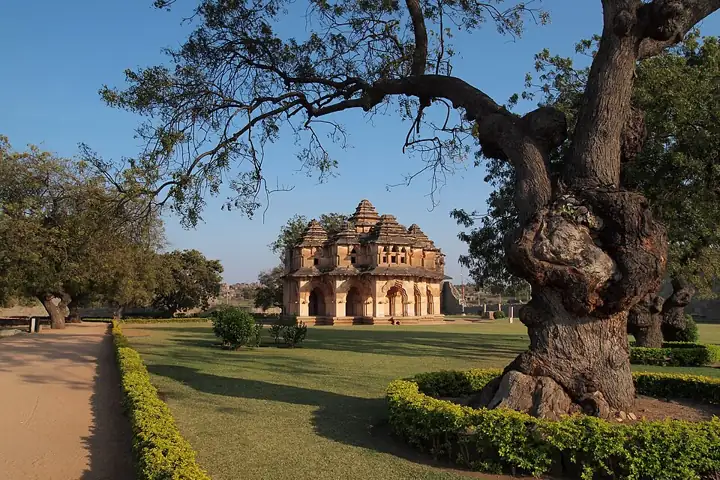
| Feature | Example |
|---|---|
| Raya gopurams | Huge gateways, taller than the shrine, as at the Virupaksha temple |
| Pillared halls | Kalyana mandapas with carved pillars; the ‘musical pillars’ of the Vitthala temple |
| Stone chariot | Garuda shrine at the Vitthala temple |
| Reliefs | The Hazara Rama temple shows the Ramayana, processions and festivals |
| Indo-Islamic touches | Arches and domes in the Lotus Mahal and the elephant stables |
Mains 2026: ‘Vijayanagara architecture exemplifies the amalgamation of past traditions with contemporary practices.’ Answer with Chola and Hoysala temple traditions (past) and sultanate arches and domes (contemporary), giving the examples above.
Vijayanagara architecture exemplifies the amalgamation of past traditions with contemporary practices. Elucidate with examples.
Talikota and decline
Rama Raya, regent for Sadashiva Raya, played the Deccan sultans against each other. In 1565 Bijapur, Ahmadnagar, Golconda and Bidar united and defeated him at Talikota (also called Rakshasa-Tangadi). The capital was sacked and left in ruins.
| After 1565 | What happened |
|---|---|
| Aravidu dynasty | Ruled from Penukonda, then Chandragiri |
| Nayakas | Madurai, Thanjavur and Gingee became independent |
| Mysore | The Wodeyars took Srirangapatna (1610) and built their own kingdom |
Prelims 2021 checked this: ‘The Mysore Kingdom emerged out of Vijayanagara Empire.’ This was true. The Nizamat of Arcot did not come from Hyderabad State, and Rohilkhand was not formed from Ahmad Shah Durrani’s lands, so the answer was 2 only.
With reference to Indian history, which of the following statements is/are correct? 1. The Nizamat of Arcot emerged out of Hyderabad State. 2. The Mysore Kingdom emerged out of Vijayanagara Empire. 3. Rohilkhand Kingdom was formed out of the territories occupied by Ahmad Shah Durrani. Select the correct answer using the code given below.
- 1 and 2
- 2 only
- 2 and 3
- 3 only
Show answer
Answer: (b) · UPSC official key
Mains box: analysis and answer points
- Likely next angle: UNESCO heritage site
- Asked: Mains 2026 (GS Paper I, 15 marks): Vijayanagara architecture exemplifies the amalgamation of past traditions with contemporary practices. Elucidate with examples.
Practice
Practice MCQs (8)
With reference to the battle of 1565 at Rakshasi-Tangadi (Talikota), consider the following statements:
1. The Vijayanagara army was led by Rama Raya, the chief minister of Vijayanagara.
2. Vijayanagara was routed by the combined armies of Bijapur, Ahmadnagar and Golconda.
3. The Sultanate of Berar led the alliance and took the largest share of Vijayanagara territory.
Which of the statements given above is/are correct?
Answer (a) & explanation
NCERT states that in 1565 Rama Raya, the chief minister of Vijayanagara, led the army into battle at Rakshasi-Tangadi (Talikota), where his forces were routed by the combined armies of Bijapur, Ahmadnagar and Golconda; the victors then sacked the city. Statement 3 is wrong: Berar was not the leader of the alliance, and NCERT names only the three Sultanates. Rama Raya was captured and killed in the battle.
After the sack of the city of Vijayanagara in 1565, the Aravidu dynasty ruled the empire from
Answer (c) & explanation
NCERT states that after 1565 the city was totally abandoned within a few years and the focus of the empire shifted east, where the Aravidu dynasty ruled from Penukonda and later from Chandragiri (near Tirupati). The empire thus survived for about a century more as a smaller eastern state. It was a local nayaka of the Chandragiri ruler who granted the English the site of Madras in 1639.
Consider the following statements about the decline of the Vijayanagara Empire:
1. After Krishnadeva Raya's death in 1529, his successors were troubled by rebellious nayakas.
2. The Aravidu dynasty, which took control at the centre, lost power within a decade of the battle of 1565.
3. The Sultan of Bijapur intervened to resolve succession disputes in Vijayanagara after Krishnadeva Raya's death.
Which of the statements given above are correct?
Answer (c) & explanation
NCERT notes that strain showed after 1529, when Krishnadeva Raya's successors were troubled by rebellious nayakas, and that the Sultan of Bijapur intervened to resolve the succession disputes that followed. Statement 2 is wrong: NCERT says the Aravidu lineage remained in power till the end of the seventeenth century, ruling from Penukonda and Chandragiri after the capital fell. The battle of 1565 ended the city, not the dynasty.
Saluva Timmarasu, remembered in popular tradition as 'Appaji', was
Answer (b) & explanation
Saluva Timmarasu served as the chief minister (mahapradhana) of Krishnadeva Raya and is credited with helping him secure the throne in 1509. Popular tales of the court, including those of Tenali Rama, call him Appaji. He is not the same person as Saluva Narasimha, the general who seized power in 1485, although both carry the Saluva name.
In his memoirs, Babur named two non-Muslim rulers as the most powerful in Hindustan at the time of his invasion. One was the Raja of Bijanagar (Vijayanagara). The other was
Answer (b) & explanation
Describing Hindustan, Babur wrote that of the pagan rulers the greatest in territory and army was the Raja of Bijanagar, and the other was Rana Sanga of Mewar, who had risen by his own valour. The Vijayanagara ruler at the time was Krishnadeva Raya. The remark shows that the empire's reputation had reached north India and Central Asia at its height.
Consider the following statements: Statement-I: In 1565 the Sultanates of Bijapur, Ahmadnagar and Golconda combined against Vijayanagara and decisively defeated it. Statement-II: Rama Raya followed an adventurous policy of trying to play off one Sultan against another.
Which one of the following is correct in respect of the above statements?
Answer (a) & explanation
Both are true and Statement-II explains Statement-I. NCERT stresses that the Vijayanagara kings and the Sultans were keen to ensure each other's stability, but it was the adventurous policy of Rama Raya, who tried to play off one Sultan against another, that led the Sultans to combine and decisively defeat him. The alliance was a political reaction to his interventions, not a religious crusade.
The palaiyakkarar (poligar) system, under which the country around Madurai was parcelled out among some seventy-two military chiefs, was organised in the sixteenth century by
Answer (d) & explanation
Vishvanatha Nayaka, sent by the Vijayanagara court to the Tamil south, founded the Madurai Nayaka line. With his dalavay and minister Ariyanatha Mudaliar he organised the palaiyakkarar system: the region was divided into palayams, traditionally seventy-two, each under a chief who paid tribute, supplied troops and kept order. The system was a local form of the amara-nayaka idea, and the poligars later resisted the English in the eighteenth century.
Consider the following kingdoms:
1. The Nayakas of Ikkeri (Keladi)
2. The Nayakas of Gingee
3. The Barid Shahis of Bidar
4. The Nayakas of Thanjavur
How many of the above arose from the governors or military chiefs (nayakas) of the Vijayanagara Empire?
Answer (c) & explanation
NCERT asks students to locate Chandragiri, Madurai, Ikkeri, Thanjavur and Mysore as centres of nayaka power, and notes that in the seventeenth century many nayakas set up independent kingdoms. Ikkeri (Keladi), Gingee and Thanjavur were all ruled by houses that began as Vijayanagara nayakas or governors. The Barid Shahis of Bidar were one of the five successor Sultanates of the Bahmani kingdom, so only three of the four fit.
0 / 0 correct
Prelims PYQs on this topic (4)
Who among the following rulers of Vijayanagara Empire constructed a large dam across Tungabhadra River and a canal-cum-aqueduct several kilometres long from the river to the capital city?
Answer (a) & explanation
Devaraya I built the Tungabhadra dam and canal (a). Devaraya I (1406–22) of the Sangama dynasty built a dam across the Tungabhadra and a long canal-cum-aqueduct that brought water to the capital, Vijayanagara (Hampi). This boosted farming and the state's revenue. The Portuguese visitor Nuniz described such works. Mallikarjuna (b), Vira Vijaya (c) and Virupaksha (d) were later Sangama rulers of a weaker period; none built this dam.
Notice the Italian traveller Nicolo de Conti, who visited under Devaraya I. The Hampi ruins, a UNESCO World Heritage site, still show tanks and channels, such as the stepped tank and the Kamalapura tank. The modern Tungabhadra dam came up in 1953.
Answer as per the official UPSC answer key.
According to Portuguese writer Nuniz, the women in Vijayanagara Empire were expert in which of the following areas?
- 1. Wrestling
- 2. Astrology
- 3. Accounting
- 4. Soothsaying
Select the correct answer using the code given below.
Answer (d) & explanation
Nuniz described women in all four roles (d). Fernão Nuniz, a Portuguese horse trader in Vijayanagara around 1535, wrote that the palace women included wrestlers (item 1), astrologers (item 2), and soothsayers (item 4). He also wrote that women kept the accounts of expenses inside the palace (item 3), and that some served as clerks and even judges. So all four appear in his chronicle.
Notice the other foreign visitors to Vijayanagara: Domingo Paes (Portuguese, under Krishnadeva Raya), Abdur Razzaq (Persian, under Deva Raya II), and Niccolò de' Conti (Italian). The capital, Hampi, is a UNESCO World Heritage Site. The empire fell after the Battle of Talikota (1565).
Answer as per the official UPSC answer key.
Consider the following statements :
- 1. It was during the reign of Iltutmish that Chengiz Khan reached the Indus in pursuit of the fugitive Khwarezm prince.
- 2. It was during the reign of Muhammad bin Tughluq that Taimur occupied Multan and crossed the Indus.
- 3. It was during the reign of Deva Raya II of Vijayanagara Empire that Vasco da Gama reached the coast of Kerala.
Which of the statements given above is/are correct?
Answer (a) & explanation
Only statement 1 is correct (a). Statement 1 is right: Chingiz Khan reached the Indus in 1221, during the reign of Iltutmish, chasing the Khwarezm prince Jalal-ud-din Mangbarni. Iltutmish wisely refused the prince shelter, saving Delhi from attack. Statement 2 is wrong: Timur invaded in 1398, in the reign of Nasir-ud-din Mahmud Tughluq, not Muhammad bin Tughluq, who died in 1351. Statement 3 is wrong: Vasco da Gama reached Calicut in 1498, long after Deva Raya II died in 1446; Vijayanagara was then under the Saluva dynasty.
Notice that Timur's sack of Delhi weakened the Sultanate, and the Sayyids followed. The Zamorin ruled Calicut when da Gama arrived.
Each statement gets the event right and puts the wrong ruler with it. Date each one.
Answer as per the official UPSC answer key.
With reference to Indian history, which of the following statements is/are correct?
- 1. The Nizamat of Arcot emerged out of Hyderabad State.
- 2. The Mysore Kingdom emerged out of Vijayanagara Empire.
- 3. Rohilkhand Kingdom was formed out of the territories occupied by Ahmad Shah Durrani.
Select the correct answer using the code given below.
Answer (b) & explanation
Only statement 2 is correct (b). Statement 1 is wrong: Arcot was the seat of the Nawabs of the Carnatic, a Mughal province; it was not a Nizamat carved out of Hyderabad, though the Nizam claimed overlordship. Statement 2 is right: the Wodeyars of Mysore began as Vijayanagara feudatories and became independent after 1565. Statement 3 is wrong: Rohilkhand was built by Ali Muhammad Khan Rohilla from Mughal lands in the 1740s, before Ahmad Shah Durrani's invasions; the Rohillas later allied with Durrani.
Notice that Haidar Ali took power in Mysore from the Wodeyars in 1761. The Third Battle of Panipat (1761) saw Durrani defeat the Marathas.
The Carnatic nawab was nominally under the Nizam, so 1 looks right. UPSC's key treats it as wrong.
Answer as per the official UPSC answer key.
Write an answer
In 150 words, explain the significance of Vijayanagara Empire with one recent example.
Flashcards (5)
When did Hampi become a World Heritage
Site? 1986.
Where are the musical pillars?
Vitthala temple.
Temple with Ramayana reliefs?
Hazara Rama temple.
Battle of Talikota?
1565; the Deccan sultans beat Rama Raya.
Which kingdom emerged out of
Vijayanagara? Mysore (Wodeyars).
Read more: related explainers
In the news
- 20 Oct 2026Sirpur in Chhattisgarh enters UNESCO’s Tentative List of World Heritage sites
- 15 Oct 2026PM inaugurates five Ladakh projects: Nimmu–Padum–Darcha road, Leh terminal, Hanu hydro
- 14 Oct 2026HAL, NCF and ASI sign MoA for Hampi, Taj Mahal and Bekal Fort
- 11 Oct 2026Birth anniversaries: Jayaprakash Narayan and Nanaji Deshmukh
 Next chapter · 5. Bahmani Kingdom →Bahmani Kingdom: Foundation and Mahmud Gawan
Syllabus: Prelims GS-I · History of India and Indian National Movement.