
Chapter 15 · Topic 15.3 · Prelims + Mains3 of 3
Partition of India: Refugees and rehabilitation
Key points
- Ministry of Relief and Rehabilitation: September 1947, K.C. Neogy.
- Camps: Kingsway Camp, Purana Qila; towns: Faridabad, Nilokheri.
- Nehru-Liaquat Pact April 1950; Displaced Persons (Compensation and Rehabilitation) Act, 1954.
- Punjab: quick, two-way move in 1947. Bengal: waves in 1950, 1964, 1971.
1 PYQ 2005–2014
Prelims box: facts and traps
- Partition Council: 27 June 1947, chaired by Mountbatten.
- Punjab Boundary Force: about 50,000 under Maj-Gen T.W. Rees, from 1 August 1947.
- Evacuee property: used to compensate refugees.
- Trap: Gandhi's fast of 13 January 1948 was for communal peace in Delhi; the payment to Pakistan was one issue around it, not its sole purpose.
Refugees and rehabilitation
The new Indian state had to feed, house and resettle millions of refugees within months. A refugee is a person forced to flee their home to stay safe. Rehabilitation means helping them start a normal life again: a roof, land or a job, and a school for the children.
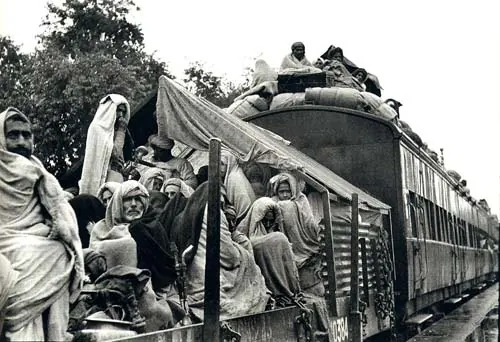
Think of a family that leaves Lahore in August 1947 with only what it can carry. It reaches a camp in Delhi, waits months for a plot, and finally builds a small shop in a new colony. Millions of such families had to be helped at the same time, often with little money and few officials.
How the government prepared
The work of dividing the country started even before independence. After the 3 June Plan a Partition Committee was formed. On 27 June 1947 it was reconstituted as the Partition Council, chaired by Mountbatten, with Patel and Rajendra Prasad for India and Jinnah and Liaquat Ali Khan for Pakistan. It divided assets such as money, offices and the army, the way a family divides its property when brothers set up separate homes.
To keep order, the Punjab Boundary Force, a mixed force of about 50,000 under Major-General T.W. Rees, took charge of twelve central Punjab districts from 1 August 1947. It was too small for so large an area, and it could not stop the killings that followed the award. It was wound up at the start of September 1947.
Relief and resettlement
Once people crossed over, the government set up a new ministry and many camps. It then built whole new towns and colonies. Land and houses left behind by people who had gone to Pakistan, called evacuee property, were given to refugees as compensation. A law in 1954 put this compensation on a firm footing, so refugees had a legal right to claim it rather than waiting for favours.
| Measure | Detail |
|---|---|
| Ministry of Relief and Rehabilitation | Set up in September 1947; K.C. Neogy the first minister |
| Camps | Kingsway Camp and Purana Qila in Delhi, and many others in Punjab and Bengal |
| New townships | Faridabad and Nilokheri; new colonies in Delhi and Calcutta |
| Evacuee property | Property left by migrants was used to compensate refugees |
| Nehru-Liaquat Pact (April 1950) | Both countries promised to protect their minorities |
| Compensation law | Displaced Persons (Compensation and Rehabilitation) Act, 1954 |
West and East were different
In the west, almost everyone moved at once in 1947, in both directions, so there was also property left behind to share out. In the east, people kept coming for years, in waves, so help was slower and harder.
| West vs East | Detail |
|---|---|
| Punjab | Movement mostly in 1947, in both directions; resettlement relatively quick |
| Bengal | Migration continued for years and peaked in waves (1950, 1964, 1971); rehabilitation was slower |
Gandhi’s last fast, begun on 13 January 1948, was for communal peace in Delhi, where refugees were angry and riots had broken out again.
Partition shaped Indian politics for decades, from refugee resettlement and the Kashmir dispute to the commitment to a secular constitution. Literature such as Khushwant Singh’s ‘Train to Pakistan’ and Saadat Hasan Manto’s stories keeps the memory alive.
What UPSC asks: Prelims: rehabilitation measures and the Nehru-Liaquat Pact. Mains: why the West and the East differed.
Mains box: analysis and answer points
- Long legacy: refugee resettlement, the Kashmir dispute and the commitment to a secular constitution.
- West vs East: one-time exchange versus continuing waves.
- Next likely angle: literature of partition.
Practice
Practice MCQs (8)
Consider the following pairs: Township built to resettle Partition refugees : Present State
1. Gandhidham : Gujarat
2. Ulhasnagar : Gujarat
3. Nilokheri : Haryana
4. Faridabad : Rajasthan
How many of the pairs given above are correctly matched?
Answer (b) & explanation
Gandhidham in Kutch (Gujarat) was built by the Sindhu Resettlement Corporation for Sindhi refugees, linked to the new port of Kandla. Ulhasnagar, near Bombay, grew out of a military camp into a Sindhi township and is in ==Maharashtra==. Nilokheri, a model agro- industrial township, and Faridabad, built with refugee labour near Delhi, are both in Haryana. Pairs 2 and 4 are wrong.
Who among the following led India's operation to recover women abducted during the Partition violence, after the Inter-Dominion conference at Lahore in December 1947?
Answer (a) & explanation
At the Inter-Dominion conference at Lahore in December 1947, India and Pakistan agreed to recover and restore abducted women and children; Mridula Sarabhai was made chief social worker and led India's recovery work, later backed by the Abducted Persons (Recovery and Restoration) Act, 1949. Kamaladevi Chattopadhyay is linked instead with ==refugee resettlement at Faridabad== through the Indian Co-operative Union.
The Punjab Boundary Force, set up to keep order in the disturbed districts of Punjab around the time of Partition, was commanded by
Answer (a) & explanation
The Punjab Boundary Force, a mixed force of about 50,000 under Major-General T.W. Rees, took charge of twelve central Punjab districts from 1 August 1947. Its troops were drawn from both communities and it was blamed by both sides; it was ==disbanded on 1 September 1947==, after barely a month, and each dominion took over security on its side. Messervy became the first C-in-C of the Pakistan Army; Usman and Cariappa were Indian officers in other roles.
With reference to the Partition Council set up in 1947, consider the following statements:
1. It was presided over by Lord Mountbatten.
2. Vallabhbhai Patel and Rajendra Prasad represented India, while M.A. Jinnah and Liaquat Ali Khan represented Pakistan.
3. Its Steering Committee consisted of two officials, H.M. Patel and Chaudhri Muhammad Ali.
Which of the statements given above is/are correct?
Answer (d) & explanation
After the 3 June Plan a Partition Committee was formed and then reconstituted, on 27 June 1947, as the Partition Council, chaired by Mountbatten, with Patel and Rajendra Prasad for India and Jinnah and Liaquat Ali Khan for Pakistan. Below it a two-member Steering Committee of officials, H.M. Patel and Chaudhri Muhammad Ali, directed expert committees on assets, services, records and armed forces. All three statements are correct; note that ==Nehru was not a member==.
Consider the following statements regarding the division of cash balances after Partition:
1. Pakistan's share of undivided India's cash balances was fixed at Rs 75 crore.
2. Rs 20 crore was paid at the outset and the remaining Rs 55 crore was withheld after fighting broke out in Kashmir.
3. The Government of India decided in January 1948 to release the Rs 55 crore.
4. Gandhi's fast of January 1948 was undertaken solely to secure this payment.
How many of the statements given above are correct?
Answer (c) & explanation
Under the financial settlement, Pakistan's share of the cash balances was Rs 75 crore; Rs 20 crore was paid, and the balance of Rs 55 crore was held back once tribal raiders and then the armies were fighting in Kashmir. On 15 January 1948, during Gandhi's fast, the Cabinet decided to pay it as a gesture of goodwill. Gandhi's fast, begun on 13 January, was ==for communal peace in Delhi==; the payment was one of the issues around it, not its sole purpose. Statement 4 is wrong.
Consider the following statements about the Nehru-Liaquat Agreement:
1. It was signed in April 1950.
2. It provided for Minority Commissions in East Bengal, West Bengal and Assam.
3. Syama Prasad Mookerjee resigned from the Union Cabinet in protest against it.
4. It was concluded through the mediation of the United Nations.
How many of the statements given above are correct?
Answer (c) & explanation
Signed at Delhi on 8 April 1950 after fresh riots and an exodus across the Bengal border, the Nehru-Liaquat Agreement promised minorities equal citizenship, security and freedom to return, and set up Minority Commissions for East Bengal, West Bengal and Assam. Syama Prasad Mookerjee and K.C. Neogy resigned from the Cabinet in protest. It was a ==bilateral agreement between the two Prime Ministers==, with no UN mediation; statement 4 is wrong.
During the division of the armed forces in 1947, who held the post of Supreme Commander, responsible for both dominions' forces until the Supreme Headquarters was wound up at the end of November 1947?
Answer (b) & explanation
On partition the Commander-in-Chief Auchinleck became Supreme Commander, with administrative control over the forces of both dominions while they were being divided; he had no operational command. Mutual suspicion, especially after the Kashmir conflict began, led to the Supreme Headquarters being closed on 30 November 1947. Rob Lockhart was ==the first Commander-in-Chief of the Indian Army== after independence, and Rees commanded the Punjab Boundary Force; Ismay was Mountbatten's chief of staff.
Which one of the following statements about the Bihar riots of October-November 1946 is NOT correct?
Answer (c) & explanation
The Bihar riots began in late October 1946, when news and exaggerated reports of the Noakhali violence were used to inflame Hindu peasants, and Muslims were the main victims in districts such as Saran, Patna and Monghyr. Gandhi moved from Noakhali to Bihar in March 1947. They were ==not a Direct Action Day outbreak==: the 16 August violence was centred in Calcutta, more than two months earlier.
0 / 0 correct
Prelims PYQs on this topic (1)
The Partition of Bengal made by Lord Curzon in 1905 lasted until
Answer (b) & explanation
At the Delhi Durbar of December 1911, King George V announced that the partition of Bengal would be annulled and the capital moved from Calcutta to Delhi (b). It did not end during the First World War (a), which began in 1914, or with the Civil Disobedience Movement (c) of 1930. Option (d) confuses it with the 1947 Partition, a different event.
After 1911, Bihar and Orissa became a separate province (1912) and Assam was again a chief commissionership. Notice how the 1905 partition sparked the Swadeshi movement, which gave India boycott, national education and swadeshi enterprises.
Answer as per the official UPSC answer key.
Write an answer
In 150 words, explain the significance of Partition of India with one recent example.
Flashcards (3)
First Minister of Relief and Rehabilitation?
K.C. Neogy.
Two refugee townships near Delhi?
Faridabad and Nilokheri.
What did the Nehru-Liaquat Pact (1950)
cover? Protection of minorities.
Read more: related explainers
In the news
 Next chapter · 16. Integration of Princely States →Integration of Princely States: The problem and the method
Syllabus: GS-I · The Freedom Struggle — its various stages and important contributors/contributio…