
Chapter 12 · Topic 12.2 · Prelims + Mains2 of 3
Revolutionary Movement: HRA, HSRA and Bhagat Singh
Key points
- HRA: 1924, Kanpur; Sachindranath Sanyal, Jogesh Chandra Chatterjee, Ramprasad Bismil.
- Kakori train action: 9 August 1925; four hanged in 1927.
- HSRA: September 1928, Feroz Shah Kotla, Delhi; socialism the goal.
- Assembly bomb 8 April 1929; Bhagat Singh, Sukhdev, Rajguru hanged 23 March 1931.
Prelims box: facts and traps
- Kakori martyrs: Ramprasad Bismil, Ashfaqulla Khan, Roshan Singh, Rajendra Lahiri.
- Saunders: shot 17 December 1928 to avenge Lajpat Rai.
- Bills opposed in 1929: Public Safety Bill and Trade Disputes Bill.
- Jatin Das: died after a 63-day hunger strike, 1929.
- Azad: killed at Alfred Park, Allahabad, 27 February 1931.
- Tribunal verdict: 7 October 1930.
The HRA and the Kakori case
When Gandhi called off the Non-Cooperation Movement in 1922, many youths were disappointed. A second phase of revolutionary activity began, now with clear socialist ideas. Socialism means sharing a country’s wealth fairly.
| HRA | Detail |
|---|---|
| Founded | Hindustan Republican Association, 1924, Kanpur |
| Leaders | Sachindranath Sanyal, Jogesh Chandra Chatterjee, Ramprasad Bismil |
| Aim | A federal republic of the United States of India through armed revolution |
| Kakori (9 August 1925) | Members looted a train carrying government money near Kakori, Lucknow |
| Result | Ramprasad Bismil, Ashfaqulla Khan, Roshan Singh and Rajendra Lahiri were hanged (1927); others jailed |
Kakori shows Hindu-Muslim unity among revolutionaries: Bismil and Ashfaqulla were close friends.
What UPSC asks: Prelims: HRA 1924. Mains: Kakori 1925.
Bhagat Singh, Azad and the HSRA
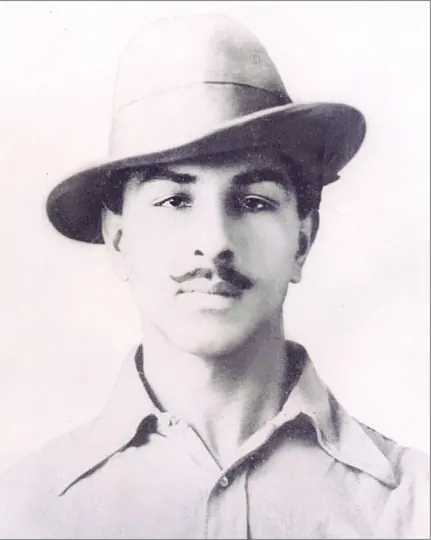
In September 1928, at Feroz Shah Kotla in Delhi, Chandrashekhar Azad, Bhagat Singh, Sukhdev and others renamed the group the Hindustan Socialist Republican Association (HSRA). Socialism was now its official goal.
| Date | Event |
|---|---|
| 1926 | Bhagat Singh helped found the Naujawan Bharat Sabha, Lahore |
| 17 December 1928 | Saunders shot in Lahore, to avenge Lala Lajpat Rai’s death after the lathi charge on the anti-Simon protest |
| 8 April 1929 | Bhagat Singh and Batukeshwar Dutt threw harmless bombs in the Central Legislative Assembly against the Public Safety and Trade Disputes Bills; shouted ‘Inquilab Zindabad’ and courted arrest |
| 1929 | Jatin Das died after a 63-day hunger strike in Lahore jail |
| 27 February 1931 | Chandrashekhar Azad killed in a gun battle at Alfred Park, Allahabad |
| 23 March 1931 | Bhagat Singh, Sukhdev and Rajguru hanged in Lahore |
Bhagat Singh’s writings, such as ‘Why I am an Atheist’, and Bhagwati Charan Vohra’s ‘Philosophy of the Bomb’ show that the HSRA saw revolution as a change of society, not just the killing of officials. Like a loud alarm, the Assembly bomb was meant, Bhagat Singh said, ‘to make the deaf hear’.
What UPSC asks: Prelims: HSRA 1928; Assembly bomb 1929.
Mains box: analysis and answer points
- Second phase: born of disappointment after 1922; now socialist.
- Ideas: 'Why I am an Atheist', 'Philosophy of the Bomb'; revolution means changing society.
- Next likely angle: Hindu-Muslim unity in Kakori.
Practice
Practice MCQs (8)
With reference to the Hindustan Socialist Republican Association (HSRA), consider the following statements:
1. It was formed at a meeting held at Ferozeshah Kotla in Delhi in September 1928.
2. The word 'Socialist' was added to the old name to show that the revolutionaries had accepted socialism as their goal.
3. Ram Prasad Bismil presided over its founding meeting.
Which of the statements given above is/are correct?
Answer (a) & explanation
Revolutionaries from the Punjab, the United Provinces, Bihar and Rajasthan met at Ferozeshah Kotla, Delhi, on 9-10 September 1928 and renamed the HRA the Hindustan Socialist Republican Association. Under the influence of Bhagat Singh, Sukhdev and Bhagwati Charan Vohra the group adopted socialism as its goal, and Chandrashekhar Azad became its military head. Ram Prasad Bismil had been hanged in December 1927 and could not have been present.
On 8 April 1929 Bhagat Singh and Batukeshwar Dutt threw two bombs, meant to frighten and not to kill, into the Central Legislative Assembly and courted arrest. Their act was a protest against the passing of
Answer (d) & explanation
The HSRA chose the moment when the government was pushing through the Public Safety Bill and the Trade Disputes Bill, aimed at curbing radicals and the labour movement. From the visitors' gallery Bhagat Singh and B.K. Dutt threw bombs on empty benches, shouted 'Inquilab Zindabad' and scattered leaflets saying that it takes a loud voice to make the deaf hear. They did not try to escape, as they wanted to use the trial for propaganda. Both were sentenced to transportation for life.
In September 1929 a revolutionary under trial in the Lahore Conspiracy Case died in Lahore jail after a hunger strike of more than sixty days for better treatment of political prisoners. His death caused an outburst of grief across the country. He was
Answer (a) & explanation
Jatindra Nath Das (Jatin Das), a Bengal revolutionary who had made bombs for the HSRA, joined Bhagat Singh and others in a hunger strike in Lahore jail from July 1929, demanding that political prisoners be treated as such. He died on 13 September 1929. His body was taken to Calcutta, where huge crowds joined the funeral procession, and the event greatly increased the popularity of the revolutionaries.
Consider the following revolutionaries:
1. Ram Prasad Bismil
2. Ashfaqulla Khan
3. Chandrashekhar Azad
4. Rajendra Lahiri
How many of the above were hanged in December 1927 after the Kakori conspiracy case?
Answer (c) & explanation
On 9 August 1925 HRA members stopped the 8-Down train on the Saharanpur- Lucknow line at Kakori, near Lucknow, and took away government treasure to fund the organisation. In the conspiracy case that followed, Ram Prasad Bismil, Ashfaqulla Khan, Roshan Singh and Rajendra Lahiri were hanged in December 1927; Sachindranath Sanyal and others were transported or jailed. Chandrashekhar Azad escaped arrest and later led the HSRA.
Consider the following pairs: Revolutionary : Associated with
1. Chandrashekhar Azad : Death in a police encounter at Alfred Park, Allahabad, in 1931
2. Batukeshwar Dutt : The bomb thrown in the Central Legislative Assembly in 1929
3. Rajguru : The Kakori train action of 1925
4. Yashpal : The Chittagong armoury raid of 1930
How many of the pairs given above are correctly matched?
Answer (b) & explanation
Pairs 1 and 2 are correct. Chandrashekhar Azad died on 27 February 1931 in a gunfight with the police at Alfred Park, Allahabad (now Chandrashekhar Azad Park). Batukeshwar Dutt threw the Assembly bombs with Bhagat Singh. Rajguru joined the HSRA later and is known for the Saunders shooting at Lahore in 1928, not for Kakori. Yashpal was an HSRA member in the north, linked with the bomb under the Viceroy's train in 1929; the Chittagong raid was the work of Surya Sen's group in Bengal.
With reference to the Hindustan Republican Association (HRA), consider the following statements:
1. It was founded at Kanpur in October 1924, with Sachindranath Sanyal, Ram Prasad Bismil and Jogesh Chandra Chatterjee among its founders.
2. It aimed to overthrow colonial rule by armed revolution and to set up a Federal Republic of the United States of India based on adult franchise.
3. It was founded at Lahore by Bhagat Singh as the armed wing of the Naujawan Bharat Sabha.
Which of the statements given above is/are correct?
Answer (b) & explanation
After the withdrawal of Non-Cooperation, young revolutionaries of the United Provinces and Bengal met at Kanpur in October 1924 and founded the Hindustan Republican Association. Its leaders were Sachindranath Sanyal, whose manifesto 'The Revolutionary' set out its aims, Ram Prasad Bismil and Jogesh Chandra Chatterjee. Its goal was a Federal Republic of the United States of India with adult franchise. Bhagat Singh joined later; the Naujawan Bharat Sabha was founded at Lahore only in 1926.
With reference to the Naujawan Bharat Sabha, consider the following statements:
1. It was founded at Lahore in 1926.
2. Bhagat Singh and Bhagwati Charan Vohra were among its founders.
3. Unlike the secret revolutionary societies, it worked openly among students, young men, peasants and workers.
Which of the statements given above is/are correct?
Answer (d) & explanation
The Naujawan Bharat Sabha was set up at Lahore in March 1926 by Bhagat Singh, Bhagwati Charan Vohra, Sukhdev and others as an open youth organisation. It held public meetings, used lantern lectures on revolutionaries and preached secular, socialist ideas among youth, peasants and workers. It thus served as the open face of the young revolutionaries of the Punjab, while the HSRA of 1928 was their secret wing. It was banned in 1930 after the Lahore case.
With reference to the trial of Bhagat Singh and his comrades in the second Lahore Conspiracy Case, consider the following statements:
1. The case was transferred to a special tribunal of three High Court judges under an ordinance issued by the Viceroy in 1930, and its judgment could not be appealed in the Indian courts.
2. The accused boycotted the tribunal's proceedings for much of the trial.
3. Batukeshwar Dutt was among those sentenced to death by the tribunal.
Which of the statements given above is/are correct?
Answer (a) & explanation
To cut short a trial the accused were using for propaganda, Lord Irwin issued the Lahore Conspiracy Case Ordinance on 1 May 1930, setting up a tribunal of three High Court judges whose judgment was final, with no appeal in India. After the accused were manhandled in court, they boycotted the proceedings, and the trial went on largely in their absence. On 7 October 1930 the tribunal sentenced Bhagat Singh, Sukhdev and Rajguru to death and others to transportation; the Privy Council dismissed a challenge to the ordinance in February 1931. B.K. Dutt was not sentenced to death.
0 / 0 correct
Write an answer
In 150 words, explain the significance of Revolutionary Movement with one recent example.
Flashcards (8)
When and where was the HRA founded?
1924, Kanpur.
Date of the Kakori train action?
9 August 1925.
Who were hanged for Kakori?
Bismil, Ashfaqulla, Roshan Singh, Lahiri.
Where was the HSRA formed?
Feroz Shah Kotla, Delhi, 1928.
Who threw bombs in the Assembly?
Bhagat Singh and Batukeshwar Dutt, 8 April 1929.
Who died after a 63-day hunger strike?
Jatin Das.
Where was Azad killed?
Alfred Park, Allahabad, 1931.
Who wrote 'Philosophy of the Bomb'?
Bhagwati Charan Vohra.
Read more: related explainers
In the news
 Next topic · 12.3 →Revolutionary Movement: Chittagong and assessment
Syllabus: GS-I · Modern Indian history from about the middle of the eighteenth century until the…