
Chapter 18 · Topic 18.1 · Prelims + Mains1 of 3
Local Government: Panchayats
Key points
- Local self-government = democratic decentralisation; Art 40 DPSP; committees: Balwant Rai
- 73rd Amendment: Part IX, Art 243–243O, Eleventh Schedule 29 subjects; in force 24 April 1993.
- Three tiers (intermediate optional up to 20 lakh); minimum age 21; SC/ST and ≥ 1/3 women's
- SFC (243I) by the Governor every five years; SEC (243K) removable like a HC judge; courts
Prelims box: facts and traps
| Committee | Year |
|---|---|
| Balwant Rai Mehta | 1957 |
| Ashok Mehta | 1977 |
| G.V.K. Rao | 1985 |
| L.M. Singhvi | 1986. |
- The 73rd Amendment (1992) came into force on 24 April 1993, now National Panchayati Raj Day.
- Local self-government can be best explained as an exercise in Prelims 2017 democratic decentralisation (2017, option b): power is handed down to elected bodies close to the people, not merely delegated to officials.
- Article 243M(1) says nothing in Part IX applies to the Scheduled Areas referred to in Article 244(1) and the tribal areas referred to in Article 244(2).
- Trap (UPSC Prelims 2011): “Constitution of District Planning Committees” is incorrect.
- Trap (UPSC Prelims 2016): “The minimum age prescribed for any person to be a member of Panchayat is 25 years” is incorrect.
Why local government, and how it grew
Local self-government can be best explained as an exercise in Prelims 2017 democratic decentralisation (2017, option b): power is handed down to elected bodies close to the people, not merely delegated to officials. Article 40, a Directive Principle, asked the State to organise village panchayats; for four decades that promise depended on each State’s goodwill.
Local self-government can be best explained as an exercise in
- Federalism
- Democratic decentralisation
- Administrative delegation
- Direct democracy
Show answer
Answer: (b) · UPSC official key
| Committee | Year | Main idea |
|---|---|---|
| Balwant Rai Mehta | 1957 | Three-tier Panchayati Raj (village, block, district); first adopted by Rajasthan at Nagaur on 2 October 1959 |
| Ashok Mehta | 1977 | Two tiers (Zila Parishad and Mandal Panchayat); open participation of political parties |
| G.V.K. Rao | 1985 | District as the unit of planning; PRIs had become ‘grass without roots’ |
| L.M. Singhvi | 1986 | Constitutional recognition for panchayats and the gram sabha |
The fundamental object of Panchayati Raj system is to ensure people’s participation in development and democratic decentralisation (2015: 1 and 3 only). Political accountability and financial mobilisation follow from it but are not its core object.
The fundamental object of Panchayati Raj system is to ensure which among the following? 1. People’s participation in development 2. Political accountability 3. Democratic decentralization 4. Financial mobilization Select the correct answer using the code given below.
- 1, 2 and 3 only
- 2 and 4 only
- 1 and 3 only
- 1, 2, 3 and 4
Show answer
Answer: (c) · UPSC official key
The 73rd Amendment: Part IX
The 73rd Amendment (1992) came into force on 24 April 1993, now National Panchayati Raj Day. It added Part IX (Art 243 to 243-O) and the Eleventh Schedule with 29 subjects. Powers of the Municipalities are given in Part IX A, emergency provisions in Part XVIII and amendment in Part XX: all three 2024 statements are correct.
Which of the following statements are correct about the Constitution of India ? 1. Powers of the Municipalities are given in Part IX A of the Constitution. 2. Emergency provisions are given in Part XVIII of the Constitution. 3. Provisions related to the amendment of the Constitution are given in Part XX of the Constitution. Select the answer using the code given below :
- 1 and 2 only
- 2 and 3 only
- 1 and 3 only
- 1, 2 and 3
Show answer
Answer: (d) · UPSC official key
| Feature | Rule |
|---|---|
| Gram sabha (243A) | All voters of the village; powers set by State law |
| Three tiers (243B) | Village, intermediate and district; the intermediate tier is not needed in a State with population up to 20 lakh |
| Elections | Direct at all levels; chairperson of the intermediate and district levels elected indirectly |
| Reservation (243D) | SCs and STs in proportion to population; at least one-third of seats and chairpersons for women; OBC reservation left to the State |
| Term (243E) | Five years; after early dissolution, elections within six months, and the new body serves only the remainder |
| Minimum age | 21 years (Art 243F: same qualifications as for the State Legislature, except that 21 is enough) |
| State Finance Commission (243I) | Constituted by the Governor every five years |
| State Election Commission (243K) | Superintends all panchayat elections; removable only like a High Court judge |
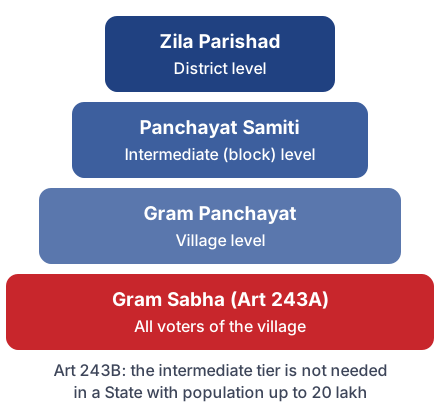
Two frequent traps. The minimum age prescribed for any person to be a member of Panchayat is 21, not 25, and a Panchayat reconstituted after premature dissolution continues only for the remainder period (2016: 2 only). In 2025 none of the three statements was correct: Panchayats at the intermediate level do not exist in all States, the age is 21 and not 30, and it is the Governor, not the Chief Minister, who constitutes the State Finance Commission (option d).
Consider the following statements : 1. The minimum age prescribed for any person to be a member of Panchayat is 25 years. 2. A Panchayat reconstituted after premature dissolution continues only for the remainder period. Which of the statements given above is/are correct?
- 1 only
- 2 only
- Both 1 and 2
- Neither 1 nor 2
Show answer
Answer: (b) · UPSC official key
Consider the following statements : I. Panchayats at the intermediate level exist in all States. II. To be eligible to be a Member of a Panchayat at the intermediate level, a person should attain the age of thirty years. III. The Chief Minister of a State constitutes a commission to review the financial position of Panchayats at the intermediate levels and to make recommendations regarding the distribution of net proceeds of taxes and duties, leviable by the State, between the State and Panchayats at the intermediate level. Which of the statements given above are not correct?
- I and II only
- II and III only
- I and III only
- I, II and III
Show answer
Answer: (d) · UPSC official key
Which bodies come from the 73rd Amendment? State Election Commissions to conduct all panchayat elections (Art 243K) and State Finance Commissions (Art 243I), yes. District Planning Committees are written in Art 243ZD, which the 74th Amendment added, but they join together the plans made by the panchayats, so UPSC’s official answer in 2011 counted all three (d).
The Constitution (Seventy-Third Amendment) Act, 1992, which aims at promoting the Panchayati Raj Institutions in the country, provides for which of the following ? 1. Constitution of District Planning Committees. 2. State Election Commissions to conduct all panchayat elections. 3. Establishment of State Finance Commissions. Select the correct answer using the codes given below :
- 1 only
- 1 and 2 only
- 2 and 3 only
- 1, 2 and 3
Show answer
Answer: (d) · UPSC official key
i PRELIMS TRAP Voluntary, not compulsory: devolving the 29 subjects, reserving seats for OBCs, giving MPs and MLAs a vote in panchayats. Compulsory: three tiers (above 20 lakh), direct elections, SC/ST and women’s reservation, five-year term, SEC and SFC.
Mains box: analysis and answer points
- Article 40, a Directive Principle, asked the State to organise village panchayats; for four decades that promise depended on each State's goodwill.
- The fundamental object of Panchayati Raj system is to ensure people's participation in development and democratic decentralisation (2015: 1 and 3 only).
- Likely next angle: Art 40 and the 73rd Amendment's link
Practice
Practice MCQs (8)
Consider the following statements:
1. PESA applies to the tribal areas covered by the Sixth Schedule.
2. PESA was enacted as part of the 74th Constitutional Amendment.
Which of the statements given above is/are correct?
Answer (d) & explanation
Neither statement is correct. PESA extends Part IX to the Fifth Schedule Scheduled Areas referred to in Article 244(1). The Sixth Schedule tribal areas of Assam, Meghalaya, Tripura and Mizoram are governed by their own autonomous district and regional councils under Article 244(2), and Part IX does not reach them. PESA is also not part of any constitutional amendment: it is a separate Act of Parliament of 1996, made under Article 243M(4)(b). The 74th Amendment, 1992 dealt with municipalities and inserted Part IXA.
In which year was the Provisions of the Panchayats (Extension to the Scheduled Areas) Act (PESA) enacted?
Answer (a) & explanation
The Provisions of the Panchayats (Extension to the Scheduled Areas) Act, known as PESA, was enacted by Parliament in 1996. Article 243M(1) keeps the Fifth Schedule Scheduled Areas outside Part IX, and Article 243M(4)(b) lets Parliament extend Part IX to them by law with exceptions and modifications; PESA is that law, drafted on the recommendations of the Bhuria Committee. The other years are the usual confusables: 1992 is the 73rd Amendment, 1993 its commencement, and 2006 the Forest Rights Act, which also strengthens Gram Sabhas in forest areas.
Consider the following statements:
1. PESA extends the provisions of Part IX, with modifications, to the Scheduled Areas under the Fifth Schedule.
2. Article 243M enables Parliament to extend Part IX by law to the Scheduled Areas.
Which of the statements given above is/are correct?
Answer (c) & explanation
Both statements are correct. Article 243M(1) says nothing in Part IX applies to the Scheduled Areas referred to in Article 244(1) and the tribal areas referred to in Article 244(2). Article 243M(4)(b) then lets Parliament, by law, extend Part IX to these areas with such exceptions and modifications as the law specifies, and says such a law shall not be deemed an amendment of the Constitution for the purposes of Article 368. PESA, 1996 is that law for the Fifth Schedule areas. It is therefore an ordinary Act of Parliament, not a constitutional amendment.
With reference to reservation under PESA, consider the following statements:
1. Not less than one-half of the total seats in every Panchayat in a Scheduled Area are reserved for Scheduled Tribes.
2. Only the office of chairperson at the village level is reserved for Scheduled Tribes.
Which of the statements given above is/are correct?
Answer (a) & explanation
Statement 1 is correct: Section 4(g) of PESA requires that the reservation of seats in Scheduled Areas at every Panchayat be in proportion to the population of the communities for which reservation is sought, but that the reservation for Scheduled Tribes shall not be less than one-half of the total seats. Statement 2 is incorrect: the same clause says that all seats of chairpersons of Panchayats at all levels shall be reserved for Scheduled Tribes. This goes well beyond the general Part IX rule of reservation in proportion to population under Article 243D.
With reference to the State Finance Commission under Article 243I, consider the following statements:
1. Its recommendations, with an explanatory memorandum on the action taken, are laid before the State Legislature.
2. Its recommendations are binding on the State Government.
Which of the statements given above is/are correct?
Answer (a) & explanation
Statement 1 is correct: Article 243I(4) says the Governor shall cause every recommendation of the Finance Commission, together with an explanatory memorandum as to the action taken on it, to be laid before the State Legislature. Statement 2 is incorrect: the Commission's recommendations are advisory. The State Government decides how far to accept them, and the memorandum exists precisely to explain to the Legislature what has been accepted, modified or rejected. The same pattern applies to the Union Finance Commission under Article 281, whose report is laid before Parliament with an action-taken memorandum.
PESA applies to the Fifth Schedule areas in how many States?
Answer (d) & explanation
Ten States have Fifth Schedule areas to which PESA applies: Andhra Pradesh, Chhattisgarh, Gujarat, Himachal Pradesh, Jharkhand, Madhya Pradesh, Maharashtra, Odisha, Rajasthan and Telangana. When PESA was enacted in 1996 the count was eight, including Bihar. In 2000 Jharkhand took over all of Bihar's Scheduled Areas and Chhattisgarh was carved out of Madhya Pradesh, making nine; Telangana, formed out of Andhra Pradesh in 2014, made it ten. The North-Eastern States with tribal areas are mostly under the Sixth Schedule or exempted by Article 243M, so they are not PESA States.
Consider the following statements:
1. After the 101st Amendment, octroi and entry taxes are levied under Entry 52 of the State List.
2. Grants recommended by the Union Finance Commission for local bodies are paid by the Union directly to each Gram Panchayat without passing through the State Government.
Which of the statements given above is/are correct?
Answer (d) & explanation
Both statements are incorrect. Entry 52 of the State List, on taxes on the entry of goods into a local area, was omitted by the 101st Amendment (2016), because such taxes were subsumed in GST. Finance Commission grants for local bodies are released by the Union to the States, which must pass them on to local bodies within a short, fixed period. This respects the fact that local government is a State subject. The 101st Amendment omitted Entry 52 (entry tax) and Entry 55 (taxes on advertisements other than in newspapers) from the State List, and narrowed Entry 62 to local-body entertainment taxes. Octroi had already been abolished in most States, and Mumbai's octroi, among the last, ended when GST arrived in July 2017. On grants, the Fifteenth Finance Commission required States to pass on local-body grants within ten working days of receiving them from the Union, with interest payable for delay, which shows that the money always flows through the State.
With reference to PESA, consider the following statements:
1. It allows the State Government to nominate members of Scheduled Tribes with no representation in a Panchayat at the intermediate or district level, up to one-fourth of its total members.
2. It requires State laws on Panchayats in Scheduled Areas to override customary law and traditional practices.
Which of the statements given above is/are correct?
Answer (d) & explanation
Neither statement is correct. Section 4(h) of PESA lets the State Government nominate persons belonging to Scheduled Tribes that have no representation in a Panchayat at the intermediate or district level, but such nomination shall not exceed one-tenth of the total members to be elected in that Panchayat, not one-fourth. Section 4(a) goes the other way from statement 2: a State law on Panchayats in Scheduled Areas shall be in consonance with the customary law, social and religious practices and traditional management practices of community resources. Section 4(d) also makes every Gram Sabha competent to safeguard the traditions, customs and cultural identity of the people.
0 / 0 correct
Write an answer
In 150 words, explain the significance of Local Government with one recent example.
Flashcards (11)
Which Directive Principle deals with village
panchayats? Art 40.
Which committee recommended three-tier
Panchayati Raj? Balwant Rai Mehta (1957).
Where was Panchayati Raj first
inaugurated? Nagaur, Rajasthan, 2 October 1959.
When did the 73rd Amendment come into
force? 24 April 1993 (National Panchayati Raj Day).
Number of subjects in the Eleventh
Schedule? 29.
Which States may skip the intermediate
tier? Those with population up to 20 lakh.
Minimum age to be a panchayat member?
21 years.
Who constitutes the State Finance
Commission? The Governor, every five years (Art 243I).
How is a State Election Commissioner
removed? Like a High Court judge.
Term of a panchayat formed after early
dissolution? Only the remainder of the five years.
Which Article provides the District Planning
Committee? Art 243ZD (74th Amendment).
Read more: related explainers
In the news
- 25 Oct 2026Cauvery panel tells Karnataka to release 3,000 cusecs to Tamil Nadu: Article 262 and the inter-State water dispute
- 22 Oct 2026Cooperative federalism and law reform: Law Commission proposes a ‘citizen friction test’
- 13 Oct 202621st Maritime State Development Council: first MSDC under the Indian Ports Act, 2025
- 8 Oct 202657th GST Council: arrest provisions to go, prosecution threshold raised to ₹5 crore
 Next topic · 18.2 →Local Government: Municipalities and PESA
Syllabus: GS-II · Functions and responsibilities of the Union and the States, issues and challenge…