
Chapter 17 · Topic 17.1 · Prelims + Mains1 of 3
Union Territories: Administration of UTs
Key points
- UT: governed directly by the Union; created by the 7th Amendment (1956) replacing Part C and D States.
- Eight UTs since 26 January 2020 (Dadra and Nagar Haveli and Daman and Diu merged); J&K Reorganisation Act, 2019 created J&K (with legislature) and Ladakh (without), 31 October 2019.
- Art 239–241: President's Administrator; 239A legislature (Puducherry, 14th Amendment 1962; J&K by 2019 Act); 239AA Delhi (69th Amendment, 1991); 240 regulations; 241 High Courts.
- Rajya Sabha: Delhi 3, J&K 4, Puducherry 1 (Prelims 2012, d). Union–UT disputes not under Art 131 (2012, c).
2 PYQs 2012–2026
Prelims box: facts and traps
- Only Delhi has its own High Court among UTs.
What a Union Territory is
Like a hostel run directly by the school office, while the big houses elect their own captains.
The idea came with the 7th Amendment (1956), which replaced the old Part C and Part D States with UTs. Areas become UTs for reasons such as:
- being the national capital (Delhi);
- strategic position (Andaman and Nicobar, Lakshadweep, Ladakh);
- a distinct culture or colonial history (Puducherry, Dadra and Nagar Haveli and Daman and Diu);
- being a shared capital (Chandigarh).
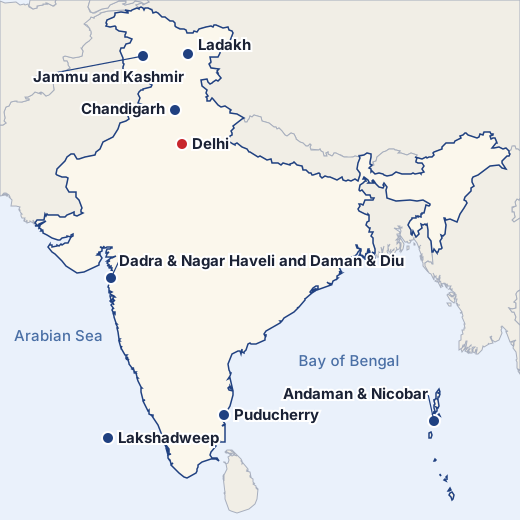
Eight UTs today. The number fell from nine to eight on 26 January 2020, when Dadra and Nagar Haveli and Daman and Diu were merged into one UT. Before that, the Jammu and Kashmir Reorganisation Act, 2019 had turned the State of Jammu and Kashmir into two UTs (31 October 2019): Jammu and Kashmir, with a legislature, and Ladakh, without one.
How UPSC asks this chapter. Prelims has asked little directly: representation in the Rajya Sabha, and the Supreme Court’s jurisdiction. Mains keeps returning to Delhi’s Lieutenant Governor versus the elected government, and to Jammu and Kashmir after 2019.
What UPSC asks: Prelims: number of UTs (8 since 2020); which have legislatures. Mains: why UTs exist; asymmetric federalism (different States and UTs getting different powers). Next likely angle: statehood demands from J&K, Ladakh and Puducherry.
How UTs are administered: Articles 239 to 241
| Article | What it provides |
|---|---|
| 239 | Every UT is administered by the President through an Administrator; a Governor of a neighbouring State can be made Administrator and then acts independently of his own ministers |
| 239A | Parliament may create a legislature and council of ministers for Puducherry (14th Amendment, 1962); applied to Jammu and Kashmir by the 2019 Act |
| 239AA, 239AB | Special provisions for Delhi (69th Amendment, 1991) |
| 239B | Administrator of Puducherry may issue ordinances when the legislature is not in session |
| 240 | President may make regulations for UTs without a legislature (and for Puducherry when its legislature is dissolved or suspended); they have the force of an Act of Parliament |
| 241 | Parliament may set up a High Court for a UT or extend a State High Court’s jurisdiction to it |
Titles of Administrators.
- Lieutenant Governor: Delhi, Puducherry, Jammu and Kashmir, Ladakh, Andaman and Nicobar.
- The Governor of Punjab: Administrator of Chandigarh.
- An Administrator: Lakshadweep, and Dadra and Nagar Haveli and Daman and Diu.
Parliament can make laws on any subject for any UT, including subjects in the State List, even where the UT has its own legislature.
Prelims 2012: a classic trap.
- “Union Territories are not represented in the Rajya Sabha”? Wrong: Delhi has 3 seats, Jammu and Kashmir 4 and Puducherry 1 under the Fourth Schedule.
- The Chief Election Commissioner does not decide election disputes (High Courts do).
- Parliament consists of the President and the two Houses (Art 79).
- So none of the statements is correct (option d).
Consider the following statements : 1. Union Territories are not represented in the Rajya Sabha. 2. It is within the purview of the Chief Election Commissioner to adjudicate the election disputes. 3. According to the Constitution of India, the Parliament consists of the Lok Sabha and the Rajya Sabha only. Which of the statements given above is/are correct?
- 1 only
- 2 and 3
- 1 and 3
- None
Show answer
Answer: (d) · UPSC official key
Courts. Only Delhi has its own High Court.
- Jammu and Kashmir and Ladakh share one.
- Chandigarh: Punjab and Haryana High Court. Andaman and Nicobar: Calcutta. Lakshadweep: Kerala. Puducherry: Madras. Dadra and Nagar Haveli and Daman and Diu: Bombay.
- A dispute between the Government of India and a Union Territory is not in the Supreme Court’s original jurisdiction (Prelims 2012, c). Art 131 covers disputes between the Union and States, and between States.
Which of the following are included in the original jurisdiction of the Supreme Court? 1. A dispute between the Government of India and one or more States 2. A dispute regarding elections to either House of the Parliament or that of Legislature of a State 3. A dispute between the Government of India and a Union Territory 4. A dispute between two or more States Select the correct answer using the codes given below :
- 1 and 2
- 2 and 3
- 1 and 4
- 3 and 4
Show answer
Answer: (c) · UPSC official key
What UPSC asks: Prelims: Rajya Sabha seats (2012); original jurisdiction (2012); Art 240 regulations. Mains: Parliament’s plenary (full) power over UTs. Next likely angle: which High Court serves which UT.
Mains box: analysis and answer points
- Delhi LG vs elected government; J&K after 2019; Parliament's plenary power over UTs.
Practice
Practice MCQs (8)
Consider the following statements about the administrator of a Union Territory:
1. The administrator is appointed by the President.
2. The President decides the designation of the administrator.
3. Parliament can make laws on State List subjects for Union Territories.
4. Like a Governor, the administrator has a fixed five-year term.
How many of the statements given above are correct?
Answer (c) & explanation
Only three statements are correct. Under Article 239, the President administers every UT through an administrator whom he appoints, with the designation he chooses: Lieutenant Governor in Delhi, Puducherry and the Andamans, and Administrator elsewhere. Under Article 246(4), Parliament can make laws for UTs on any subject, including those in the State List. Statement 4 is incorrect: unlike a Governor, who has a five-year term under Article 156, the administrator has no fixed tenure and holds office as the President decides.
Under Article 241 of the Constitution of India, Parliament may by law
Answer (c) & explanation
Article 241 lets Parliament by law constitute a High Court for a Union Territory, or declare any court in a UT to be a High Court for all or any of the Constitution's purposes. Using this power, Parliament set up the Delhi High Court in 1966. Other UTs come under the High Court of a neighbouring State, for example Chandigarh under the Punjab and Haryana High Court. Appointment of judges is by the President under Article 217, and transfers are under Article 222; Article 241 does neither.
Match List-I (Article) with List-II (Subject): List-I A. Article 239 B. Article 239A C. Article 239B D. Article 240 List-II
1. Administration of Union Territories through an administrator
2. Creation of local legislatures or Councils of Ministers for certain Union Territories
3. Power of the administrator to promulgate ordinances during recess of the legislature
4. Power of the President to make regulations for certain Union Territories
Select the correct answer using the code given below:
Answer (a) & explanation
Part VIII of the Constitution deals with the Union Territories. Article 239 provides for their administration by the President through an administrator. Article 239A, added in 1962, lets Parliament create local legislatures or Councils of Ministers for certain UTs, now Puducherry. Article 239B gives the administrator power to promulgate ordinances during a recess of the legislature. Article 240 gives the President power to make regulations for certain UTs. So the code is A-1, B-2, C-3, D-4.
With reference to Article 239 of the Constitution of India, consider the following statements:
1. The President may appoint the Governor of a State as the administrator of an adjoining Union Territory.
2. A Governor so appointed exercises his functions as administrator independently of his Council of Ministers.
Which of the statements given above is/are correct?
Answer (c) & explanation
Both statements are correct. Article 239(1) says every UT is administered by the President through an administrator with such designation as he specifies. Article 239(2) adds that the President may appoint the Governor of a State as the administrator of an adjoining UT, and that a Governor so appointed shall act independently of his Council of Ministers. The reason is that the UT is the Centre's responsibility, not the State's. The standing example is the Governor of Punjab, who has also been the Administrator of Chandigarh since 1984.
Consider the following statements:
1. Article 239A was meant from the start only for Puducherry.
2. Article 239A was inserted by the 14th Amendment Act, 1962.
Which of the statements given above is/are correct?
Answer (b) & explanation
Statement 2 is correct: Article 239A was inserted by the Constitution (Fourteenth Amendment) Act, 1962, which let Parliament create legislatures or Councils of Ministers for certain UTs. Parliament then passed the Government of Union Territories Act, 1963. Statement 1 is incorrect: the Article first covered Himachal Pradesh, Manipur, Tripura, Goa, Daman and Diu and Pondicherry. As these became States, or in Daman and Diu's case remained a UT without a legislature, the Article came to apply to Puducherry alone.
Consider the following statements:
1. The administrator of a Union Territory must be a resident of that territory.
2. Parliament loses its power to legislate for a Union Territory once that territory is given a legislature.
Which of the statements given above is/are correct?
Answer (d) & explanation
Both statements are incorrect. The Constitution sets no residence or other qualification for a UT administrator; the President may appoint any person, often a retired civil servant or military officer. Statement 2 is also wrong: under Article 246(4), Parliament can legislate for UTs on any subject, and creating a legislature does not take this away. For Delhi, Article 239AA(3)(b) expressly keeps Parliament's power on any matter, and for Puducherry the Government of Union Territories Act, 1963 makes the local legislature's power subject to Parliament's laws.
Consider the following statements:
1. The President cannot make regulations under Article 240 for Puducherry while its Legislative Assembly is functioning.
2. The President can make regulations under Article 240 for the National Capital Territory of Delhi.
Which of the statements given above is/are correct?
Answer (a) & explanation
Statement 1 is correct: the proviso to Article 240(1) says that when a legislature has been created for Puducherry under Article 239A, the President shall not make regulations for it from the date of the legislature's first meeting, except while that legislature is suspended or dissolved. Statement 2 is incorrect: Delhi is not in the list in Article 240. As the National Capital Territory, it has its own Legislative Assembly under Article 239AA, and laws for it are made by that Assembly and by Parliament.
Consider the following statements:
1. The administrator of a Union Territory with a legislature can promulgate ordinances even while its legislature is dissolved.
2. Such an administrator can promulgate an ordinance only after obtaining instructions from the President.
Which of the statements given above is/are correct?
Answer (b) & explanation
Statement 2 is correct: under Article 239B(1), the administrator of Puducherry may promulgate an ordinance when its legislature is not in session, but only after obtaining instructions from the President. Statement 1 is incorrect: the proviso to Article 239B(1) bars any ordinance while the legislature is dissolved or its functioning is suspended. In that situation the President can act directly through Article 240 regulations. An ordinance under 239B must be laid before the legislature and lapses six weeks after it reassembles.
0 / 0 correct
Prelims PYQs on this topic (2)
Which of the following statements with respect to the Revamped Rashtriya Gram Swaraj Abhiyan (RGSA) is/are correct ?
- 1. The period of its implementation is 1st April, 2021 to 31st March, 2026.
- 2. The key objective of the Revamped RGSA is to develop the governance capabilities of the Panchayati Raj Institutions to deliver on the Sustainable Development Goals.
- 3. The share of the Central funding for the Revamped RGSA is 100% for all States and Union Territories.
Select the answer using the code given below :
Answer (b) & explanation
Only statement 2 is correct (b). Statement 2 is right: the Revamped RGSA aims to build the governance capacity of Panchayati Raj Institutions to deliver on the SDGs. Statement 1 is wrong: it was approved in 2022 to run from 2022-23 to 2025-26, not from April 2021. Statement 3 is wrong: funding is shared 60:40 with States (90:10 for north-eastern and hill States); only Union Territories get 100%. So options (a), (c) and (d) fail.
Notice the link: the RGSA uses the Localisation of SDGs approach through nine themes, such as poverty-free and healthy villages. The 73rd Amendment (1992) gave Panchayats constitutional status. 24 April is National Panchayati Raj Day.
"100% for all" is the giveaway. Centrally sponsored schemes almost always share costs with States.
Answer as per the official UPSC answer key.
Consider the following statements :
- 1. Union Territories are not represented in the Rajya Sabha.
- 2. It is within the purview of the Chief Election Commissioner to adjudicate the election disputes.
- 3. According to the Constitution of India, the Parliament consists of the Lok Sabha and the Rajya Sabha only.
Which of the statements given above is/are correct?
Answer (d) & explanation
None of the statements is correct (d). Statement 1 is wrong: Delhi, Puducherry and Jammu and Kashmir send members to the Rajya Sabha, elected by their legislative assemblies. Statement 2 is wrong: election disputes are decided by the High Courts through election petitions, with appeal to the Supreme Court; the Election Commission does not adjudicate them. Statement 3 is wrong: under Article 79, Parliament consists of the President and the two Houses. So (a), (b) and (c) fail.
Notice the details: Rajya Sabha has 245 seats, 233 elected and 12 nominated by the President. Disputes over the President's and Vice-President's elections go straight to the Supreme Court (Article 71). Trap: the President is part of Parliament though not a member of either House.
Answer as per the official UPSC answer key.
Write an answer
In 150 words, explain the significance of Union Territories with one recent example.
Flashcards (9)
How many Union Territories are there?
Eight (since 26 January 2020).
Which UTs have a legislature?
Delhi, Puducherry, and Jammu and Kashmir.
Which Amendment created the category of
Union Territories? The 7th Amendment (1956).
Who administers a UT under Art 239?
The President, through an Administrator.
Who is the Administrator of Chandigarh?
The Governor of Punjab.
Rajya Sabha seats of Delhi, J&K and
Puducherry? 3, 4 and 1.
Is a dispute between the Union and a UT in
the Supreme Court's original jurisdiction? No. Art 131 covers only the Union and States.
Which Article lets the President make
regulations for some UTs? Art 240.
When did J&K and Ladakh become UTs?
31 October 2019.
In the news
- 25 Oct 2026Cauvery panel tells Karnataka to release 3,000 cusecs to Tamil Nadu: Article 262 and the inter-State water dispute
- 22 Oct 2026Cooperative federalism and law reform: Law Commission proposes a ‘citizen friction test’
- 13 Oct 202621st Maritime State Development Council: first MSDC under the Indian Ports Act, 2025
- 8 Oct 202657th GST Council: arrest provisions to go, prosecution threshold raised to ₹5 crore
 Next topic · 17.2 →Union Territories: Delhi
Syllabus: GS-II · Functions and responsibilities of the Union and the States, issues and challenge…