
Chapter 14 · Topic 14.2 · Prelims + Mains2 of 3
Emerging Technologies: Energy and mobility
Key points
- NGHM: 4 Jan 2023, Rs 19,744 crore, SIGHT Rs 17,490 crore, 5 MMT by 2030.
- H2 fuel cell: electricity, water, heat only.
- DERs: batteries, biomass, fuel cells, rooftop solar.
- PM E-DRIVE: 11 Sep 2024, Rs 10,900 crore, 14,028 e-buses.
- Black boxes: CVR and FDR, each with locator beacon.
Prelims box: facts and traps
- Green zone: airspace up to 400 ft (120 m), no drone permission needed.
- Trap (Prelims 2026): black boxes do not carry a red-light beacon.
- Trap (Prelims 2015): fuel cells do not give AC output directly.
Green hydrogen, fuel cells and storage
Green hydrogen is hydrogen made by splitting water with electricity from renewable sources like solar and wind, so no carbon is released. The Union Cabinet approved the National Green Hydrogen Mission on 4 January 2023 with an initial outlay of Rs 19,744 crore. This includes Rs 17,490 crore for the SIGHT programme, which gives incentives for making electrolysers (machines that split water) in India and for producing green hydrogen. MNRE coordinates the mission (PIB, 4 Jan 2023).
| Mission item | Figure | Type |
|---|---|---|
| Initial outlay | Rs 19,744 crore | approved outlay |
| SIGHT | Rs 17,490 crore | approved outlay |
| Green hydrogen capacity | at least 5 MMT a year by 2030 | target |
| Renewable capacity linked | about 125 GW | target |
| Emissions averted | nearly 50 MMT a year by 2030 | expected outcome |
PIB, 4 Jan 2023. Targets and expected outcomes, not achievements.
A fuel cell uses the chemical energy of hydrogen or other fuels to produce electricity, like a battery that never runs down as long as fuel flows in. If hydrogen is the fuel, the only products are electricity, water and heat. Fuel cells can power systems as large as a utility power station and as small as a laptop computer (US Department of Energy). So in Prelims 2015 only statement 1 holds: if pure hydrogen is used as a fuel, the fuel cell emits heat and water as by-products. Statement 2 fails on laptops, and the key also rejects statement 3 on AC output (answer (a)).
With reference to ‘fuel cells’ in which hydrogen-rich fuel and oxygen are used to generate electricity, consider the following statements : 1. If pure hydrogen is used as a fuel, the fuel cell emits heat and water as by-products. 2. Fuel cells can be used for powering buildings and not for small devices like laptop computers. 3. Fuel cells produce electricity in the form of Alternating Current (AC). Which of the statements given above is/are correct?
- 1 only
- 2 and 3 only
- 1 and 3 only
- 1, 2 and 3
Show answer
Answer: (a) · UPSC official key
Distributed energy resources are small generation or storage units placed close to where power is used, instead of one large plant. UPSC’s key counts all four as distributed energy resources: battery storage, biomass generators, fuel cells and rooftop solar photovoltaic units (Prelims 2024: answer (d)).
Consider the following : 1. Battery storage 2. Biomass generators 3. Fuel cells 4. Rooftop solar photovoltaic units How many of the above are considered “Distributed Energy Resources” ?
- Only one
- Only two
- Only three
- All four
Show answer
Answer: (d) · UPSC official key
Electric vehicles, drones and flight safety
Alternative powertrains replace or support the petrol or diesel engine. A powertrain is the part of a vehicle that makes it move. UPSC’s key counts all three as alternative powertrain vehicles: full battery electric vehicles, hydrogen fuel cell vehicles and fuel cell-electric hybrid vehicles (Prelims 2025: answer (c), all three).
Consider the following types of vehicles : I. Full battery electric vehicles II. Hydrogen fuel cell vehicles III. Fuel cell-electric hybrid vehicles How many of the above are considered as alternative powertrain vehicles?
- Only one
- Only two
- All the three
- None
Show answer
Answer: (c) · UPSC official key
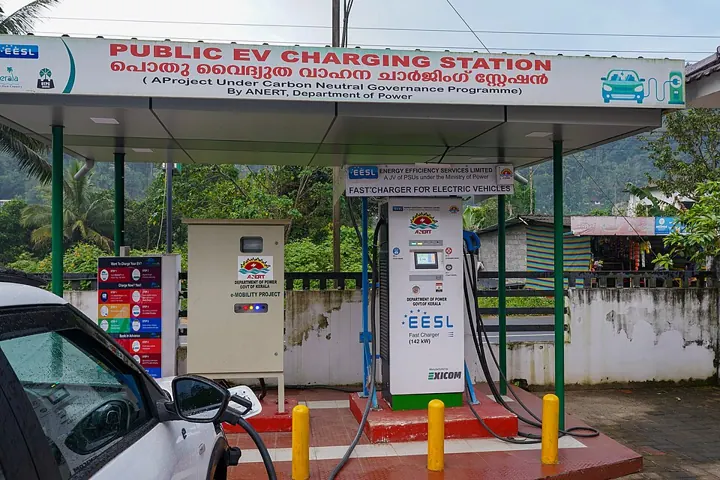
The Cabinet approved the PM E-DRIVE scheme on 11 September 2024 with an outlay of Rs 10,900 crore over two years (PIB, 11 Sep 2024). It plans:
- support for 24.79 lakh e-2Ws, 3.16 lakh e-3Ws and 14,028 e-buses,
- 22,100 fast chargers for e-4Ws, 1,800 for e-buses and 48,400 for e-2Ws and 3Ws,
- e-vouchers, plus cover for e-ambulances and e-trucks.
These are scheme targets, not vehicles already sold.
Mains 2023 asked how electric vehicles help cut carbon emissions and what benefits they offer over combustion engine vehicles. Frame: no tailpipe emissions, and total emissions fall further as the grid adds renewable power. Benefits include lower running cost, less urban air pollution, lower oil imports and quieter streets. Limits include battery minerals, charging gaps and upfront cost. Close with PM E-DRIVE and green hydrogen as India’s levers.
The adoption of electric vehicles is rapidly growing worldwide. How do electric vehicles contribute to reducing carbon emissions and what are the key benefits they offer compared to traditional combustion engine vehicles?
Drone Rules, 2021 replaced a permit-heavy regime. Several approvals were abolished, drone coverage was raised from 300 kg to 500 kg, and no permission is needed to fly in green zones, meaning airspace up to 400 feet (120 m) not marked red or yellow (PIB, 26 Aug 2021).
Flight tech also appears in news questions. Greased Lightning-10 (GL-10) was an electric plane tested by NASA (Prelims 2016: answer (a)). Aircraft carry two black boxes, the Cockpit Voice Recorder and the Flight Data Recorder, each with an underwater locator beacon that sends signals to help find it after a crash at sea (US NTSB). For 2026 the provisional key accepts that they record both the cockpit voice and flight data and the memory-unit statement, and rejects the red-light beacon statement (answer (b), answer key provisional).
What is ‘Greased Lightning-10 (GL-10)’, recently in the news?
- Electric plane tested by NASA
- Solar-powered two-seater aircraft designed by Japan
- Space observatory launched by China
- Reusable rocket designed by ISRO
Show answer
Answer: (a) · UPSC official key
Which of the following statements with regard to Black Boxes used in modern aircrafts is/are correct ? 1. They carry a beacon emitting red light pulses to facilitate underwater detection. 2. They record both the cockpit voice and flight data. 3. Their memory units are made using either stainless steel or titanium. Select the answer using the code given below :
- 1 only
- 2 and 3 only
- 1 and 2 only
- 1, 2 and 3
Show answer
Answer: (b) · UPSC provisional key (final key awaited)
| Topic | Fact | Source |
|---|---|---|
| PM E-DRIVE | Rs 10,900 crore, 2 years (approved 11 Sep 2024) | PIB |
| e-buses | 14,028 (target) | PIB |
| Drone Rules | green zone: no permission up to 400 ft | PIB 2021 |
| Black boxes | CVR and FDR, each with locator beacon | NTSB |
PIB 2021, 2024, US NTSB.
What UPSC asks: Prelims: NGHM has Rs 19,744 crore, PM E-DRIVE has Rs 10,900 crore, GL-10 was a NASA electric plane. Mains: 5 MMT by 2030 (target), a hydrogen fuel cell gives water and heat, green zones need no permission.
Mains box: analysis and answer points
- EVs: emission cuts, benefits, limits.
- Green hydrogen: mission targets and role.
Practice
Practice MCQs (8)
As the temperature of a piece of pure (intrinsic) silicon is raised from room temperature, its electrical resistivity
Answer (b) & explanation
In an intrinsic semiconductor, heat breaks more covalent bonds and lifts more electrons across the gap, creating electron-hole pairs. The rise in the number of charge carriers outweighs the slight fall in their mobility, so the conductivity rises and the resistivity falls: a semiconductor has a negative temperature coefficient of resistance. In metals the carrier number is fixed and stronger lattice vibration raises resistivity.
In warehouses and factories, an autonomous mobile robot (AMR) differs from a conventional automated guided vehicle (AGV) mainly because the AMR
Answer (b) & explanation
The answer is the second option. A conventional AGV follows a predetermined path marked by wires buried in the floor, magnetic tape, reflectors or other external guidance; the International Federation of Robotics, citing ISO 8373, describes it as a mobile platform following a path indicated by markers or external guidance commands. It is reliable on fixed routes, but if a pallet or a person blocks the path, it simply stops and waits. An AMR carries its own sensors, such as cameras and laser scanners, builds or uses a map of the building and localises itself with techniques such as SLAM; it can then plan a route to any destination and re-plan on the fly to go around obstacles. This flexibility lets AMRs work in changing layouts and mixed traffic with people, which is why they are spreading quickly in e-commerce warehouses and hospitals.
Consider the following statements: Statement-I: Small battery-powered multirotor drones can usually stay airborne for only a few tens of minutes on one charge. Statement-II: Lithium-ion and lithium-polymer batteries store far less energy per kilogram than liquid hydrocarbon fuels.
Which one of the following is correct in respect of the above statements?
Answer (a) & explanation
Both statements are correct and Statement-II explains Statement-I. The best lithium batteries hold roughly 0.15 to 0.3 kWh per kg, while petrol or kerosene holds about 12 kWh per kg in chemical energy; even after allowing for the low efficiency of engines, fuel carries several times more usable energy per kilogram. A multirotor also spends power continuously just to stay up. Together, the low specific energy of batteries and the cost of hovering limit most small electric multirotors to roughly 20 to 45 minutes. That is why long- endurance military UAVs use piston, turboprop or jet engines, and why hydrogen fuel cells are being tried for longer civil flights.
With reference to the band theory of solids, consider the following statements:
1. In insulators, the forbidden energy gap between the valence band and the conduction band is generally larger than about 3 eV.
2. In metals, the conduction band is partly filled or overlaps the valence band, so there is effectively no energy gap.
3. The energy gap of silicon is larger than that of germanium.
Which of the statements given above is/are correct?
Answer (d) & explanation
All three statements are correct. NCERT classifies solids by the energy gap (Eg): in insulators Eg is large, greater than about 3 eV, so almost no electron can reach the conduction band at room temperature; in metals the bands overlap or the conduction band is partly filled, so free electrons are always available; semiconductors have a small but finite gap. The gap of silicon is about 1.1 eV and that of germanium about 0.7 eV, so silicon's gap is larger.
Consider the following statements regarding extrinsic semiconductors:
1. Adding a small amount of phosphorus to pure silicon produces an n-type semiconductor.
2. An n-type semiconductor carries a net negative charge because it has excess free electrons.
3. In a p-type semiconductor, holes are the majority charge carriers.
Which of the statements given above is/are correct?
Answer (c) & explanation
Statements 1 and 3 are correct. Phosphorus is pentavalent: four of its electrons bond with silicon and the fifth becomes a free electron, so it is a donor and the material is n- type. Boron, aluminium or indium (trivalent) create holes and give p-type material, where holes are the majority carriers. Statement 2 is wrong: every free electron comes from a neutral donor atom that is left as a fixed positive ion, so the doped crystal stays electrically neutral.
With reference to the design of unmanned aerial vehicles (UAVs), consider the following statements:
1. For a similar weight and battery, a fixed-wing UAV can usually fly longer and farther than a multirotor, because its wing produces lift as it moves forward.
2. Hybrid VTOL designs combine rotors for vertical take-off and landing with a wing for efficient forward cruise.
3. In a quadcopter all four rotors spin in the same direction, so that their torques add up and keep the frame steady.
Which of the statements given above is/are correct?
Answer (b) & explanation
Statements 1 and 2 are correct. A multirotor must hold its whole weight up with rotor thrust all the time, which costs a lot of power; a fixed-wing UAV gets most of its lift from air flowing over the wing, so the same energy gives much longer endurance and range. Hybrid VTOL aircraft (for example 'quadplanes' and tilt-rotors) take off and land vertically like a multirotor and then cruise on a wing. Statement 3 is wrong: in a quadcopter two rotors turn clockwise and two counter-clockwise, so that their reaction torques cancel; if all turned the same way, the frame would spin.
Consider the following statements: Statement-I: At room temperature, the concentration of thermally generated charge carriers in pure germanium is far higher than in pure silicon. Statement-II: Germanium has a smaller forbidden energy gap than silicon.
Which one of the following is correct in respect of the above statements?
Answer (a) & explanation
Both statements are correct and II explains I. The number of electrons that heat can lift across the gap falls steeply (exponentially) as the gap widens. With a gap of about 0.7 eV against silicon's 1.1 eV, germanium has an intrinsic carrier concentration more than a thousand times higher at 300 K. This is why germanium devices leak more current and are more temperature-sensitive, and why silicon became the standard material for chips.
A laboratory has a doped semiconductor sample and wants to find out whether its majority charge carriers are electrons or holes. Which one of the following measurements directly reveals this?
Answer (c) & explanation
In the Hall effect, a magnetic field perpendicular to the current pushes the moving carriers to one side of the sample. Electrons and holes moving in the same current direction are pushed to the same side, so the sign of the Hall voltage shows whether the side collects negative or positive charge, that is, whether the sample is n-type or p-type. The size of the voltage also gives the carrier density. Band gap and temperature behaviour are similar for both types.
0 / 0 correct
Write an answer
In 150 words, explain the significance of Emerging Technologies with one recent example.
Flashcards (11)
NGHM outlay?
Rs 19,744 crore.
NGHM production target?
At least 5 MMT a year by 2030.
SIGHT supports what?
Electrolyser manufacturing and green hydrogen production.
By-products of a pure-hydrogen fuel cell?
Water and heat.
Can fuel cells power laptops?
Yes, per US DOE.
Four DERs in UPSC 2024?
Battery storage, biomass generators, fuel cells, rooftop solar.
Alternative powertrains (UPSC 2025)?
BEV, hydrogen fuel cell, fuel cell-electric hybrid.
PM E-DRIVE outlay?
Rs 10,900 crore over two years.
Drone green zone height?
Up to 400 feet (120 m).
What was GL-10?
Electric plane tested by NASA.
Two black boxes?
Cockpit Voice Recorder and Flight Data Recorder.
Read more: related explainers
In the news
- 24 Oct 2026NVS-03 launch on 30 October: can ISRO’s new satellite bring NavIC back to life?
- 22 Oct 2026eMudhra weak-key flaw: browsers block 8 certificates; what it means for India’s web trust
- 21 Oct 2026Japan’s MMX mission lifts off for Mars to bring back a sample of Phobos by 2031
- 21 Oct 2026Open-weight AI models: why Big Tech gives them away and what it means for India
 Next topic · 14.3 →Emerging Technologies: Virtual tech and missions
Syllabus: GS-III · Awareness in the fields of IT, Space, Computers, robotics, nano-technology, bio-…