
Chapter 8 · Topic 8.3 · Prelims + Mains3 of 3
Nuclear Technology: Fusion, radiation and the nuclear order
Key points
- ITER: 7 members incl. India. India's cryostat 3,850 t (2022).
- Radiation: 71 mutant crop varieties, 28 food irradiation plants.
- NPT: weapon State = tested before 1 Jan 1967 (Article IX).
- NSG: 1975, 48 members, not a treaty.
- India's IAEA Additional Protocol: in force 25 July 2014.
- New START: 1,550 warheads, 700 delivery systems.
Prelims box: facts and traps
- At Fukushima Daiichi (Japan, 11 March 2011) the operating reactors shut down when the earthquake struck, but the tsunami flooded the emergency diesel generators. Without cooling, decay heat melted three cores.
- Trap (Prelims 2017): the Nuclear Security Summits were not held under the UN, and the International Panel on Fissile Materials is not an IAEA organ.
- Trap (Prelims 2018): an NSG member does not automatically join the NPT.
ITER, fusion and peaceful uses of radiation
ITER (International Thermonuclear Experimental Reactor) is testing whether fusion can be a power source. Its members are China, the European Union, India, Japan, Korea, Russia and the United States, who share the cost of building and running it and its results (ITER Organization). India makes 14 procurement packages, meaning India supplies parts, not just cash. They include the 3,850-tonne cryostat, a giant fridge-like vessel that keeps the magnets very cold, completed in 2022 and the largest of them (ITER). India also supplies cooling water, cryogenic and heating systems, in-wall shielding and power supplies through ITER-India at the Institute for Plasma Research (ITER-India). If ITER works, the immediate gain is that it can build fusion reactors for power generation (Prelims 2016: answer (d)).
India is an important member of the ‘International Thermonuclear Experimental Reactor’. If this experiment succeeds, what is the immediate advantage for India?
- It can use thorium in place of uranium for power generation
- It can attain a global role in satellite navigation
- It can drastically improve the efficiency of its fission reactors in power generation
- It can build fusion reactors for power generation
Show answer
Answer: (d) · UPSC official key
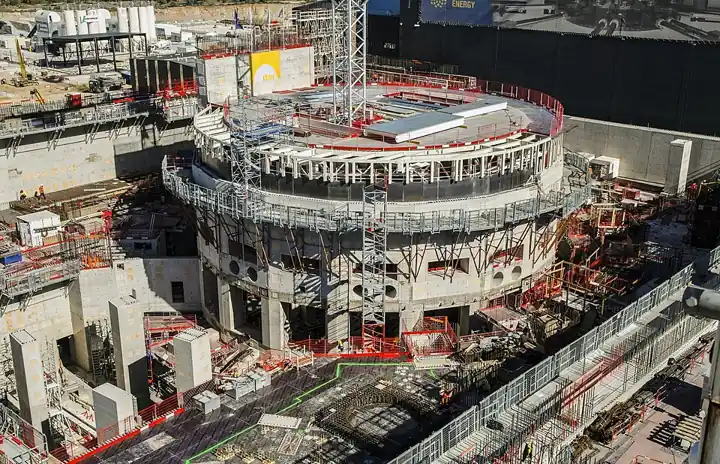
Mains 2025 asked about India’s contributions to ITER and what its success would mean. Points:
- the cryostat and other in-kind systems,
- access to all results and intellectual property as a member,
- in the long term, fusion could give low-carbon power without long-lived high-level waste, but it is still experimental.
The fusion energy programme in India has steadily evolved over the past few decades. Mention India’s contributions to the international fusion energy project – International Thermonuclear Experimental Reactor (ITER). What will be the implications of the success of this project for the future of global energy?
Radiation has many peaceful uses (PIB, 23 Jul 2025):
- BARC has released 71 crop varieties bred with radiation-induced mutation, which means changing a seed’s genes with radiation to get a better plant.
- The Board of Radiation and Isotope Technology (BRIT) supplies cobalt-60 sources.
- Radiation processing kills germs and stops sprouting. It extends the shelf life of mangoes to 35 days and of onions and potatoes to 7.5 and 8 months.
- There are 28 food irradiation plants, 22 of them private.
- BARC makes radioisotopes such as iodine-131 and lutetium-177 for cancer diagnosis and therapy.
Gamma rays for food come from cobalt-60 or caesium-137, while electron beams and X-rays come from machines (BARC). Irradiated food does not become radioactive, just as a person does not glow after an X-ray.
The global nuclear order and India
The NPT (Treaty on the Non-Proliferation of Nuclear Weapons) says a nuclear-weapon State is one which has manufactured and exploded a nuclear weapon before 1 January 1967 (NPT, Article IX). So, per UPSC’s key, among China, France, India, Israel and Pakistan only China and France are Nuclear Weapons States as recognised by the NPT (Prelims 2015: answer (a)).
Consider the following countries : 1. China 2. France 3. India 4. Israel 5. Pakistan Which among the above are Nuclear Weapons States as recognized by the Treaty on the Non-Proliferation of Nuclear Weapons, commonly known as Nuclear Non-Proliferation Treaty (NPT)?
- 1 and 2 only
- 1, 3, 4 and 5 only
- 2, 4 and 5 only
- 1, 2, 3, 4 and 5
Show answer
Answer: (a) · UPSC official key
The Nuclear Suppliers Group (NSG) is a group of nuclear supplier countries that applies guidelines to nuclear and nuclear-related exports. It began in 1975, after a non-nuclear-weapon State exploded a nuclear device in 1974, showing that peaceful technology could be misused. It has 48 Participating Governments, and it is not treaty-based (NSG). Joining gives easier access to nuclear trade. A member will have access to the latest and most efficient nuclear technologies, but does not automatically join the NPT (Prelims 2018: answer (a), 1 only).
What is/are the consequence/consequences of a country becoming the member of the ‘Nuclear Suppliers Group’ ? 1. It will have access to the latest and most efficient nuclear technologies. 2. It automatically becomes a member of “The Treaty on the Non-Proliferation of Nuclear Weapons (NPT)”. Select the correct answer using the code given below :
- 1 only
- 2 only
- Both 1 and 2
- Neither 1 nor 2
Show answer
Answer: (a) · UPSC official key
Safeguards are IAEA (International Atomic Energy Agency) inspections that check nuclear material is not diverted to weapons. India placed its civilian nuclear facilities under an IAEA safeguards agreement, and its Additional Protocol to that agreement entered into force on 25 July 2014 (IAEA, INFCIRC/754/Add.6). So ratifying it means the civilian nuclear reactors come under IAEA safeguards, not military sites (Prelims 2018: answer (a)). UPSC’s key also says some reactors are safeguarded because some use imported uranium and others use domestic supplies (Prelims 2020: answer (b)).
In the Indian context, what is the implication of ratifying the ‘Additional Protocol’ with the ‘International Atomic Energy Agency (IAEA)’ ?
- The civilian nuclear reactors come under IAEA safeguards.
- The military nuclear installations come under the inspection of IAEA.
- The country will have the privilege to buy uranium from the Nuclear Suppliers Group (NSG).
- The country automatically becomes a member of the NSG.
Show answer
Answer: (a) · UPSC official key
In India, why are some nuclear reactors kept under “IAEA Safeguards” while others are not ?
- Some use uranium and others use thorium
- Some use imported uranium and others use domestic supplies
- Some are operated by foreign enterprises and others are operated by domestic enterprises
- Some are State-owned and others are privately-owned
Show answer
Answer: (b) · UPSC official key
New START is a bilateral strategic nuclear arms reduction treaty between the USA and the Russian Federation (Prelims 2011: answer (a)). It caps each side at 1,550 warheads on deployed ICBMs (land-based long-range missiles), SLBMs (submarine-launched missiles) and heavy bombers, and 700 deployed delivery systems (US State Department). UPSC’s key rejects the claims that the Nuclear Security Summits were held under the UN and that the International Panel on Fissile Materials is an IAEA organ (Prelims 2017: answer (d)).
The “New START” treaty was in the news. What is this treaty ?
- It is a bilateral strategic nuclear arms reduction treaty between the USA and the Russian Federation
- It is a multilateral energy security cooperation treaty among the members of the East Asia Summit
- It is a treaty between the Russian Federation and the European Union for the energy security cooperation
- It is a multilateral cooperation treaty among the BRICS countries for the promotion of trade
Show answer
Answer: (a) · UPSC official key
Consider the following statements : 1. The Nuclear Security Summits are periodically held under the aegis of the United Nations. 2. The International Panel on Fissile Materials is an organ of International Atomic Energy Agency. Which of the statements given above is/are correct ?
- 1 only
- 2 only
- Both 1 and 2
- Neither 1 nor 2
Show answer
Answer: (d) · UPSC official key
Mains 2018 (GS II) asked how the US-Iran nuclear pact controversy affects India. Points:
- oil imports and prices,
- the Chabahar port and connectivity to Afghanistan and Central Asia,
- the Indian diaspora in the Gulf,
- the risk of sanctions.
India’s response: diversify oil sources, back dialogue, and protect Chabahar.
In what ways would the ongoing US-Iran Nuclear Pact Controversy affect the national interest of India? How should India respond to this situation?
What UPSC asks: Prelims: ITER members, NPT 1967 cut-off, NSG. Mains: India’s cryostat, food irradiation, safeguards.
Mains box: analysis and answer points
- ITER: India's role and fusion's promise.
- Nuclear order: NPT, NSG and India's safeguards.
- Iran deal: effects on India.
Practice
Practice MCQs (8)
Consider the following pairs: Unit — Quantity measured
1. Becquerel — Activity of a radioactive source (decays per second)
2. Gray — Absorbed dose of radiation (energy per kilogram)
3. Sievert — Equivalent or effective dose, accounting for biological harm
4. Curie — Absorbed dose of radiation
How many of the pairs given above are correctly matched?
Answer (c) & explanation
Pairs 1, 2 and 3 are correct. The becquerel (Bq) is the SI unit of activity: one decay per second. The gray (Gy) is absorbed dose: one joule of radiation energy absorbed per kilogram. The sievert (Sv) weights the absorbed dose by the type of radiation and the sensitivity of tissues, so it measures biological harm; public dose limits (1 mSv per year) are set in sieverts. Pair 4 is wrong: the curie (Ci) is an older unit of activity (3.7 × 10¹⁰ decays per second, the activity of one gram of radium-226), not of dose.
Consider the following statements about food irradiation:
1. Food exposed to gamma radiation for preservation does not itself become radioactive.
2. Gamma rays from cobalt-60 sources are commonly used for irradiating food.
3. Low doses of radiation are used to stop sprouting in potatoes and onions during storage.
Which of the statements given above is/are correct?
Answer (d) & explanation
All three statements are correct. In food irradiation the food passes near a sealed gamma source (or an electron or X-ray beam) and never touches radioactive material; the energy used is too low to make atomic nuclei radioactive, so the food does not become radioactive. Cobalt-60 is the usual gamma source, supplied in India by BRIT. Low doses inhibit sprouting (potatoes, onions), medium doses kill insects and delay ripening, and higher doses destroy pathogens in spices. BARC's KRUSHAK plant at Lasalgaon (Nashik) irradiates onions, and FSSAI regulations allow irradiation of listed foods with labelling.
Many crop varieties released by the Bhabha Atomic Research Centre carry the prefix 'Trombay' (for example, the TG series of groundnut). These varieties have been developed mainly by
Answer (b) & explanation
The answer is (b). BARC uses mutation breeding: seeds or plant parts are exposed to gamma rays (or other radiation) to induce random heritable mutations, and breeders then select and cross the useful mutants for traits such as yield, earliness, seed size or disease resistance. The 'Trombay' groundnut (TG), mustard, pulse and rice varieties have been released for cultivation this way. It is not genetic modification: no foreign gene is inserted, so these varieties are not regulated as GM crops. Option (d) describes food irradiation, which preserves the produce and creates no new variety.
With reference to Positron Emission Tomography (PET) scans used in medicine, consider the following statements:
1. The tracer most commonly used is a glucose-like molecule labelled with the radioisotope fluorine-18.
2. The images are formed by detecting the positrons as they leave the patient's body.
Which of the statements given above is/are correct?
Answer (a) & explanation
Only statement 1 is correct. The usual PET tracer is FDG (fluorodeoxyglucose labelled with fluorine-18, half-life about 110 minutes), which collects in cells that use a lot of glucose, such as many cancers, active brain areas and inflamed tissue. Statement 2 is wrong: a positron is the antiparticle of the electron and travels only about a millimetre in tissue before meeting an electron; the two annihilate into a pair of 511 keV gamma photons flying in opposite directions, and it is these photons that the ring of detectors records. Short-lived isotopes such as F-18 are made in medical cyclotrons.
Consider the following:
1. Radon gas seeping from soil and rocks into buildings
2. Cosmic rays from outer space
3. Potassium-40 present in the human body
4. Carbon-14 present in the human body
How many of the above are sources of natural background radiation to which people are exposed?
Answer (d) & explanation
All four are natural sources. According to UNSCEAR, radon (a radioactive gas from the decay of uranium in soil and rocks) is the largest single source of natural exposure, typically about half. Cosmic rays add more at high altitude and during flights. Our bodies contain radioactive potassium-40 (in all potassium) and carbon-14 (formed in the atmosphere and taken up through food), which irradiate us from within. Terrestrial gamma rays from soil and building materials are the other component; coastal Kerala's monazite sands give some of the highest natural background levels in the world.
With reference to the release of treated water from the Fukushima Daiichi nuclear power station, consider the following statements:
1. Japan began discharging the treated water into the Pacific Ocean in August 2023.
2. The Advanced Liquid Processing System (ALPS) removes most radionuclides but not tritium, so the water is diluted with seawater before release.
3. The International Atomic Energy Agency's review of July 2023 concluded that the plan was inconsistent with international safety standards.
Which of the statements given above is/are correct?
Answer (a) & explanation
Statements 1 and 2 are correct. The first discharge began on 24 August 2023. ALPS filters out most radioactive elements, but tritium is part of the water molecule itself (as HTO) and cannot be filtered out, so TEPCO dilutes the water to below 1,500 becquerels per litre, about one-fortieth of Japan's regulatory standard, before releasing it through an undersea tunnel. Statement 3 is the reverse: the IAEA's comprehensive report of 4 July 2023 found the plan consistent with international safety standards, with negligible radiological impact on people and the environment; China and some neighbours still objected.
Consider the following statements about major nuclear accidents:
1. The reactor that exploded at Chernobyl in 1986 was a graphite-moderated design (RBMK).
2. The Fukushima Daiichi accident of 2011 followed an earthquake and tsunami that knocked out the power needed to cool the reactors.
3. Both accidents were rated at the highest level, level 7, of the International Nuclear and Radiological Event Scale (INES).
Which of the statements given above is/are correct?
Answer (d) & explanation
All three statements are correct. Chernobyl unit 4 (Ukraine, then USSR) was an RBMK, a graphite-moderated, light-water-cooled reactor with a design flaw that made power rise when coolant turned to steam; a test on 26 April 1986 led to a power surge, explosions and a graphite fire. At Fukushima Daiichi (Japan, 11 March 2011) the operating reactors shut down when the earthquake struck, but the tsunami flooded the emergency diesel generators; without cooling, decay heat melted three cores. The INES has seven levels, and both are the only accidents rated level 7 ('major accident').
Comparing deuterium-tritium fusion reactors with fission reactors, consider the following statements:
1. Fusion reactors produce long-lived high-level waste similar to the spent fuel of fission reactors.
2. A runaway chain reaction is not possible in a fusion reactor, because the plasma cools and the reaction stops if conditions are disturbed.
3. In deuterium-tritium fusion, most of the energy released is carried away by fast neutrons.
Which of the statements given above is/are correct?
Answer (d) & explanation
Statements 2 and 3 are correct. Fusion is not a chain reaction: only a few grams of fuel are in the vessel at any time, and any disturbance lets the plasma cool and the reaction stop within seconds, so a Chernobyl-type runaway is not possible. Each D-T reaction gives a helium nucleus (3.5 MeV) and a 14.1 MeV neutron, about 80% of the 17.6 MeV total; the neutrons carry heat to the blanket and breed tritium. Statement 1 is wrong: fusion produces no long-lived high-level waste such as fission products and actinides; neutrons do activate structural materials, but ITER expects most of that waste to decay within about 100 years.
0 / 0 correct
Write an answer
In 150 words, explain the significance of Nuclear Technology with one recent example.
Flashcards (7)
India's largest ITER package?
The 3,850-tonne cryostat.
How many ITER members?
Seven.
Food irradiation plants in India?
28, of which 22 private.
NPT cut-off date for nuclear-weapon
states? Tested before 1 January 1967.
How many NSG participating governments?
48.
When did India's Additional Protocol enter
into force? 25 July 2014.
New START warhead cap?
1,550 deployed strategic warheads.
Read more: related explainers
In the news
- 25 Oct 2026DRDO’s indigenous AIP for Kalvari-class submarines reaches the Setting to Work Phase-2 stage
- 24 Oct 2026NVS-03 launch on 30 October: can ISRO’s new satellite bring NavIC back to life?
- 22 Oct 2026Army’s new Land Warfare Doctrine: what it is and why the Army is rewriting it now
- 21 Oct 2026Japan’s MMX mission lifts off for Mars to bring back a sample of Phobos by 2031
 Next chapter · 9. Information Technology →Information Technology: Wireless, internet and cloud
Syllabus: GS-III · Achievements of Indians in science & technology; indigenization of technology an…