
Chapter 9 · Topic 9.1 · Prelims + Mains1 of 3
Information Technology: Wireless, internet and cloud
Key points
- Bluetooth, NFC, Li-Fi, VLC, LTE.
- VPN, IoT, edge, cloud, SaaS.
1 PYQ 2017–2026
Prelims box: facts and traps
| Technology | Medium |
|---|---|
| Bluetooth Classic | Radio, 2.4 GHz ISM band, 79 channels |
| NFC | Radio, 13.56 MHz |
| Li-Fi / VLC | Visible light (LEDs) |
| LTE / VoLTE | Cellular radio; voice as data on VoLTE. |
- The Bluetooth SIG says Bluetooth Classic is a low-power radio that streams data over 79 channels in the 2.4 GHz unlicensed ISM band, mainly for wireless audio (Bluetooth SIG).
- The NFC Forum defines it as a contactless communication technology operating over a radio at 13.56 MHz, with a typical range of up to 2 cm and data rates from 46 kbit/s to 1.7 Mbit/s.
- users can access their data through their mobile devices Prelims 2022, and that Outlook, Hotmail and Yahoo!
- Trap (UPSC Prelims 2022, “Software as a Service (SaaS)”): all the statements are correct.
- Trap (UPSC Prelims 2019, communication technologies): “LTE is commonly marketed as 3G and VoLTE is commonly marketed as advanced 3G” is incorrect. “LTE is data-only technology and VoLTE is voice-only technology” is incorrect.
Wireless and light-based communication
Short-range wireless links connect devices without cables. The Bluetooth SIG says Bluetooth Classic is a low-power radio that streams data over 79 channels in the 2.4 GHz unlicensed ISM band, mainly for wireless audio (Bluetooth SIG). UPSC’s correct option was that Bluetooth uses 2.4 GHz radio frequency band, whereas Wi-Fi can use 2.4 GHz or 5 GHz; neither needs line of sight (Prelims 2011: answer (a)).
What is the difference between Bluetooth and Wi-Fi devices ? ✓ Area Networks (WWAN) only in the line of sight of each other, but when Wi-Fi technology is used the devices need not be in the line of sight of each other
- Bluetooth uses 2.4 GHz radio frequency band, whereas Wi-Fi can use 2.4 GHz or 5 GHz frequency band
- Bluetooth is used for Wireless Local Area Networks (WLAN) only, whereas Wi-Fi is used for Wireless Wide
- When information is transmitted between two devices using Bluetooth technology, the devices have to be
- The statements (a) and (b) given above are correct in this context
Show answer
Answer: (a) · UPSC official key
Near Field Communication (NFC) works at even closer range. The NFC Forum defines it as a contactless communication technology operating over a radio at 13.56 MHz, with a typical range of up to 2 cm and data rates from 46 kbit/s to 1.7 Mbit/s; one side can also send power, which lets battery-less tags work (NFC Forum). So NFC is a contactless communication technology that uses electromagnetic radio fields and, per UPSC’s key, can use encryption, but it is not meant for devices a metre apart (Prelims 2015: answer (c), 1 and 3 only).
With reference to ‘Near Field Communication (NFC) Technology’, which of the following statements is/are correct? 1. It is a contactless communication technology that uses electromagnetic radio fields. 2. NFC is designed for use by devices which can be at a distance of even a metre from each other. 3. NFC can use encryption when sending sensitive information. Select the correct answer using the code given below.
- 1 and 2 only
- 3 only
- 1 and 3 only
- 1, 2 and 3
Show answer
Answer: (c) · UPSC official key
Li-Fi and Visible Light Communication (VLC) carry data on light from LEDs that flicker too fast for the eye. On Li-Fi, UPSC’s key accepted both statements: It uses light as the medium for high-speed data transmission, and it is wireless and several times faster than Wi-Fi (Prelims 2016: answer (c)). On VLC, the key accepted that VLC uses electromagnetic spectrum wavelengths 375 to 780 nm, can carry large amounts of data faster than Bluetooth and has no electromagnetic interference, but rejected ‘long-range’: light does not pass through walls (Prelims 2020: answer (c)).
With reference to ‘LiFi’, recently in the news, which of the following statements is/are correct? 1. It uses light as the medium for high-speed data transmission. 2. It is a wireless technology and is several times faster than ‘WiFi’. Select the correct answer using the code given below.
- 1 only
- 2 only
- Both 1 and 2
- Neither 1 nor 2
Show answer
Answer: (c) · UPSC official key
With reference to Visible Light Communication (VLC) technology, which of the following statements are correct ? 1. VLC uses electromagnetic spectrum wavelengths 375 to 780 nm. 2. VLC is known as long-range optical wireless communication. 3. VLC can transmit large amounts of data faster than Bluetooth. 4. VLC has no electromagnetic interference. Select the correct answer using the code given below :
- 1, 2 and 3 only
- 1, 2 and 4 only
- 1, 3 and 4 only
- 2, 3 and 4 only
Show answer
Answer: (c) · UPSC official key
Mobile networks: LTE (Long-Term Evolution) is the 4G data standard, and VoLTE carries voice calls as data over the same LTE network. So both claims were wrong: LTE is not marketed as 3G, and it is not true that LTE is data-only technology and VoLTE is voice-only technology (Prelims 2019: answer (d), per UPSC’s key).
With reference to communication technologies, what is/are the difference/differences between LTE (Long- Term Evolution) and VoLTE (Voice over Long-Term Evolution)? 1. LTE is commonly marketed as 3G and VoLTE is commonly marketed as advanced 3G. 2. LTE is data-only technology and VoLTE is voice-only technology. Select the correct answer using the code given below.
- 1 only
- 2 only
- Both 1 and 2
- Neither 1 nor 2
Show answer
Answer: (d) · UPSC official key
| Technology | Medium | Range | Source |
|---|---|---|---|
| Bluetooth Classic | Radio, 2.4 GHz ISM band, 79 channels | Short | Bluetooth SIG |
| NFC | Radio, 13.56 MHz | Typically up to 2 cm | NFC Forum |
| Li-Fi / VLC | Visible light (LEDs) | Short; blocked by walls | UPSC key 2016, 2020 |
| LTE / VoLTE | Cellular radio; voice as data on VoLTE | Wide area | UPSC key 2019 |
Sources as listed. Rows marked UPSC key are explained per the official answer key, not a technical standard.
The internet, VPNs, IoT and cloud computing
A Virtual Private Network creates a secure tunnel over the open internet. UPSC defined it as a computer network across a public internet that gives users access to their organisation’s network while keeping the information secure (Prelims 2011: answer (b)).
What is “Virtual Private Network” ? information through the server of the organization network while maintaining the security of the information transmitted ✓ service provider
- It is a private computer network of an organization where the remote users can transmit encrypted
- It is a computer network across a public internet that provides users access to their organization’s
- It is a computer network in which users can access a shared pool of computing resources through a
- None of the statements (a), (b) and (c) given above is a correct description of Virtual Private Network
Show answer
Answer: (b) · UPSC official key
The Internet of Things (IoT) links everyday objects, such as alarms, geysers, fridges, door locks and cars, through sensors and the internet so they act on their own. UPSC described such a smart home and asked for the term: Internet of Things (Prelims 2018: answer (b)). Edge computing processes this data close to the device rather than in a distant data centre, cutting delay.
When the alarm of your smartphone rings in the morning, you wake up and tap it to stop the alarm which causes your geyser to be switched on automatically. The smart mirror in your bathroom shows the day’s weather and also indicates the level of water in your overhead tank. After you take some groceries from your refrigerator for making breakfast, it recognises the shortage of stock in it and places an order for the supply of fresh grocery items. When you step out of your house and lock the door, all lights, fans, geysers and AC machines get switched off automatically. On your way to office, your car warns you about traffic congestion ahead and suggests an alternative route, and if you are late for a meeting, it sends a message to your office accordingly. In the context of emerging communication technologies, which one of the following terms best applies to the above scenario ?
- Border Gateway Protocol
- Internet of Things
- Internet Protocol
- Virtual Private Network
Show answer
Answer: (b) · UPSC official key
NIST defines cloud computing as on-demand network access to a shared pool of configurable computing resources (networks, servers, storage, applications and services) that can be rapidly provisioned and released with minimal management effort; the model has five essential characteristics, three service models and four deployment models (NIST SP 800-145). The service models are Software, Platform and Infrastructure as a Service. In Software as a Service (SaaS) users rent ready applications: UPSC’s key accepted that buyers can customise the interface and data fields, that SaaS
users can access their data through their mobile devices Prelims 2022, and that Outlook, Hotmail and Yahoo! Mail are SaaS (Prelims 2022: answer (d)).
With reference to “Software as a Service (SaaS)”, consider the following statements : 1. SaaS buyers can customise the user interface and can change data fields. 2. SaaS users can access their data through their mobile devices. 3. Outlook, Hotmail and Yahoo! Mail are forms of SaaS. Which of the statements given above are correct ?
- 1 and 2 only
- 2 and 3 only
- 1 and 3 only
- 1, 2 and 3
Show answer
Answer: (d) · UPSC official key
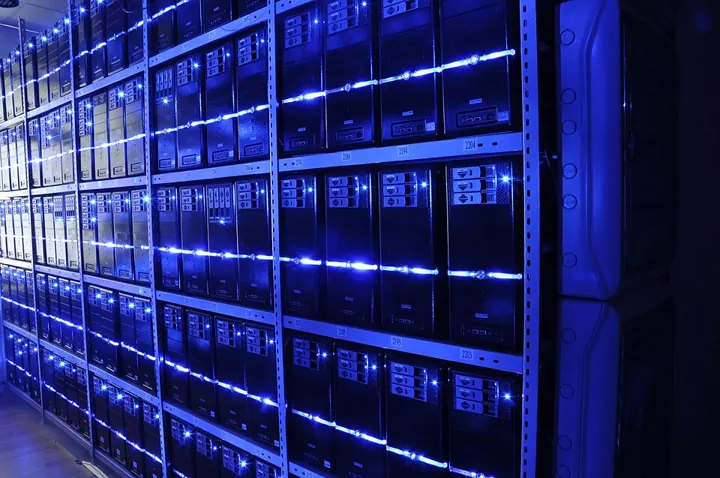
Mains 2015 asked about the advantages and security implications of cloud hosting of servers vis-a-vis in-house hosting for government. Advantages: pay-as-you-go, quick scaling, backups and less hardware to run. Risks: data location and sovereignty, dependence on a vendor, shared infrastructure and outages; answers include government-empanelled clouds, encryption and audits.
Discuss the advantages and security implications of cloud hosting of servers vis-a-vis in-house machine- based hosting for government businesses.
Mains box: analysis and answer points
- Short-range wireless links connect devices without cables.
- Near Field Communication (NFC) works at even closer range.
- Likely next angle: VLC: short range
- Asked: Mains 2015 (GS Paper III, 12.5 marks): Discuss the advantages and security implications of cloud hosting of servers vis-a-vis in-house machine- based hosting for government businesses.
Practice
Practice MCQs (8)
In cloud computing, 'serverless computing' (or Function as a Service) means that
Answer (a) & explanation
The answer is the second option. 'Serverless' does not mean there are no servers; it means the developer does not manage them. In Function as a Service (FaaS), a developer uploads a piece of code, a function, and specifies the events that should trigger it: a file arriving in storage, a message from an IoT device, a web request or a timer. The provider allocates computing capacity when the event occurs, scales from zero to thousands of parallel copies if needed, and bills by the number of invocations and the time they actually run, so nothing is paid while the code is idle. This makes serverless popular for bursty workloads such as processing IoT sensor messages, resizing uploaded images or running scheduled jobs. The provider also patches the underlying OS and runtime, while the developer remains responsible for the code, its permissions and the data it handles.
In the context of the Internet of Things, the main reason for using 'edge computing' is to
Answer (c) & explanation
The answer is processing near the source. In a pure cloud design, every reading travels to a distant data centre, is processed there and a decision travels back. For a self- driving vehicle, a factory robot or a grid protection relay, that round trip can be too slow, and streaming raw video or high-frequency vibration data to the cloud wastes bandwidth. Edge computing moves part of the computation to the device, a gateway or a nearby micro data centre, so that time-critical decisions are taken locally with very low latency, only summaries or alerts go to the cloud, and the system keeps working if the link fails. Processing locally can also help privacy, since raw images or personal data need not leave the premises. The cloud is still used for heavy analytics, long-term storage and training models that are then pushed to the edge.
Consider the following statements about cloud deployment models:
1. A community cloud is provisioned for the exclusive use of a specific community of consumers from organisations that have shared concerns, such as security or compliance requirements.
2. A hybrid cloud is a composition of two or more distinct cloud infrastructures, such as private and public, bound together by technology that allows data and applications to move between them.
3. A cloud is called 'public' only if it is owned and operated by a government agency.
Which of the statements given above is/are correct?
Answer (d) & explanation
Statements 1 and 2 are correct. NIST SP 800-145 lists four deployment models: private, community, public and hybrid. A community cloud serves a group of organisations with shared concerns (mission, security, policy or compliance) and may be owned by one or more of them, a third party or a combination; a government cloud shared by several departments is a typical example. A hybrid cloud joins two or more distinct infrastructures that remain separate entities but are bound by standardised or proprietary technology enabling data and application portability, for example 'cloud bursting' from a private cloud into a public one at peak load. Statement 3 is wrong. 'Public' describes who may use the cloud (the general public), not who owns it; NIST notes that a public cloud may be owned and operated by a business, academic or government organisation, or a combination, and in practice most public clouds are run by private companies.
Which one of the following statements about cloud computing is NOT correct?
Answer (d) & explanation
Statement (d) is the incorrect one. The first three are three of the five essential characteristics in NIST SP 800-145: rapid elasticity, measured service and broad network access (the other two are on-demand self-service and resource pooling). Statement (d) ignores the shared responsibility model. Providers secure the infrastructure they run, but customers always keep responsibility for their own data, user accounts and access permissions, and, depending on the service model, also for operating systems, applications and network rules. Industry reports and CERT-In advisories repeatedly trace cloud data leaks to misconfiguration by customers, such as publicly exposed storage buckets or weak access keys, rather than to failures of the provider's hardware.
Consider the following:
1. On-demand self-service
2. Rapid elasticity
3. Ownership of the physical servers by the consumer
4. Dedicated, single-tenant hardware for every customer
How many of the above are among the essential characteristics of cloud computing listed in the NIST definition (SP 800-145)?
Answer (b) & explanation
Only items 1 and 2 are essential characteristics. NIST SP 800-145 (September 2011) lists five: on-demand self-service (a user can provision computing capability without human interaction with the provider), broad network access, resource pooling, rapid elasticity (capacity scales out and in, often automatically, so it appears unlimited) and measured service (use is metered, which makes pay-per-use possible). Item 3 is the opposite of cloud: the consumer rents capability and does not own the provider's servers. Item 4 contradicts resource pooling, under which the provider's resources serve many consumers through a multi-tenant model, with physical and virtual resources assigned and reassigned according to demand. Dedicated hardware can be bought as an option, but it is not a defining characteristic.
With reference to 'MeghRaj', consider the following statements:
1. It is the name of the Government of India's GI Cloud initiative, launched in February 2014 to speed up the delivery of e-services and optimise ICT spending.
2. Under it, the Ministry of Electronics and Information Technology empanels the cloud service offerings of service providers after their data centres and offerings are audited by STQC.
3. Under it, government workloads may be hosted only in data centres owned by the National Informatics Centre, and private cloud service providers are barred.
Which of the statements given above is/are correct?
Answer (a) & explanation
Statements 1 and 2 are correct. GI Cloud, named MeghRaj, was launched by the then Department of Electronics and IT on 4 February 2014 so that ministries could share computing infrastructure, deploy applications faster and avoid building separate data centres for every project. To give departments a trusted list of commercial providers, MeitY began empanelling the cloud service offerings of providers from 2016; a provider must meet the pre- qualification and compliance requirements and its data centres and offerings are audited by STQC (Standardisation Testing and Quality Certification), with surveillance audits afterwards. Statement 3 is wrong: the empanelment system exists precisely so that departments can procure services from empanelled private providers as well as from NIC's national cloud, subject to MeitY's security and data-location conditions.
Consider the following statements about virtualisation and containers, the technologies on which most cloud services run:
1. A Type 1 (bare-metal) hypervisor runs directly on the server hardware, whereas a Type 2 (hosted) hypervisor runs on top of a conventional host operating system.
2. Containers on a host share that host's operating-system kernel, which makes them lighter and faster to start than full virtual machines.
3. Containers provide stronger isolation than virtual machines because each container runs its own separate kernel.
Which of the statements given above is/are correct?
Answer (a) & explanation
Statements 1 and 2 are correct. A hypervisor creates and runs virtual machines (VMs), each with its own guest operating system. A Type 1 or bare-metal hypervisor sits directly on the hardware and is the usual choice in cloud data centres; a Type 2 or hosted hypervisor runs as an application on a desktop operating system, as in many personal virtualisation tools. NIST SP 800-190 explains that containers package an application with its libraries but share the host OS kernel, isolated from one another by operating-system features. Because no separate guest OS has to boot, containers are small and start in seconds, which suits microservices and auto-scaling. Statement 3 reverses the trade-off: precisely because they share one kernel, containers have weaker isolation than VMs, whose hypervisor enforces hardware-level separation; a kernel flaw can affect all containers on the host. That is why sensitive workloads often run containers inside VMs.
Consider the following statements:
1. The radio waves used in mobile communication, including millimetre waves, are non-ionising radiation.
2. The energy carried by a single photon increases with the frequency of the radiation.
3. A photon of a 26 GHz millimetre-wave signal carries more energy than a photon of visible light.
Which of the statements given above is/are correct?
Answer (b) & explanation
Statements 1 and 2 are correct. Photon energy is E = hf, so it rises with frequency. Visible light is around 4-7.5 x 10^14 Hz, about ten thousand times higher than 26 GHz (2.6 x 10^10 Hz), so a visible photon carries far more energy. Ionisation needs photon energies of roughly 10 eV and above, reached only in the far ultraviolet, X-rays and gamma rays. All mobile bands, mmWave and even terahertz, lie far below, which is why they are classed as non- ionising; their main biological effect at high intensity is heating.
0 / 0 correct
Mains PYQs on this topic (1)
Write an answer
In 150 words, explain the significance of Information Technology with one recent example.
Flashcards (9)
Band used by Bluetooth Classic?
2.4 GHz ISM band.
NFC base frequency and typical range?
13.56 MHz; up to 2 cm.
Medium used by Li-Fi?
Visible light from LEDs.
Why is VLC short-range?
Light does not pass through walls.
What does VoLTE carry?
Voice calls as data over LTE.
What is a VPN?
A secure network across the public internet.
Smart home where objects act on their
own? Internet of Things.
NIST cloud model: characteristics, service
and deployment models? 5, 3 and 4.
Example of SaaS?
Web mail such as Outlook.
Read more: related explainers
In the news
- 24 Oct 2026Panel to review pharma marketing code: UCPMP 2024 and why a voluntary code is not enough
- 24 Oct 2026NVS-03 launch on 30 October: can ISRO’s new satellite bring NavIC back to life?
- 23 Oct 2026Nasha Mukt Bharat Abhiyaan reaches 35 crore people: demand reduction and the 2029 drug-free goal
- 23 Oct 2026Carbon capture: how India can make its ₹20,000 crore CCUS push count, in three phases
 Next topic · 9.2 →Information Technology: AI, quantum and blockchain
Syllabus: GS-III · Science and Technology- developments and their applications and effects in every…