
Chapter 2 · Topic 2.2 · Prelims + Mains2 of 3
American Revolution: War and Constitution
Key points
- The War of Independence (1775–83)
- The Constitution of 1787
Prelims box: facts and traps
| Event | Marker |
|---|---|
| Lexington and Concord (April 1775) | First shots |
| Bunker Hill (June 1775) | Costly British victory |
| George Washington | Commander of the Continental Army |
| Saratoga (1777) | Turning point; brought France into the war (alliance, 1778); Spain and the Dutch followed |
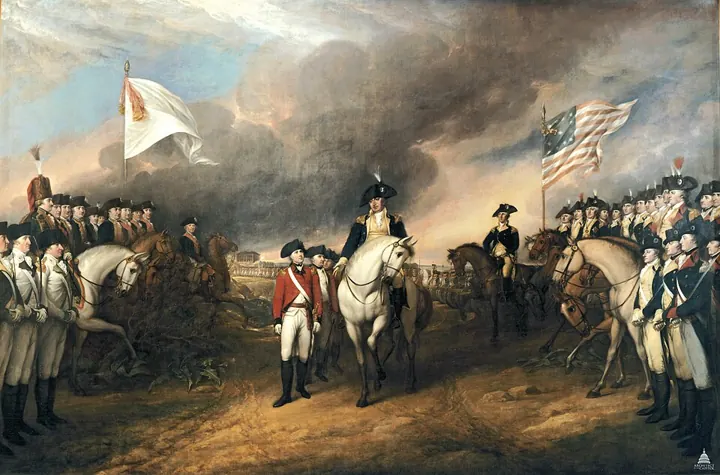
| Yorktown (1781) | Cornwallis surrendered to Washington and French forces |
| Treaty of Paris (1783) | Britain recognised US independence; border at the Mississippi. |
- The war's cost pushed France towards bankruptcy, a direct link to 1789.
The War of Independence (1775–83)
| Event | Marker |
|---|---|
| Lexington and Concord (April 1775) | First shots |
| Bunker Hill (June 1775) | Costly British victory |
| George Washington | Commander of the Continental Army |
| Saratoga (1777) | Turning point; brought France into the war (alliance, 1778); Spain and the Dutch followed |
| Yorktown (1781) | Cornwallis surrendered to Washington and French forces |
| Treaty of Paris (1783) | Britain recognised US independence; border at the Mississippi |
Why the colonists won: home ground, French money and navy, British supply lines across the Atlantic, and Britain’s global war against France and Spain. The war’s cost pushed France towards bankruptcy, a direct link to 1789.
The Constitution of 1787
| Feature | Detail |
|---|---|
| Articles of Confederation (1781) | Weak centre: no power to tax or regulate trade |
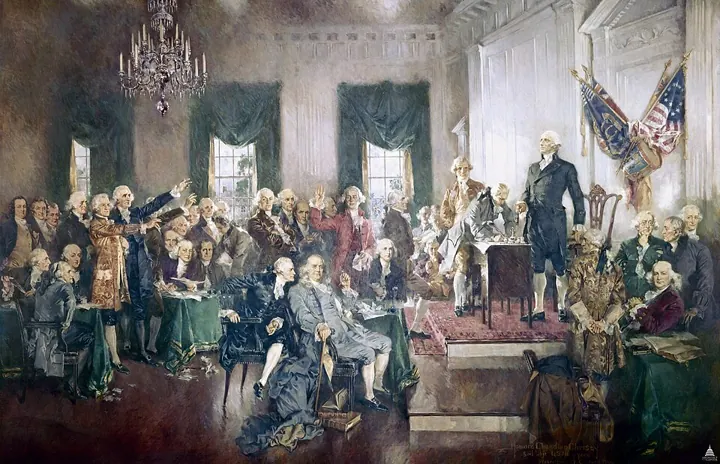
| Philadelphia Convention (1787) | Chaired by Washington; James Madison ‘father of the Constitution’ |
| Federalism | Powers divided between the Union and the states |
| Separation of powers | Congress, President, Supreme Court with checks and balances (Montesquieu) |
| Great Compromise | House by population, Senate with two seats per state |
| Bill of Rights (1791) | First ten amendments: speech, religion, press, fair trial |
| Federalist Papers | Hamilton, Madison and Jay argued for ratification |
It is the oldest written national constitution still in force; India borrowed judicial review, the Vice- President’s role, fundamental rights and impeachment ideas from it.
Mains box: analysis and answer points
- Why the colonists won: home ground, French money and navy, British supply lines across the Atlantic, and Britain's global war against France and Spain.
- Likely next angle: Treaty of Paris 1783
Practice
Write an answer
In 150 words, explain the significance of American Revolution with one recent example.
Flashcards (9)
First battles?
Lexington and Concord, April 1775.
Turning-point battle?
Saratoga, 1777.
Where did Cornwallis surrender?
Yorktown, 1781.
Treaty ending the war?
Treaty of Paris, 1783.
Which country allied with the US in 1778?
France.
Father of the US Constitution?
James Madison.
Year of the Philadelphia Convention?
1787.
Bill of Rights?
First ten amendments, 1791.
Great Compromise?
House by population, Senate two per state.
Read more: related explainers
 Next topic · 2.3 →American Revolution: Impact and legacy
Syllabus: GS-I · History of the world will include events from 18th century such as industrial re…