
Chapter 15 · Topic 15.1 · Prelims + Mains1 of 3
Arab-Israel Conflict: Origins and 1948
Key points
- Zionism began with Herzl's The Jewish State (1896) and the Basel Congress (1897).
- Britain's clashing promises (Hussein–McMahon, Sykes–Picot, Balfour 1917) and the Mandate (1920–48) set up the conflict.
- UN Resolution 181 (1947) split Palestine; Israel was proclaimed on 14 May 1948; about 700,000 Palestinians lost their homes (Nakba).
Prelims box: facts and traps
- Peel Commission: 1937, first partition proposal.
- White Paper: 1939, capped Jewish migration.
- India: voted against partition; recognised Israel 1950, full ties 1992.
Background: Zionism and the Mandate
Imagine a shopkeeper who sells the same flat to two families, each getting a signed letter. When both arrive with their luggage, a fight is certain. That, in simple terms, is how the conflict began.
| Point | Detail |
|---|---|
| Zionism | Theodor Herzl’s The Jewish State (1896); First Zionist Congress, Basel (1897) |
| Arab nationalism | Arab revolt against the Ottomans (1916), encouraged by Britain |
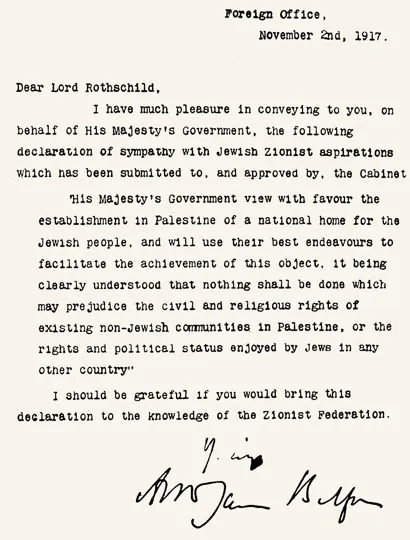
| Contradictory promises | Hussein–McMahon letters (1915–16), Sykes–Picot (1916), Balfour Declaration (1917) |
| British Mandate (1920–48) | Jewish immigration rose, especially after 1933 |
| Conflict | Arab Revolt (1936–39); Peel Commission proposed partition (1937); White Paper limited immigration (1939) |
Zionism is the movement for a Jewish homeland in Palestine, the land of ancient Israel. It grew because Jews faced hatred and attacks, called pogroms, across Europe. Herzl, an Austrian journalist, gave it shape.
Arab nationalism was the wish of Arabs to rule themselves after centuries under the Ottoman (Turkish) Empire.
Britain’s three promises clashed:
- Hussein–McMahon letters: promised the Arabs independence if they revolted against the Ottomans.
- Sykes–Picot Agreement: a secret plan to split the Arab lands between Britain and France.
- Balfour Declaration (1917): Britain backed “a national home for the Jewish people” in Palestine.
A Mandate was a territory the League of Nations handed to a power to run until it was “ready” for self-rule. Under the British Mandate, Jewish migration rose sharply after Hitler came to power in 1933. Arabs revolted in 1936–39. The Peel Commission first suggested splitting the land, and the 1939 White Paper then capped Jewish migration.
Creation of Israel (1947–49)
| Step | Detail |
|---|---|
| UN partition plan | Resolution 181, November 1947; India voted against and proposed a federal state |
| Israel proclaimed | 14 May 1948 by David Ben-Gurion |
| First Arab–Israeli War (1948–49) | Israel won more territory than the plan gave it |
| Nakba | About 700,000 Palestinians fled or were expelled |
| Outcome | Jordan held the West Bank and East Jerusalem; Egypt held Gaza |
| India | Recognised Israel in 1950; full diplomatic ties in 1992 |
After the Holocaust, the killing of about six million Jews by Nazi Germany, world sympathy for a Jewish state grew. Britain, worn out, handed the problem to the UN. Resolution 181 split Palestine into a Jewish state, an Arab state and an international Jerusalem. Jewish leaders accepted; Arab leaders rejected it.
The day after Israel was proclaimed, Egypt, Jordan, Syria, Iraq and Lebanon attacked. Israel won. Palestinians call this time the Nakba, Arabic for “catastrophe”, because hundreds of thousands lost their homes and became refugees.
Why India voted against partition
India had just suffered its own painful partition in 1947. It did not want a land split on religion, and proposed one federal state with Jewish and Arab parts instead.
Common doubts
Why is Jerusalem so disputed? It is holy to Jews, Christians and Muslims, and both Israelis and Palestinians claim it as their capital.
Who are the Palestinians? The Arab people who lived in Palestine for centuries, mostly Muslim with some Christians. Many today live as refugees in Jordan, Lebanon and Syria.
What UPSC asks
Prelims: Herzl, Balfour 1917, Resolution 181, 14 May 1948, Nakba. Mains: how British promises and the Mandate created the conflict, and India’s stand.
Mains box: analysis and answer points
- Roots of the conflict: British promises and the Mandate.
- India's stand in 1947: a federal state, not partition.
Practice
Write an answer
In 150 words, explain the significance of Arab-Israel Conflict with one recent example.
Flashcards (8)
Founder of political Zionism?
Theodor Herzl.
First Zionist Congress?
Basel, 1897.
Balfour Declaration?
2 November 1917.
Commission proposing partition in 1937?
Peel Commission.
UN partition resolution?
Resolution 181 (1947).
Israel proclaimed?
14 May 1948.
Israel's first PM?
David Ben-Gurion.
India–Israel full ties?
1992.
Read more: related explainers
 Next topic · 15.2 →Arab-Israel Conflict: Wars and Palestine
Syllabus: GS-I · History of the world will include events from 18th century such as industrial re…