
Chapter 12 · Topic 12.2 · Prelims + Mains2 of 3
Chinese Revolution: Civil war and Mao
Key points
- The KMT and CCP allied (1923–27), split violently in 1927, joined against Japan (1937) and fought again (1946–49).
- The Long March (1934–35) made Mao leader.
- The Communists won through a peasant strategy, land reform, a patriotic image and KMT weakness.
1 PYQ 2013–2022
Prelims box: facts and traps
- CCP founded: 1921, Shanghai.
- Shanghai massacre: 1927. Xi'an Incident: 1936.
- Long March: about 9,000 km to Yan'an.
- Huaihai: 1948–49, decisive PLA victory.
Nationalists versus Communists
Think of two partners who start a business together, fall out bitterly, join hands only when a robber attacks the shop, and then fight again once he leaves. That is the KMT–CCP story.
| Stage | Detail |
|---|---|
| CCP founded | 1921, Shanghai |
| First United Front | KMT–CCP alliance with Soviet help (1923–27) |
| Northern Expedition and split | Chiang Kai-shek unified China and massacred Communists in Shanghai (1927) |
| Long March (1934–35) | Communists retreated about 9,000 km to Yan’an; Mao became leader |
| Second United Front | Against Japan after the Xi’an Incident (1936) and invasion (1937) |
| Civil war (1946–49) | Communists won; KMT retreated to Taiwan |
The story step by step
- Partners (1923–27): on Soviet advice, the small Communist Party joined Sun Yat-sen’s KMT. Together they marched north to defeat the warlords, the “Northern Expedition”.
- Betrayal (1927): Chiang Kai-shek, now KMT leader, turned on the Communists in Shanghai and killed thousands. The survivors fled to the countryside.
- Survival (1934–35): surrounded in the south, the Communists broke out and walked about 9,000 km to Yan’an in the north-west. Most marchers died on the way, but the Long March made Mao the leader and became a legend.
- Truce (1936–45): in the Xi’an Incident, Chiang was held by his own generals until he agreed to unite with the Communists against Japan. Japan invaded fully in 1937.
- Final round (1946–49): after Japan’s defeat, civil war resumed. The Communists won, and Mao proclaimed the People’s Republic in 1949.
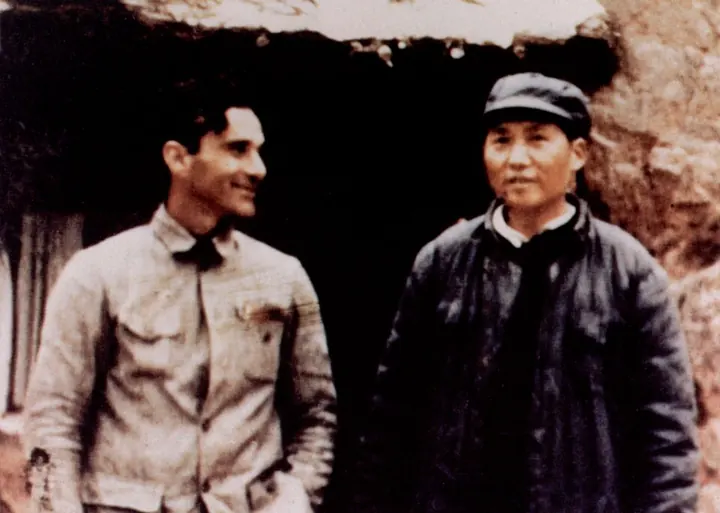
Mao Zedong and why the Communists won
| Reason | Detail |
|---|---|
| Peasant strategy | Mao adapted Marxism to rural China instead of urban workers |
| Land reform | Won peasant support in liberated areas |
| Patriotic image | Communists seen as resisting Japan |
| KMT weakness | Corruption, inflation, landlord ties, battle losses |
| Guerrilla to conventional war | People’s Liberation Army won Huaihai (1948–49) |
Marx expected factory workers in cities to lead revolutions. China had few such workers but hundreds of millions of poor peasants, so Mao built his revolution on them. That was his big change to Marxism. In areas they controlled, the Communists took land from landlords and gave it to peasants, which won them loyal support. The KMT, by contrast, was linked to landlords and big business, printed money until prices ran wild, and lost the people’s trust.
Russia 1917 and China 1949 compared
| Point | Russia | China |
|---|---|---|
| Main support | City workers and soldiers | Peasants |
| Method | Quick seizure of the capital | Long rural guerrilla war |
| Time taken | Months, then civil war | More than 20 years |
Common doubts
Why did the Japanese invasion help the Communists? Japan’s army hit the KMT’s cities and best troops hardest, while the Communists fought a guerrilla war in the countryside and grew stronger. Many Chinese came to see the Communists as the true patriots.
What happened to the KMT? Chiang Kai-shek moved his government and army to the island of Taiwan in 1949. It still calls itself the Republic of China, and China claims Taiwan as its own, which remains a major world issue.
Did the USA help Chiang? Yes, with money and weapons, but it could not save a government that had lost the people’s support.
What UPSC asks
Prelims: CCP 1921, Long March 1934–35, Xi’an Incident 1936. Mains: why the Communists won, and how Chinese communism differed from the Russian model.
Mains box: analysis and answer points
- Why the Communists won: peasants, land reform, anti-Japanese record, KMT corruption and inflation.
- Russia vs China: workers vs peasants; quick seizure vs long rural war.
Practice
Prelims PYQs on this topic (1)
Consider the following statements :
- 1. Bidibidi is a large refugee settlement in north-western Kenya.
- 2. Some people who fled from South Sudan civil war live in Bidibidi.
- 3. Some people who fled from civil war in Somalia live in Dadaab refugee complex in Kenya.
Which of the statements given above is/are correct ?
Answer (c) & explanation
Statements 2 and 3 are correct (c). Statement 2 is right: Bidibidi, one of the world's largest refugee settlements, shelters people who fled the South Sudan civil war that began in 2013. Statement 3 is right: the Dadaab complex in eastern Kenya, near the border, has sheltered Somali refugees fleeing civil war since 1991. Statement 1 is wrong: Bidibidi is in north-western Uganda, in Yumbe district, not in Kenya.
Notice Kenya's other huge camp, Kakuma, in the north-west, which hosts many South Sudanese. Uganda is praised for its open policy: refugees get land to farm and can move and work freely. UPSC uses such places to test both map sense and current affairs.
Answer as per the official UPSC answer key.
Write an answer
In 150 words, explain the significance of Chinese Revolution with one recent example.
Flashcards (4)
CCP founded?
1921, Shanghai.
Nationalist leader after Sun?
Chiang Kai-shek.
Long March?
1934–35, to Yan'an.
Decisive battle of 1948–49?
Huaihai.
Read more: related explainers
 Next topic · 12.3 →Chinese Revolution: Chapter test
Syllabus: GS-I · History of the world will include events from 18th century such as industrial re…