
Chapter 8 · Topic 8.2 · Prelims + Mains2 of 3
World War I: Events and Versailles
Key points
- Trench deadlock on the Western Front; the USA joined in 1917 and the armistice came on 11 November 1918.
- India sent over 1.3 million men; about 74,000 died.
- Versailles (28 June 1919): war guilt (Article 231), reparations, lost land and colonies, a tiny army.
Prelims box: facts and traps
- Tanks first used: the Somme, 1916. Zimmermann Telegram: 1917.
- Article 231: war guilt; reparations 132 billion gold marks (1921).
- Treaties: St Germain (Austria), Trianon (Hungary), Neuilly (Bulgaria), Sèvres then Lausanne (Turkey).
- Khudadad Khan: first Indian Victoria Cross (1914).
Important events
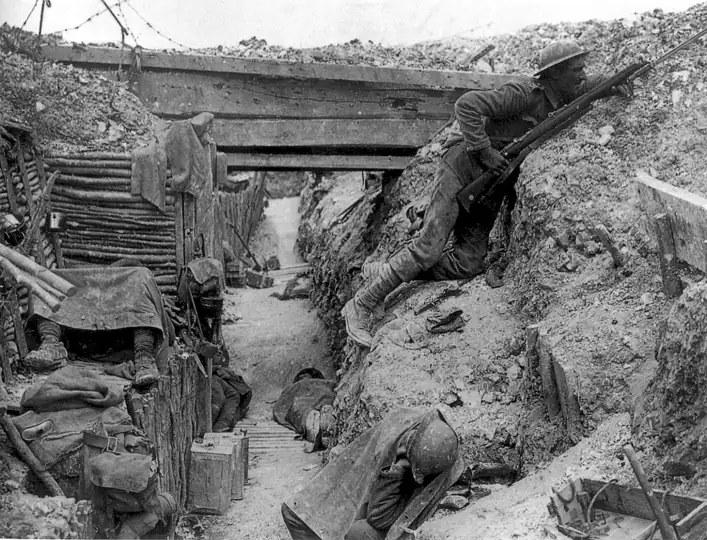
Everyone expected a short war, “over by Christmas”. Instead, armies dug long lines of trenches facing each other across a strip of land, and neither side could break through for years. Imagine two teams in a tug of war, both too strong to lose and too weak to win, while the rope slowly kills them.
| Year | Event |
|---|---|
| 1914 | Schlieffen Plan halted at the Marne; trench deadlock on the Western Front; Russia beaten at Tannenberg |
| 1915 | Gallipoli campaign fails; poison gas at Ypres; Lusitania sunk |
| 1916 | Verdun and the Somme (tanks first used); Jutland naval battle |
| 1917 | Unrestricted submarine warfare and the Zimmermann Telegram bring the USA in (April); Russia exits after the Revolution |
| 1918 | Brest-Litovsk; German spring offensive fails; Hundred Days; armistice 11 November 1918 |
- Unrestricted submarine warfare: German U-boats sank any ship near Britain, even neutral ones. This angered the USA.
- Zimmermann Telegram: a secret German message asking Mexico to attack the USA. Britain decoded it and the US public was outraged.
- Armistice: an agreement to stop fighting, signed before a full peace treaty.
India in the war
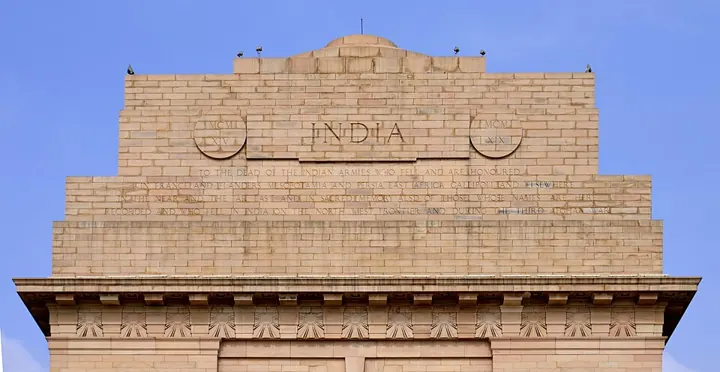
India sent over 1.3 million men; about 74,000 died. Indian troops fought in France, Gallipoli, Mesopotamia, Palestine and East Africa. Khudadad Khan became the first Indian soldier to win the Victoria Cross, near Ypres in 1914. India also gave Britain a war contribution of £100 million. India Gate in New Delhi commemorates them.
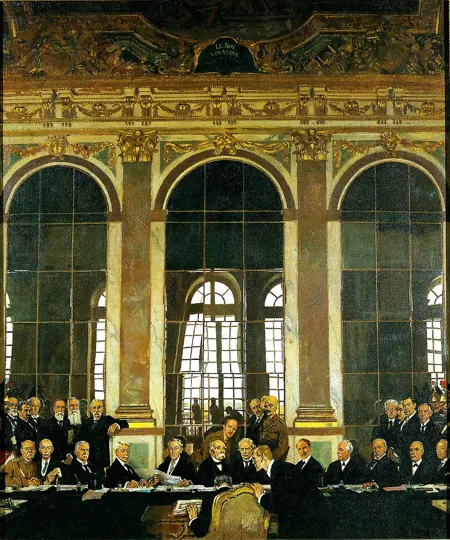
The Treaty of Versailles (1919)
| Term | Detail |
|---|---|
| Signed | 28 June 1919, Hall of Mirrors; Big Three: Wilson, Lloyd George, Clemenceau (with Orlando) |
| War guilt (Article 231) | Germany accepted responsibility; reparations fixed at 132 billion gold marks (1921) |
| Territory | Alsace-Lorraine to France; Polish Corridor; Saar under the League; all colonies taken as mandates |
| Military | Army capped at 100,000; no air force, tanks or submarines; Rhineland demilitarised |
| Other treaties | St Germain (Austria), Trianon (Hungary), Neuilly (Bulgaria), Sèvres then Lausanne (Turkey) |
- Reparations: money a defeated country must pay for war damage.
- Mandates: former German and Ottoman colonies handed to Britain and France to run “on behalf of” the League. In practice they were colonies under a new name.
- Demilitarised: no troops or forts allowed, here in the Rhineland on France’s border.
Germans called the treaty a Diktat, a dictated peace, because they had no say in it. The war guilt clause hurt their pride most. Hitler later used this anger.
Wilson’s Fourteen Points (January 1918) promised self-determination, the right of each people to choose its own government. But it was applied to Europe, not to colonies, a disappointment felt sharply in India and Egypt.
Common doubts
Why did the USA join so late? Most Americans wanted to stay out of Europe’s quarrels. Only the submarine attacks and the Zimmermann Telegram changed their minds, in 1917.
Was Versailles too harsh or too soft? Both views exist. It was harsh enough to anger Germany but not strong enough to keep it down for good. That is why many call it the worst of both worlds.
What UPSC asks
Prelims: Article 231, the Big Three, mandates, India’s war role. Mains: how Versailles sowed the seeds of the Second World War.
Mains box: analysis and answer points
- Versailles and WWII: humiliation (Diktat, war guilt), reparations and lost land fed German anger that Hitler used.
- Self-determination: applied to Europe, not colonies; disappointment in India and Egypt.
Practice
Write an answer
In 150 words, explain the significance of World War I with one recent example.
Flashcards (9)
Battle that stopped the Schlieffen Plan?
First Marne, 1914.
Where were tanks first used?
The Somme, 1916.
When did the USA enter?
April 1917.
Armistice date?
11 November 1918.
Indian war memorial in Delhi?
India Gate.
Versailles signed?
28 June 1919.
War guilt clause?
Article 231.
German army limit?
100,000.
Treaty with Hungary?
Trianon.
Read more: related explainers
 Next topic · 8.3 →World War I: Chapter test
Syllabus: GS-I · History of the world will include events from 18th century such as industrial re…