
Chapter 10 · Topic 10.3 · Prelims + Mains3 of 3
World War II: Chapter test
Key points
- Wartime conferences (Tehran, Yalta, Potsdam) shaped the peace; Bretton Woods (1944) created the IMF and World Bank.
- The UN was born on 24 October 1945; India was a founding member.
- The war made the USA and USSR superpowers, weakened Britain and sped up India's independence.
1 PYQ 2016–2025
Prelims box: facts and traps
- Dumbarton Oaks: 1944, UN draft. Yalta: February 1945, veto and zones for Germany.
- San Francisco: June 1945, UN Charter.
- India: about 2.5 million volunteers; Quit India 1942; Bengal famine 1943; INA trials 1945–46.
Wartime conferences and the United Nations
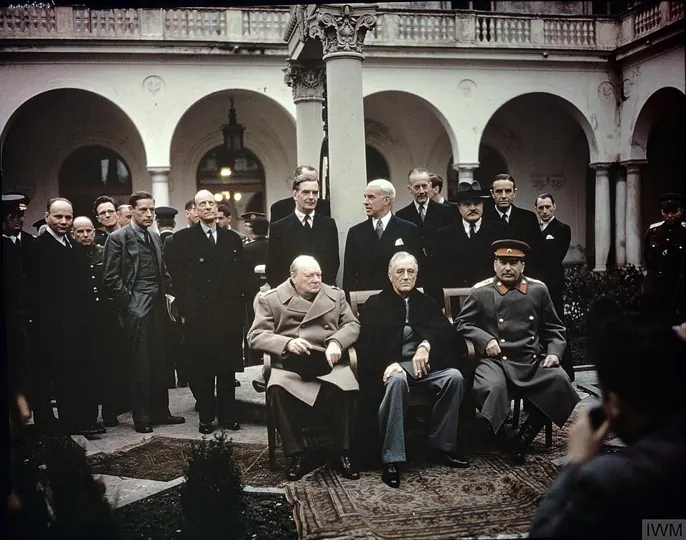
Think of it like a family planning a new house while the old one is still on fire. The “Big Three” leaders, Roosevelt (USA), Churchill (Britain) and Stalin (USSR), met again and again to decide what the world would look like after victory.
| Conference | Outcome |
|---|---|
| Tehran (1943) | Big Three agree on a second front |
| Dumbarton Oaks (1944) | Draft structure of the UN |
| Bretton Woods (1944) | IMF and World Bank (IBRD) |
| Yalta (February 1945) | Germany’s division into zones; Security Council veto; Soviet entry against Japan |
| San Francisco (June 1945) | UN Charter signed; India a founding member |
| Potsdam (July–August 1945) | Occupation of Germany; ultimatum to Japan |
- Second front: an attack on Germany from the west, to take pressure off the Soviets in the east. It came on D-Day in 1944.
- IMF: the International Monetary Fund lends to countries short of foreign money for a while. World Bank (IBRD): lends for long-term rebuilding and development. India took part at Bretton Woods, where 44 countries met.
- Veto: the power of one permanent member to block a Security Council decision.
The UN came into being on 24 October 1945, now observed as UN Day, with five permanent Security Council members holding a veto: the USA, USSR (now Russia), Britain, France and China.
Consequences, and India’s role
| Consequence | Detail |
|---|---|
| Human cost | About 70–85 million dead, most of them civilians |
| Superpowers | USA and USSR replaced Europe at the centre; Cold War began |
| Decolonisation | Weakened Britain and France; India independent in 1947; Asia and Africa followed |
| Germany and Japan | Occupied; Germany divided; both rebuilt as democracies |
| India’s role | About 2.5 million volunteers, the largest volunteer army; fought in North Africa, Italy and Burma |
| India at home | Quit India (1942); Bengal famine (1943); INA trials (1945–46); sterling balances owed by Britain |
India’s war, step by step
- 1939: the Viceroy declared India at war without asking Indian leaders. Congress ministries resigned in protest.
- 1942: the Cripps Mission offered only future dominion status and failed. Gandhi launched Quit India on 8 August 1942, and the whole Congress leadership was jailed.
- 1943: the Bengal famine killed about three million people, worsened by wartime policies.
- 1945–46: the trials of INA officers at the Red Fort united Indians in anger, and the Royal Indian Navy revolt of 1946 showed Britain could no longer count on Indian soldiers.
India also emerged with a bigger industrial base and a battle-tested army. Sterling balances were money Britain owed India for war supplies. They helped India pay for imports after independence.
Common doubts
How was the UN different from the League? The USA and USSR were members from the start, the big powers got a veto so they would stay inside, and the Security Council could order the use of force.
Why did the war speed up India’s freedom? Britain came out broke and exhausted, the USA pushed against old empires, and Indian soldiers’ loyalty could no longer be assumed. Ruling India by force had become too costly, so Britain sent the Cabinet Mission in 1946.
What UPSC asks
Prelims: Yalta 1945, Bretton Woods 1944, UN Day 24 October, India as a UN founder. Mains: consequences of the war and its impact on India’s freedom struggle.
Mains box: analysis and answer points
- Consequences: human cost, superpowers, Cold War, decolonisation, new institutions.
- Impact on India's freedom: Britain exhausted, US pressure, INA trials and the 1946 naval revolt.
Practice
Prelims PYQs on this topic (1)
Consider the following statements in respect of the International Bank for Reconstruction and Development (IBRD) :
- I. It provides loans and guarantees to middle income countries.
- II. It works single-handedly to help developing countries to reduce poverty.
- III. It was established to help Europe rebuild after the World War II.
Which of the statements given above are correct?
Answer (c) & explanation
Statements I and III are correct (c). Statement III is right: the IBRD, set up at Bretton Woods in 1944, was meant to rebuild war-torn Europe; its first loan went to France in 1947. Statement I is right: today it gives loans and guarantees to middle-income and creditworthy poorer countries. Statement II is wrong: it works with the IDA, IFC, MIGA and ICSID as the World Bank Group, so "single-handedly" is wrong.
Notice the split: the IDA gives soft loans and grants to the poorest countries, the IFC lends to the private sector, and MIGA gives risk insurance. India is one of the IBRD's largest borrowers, and is not a member of ICSID. The World Bank's twin is the IMF.
"single-handedly". A Bank with four sister bodies does not work alone.
Answer as per the official UPSC answer key.
Write an answer
In 150 words, explain the significance of World War II with one recent example.
Flashcards (3)
Conference that created IMF and World
Bank? Bretton Woods (1944).
UN came into being?
24 October 1945.
Indian Army size in WWII?
About 2.5 million, the largest volunteer army.
Read more: related explainers
 Next chapter · 11. Cold War →Cold War: Origins and blocs
Syllabus: GS-I · History of the world will include events from 18th century such as industrial re…