
CSAT 2011: every question, solved
80 questions from the official UPSC Prelims 2011 paper, in paper order. Tap an option; the answer and the reason appear instantly.
Read the passage
For achieving inclusive growth there is a critical need to rethink the role of the State. The early debate among economists about the size of the Government can be misleading. The need of the hour is to have an enabling Government. India is too large and complex a nation for the State to be able to deliver all that is needed. Asking the Government to produce all the essential goods, create all the necessary jobs, and keep a curb on the prices of all goods is to lead to a large cumbersome bureaucracy and widespread corruption.
The aim must be to stay with the objective of inclusive growth that was laid down by the founding fathers of the nation and also to take a more modern view of what the State can realistically deliver.
This is what leads to the idea of an enabling State, that is, a Government that does not try to directly deliver to the citizens everything that they need. Instead, it (1) creates an enabling ethos for the market so that individual enterprise can flourish and citizens can, for the most part, provide for the needs of one another, and (2) steps in to help those who do not manage to do well for themselves, for there will always be individuals, no matter what the system, who need support and help. Hence we need a Government that, when it comes to the market, sets effective, incentive-compatible rules and remains on the sidelines with minimal interference, and, at the same time, plays an important role in directly helping the poor by ensuring that they get basic education and health services and receive adequate nutrition and food.
According to the passage :
- 1. The objective of inclusive growth was laid down by the founding fathers of the nation.
- 2. Need of the hour is to have an enabling Government.
- 3. The Government should engage in maximum interference in market processes.
- 4. There is a need to change the size of the Government.
Which of the statements given above are correct ?
Answer (a) & explanation
Statements 1 and 2 are correct (a). Step 1: the passage says we must 'stay with the objective of inclusive growth that was laid down by the founding fathers of the nation'. So statement 1 is stated. Step 2: it says 'the need of the hour is to have an enabling Government'. So statement 2 is stated word for word. Step 3: check the others. Statement 3 is the opposite: the Government should remain 'on the sidelines with minimal interference'. Statement 4 is wrong: the passage says the debate about the size of Government 'can be misleading'. So options (b), (c) and (d) fail.
Tip: when a statement uses a strong word like 'maximum', look for the passage's own word. Here 'minimal' kills it at once.
Answer as per the official UPSC answer key.
Read the passage
For achieving inclusive growth there is a critical need to rethink the role of the State. The early debate among economists about the size of the Government can be misleading. The need of the hour is to have an enabling Government. India is too large and complex a nation for the State to be able to deliver all that is needed. Asking the Government to produce all the essential goods, create all the necessary jobs, and keep a curb on the prices of all goods is to lead to a large cumbersome bureaucracy and widespread corruption.
The aim must be to stay with the objective of inclusive growth that was laid down by the founding fathers of the nation and also to take a more modern view of what the State can realistically deliver.
This is what leads to the idea of an enabling State, that is, a Government that does not try to directly deliver to the citizens everything that they need. Instead, it (1) creates an enabling ethos for the market so that individual enterprise can flourish and citizens can, for the most part, provide for the needs of one another, and (2) steps in to help those who do not manage to do well for themselves, for there will always be individuals, no matter what the system, who need support and help. Hence we need a Government that, when it comes to the market, sets effective, incentive-compatible rules and remains on the sidelines with minimal interference, and, at the same time, plays an important role in directly helping the poor by ensuring that they get basic education and health services and receive adequate nutrition and food.
According to the passage, the strategy of inclusive growth can be effected by focussing on
Answer (d) & explanation
Delivery of basic services to the deprived is correct (d). Step 1: find what the State should do for the poor. The passage says it should play 'an important role in directly helping the poor' by ensuring basic education and health services and adequate nutrition and food. That is option (d). Step 2: check (a). The passage says India is too large for the State to 'deliver all that is needed', so 'all the needs of every citizen' is wrong. Step 3: check (b) and (c). More regulation and controlling distribution are what the passage rejects; it wants minimal interference in markets. So (a), (b) and (c) fail.
Tip: options that sound generous ('all needs') are often the trap. Match the option to the passage's exact list of services.
Answer as per the official UPSC answer key.
Read the passage
For achieving inclusive growth there is a critical need to rethink the role of the State. The early debate among economists about the size of the Government can be misleading. The need of the hour is to have an enabling Government. India is too large and complex a nation for the State to be able to deliver all that is needed. Asking the Government to produce all the essential goods, create all the necessary jobs, and keep a curb on the prices of all goods is to lead to a large cumbersome bureaucracy and widespread corruption.
The aim must be to stay with the objective of inclusive growth that was laid down by the founding fathers of the nation and also to take a more modern view of what the State can realistically deliver.
This is what leads to the idea of an enabling State, that is, a Government that does not try to directly deliver to the citizens everything that they need. Instead, it (1) creates an enabling ethos for the market so that individual enterprise can flourish and citizens can, for the most part, provide for the needs of one another, and (2) steps in to help those who do not manage to do well for themselves, for there will always be individuals, no matter what the system, who need support and help. Hence we need a Government that, when it comes to the market, sets effective, incentive-compatible rules and remains on the sidelines with minimal interference, and, at the same time, plays an important role in directly helping the poor by ensuring that they get basic education and health services and receive adequate nutrition and food.
What constitutes an enabling Government ?
- 1. A large bureaucracy.
- 2. Implementation of welfare programmes through representatives.
- 3. Creating an ethos that helps individual enterprise.
- 4. Providing resources to those who are underprivileged.
- 5. Offering direct help to the poor regarding basic services.
Select the correct answer from the codes given below :
Answer (c) & explanation
Items 3, 4 and 5 are correct (c). Step 1: the passage says an enabling State 'creates an enabling ethos for the market so that individual enterprise can flourish'. That is item 3. Step 2: it 'steps in to help those who do not manage to do well' and directly helps the poor with basic services. Those are items 4 and 5. Step 3: check the rest. Item 1 is wrong: a large bureaucracy is named as a problem leading to corruption. Item 2 is wrong: the passage never mentions working through representatives. So (a), (b) and (d) fail.
Tip: anything the passage criticises cannot be part of its ideal. Spot the warnings first, then strike those items.
Answer as per the official UPSC answer key.
Read the passage
For achieving inclusive growth there is a critical need to rethink the role of the State. The early debate among economists about the size of the Government can be misleading. The need of the hour is to have an enabling Government. India is too large and complex a nation for the State to be able to deliver all that is needed. Asking the Government to produce all the essential goods, create all the necessary jobs, and keep a curb on the prices of all goods is to lead to a large cumbersome bureaucracy and widespread corruption.
The aim must be to stay with the objective of inclusive growth that was laid down by the founding fathers of the nation and also to take a more modern view of what the State can realistically deliver.
This is what leads to the idea of an enabling State, that is, a Government that does not try to directly deliver to the citizens everything that they need. Instead, it (1) creates an enabling ethos for the market so that individual enterprise can flourish and citizens can, for the most part, provide for the needs of one another, and (2) steps in to help those who do not manage to do well for themselves, for there will always be individuals, no matter what the system, who need support and help. Hence we need a Government that, when it comes to the market, sets effective, incentive-compatible rules and remains on the sidelines with minimal interference, and, at the same time, plays an important role in directly helping the poor by ensuring that they get basic education and health services and receive adequate nutrition and food.
Why is the State unable to deliver “all that is needed” ?
- 1. It does not have sufficient bureaucracy.
- 2. It does not promote inclusive growth.
Select the correct answer from the codes given below :
Answer (d) & explanation
Neither statement is correct (d). Step 1: find the passage's reason. It says 'India is too large and complex a nation for the State to be able to deliver all that is needed'. Step 2: check statement 1. The passage does not blame a shortage of bureaucracy; it warns that trying to do everything would create a large, cumbersome bureaucracy and corruption. So 1 is wrong. Step 3: check statement 2. The State failing to promote inclusive growth is not the reason given; inclusive growth remains the goal. So 2 is wrong too. Options (a), (b) and (c) fail.
Tip: 'why' questions want the reason the passage actually states. Find that sentence first; anything else, however logical, is outside the passage.
Answer as per the official UPSC answer key.
Read the passage
For achieving inclusive growth there is a critical need to rethink the role of the State. The early debate among economists about the size of the Government can be misleading. The need of the hour is to have an enabling Government. India is too large and complex a nation for the State to be able to deliver all that is needed. Asking the Government to produce all the essential goods, create all the necessary jobs, and keep a curb on the prices of all goods is to lead to a large cumbersome bureaucracy and widespread corruption.
The aim must be to stay with the objective of inclusive growth that was laid down by the founding fathers of the nation and also to take a more modern view of what the State can realistically deliver.
This is what leads to the idea of an enabling State, that is, a Government that does not try to directly deliver to the citizens everything that they need. Instead, it (1) creates an enabling ethos for the market so that individual enterprise can flourish and citizens can, for the most part, provide for the needs of one another, and (2) steps in to help those who do not manage to do well for themselves, for there will always be individuals, no matter what the system, who need support and help. Hence we need a Government that, when it comes to the market, sets effective, incentive-compatible rules and remains on the sidelines with minimal interference, and, at the same time, plays an important role in directly helping the poor by ensuring that they get basic education and health services and receive adequate nutrition and food.
What is the essential message being conveyed by the author of the passage ?
Answer (d) & explanation
Rethinking the role of the State is correct (d). Step 1: read the first line: 'For achieving inclusive growth there is a critical need to rethink the role of the State.' Step 2: see how the rest supports it. The passage explains why the State cannot do everything and describes the enabling State as the new role. So the central message is (d). Step 3: check the others. (a) is a supporting detail about the founding fathers. (b) is too narrow: schools and health are only part of the poor's support. (c) is the opposite: the State should not run markets and industries. So (a), (b) and (c) fail.
Tip: the main message is often in the first or last line. A detail, however true, is not the 'essential message'.
Answer as per the official UPSC answer key.
Read the passage
The concept of ‘creative society’ refers to a phase of development of a society in which a large number of potential contradictions become articulate and active. This is most evident when oppressed social groups get politically mobilised and demand their rights. The upsurge of the peasants and tribals, the movements for regional autonomy and self-determination, the environmental movements, and the women’s movements in the developing countries are signs of emergence of creative society in contemporary times. The forms of social movements and their intensity may vary from country to country and place to place within a country. But the very presence of movements for social transformation in various spheres of a society indicates the emergence of a creative society in a country.
What does the author imply by “creative society” ?
- 1. A society where diverse art forms and literary writings seek incentive.
- 2. A society where social inequalities are accepted as the norm.
- 3. A society where a large number of contradictions are recognised.
- 4. A society where the exploited and the oppressed groups grow conscious of their human rights and upliftment.
Select the correct answer using the codes given below :
Answer (c) & explanation
Items 3 and 4 are correct (c). Step 1: the passage defines a creative society as one where 'a large number of potential contradictions become articulate and active'. That matches item 3. Step 2: it says this is most evident 'when oppressed social groups get politically mobilised and demand their rights'. That matches item 4. Step 3: check the traps. Item 1 picks up the word 'creative' and talks about art and literature, which the passage never mentions. Item 2 says inequalities are accepted, but the passage says they are challenged. So (a), (b) and (d) fail.
Tip: watch for options that play on the everyday meaning of a word. Here 'creative' does not mean artistic; the passage gives its own meaning.
Answer as per the official UPSC answer key.
Read the passage
The concept of ‘creative society’ refers to a phase of development of a society in which a large number of potential contradictions become articulate and active. This is most evident when oppressed social groups get politically mobilised and demand their rights. The upsurge of the peasants and tribals, the movements for regional autonomy and self-determination, the environmental movements, and the women’s movements in the developing countries are signs of emergence of creative society in contemporary times. The forms of social movements and their intensity may vary from country to country and place to place within a country. But the very presence of movements for social transformation in various spheres of a society indicates the emergence of a creative society in a country.
What according to the passage are the manifestations of social movements ?
- 1. Aggressiveness and being incendiary.
- 2. Instigation by external forces.
- 3. Quest for social equality and individual freedom.
- 4. Urge for granting privileges and self-respect to disparaged sections of the society.
Select the correct answer using the codes given below :
Answer (c) & explanation
Items 3 and 4 are correct (c). Step 1: list the movements the passage names: upsurges of peasants and tribals, movements for regional autonomy and self-determination, environmental movements and women's movements. Step 2: see what they show. They express a quest for equality and freedom (item 3) and an urge for rights and dignity for disparaged groups (item 4). Step 3: check the others. Item 1, aggressiveness, and item 2, external instigation, are never mentioned. So (a), (b) and (d) fail.
Tip: do not import ideas the passage does not contain. If a word like 'incendiary' or 'external forces' never appears, the item is out.
Answer as per the official UPSC answer key.
Read the passage
The concept of ‘creative society’ refers to a phase of development of a society in which a large number of potential contradictions become articulate and active. This is most evident when oppressed social groups get politically mobilised and demand their rights. The upsurge of the peasants and tribals, the movements for regional autonomy and self-determination, the environmental movements, and the women’s movements in the developing countries are signs of emergence of creative society in contemporary times. The forms of social movements and their intensity may vary from country to country and place to place within a country. But the very presence of movements for social transformation in various spheres of a society indicates the emergence of a creative society in a country.
With reference to the passage, consider the following statements :
- 1. To be a creative society, it is essential to have a variety of social movements.
- 2. To be a creative society, it is imperative to have potential contradictions and conflicts.
Which of the statements given above is/are correct ?
Answer (c) & explanation
Both statements are correct (c). Step 1: the passage says 'the very presence of movements for social transformation in various spheres' indicates a creative society. So a variety of social movements is essential: statement 1 follows. Step 2: the definition itself rests on 'potential contradictions becom[ing] articulate and active'. Without contradictions and conflicts, there is no creative society: statement 2 follows. Step 3: since both come straight from the definition, options (a), (b) and (d) fail.
Tip: when a passage defines a term, every key part of the definition becomes a necessary condition. Check each statement against those parts.
Answer as per the official UPSC answer key.
Consider the following three statements:
- 1. Only students can participate in the race.
- 2. Some participants in the race are girls.
- 3. All girl participants in the race are invited for coaching.
Which one of the following conclusions can be drawn from the above statements?
Answer (c) & explanation
All participants are students is correct (c). Step 1: 'Only students can participate' means every participant is a student. That is option (c), drawn directly. Step 2: check (a). Only girl participants are invited for coaching; boys who participate may not be. So 'all participants are invited' goes too far. Step 3: check (b). Not every student takes part in the race, and only girl participants are invited, so 'all students are invited' is also wrong. So (a), (b) and (d) fail.
Tip: 'only A can do B' means 'everyone who does B is A'. Turn 'only' into 'all ... are' and the answer pops out.
Answer as per the official UPSC answer key.
The following item consists of four statements. Of these four statements, two cannot both be true, but both can be false. Study the statements carefully and identify the two that satisfy the above condition.
- 1. All animals are carnivorous.
- 2. Some animals are not carnivorous.
- 3. Animals are not carnivorous.
- 4. Some animals are carnivorous.
Answer (a) & explanation
Statements 1 and 3 are correct (a). Step 1: we need two statements that cannot both be true but can both be false. Step 2: 'All animals are carnivorous' (1) and 'Animals are not carnivorous', meaning none are (3), cannot both be true. But if only some animals eat meat, both are false. So 1 and 3 fit. Step 3: check the other pairs. 1 and 2 are exact opposites: one must be true. 3 and 4 are also exact opposites. 2 and 4 can both be true. So (b), (c) and (d) fail.
Tip: 'All' and 'None' are contraries: never both true, can both be false. 'All' and 'Some not' are contradictories: exactly one is true.
Answer as per the official UPSC answer key.
The following item consists of four statements. Of these four statements, two cannot both be true, but both can be false. Study the statements carefully and identify the two that satisfy the above condition.
- 1. All trains are run by diesel engine.
- 2. Some trains are run by diesel engine.
- 3. No train is run by diesel engine.
- 4. Some trains are not run by diesel engine.
Answer (c) & explanation
Statements 1 and 3 are correct (c). Step 1: we need two statements that cannot both be true but can both be false. Step 2: 'All trains are run by diesel' (1) and 'No train is run by diesel' (3) clash, so they cannot both be true. If only some trains use diesel and others are electric, both are false. So 1 and 3 fit. Step 3: check others. 1 and 4 are exact opposites: one must be true. 2 and 3 are also exact opposites. 1 and 2 can both be true. So (a), (b) and (d) fail.
Tip: this is the same pattern as the question before. Learn it once: All vs None is always the answer to 'cannot both be true, can both be false'.
Answer as per the official UPSC answer key.
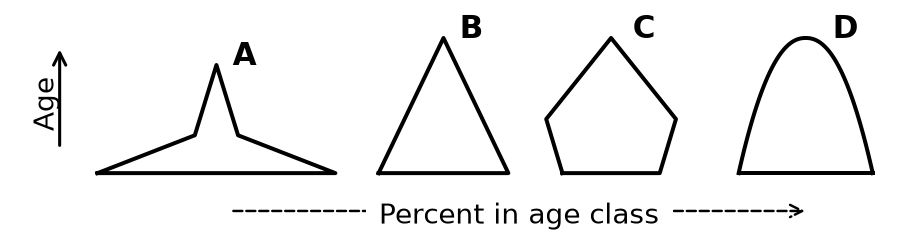
Consider the four age pyramids given below namely A, B, C and D representing four different countries.
Which one of them indicates the declining population?
Answer (c) & explanation
C is correct (c). Step 1: in an age pyramid, the bottom bars show children and the top bars show old people. Step 2: a wide bottom means many children are being born, so the population will grow. Pyramids A, B and D have this shape. Step 3: in C, the bottom is narrower than the middle: fewer children are being born than there are adults now. Fewer children today means fewer parents tomorrow, so the population will decline. So (a), (b) and (d) fail.
Tip: read a pyramid from the bottom up. A narrowing base is the sign of an ageing, shrinking population, as in Japan or Italy today.
Answer as per the official UPSC answer key.
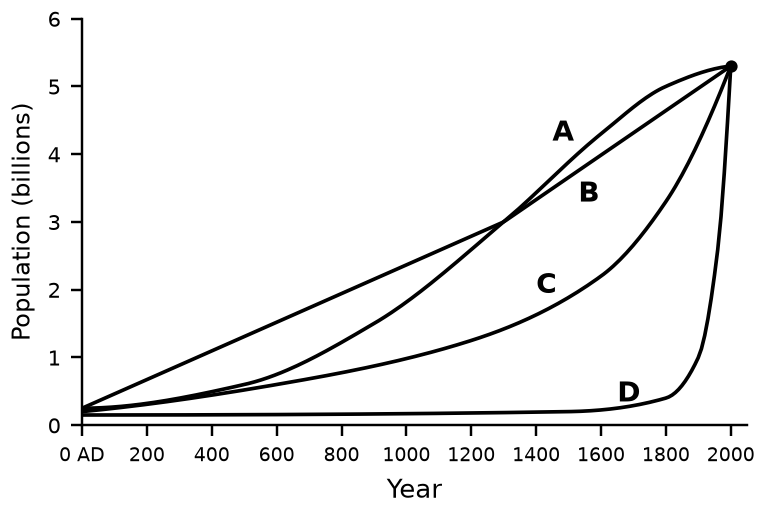
The following figure has four curves namely A, B, C and D. Study the figure and answer the item that follows.
Which curve indicates the exponential growth?
Answer (c) & explanation
C is correct (c). Step 1: exponential growth means the quantity grows by the same percentage each period, so the curve rises slowly at first and then faster and faster. Step 2: check the curves. B is a straight line, which shows steady (linear) growth. A rises but bends over and flattens at the top, which shows growth slowing to a limit. Step 3: C keeps bending upward, getting steeper each period. That is the exponential shape. So (a), (b) and (d) fail.
Tip: straight line = constant addition; upward curve = constant multiplication; S-shaped or flattening curve = growth hitting a limit.
Many readers pick D because it looks like the sharp J-shaped curve; the official answer is (c), as printed.
Answer as per the official UPSC answer key.
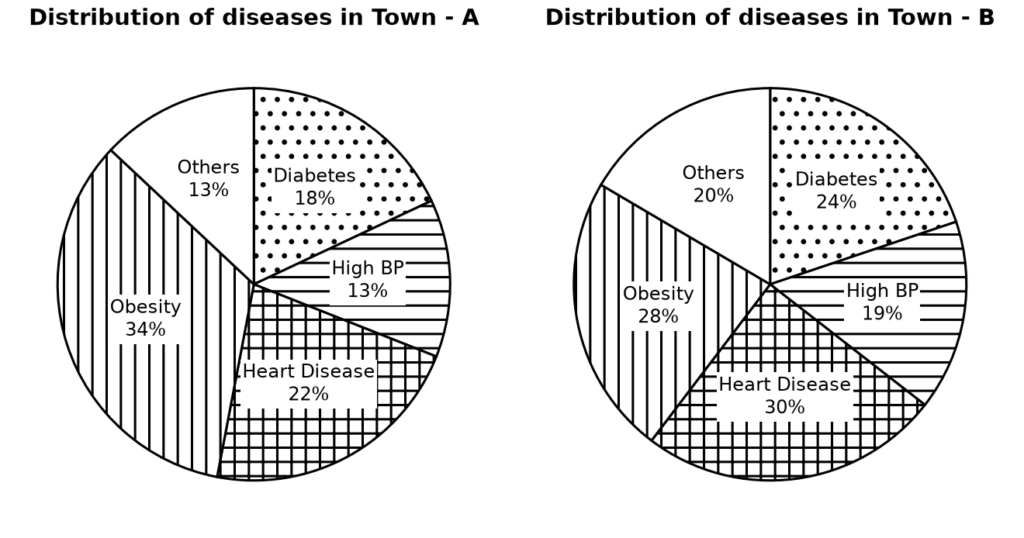
Directions for the following 2 (two) items: The following pie charts show the break-up of disease categories recorded in the patients from two towns, Town A and Town B. Pie charts plot the disease categories as percentage of the total number of patients. Based on these, answer the two items that follow the charts.
Which of the two towns has a higher number of persons with Diabetes?
Answer (d) & explanation
No inference can be drawn is correct (d). Step 1: the pie charts give only percentages: diabetes is 18% of patients in Town A and 24% in Town B. Step 2: we are not told how many patients each town has. Step 3: 24% of a small number can be less than 18% of a big number. For example, 24% of 100 is 24, but 18% of 1,000 is 180. So we cannot say which town has more diabetics. Options (a), (b) and (c) fail.
Tip: a percentage alone never tells you the actual number. Always ask 'percentage of what total?' before comparing two groups.
Answer as per the official UPSC answer key.
(Same pie charts as the question above.)
What can we say about persons with more than one disease from these graphs?
Answer (b) & explanation
Town B is correct (b). Step 1: add the slices of Town A: 13 + 18 + 13 + 22 + 34 = 100%. So each patient is counted exactly once. Step 2: add the slices of Town B: 20 + 24 + 19 + 30 + 28 = 121%. That is more than 100%. Step 3: the extra 21% can only come from patients counted in two disease groups. So Town B is likely to have persons with more than one disease. So (a), (c) and (d) fail.
Tip: when pie-chart slices add up to more than 100%, some items are counted twice. That simple sum is the whole question.
Answer as per the official UPSC answer key.
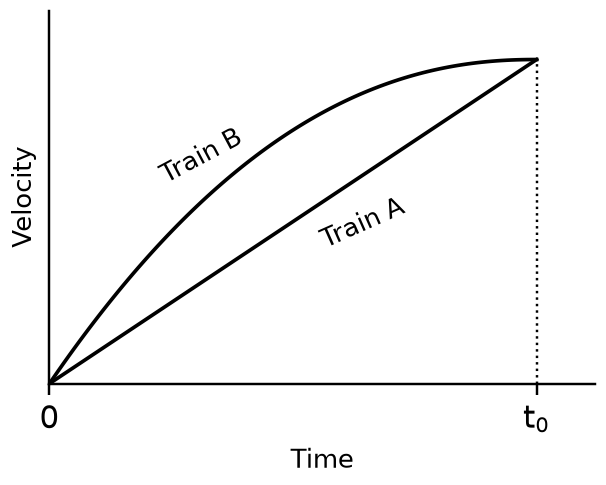
Consider the following Velocity-Time graph. It shows two trains starting simultaneously on parallel tracks.
With reference to the above graph, which one of the following statements is not correct?
Answer (d) & explanation
Option (d) is the statement that is not correct. Step 1: on a velocity–time graph, the slope shows acceleration. At the start B's line climbs more steeply, so (a) is correct. Both lines meet at t₀, so they have the same velocity then, and (c) is correct. Step 2: B's line stays above A's until t₀, so B is faster at all times up to t₀, and (b) is accepted. Step 3: distance is the area under the velocity line. B's line is above A's the whole way, so B covers more ground. 'Both travel the same distance' is wrong.
Tip: on a speed graph, the meeting point means same speed, not same distance. Distance is area, not height.
Some readers also object to (b), since the speeds are equal at the instant t0; the official answer is (d), as printed.
Answer as per the official UPSC answer key.
Read the passage
Ecosystems provide people with a variety of goods and services; food, clean water, clean air, flood control, soil stabilization, pollination, climate regulation, spiritual fulfilment and aesthetic enjoyment, to name just a few. Most of these benefits either are irreplaceable or the technology necessary to replace them is prohibitively expensive. For example, potable fresh water can be provided by desalinating sea-water, but only at great cost.
The rapidly expanding human population has greatly modified the Earth’s ecosystems to meet their increased requirements of some of the goods and services, particularly food, fresh water, timber, fibre and fuel. These modifications have contributed substantially to human well being and economic development. The benefits have not been equally distributed. Some people have actually been harmed by these changes. Moreover, short-term increases in some ecosystem goods and services have come at the cost of the long-term degradation of others. For example, efforts to increase the production of food and fibre have decreased the ability of some ecosystems to provide clean water, regulate flooding and support biodiversity.
With reference to the passage, consider the following statements.
Expanding human population has an adverse effect on :
- 1. Spiritual fulfilment
- 2. Aesthetic enjoyment
- 3. Potable fresh water
- 4. Production of food and fibre
- 5. Biodiversity
Which of the statements given above are correct ?
Answer (c) & explanation
Items 3 and 5 are correct (c). Step 1: the passage says efforts to increase food and fibre 'have decreased the ability of some ecosystems to provide clean water, regulate flooding and support biodiversity'. That gives items 3 and 5. Step 2: check item 4. Production of food and fibre actually rose; it was the cause, not the victim. Step 3: check items 1 and 2. Spiritual fulfilment and aesthetic enjoyment appear only in the opening list of services; the passage never says population growth harmed them. So (a), (b) and (d) fail.
Tip: a word appearing in the passage is not enough. Check whether the passage says what the option claims about it.
Answer as per the official UPSC answer key.
Read the passage
Ecosystems provide people with a variety of goods and services; food, clean water, clean air, flood control, soil stabilization, pollination, climate regulation, spiritual fulfilment and aesthetic enjoyment, to name just a few. Most of these benefits either are irreplaceable or the technology necessary to replace them is prohibitively expensive. For example, potable fresh water can be provided by desalinating sea-water, but only at great cost.
The rapidly expanding human population has greatly modified the Earth’s ecosystems to meet their increased requirements of some of the goods and services, particularly food, fresh water, timber, fibre and fuel. These modifications have contributed substantially to human well being and economic development. The benefits have not been equally distributed. Some people have actually been harmed by these changes. Moreover, short-term increases in some ecosystem goods and services have come at the cost of the long-term degradation of others. For example, efforts to increase the production of food and fibre have decreased the ability of some ecosystems to provide clean water, regulate flooding and support biodiversity.
The passage mentions that “some people have actually been harmed by these changes”. What does it imply ?
- 1. The rapid expansion of population has adversely affected some people.
- 2. Sufficient efforts have not been made to increase the production of food and fibre.
- 3. In the short term some people may be harmed, but in the long term everyone will benefit from modifications in the Earth’s ecosystems.
Which of the statement given above is/are correct ?
Answer (a) & explanation
Statement 1 only is correct (a). Step 1: the passage says the rapidly expanding population 'greatly modified' ecosystems, and 'some people have actually been harmed by these changes'. So population-driven change hurt some people: statement 1. Step 2: statement 2 is wrong: the passage says efforts to increase food and fibre were made. Step 3: statement 3 is wrong: the passage warns of 'the long-term degradation' of ecosystems, not long-term benefit for everyone. So (b), (c) and (d) fail.
Tip: when an option promises a happy ending ('everyone will benefit'), check the passage's tone. Here it is a warning, so the optimistic option is out.
Answer as per the official UPSC answer key.
Read the passage
Ecosystems provide people with a variety of goods and services; food, clean water, clean air, flood control, soil stabilization, pollination, climate regulation, spiritual fulfilment and aesthetic enjoyment, to name just a few. Most of these benefits either are irreplaceable or the technology necessary to replace them is prohibitively expensive. For example, potable fresh water can be provided by desalinating sea-water, but only at great cost.
The rapidly expanding human population has greatly modified the Earth’s ecosystems to meet their increased requirements of some of the goods and services, particularly food, fresh water, timber, fibre and fuel. These modifications have contributed substantially to human well being and economic development. The benefits have not been equally distributed. Some people have actually been harmed by these changes. Moreover, short-term increases in some ecosystem goods and services have come at the cost of the long-term degradation of others. For example, efforts to increase the production of food and fibre have decreased the ability of some ecosystems to provide clean water, regulate flooding and support biodiversity.
With reference to the passage, consider the following statements :
- 1. It is imperative to modify the Earth’s ecosystems for the well being of mankind.
- 2. Technology can never replace all the goods and services provided by ecosystems.
Which of the statements given above is/are correct ?
Answer (d) & explanation
Neither statement is correct (d). Step 1: statement 1 says it is imperative to modify ecosystems. The passage only records that modifications happened and helped development; it never says they are necessary, and it stresses the harm. So 1 is wrong. Step 2: statement 2 says technology can never replace ecosystem services. The passage says most are irreplaceable or the technology is 'prohibitively expensive', and gives desalination as a costly but working replacement. So 'never' overstates it. Step 3: options (a), (b) and (c) fail.
Tip: strong words like 'imperative', 'never' and 'always' are red flags. Check whether the passage is that absolute.
Answer as per the official UPSC answer key.
Read the passage
A moral act must be our own act; must spring from our own will. If we act mechanically, there is no moral content in our act. Such action would be moral, if we think it proper to act like a machine and do so. For, in doing so, we use our discrimination. We should bear in mind the distinction between acting mechanically and acting intentionally. It may be moral of a king to pardon a culprit. But the messenger carrying out the order of pardon plays only a mechanical part in the king’s moral act. But if the messenger were to carry out the king’s order considering it to be his duty, his action would be a moral one. How can a man understand morality who does not use his own intelligence and power of thought, but lets himself be swept along like a log of wood by a current ? Sometimes a man defies convention and acts on his own with a view to absolute good.
Which of the following statements best describe/describes the thought of the writer ?
- 1. A moral act calls for using our discretion.
- 2. Man should react to a situation immediately.
- 3. Man must do his duty.
- 4. Man should be able to defy convention in order to be moral.
Select the correct answer from the codes given below :
Answer (d) & explanation
Statements 1 and 4 are correct per UPSC's key (d), though statement 3 is arguable. Step 1: the passage says a moral act uses 'our discrimination' and must spring from our own will: statement 1. Step 2: it says a man sometimes 'defies convention and acts on his own with a view to absolute good': statement 4. Step 3: statement 2 is wrong; the passage never asks for immediate reaction. Statement 3 is the doubt: the messenger acting from duty is called moral, so duty matters, but the writer stresses conscious choice, not duty as such; UPSC left it out. So (a), (b) and (c) fail on the key.
Tip: pick statements that capture the writer's core idea, here thinking for oneself, rather than examples used along the way.
Answer as per the official UPSC answer key.
Read the passage
A moral act must be our own act; must spring from our own will. If we act mechanically, there is no moral content in our act. Such action would be moral, if we think it proper to act like a machine and do so. For, in doing so, we use our discrimination. We should bear in mind the distinction between acting mechanically and acting intentionally. It may be moral of a king to pardon a culprit. But the messenger carrying out the order of pardon plays only a mechanical part in the king’s moral act. But if the messenger were to carry out the king’s order considering it to be his duty, his action would be a moral one. How can a man understand morality who does not use his own intelligence and power of thought, but lets himself be swept along like a log of wood by a current ? Sometimes a man defies convention and acts on his own with a view to absolute good.
Which of the following statements is the nearest definition of moral action, according to the writer ?
Answer (b) & explanation
An action based on our sense of discretion is correct (b). Step 1: the passage says 'a moral act must be our own act; must spring from our own will', and 'we use our discrimination'. Discrimination here means judgement or discretion. That is (b). Step 2: check (a). The messenger who acts mechanically on orders is the writer's example of a non-moral act, so (a) is the opposite. Step 3: check (c) and (d). 'Clever' action and 'religious' action are never mentioned. So (a), (c) and (d) fail.
Tip: in old-style English, 'discrimination' means the ability to judge well, not unfair treatment. Knowing this unlocks the answer.
Answer as per the official UPSC answer key.
Read the passage
A moral act must be our own act; must spring from our own will. If we act mechanically, there is no moral content in our act. Such action would be moral, if we think it proper to act like a machine and do so. For, in doing so, we use our discrimination. We should bear in mind the distinction between acting mechanically and acting intentionally. It may be moral of a king to pardon a culprit. But the messenger carrying out the order of pardon plays only a mechanical part in the king’s moral act. But if the messenger were to carry out the king’s order considering it to be his duty, his action would be a moral one. How can a man understand morality who does not use his own intelligence and power of thought, but lets himself be swept along like a log of wood by a current ? Sometimes a man defies convention and acts on his own with a view to absolute good.
The passage contains a statement “lets himself be swept along like a log of wood by a current”. Among the following statements, which is/are nearest in meaning to this ?
- 1. A person does not use his own reason.
- 2. He is susceptible to influence/pressure.
- 3. He cannot withstand difficulties/challenges.
- 4. He is like a log of wood.
Select the correct answer using the codes given below :
Answer (b) & explanation
Statements 1 and 2 are correct (b). Step 1: the passage asks how a man can understand morality 'who does not use his own intelligence and power of thought'. That matches statement 1. Step 2: being 'swept along like a log of wood by a current' means drifting with whatever pushes him: being open to outside influence or pressure, statement 2. Step 3: statement 3, about difficulties, is not the idea. Statement 4 reads the simile literally; the man is not actually a log. So (a), (c) and (d) fail.
Tip: a simile compares one quality, not everything. Ask what quality the image shares; here it is passivity.
Answer as per the official UPSC answer key.
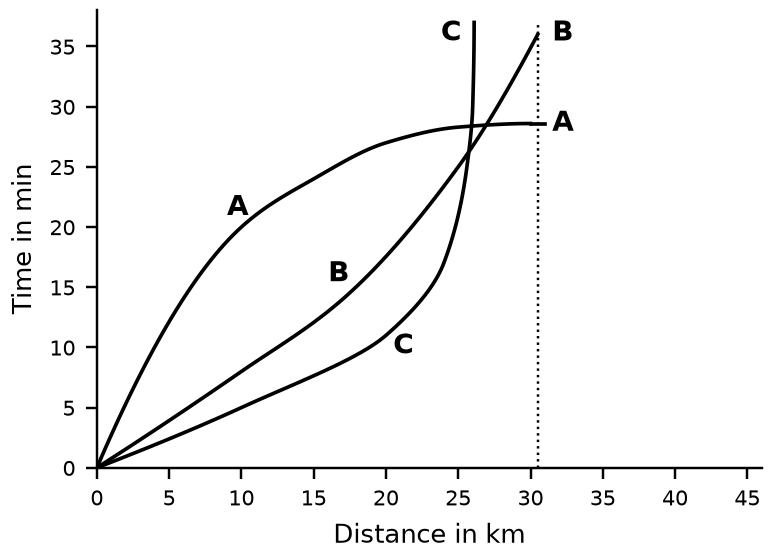
Consider the following distance-time graph. The graph shows three athletes A, B, and C running side by side for a 30 km race.
With reference to the above graph, consider the following statements:
- 1. The race was won by A.
- 2. B was ahead of A up to 25 km mark.
- 3. C ran very slowly from the beginning.
Which of the statements given above is/are correct?
Answer (b) & explanation
1. Here time is on the up-down axis, so a lower line means less time taken for the same distance (faster).
2. At 30 km, A's line is lowest (about 28 min); B takes about 35 min and C never reaches 30 km. A wins: 1 is correct.
3. Up to about 25 km, B's line is below A's, so B reached each mark sooner: 2 is correct.
4. At the start C's line is the lowest of all, so C was the fastest early on: 3 is wrong.
5. Answer: 1 and 2 only.
Answer as per the official UPSC answer key.
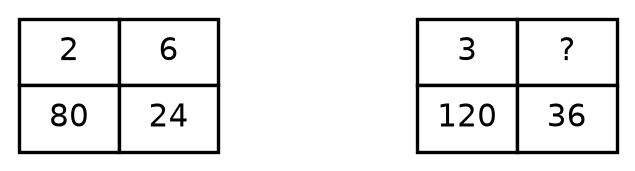
Consider the following figures:
What is the missing number?
Answer (c) & explanation
9 is correct (c). Step 1: look at the first figure. The top numbers are 2 and 6. The bottom-left number 80 = (2 + 6) × 10. The bottom-right number 24 = 6 × 4. Step 2: apply the same rule to the second figure. The bottom-right is 36, and it equals the missing number × 4. So the missing number = 36 ÷ 4 = 9. Step 3: check the bottom-left: (3 + 9) × 10 = 120, which matches the figure. So (a), (b) and (d) fail.
Tip: find the rule in the complete figure first, then test it on every number in the second figure. If one number fits and another does not, the rule is wrong.
Answer as per the official UPSC answer key.
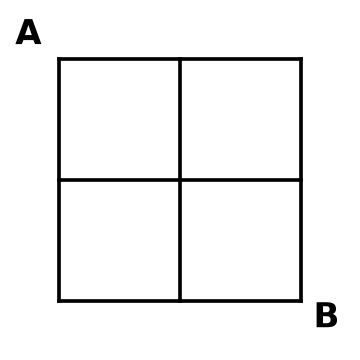
Study the following figure:
A person goes from A to B always moving to the right or downwards along the lines. How many different routes can he adopt?
Select the correct answer from the codes given below:
Answer (c) & explanation
6 routes is correct (c). Step 1: from A to B on this grid, every route needs exactly 2 steps right (R) and 2 steps down (D), in some order. Step 2: list the orders: RRDD, RDRD, RDDR, DRRD, DRDR, DDRR. That is 6 routes. Step 3: check with a formula: the number of ways to arrange 2 R's and 2 D's is 4! ÷ (2! × 2!) = 24 ÷ 4 = 6. So (a), (b) and (d) fail.
Tip: for grid routes moving only right and down, count the steps of each kind, then use (total steps)! ÷ (rights! × downs!). For bigger grids, this saves a lot of drawing.
Answer as per the official UPSC answer key.
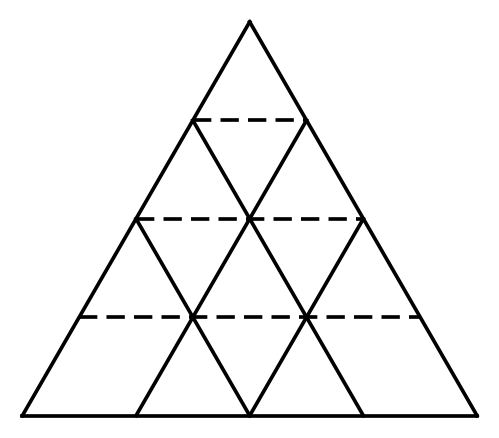
Consider the following figure and answer the item that follows:
What is the total number of triangles in the above grid?
Answer (c) & explanation
1. Count the smallest triangles (one small cell each): 8 point up and 4 point down = 12.
2. Count triangles made of 4 small cells (2 small sides long): 6 point up and 1 points down (in the middle) = 7.
3. Count triangles 3 small sides long: one at each bottom corner and one upright through the middle = 3.
4. The whole big triangle: 1.
5. Total = 12 + 7 + 3 + 1 = 23.
Answer as per the official UPSC answer key.
Read the passage
A country under foreign domination seeks escape from the present in dreams of a vanished age, and finds consolation in visions of past greatness. That is a foolish and dangerous pastime in which many of us indulge. An equally questionable practice for us in India is to imagine that we are still spiritually great though we have come down in the world in other respects. Spiritual or any other greatness cannot be founded on lack of freedom and opportunity, or on starvation and misery. Many western writers have encouraged that notion that Indians are other-worldly. I suppose the poor and unfortunate in every country become to some extent other-worldly, unless they become revolutionaries, for this world is evidently not meant for them. So also subject peoples.
As a man grows to maturity he is not entirely engrossed in, or satisfied with, the external objective world. He seeks also some inner meaning, some psychological and physical satisfactions. So also with peoples and civilizations as they mature and grow adult. Every civilization and every people exhibit these parallel streams of an external life and an internal life. Where they meet or keep close to each other, there is an equilibrium and stability. When they diverge conflict arises and the crises that torture the mind and spirit.
The passage mentions that “this world is evidently not meant for them”. It refers to people who
- 1. seek freedom from foreign domination.
- 2. live in starvation and misery.
- 3. become revolutionaries.
Which of the statements given above is/are correct ?
Answer (b) & explanation
Statement 2 only is correct (b). Step 1: find the sentence: 'the poor and unfortunate in every country become to some extent other-worldly, unless they become revolutionaries, for this world is evidently not meant for them'. So 'them' means the poor and unfortunate, people living in starvation and misery: statement 2. Step 2: statement 3 is wrong: revolutionaries are the exception ('unless'), not the people meant. Step 3: statement 1 is wrong: subject peoples are added only afterwards with 'So also'; they are compared, not referred to by 'them'. So (a), (c) and (d) fail.
Tip: for 'it refers to' questions, find the pronoun and trace it back to the nearest matching noun in the same sentence.
Answer as per the official UPSC answer key.
Read the passage
A country under foreign domination seeks escape from the present in dreams of a vanished age, and finds consolation in visions of past greatness. That is a foolish and dangerous pastime in which many of us indulge. An equally questionable practice for us in India is to imagine that we are still spiritually great though we have come down in the world in other respects. Spiritual or any other greatness cannot be founded on lack of freedom and opportunity, or on starvation and misery. Many western writers have encouraged that notion that Indians are other-worldly. I suppose the poor and unfortunate in every country become to some extent other-worldly, unless they become revolutionaries, for this world is evidently not meant for them. So also subject peoples.
As a man grows to maturity he is not entirely engrossed in, or satisfied with, the external objective world. He seeks also some inner meaning, some psychological and physical satisfactions. So also with peoples and civilizations as they mature and grow adult. Every civilization and every people exhibit these parallel streams of an external life and an internal life. Where they meet or keep close to each other, there is an equilibrium and stability. When they diverge conflict arises and the crises that torture the mind and spirit.
Consider the following assumptions :
- 1. A country under foreign domination cannot indulge in spiritual pursuit.
- 2. Poverty is an impediment in the spiritual pursuit.
- 3. Subject peoples may become other-worldly.
With reference to the passage, which of the above assumptions is/are valid ?
Answer (c) & explanation
Assumptions 2 and 3 are valid (c). Step 1: the passage says 'spiritual or any other greatness cannot be founded on ... starvation and misery'. So poverty blocks spiritual pursuit: assumption 2. Step 2: after describing how the poor turn other-worldly, it adds 'So also subject peoples'. So subject peoples may become other-worldly: assumption 3. Step 3: assumption 1 is wrong: the passage says a dominated country does seek consolation in visions of past spiritual greatness, so it does indulge in such pursuits; 'cannot' is too strong. So (a), (b) and (d) fail.
Tip: 'cannot' is an absolute. If the passage shows people doing something, even foolishly, 'cannot' fails.
Answer as per the official UPSC answer key.
Read the passage
A country under foreign domination seeks escape from the present in dreams of a vanished age, and finds consolation in visions of past greatness. That is a foolish and dangerous pastime in which many of us indulge. An equally questionable practice for us in India is to imagine that we are still spiritually great though we have come down in the world in other respects. Spiritual or any other greatness cannot be founded on lack of freedom and opportunity, or on starvation and misery. Many western writers have encouraged that notion that Indians are other-worldly. I suppose the poor and unfortunate in every country become to some extent other-worldly, unless they become revolutionaries, for this world is evidently not meant for them. So also subject peoples.
As a man grows to maturity he is not entirely engrossed in, or satisfied with, the external objective world. He seeks also some inner meaning, some psychological and physical satisfactions. So also with peoples and civilizations as they mature and grow adult. Every civilization and every people exhibit these parallel streams of an external life and an internal life. Where they meet or keep close to each other, there is an equilibrium and stability. When they diverge conflict arises and the crises that torture the mind and spirit.
The passage thematically centres on
Answer (a) & explanation
The state of mind of oppressed people is correct (a). Step 1: the passage begins with a country under foreign domination escaping into dreams of past greatness. Step 2: it then explains how the poor and subject peoples turn other-worldly, and ends with the conflict that tortures 'the mind and spirit'. All of this is about how oppressed people think and feel. Step 3: check the others. (b) starvation and misery is one cause mentioned, not the theme. (c) the growth of civilisation appears only as a comparison. (d) is too general; the passage is about oppressed people, not people in general. So (b), (c) and (d) fail.
Tip: the theme should cover the beginning, middle and end of the passage. A word that appears once is usually a detail.
Answer as per the official UPSC answer key.
Read the passage
A country under foreign domination seeks escape from the present in dreams of a vanished age, and finds consolation in visions of past greatness. That is a foolish and dangerous pastime in which many of us indulge. An equally questionable practice for us in India is to imagine that we are still spiritually great though we have come down in the world in other respects. Spiritual or any other greatness cannot be founded on lack of freedom and opportunity, or on starvation and misery. Many western writers have encouraged that notion that Indians are other-worldly. I suppose the poor and unfortunate in every country become to some extent other-worldly, unless they become revolutionaries, for this world is evidently not meant for them. So also subject peoples.
As a man grows to maturity he is not entirely engrossed in, or satisfied with, the external objective world. He seeks also some inner meaning, some psychological and physical satisfactions. So also with peoples and civilizations as they mature and grow adult. Every civilization and every people exhibit these parallel streams of an external life and an internal life. Where they meet or keep close to each other, there is an equilibrium and stability. When they diverge conflict arises and the crises that torture the mind and spirit.
According to the passage, the torture of the mind and spirit is caused
Answer (c) & explanation
Lack of equilibrium between external and internal life is correct (c). Step 1: find the phrase. The passage says every people has 'parallel streams of an external life and an internal life'. Step 2: 'Where they meet or keep close to each other, there is an equilibrium and stability. When they diverge conflict arises and the crises that torture the mind and spirit.' So the cause is the loss of balance between the two lives: (c). Step 3: (a) and (b) mention foreign domination, which appears in the first paragraph, not as the cause of this torture. (d) is invented. So (a), (b) and (d) fail.
Tip: when a question quotes a phrase, find that exact phrase and read the sentence just before it. The cause is usually right there.
Answer as per the official UPSC answer key.
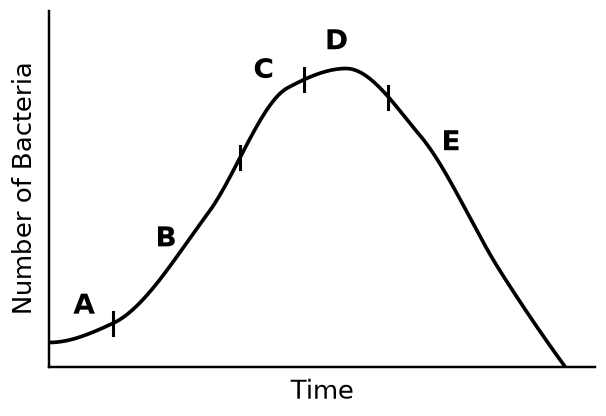
Directions for the following 3 (three) items: Read the passage given below, study the graph that follows and answer the three items given below the figure.
During a party, a person was exposed to contaminated water. A few days later, he developed fever and loose motions. He suffered for some days before going to a doctor for treatment. On starting the treatment, he soon became better and recovered completely a few days later. The following graph shows different phases of the person's disease condition as regions A, B, C, D and E of the curve.
Which region/regions of the curve correspond/corresponds to incubation phase of the infection?
Answer (a) & explanation
A only is correct (a). Step 1: the incubation phase is the quiet time after germs enter the body and before the person falls ill. Step 2: look at the curve. In region A, the bacteria count is low and almost flat: the germs have entered from the contaminated water but are only settling in, and there are no symptoms yet. Step 3: in B the count climbs fast, which means illness has begun, so B is not incubation. So (b), (c) and (d) fail.
Tip: link each part of a disease curve to a stage of the story: exposure and quiet growth, then symptoms, then the peak, then recovery after treatment.
Answer as per the official UPSC answer key.
(Same passage and graph as the question above.)
Which region of the curve indicates that the person began showing the symptoms of infection?
Answer (b) & explanation
B is correct (b). Step 1: symptoms such as fever and loose motions start when the bacteria begin to multiply quickly and the body reacts. Step 2: on the graph, the curve starts climbing fast in region B, right after the flat incubation stretch A. That is where he began to show symptoms. Step 3: A is the quiet incubation phase; C and D are the later stages when he was already ill, before and around the peak. So (a), (c) and (d) fail.
Tip: the start of a steep rise marks the start of trouble. Find where the curve first turns sharply upward.
Answer as per the official UPSC answer key.
(Same passage and graph as the question above.)
Which region of the curve indicates that the treatment yielded effective relief?
Answer (c) & explanation
E is correct (c). Step 1: effective relief means the bacteria count is falling and the person is getting better. Step 2: on the graph, the curve goes down only in region E, after he started treatment. Step 3: in C and D the count is still high or near its peak, so the person is still ill; treatment had not yet worked there. (d) is wrong because the falling part of the curve clearly shows the effect of treatment. So (a), (b) and (d) fail.
Tip: improvement on a germ-count graph always means a falling line. Look for the only part of the curve that heads down.
Answer as per the official UPSC answer key.
There are four routes to travel from city A to city B and six routes from city B to city C. How many routes are possible to travel from the city A to city C?
Answer (a) & explanation
24 routes is correct (a). Step 1: there are 4 routes from A to B. Step 2: for each of those, there are 6 routes from B to C. Step 3: so the total number of A-to-C routes is 4 × 6 = 24. Adding them (4 + 6 = 10) would be wrong, because every first route pairs with every second route. So (b), (c) and (d) fail.
Tip: this is the multiplication rule of counting. When one choice is followed by another, multiply the number of ways. Add only when you choose one path or another, not one then another.
Answer as per the official UPSC answer key.
A contract on construction job specifies a penalty for delay in completion of the work beyond a certain date is as follows: Rs. 200 for the first day, Rs. 250 for the second day, Rs. 300 for the third day etc., the penalty for each succeeding day being Rs. 50 more than that of the preceding day. How much penalty should the contractor pay if he delays the work by 10 days?
Answer (b) & explanation
Rs. 4,250 is correct (b). Step 1: the penalties form a series rising by Rs. 50 each day: 200, 250, 300 and so on. The 10th day's penalty = 200 + 9 × 50 = Rs. 650. Step 2: the total of an evenly rising series = number of days × (first + last) ÷ 2 = 10 × (200 + 650) ÷ 2 = 10 × 425 = Rs. 4,250. Step 3: (d) Rs. 650 is only the last day's penalty, a trap. (a) and (c) come from wrong sums. So (a), (c) and (d) fail.
Tip: for any steady increase, the average of the first and last term, times the number of terms, gives the total. No need to add ten numbers.
Rs. 650 is only the 10th day, not the total.
Answer as per the official UPSC answer key.
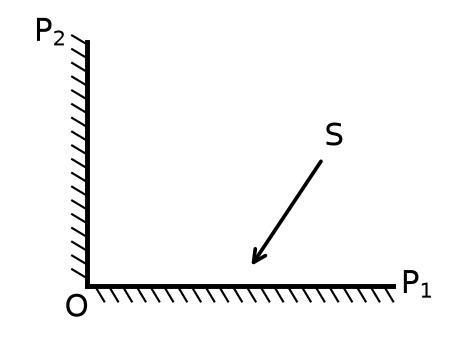
Consider the figure given below and answer the item that follows:
In the figure shown above, OP1 and OP2 are two plane mirrors kept perpendicular to each other. S is the direction of a beam of light falling on the mirror OP1. The direction of the reflected beam of light from the mirror OP2 will be
Answer (c) & explanation
Opposite and parallel to S is correct (c). Step 1: think of the beam as having two parts: an up-down part and a left-right part. Step 2: the first mirror OP₁ reverses one part, and the second mirror OP₂, at 90° to the first, reverses the other part. Step 3: with both parts reversed, the beam goes straight back the way it came, travelling opposite and parallel to S, just shifted sideways. So (a), (b) and (d) fail.
Tip: two mirrors at right angles always send light back parallel to where it came from. This is how corner reflectors on bicycles and the reflectors left on the Moon work.
Answer as per the official UPSC answer key.

Consider the following figure and answer the item that follows:
What is the minimum number of different colours required to paint the figure given above such that no two adjacent regions have the same colour?
Answer (a) & explanation
1. Going out from the centre: centre circle, plain ring, ring cut into 6, plain ring, ring cut into 8.
2. Colour the ring of 6 red, blue, red, blue, red, blue. 6 is even, so the last piece does not touch a piece of its own colour. Do the same for the ring of 8.
3. Each plain ring touches both red and blue pieces, so it needs a third colour, green.
4. The centre circle touches only the green ring next to it, so it can be red.
5. Minimum colours = 3.
Answer as per the official UPSC answer key.
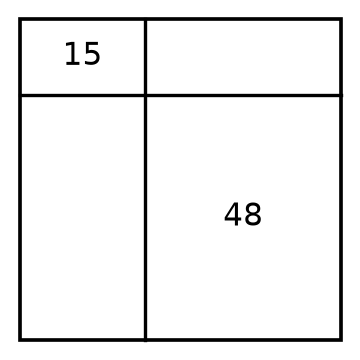
Consider the following figure and answer the item that follows:
A square is divided into four rectangles as shown above. The lengths of the sides of rectangles are natural numbers. The areas of two rectangles are indicated in the figure. What is the length of each side of the square?
Answer (b) & explanation
1. Call the side of the square s. The '15' box is a wide by b tall; the '48' box is then (s − a) wide by (s − b) tall.
2. Whole-number sides for 15: 1 × 15 or 3 × 5.
3. Try 3 and 5 with s = 11: the other box is (11 − 5) × (11 − 3) = 6 × 8 = 48. It fits.
4. Check the other options: s = 10 gives 5 × 7 = 35, not 48; s = 15 gives 10 × 12 = 120 (or 0 if 1 × 15 is used). Neither fits.
5. So each side is 11.
Answer as per the official UPSC answer key.
A person has only Rs. 1 and Rs. 2 coins with her. If the total number of coins that she has is 50 and the amount of money with her is Rs. 75, then the number of Rs. 1 and Rs. 2 coins are, respectively
Answer (d) & explanation
25 and 25 is correct (d). Step 1: suppose all 50 coins were Rs. 1 coins. That gives only Rs. 50. Step 2: she has Rs. 75, which is Rs. 25 more. Each time a Rs. 1 coin is swapped for a Rs. 2 coin, the total rises by Rs. 1. So there must be 25 Rs. 2 coins. Step 3: the rest, 50 − 25 = 25, are Rs. 1 coins. Check: 25 × 1 + 25 × 2 = 75. So (a), (b) and (c) fail.
Tip: the 'assume all are the cheaper kind' trick solves most two-item coin and ticket problems in seconds. Or just test each option quickly.
Answer as per the official UPSC answer key.
Three persons start walking together and their steps measure 40 cm, 42 cm and 45 cm respectively. What is the minimum distance each should walk so that each can cover the same distance in complete steps?
Answer (a) & explanation
25 m 20 cm is correct (a). Step 1: each person must cover the same distance in whole steps, so the distance must be a multiple of 40, 42 and 45. The minimum is their LCM. Step 2: break into primes: 40 = 2³ × 5; 42 = 2 × 3 × 7; 45 = 3² × 5. LCM = 2³ × 3² × 5 × 7 = 2,520 cm. Step 3: 2,520 cm = 25 m 20 cm. The other options are 2, 3 and 4 times this, so they are not the minimum. So (b), (c) and (d) fail.
Tip: 'minimum common distance' or 'first time together' means LCM. Take the highest power of each prime factor.
Answer as per the official UPSC answer key.
If a bus travels 160 km in 4 hours and a train travels 320 km in 5 hours at uniform speeds, then what is the ratio of the distances travelled by them in one hour?
Answer (b) & explanation
5 : 8 is correct (b). Step 1: the bus covers 160 km in 4 hours, so in one hour it covers 160 ÷ 4 = 40 km. Step 2: the train covers 320 km in 5 hours, so in one hour it covers 320 ÷ 5 = 64 km. Step 3: the ratio is 40 : 64. Divide both by 8: 5 : 8. (a) reverses the order, a common trap. So (a), (c) and (d) fail.
Tip: always keep the ratio in the order the question asks (bus first, train second). Reversed answers are always among the options.
Answer as per the official UPSC answer key.
There are 100 students in a particular class. 60% students play cricket, 30% students play football and 10% students play both the games. What is the number of students who play neither cricket nor football?
Answer (b) & explanation
20 students is correct (b). Step 1: 60 play cricket and 30 play football. But the 10 who play both are counted twice. Step 2: students playing at least one game = 60 + 30 − 10 = 80. Step 3: students playing neither = 100 − 80 = 20. So (a), (c) and (d) fail.
Tip: for two overlapping groups, total in either = A + B − both. Drawing two overlapping circles (a Venn diagram) makes this clear at a glance.
Answer as per the official UPSC answer key.
A village having a population of 4000 requires 150 litres of water per head per day. It has a tank measuring 20 m × 15 m × 6 m. The water of this tank will last for
Answer (b) & explanation
3 days is correct (b). Step 1: the tank's volume = 20 × 15 × 6 = 1,800 m³. Since 1 m³ = 1,000 litres, it holds 18,00,000 litres. Step 2: the village needs 4,000 people × 150 litres = 6,00,000 litres every day. Step 3: the water lasts 18,00,000 ÷ 6,00,000 = 3 days. So (a), (c) and (d) fail.
Tip: always convert units before dividing. Remember that 1 cubic metre is 1,000 litres; forgetting this gives answers that are a thousand times too big or too small. Write the units next to each number as you go.
Answer as per the official UPSC answer key.
Read the passage
A species that exerts an influence out of proportion to its abundance in an ecosystem is called a keystone species. The keystone species may influence both the species richness of communities and the flow of energy and materials through ecosystems. The sea star Pisaster ochraceus, which lives in rocky intertidal ecosystems on the Pacific coast of North America, is also an example of a keystone species. Its preferred prey is the mussel Mytilus californianus. In the absence of sea stars, these mussels crowd out other competitors in a broad belt of the intertidal zone. By consuming mussels, sea star creates bare spaces that are taken over by a variety of other species.
A study at the University of Washington demonstrated the influence of Pisaster on species richness by removing sea stars from selected parts of the intertidal zone repeatedly over a period of five years. Two major changes occurred in the areas from which sea stars were removed. First, the lower edge of the mussel bed extended farther down into the intertidal zone, showing that sea stars are able to eliminate mussels completely where they are covered with water most of the time. Second, and more dramatically, 28 species of animals and algae disappeared from the sea star removal zone. Eventually only Mytilus, the dominant competitor, occupied the entire substratum. Through its effect on competitive relationships, predation by Pisaster largely determines which species live in these rocky intertidal ecosystems.
What is the crux of the passage ?
Answer (c) & explanation
Keystone species ensures species diversity is correct (c). Step 1: the passage says a keystone species influences 'species richness'. Step 2: when sea stars were removed, 28 species of animals and algae disappeared, and only the mussel took over. So the keystone predator keeps many species alive: (c). Step 3: (a) is a detail, the sea star's preferred prey. (b) reverses the relation. (d) is wrong: the passage says the sea star is 'also an example', so it is not the only one. So (a), (b) and (d) fail.
Tip: the crux is the general idea that the example proves. Here the sea star story proves the keystone idea.
Answer as per the official UPSC answer key.
Read the passage
A species that exerts an influence out of proportion to its abundance in an ecosystem is called a keystone species. The keystone species may influence both the species richness of communities and the flow of energy and materials through ecosystems. The sea star Pisaster ochraceus, which lives in rocky intertidal ecosystems on the Pacific coast of North America, is also an example of a keystone species. Its preferred prey is the mussel Mytilus californianus. In the absence of sea stars, these mussels crowd out other competitors in a broad belt of the intertidal zone. By consuming mussels, sea star creates bare spaces that are taken over by a variety of other species.
A study at the University of Washington demonstrated the influence of Pisaster on species richness by removing sea stars from selected parts of the intertidal zone repeatedly over a period of five years. Two major changes occurred in the areas from which sea stars were removed. First, the lower edge of the mussel bed extended farther down into the intertidal zone, showing that sea stars are able to eliminate mussels completely where they are covered with water most of the time. Second, and more dramatically, 28 species of animals and algae disappeared from the sea star removal zone. Eventually only Mytilus, the dominant competitor, occupied the entire substratum. Through its effect on competitive relationships, predation by Pisaster largely determines which species live in these rocky intertidal ecosystems.
With reference to the passage, consider the following statements :
- 1. Mussels are generally the dominant species in intertidal ecosystems.
- 2. The survival of sea stars is generally determined by the abundance of mussels.
Which of the statements given above is/are correct ?
Answer (d) & explanation
Neither statement is correct (d). Step 1: statement 1 says mussels are generally dominant. The passage says they crowd out others only 'in the absence of sea stars'. So they are not generally dominant: 1 is wrong. Step 2: statement 2 says sea-star survival depends on mussels. The passage shows the reverse: sea stars control mussels, not mussels controlling sea stars. So 2 is wrong. Step 3: options (a), (b) and (c) fail.
Tip: watch for conditions. 'In the absence of X' cannot become 'generally'. Also check the direction of cause and effect.
Answer as per the official UPSC answer key.
Read the passage
A species that exerts an influence out of proportion to its abundance in an ecosystem is called a keystone species. The keystone species may influence both the species richness of communities and the flow of energy and materials through ecosystems. The sea star Pisaster ochraceus, which lives in rocky intertidal ecosystems on the Pacific coast of North America, is also an example of a keystone species. Its preferred prey is the mussel Mytilus californianus. In the absence of sea stars, these mussels crowd out other competitors in a broad belt of the intertidal zone. By consuming mussels, sea star creates bare spaces that are taken over by a variety of other species.
A study at the University of Washington demonstrated the influence of Pisaster on species richness by removing sea stars from selected parts of the intertidal zone repeatedly over a period of five years. Two major changes occurred in the areas from which sea stars were removed. First, the lower edge of the mussel bed extended farther down into the intertidal zone, showing that sea stars are able to eliminate mussels completely where they are covered with water most of the time. Second, and more dramatically, 28 species of animals and algae disappeared from the sea star removal zone. Eventually only Mytilus, the dominant competitor, occupied the entire substratum. Through its effect on competitive relationships, predation by Pisaster largely determines which species live in these rocky intertidal ecosystems.
Which of the following is/are implied by the passage ?
- 1. Mussels are always hard competitors for sea stars.
- 2. Sea stars of the Pacific coast have reached the climax of their evolution.
- 3. Sea stars constitute an important component in the energy flow in intertidal ecosystem.
Which of the statements given above is/are correct ?
Answer (d) & explanation
Statement 3 only is correct (d). Step 1: the passage says keystone species influence 'the flow of energy and materials through ecosystems', and the sea star is a keystone species. So it is an important part of energy flow: statement 3. Step 2: statement 1 is wrong: mussels are the sea star's prey, not its competitors; mussels compete with other species for space. Step 3: statement 2 is wrong: the passage never discusses evolution or a 'climax'. So (a), (b) and (c) fail.
Tip: check each role carefully. Prey and competitor are different relationships, and options love to swap them.
Answer as per the official UPSC answer key.
Read the passage
A species that exerts an influence out of proportion to its abundance in an ecosystem is called a keystone species. The keystone species may influence both the species richness of communities and the flow of energy and materials through ecosystems. The sea star Pisaster ochraceus, which lives in rocky intertidal ecosystems on the Pacific coast of North America, is also an example of a keystone species. Its preferred prey is the mussel Mytilus californianus. In the absence of sea stars, these mussels crowd out other competitors in a broad belt of the intertidal zone. By consuming mussels, sea star creates bare spaces that are taken over by a variety of other species.
A study at the University of Washington demonstrated the influence of Pisaster on species richness by removing sea stars from selected parts of the intertidal zone repeatedly over a period of five years. Two major changes occurred in the areas from which sea stars were removed. First, the lower edge of the mussel bed extended farther down into the intertidal zone, showing that sea stars are able to eliminate mussels completely where they are covered with water most of the time. Second, and more dramatically, 28 species of animals and algae disappeared from the sea star removal zone. Eventually only Mytilus, the dominant competitor, occupied the entire substratum. Through its effect on competitive relationships, predation by Pisaster largely determines which species live in these rocky intertidal ecosystems.
Consider the following assumptions :
- 1. The food chains/food web in an ecosystem are influenced by keystone species.
- 2. The presence of keystone species is a specific characteristic of aquatic ecosystems.
- 3. If the keystone species is completely removed from an ecosystem, it will lead to the collapse of the ecosystem.
With reference to the passage, which of the above assumptions is/are valid ?
Answer (c) & explanation
Assumptions 1 and 3 are valid per UPSC's key (c). Step 1: the passage says predation by the sea star 'largely determines which species live' there, so keystone species shape the food web: assumption 1. Step 2: when sea stars were removed, 28 species vanished and only mussels remained, a collapse of the community: UPSC accepts assumption 3, though 'collapse of the ecosystem' slightly overstates a single study. Step 3: assumption 2 is wrong: one marine example cannot show that keystone species are found only in aquatic ecosystems. So (a), (b) and (d) fail.
Tip: one example never proves 'specific to' or 'only'. Generalising from a single case is the trap.
Answer as per the official UPSC answer key.
Consider the following argument: "In order to be a teacher one must graduate from college. All poets are poor. Some Mathematicians are poets. No college graduate is poor." Which one of the following is not a valid conclusion regarding the above argument?
Answer (b) & explanation
Option (b) is the conclusion that is not valid. Step 1: chain the facts. Teacher → college graduate → not poor. Poets are poor, so poets are not teachers (d is valid) and teachers are not poor (c is valid). Step 2: some mathematicians are poets, and those poets are not teachers, so some mathematicians are not teachers (a is valid). Step 3: nothing tells us whether any teacher is a mathematician or not. So 'some teachers are not mathematicians' cannot be concluded: (b) is not valid.
Tip: write each statement as an arrow and follow the chain. A conclusion is valid only if every link is given; if a link is missing, it does not follow.
Answer as per the official UPSC answer key.
A student on her first 3 tests received an average score of N points. If she exceeds her previous average score by 20 points on her fourth test, then what is the average score for the first 4 tests?
Answer (d) & explanation
N + 5 is correct (d). Step 1: the first three tests total 3N. Step 2: the fourth score is N + 20. The new total is 3N + N + 20 = 4N + 20. Step 3: the new average = (4N + 20) ÷ 4 = N + 5. In simple words, the extra 20 points are shared over four tests, adding 5 to the average. So (a), (b) and (c) fail.
Tip: when one new value is above the old average, the average rises by (excess ÷ new count). Here 20 ÷ 4 = 5.
Answer as per the official UPSC answer key.
In a group of persons, 70% of the persons are male and 30% of the persons are married. If two-sevenths of the males are married, what fraction of the females is single?
Answer (d) & explanation
2/3 is correct (d). Step 1: take 100 people. Males = 70, females = 30. Married = 30 in total. Step 2: two-sevenths of males are married: 2/7 × 70 = 20 married males. So married females = 30 − 20 = 10. Step 3: single females = 30 − 10 = 20. The fraction of females who are single = 20 ÷ 30 = 2/3. So (a), (b) and (c) fail.
Tip: for percentage puzzles, assume a total of 100. It turns every percentage into a simple number you can add and subtract.
the fraction is of the females, not of the whole group.
Answer as per the official UPSC answer key.
The houses of A and B face each other on a road going north-south, A's being on the western side. A comes out of his house, turns left, travels 5 km, turns right, travels 5 km to the front of D's house. B does exactly the same and reaches the front of C's house. In this context, which one of the following statements is correct?
Answer (c) & explanation
Less than 20 km apart is correct (c). Step 1: A lives on the west side, so he faces east when he comes out. Turning left means going north 5 km; turning right then means going east 5 km. So D's house is 5 km north and 5 km east of A. Step 2: B lives on the east side and faces west. Left means south 5 km; right then means west 5 km. So C's house is 5 km south and 5 km west of B. Step 3: C and D are about 10 km apart north–south and roughly 10 km apart east–west, so the straight distance is about 14 km, well under 20 km. (a) and (b) cannot be fixed from the data. So (a), (b) and (d) fail.
Tip: draw it. Mark which way each person faces first; 'left' depends on that.
Answer as per the official UPSC answer key.
Read the passage
Now India’s children have a right to receive at least eight years of education, the gnawing question is whether it will remain on paper or become a reality. One hardly needs a reminder that this right is different from the others enshrined in the Constitution, that the beneficiary – a six year old child cannot demand it, nor can she or he fight a legal battle when the right is denied or violated. In all cases, it is the adult society which must act on behalf of the child. In another peculiarity, where a child’s right to education is denied, no compensation offered later can be adequate or relevant. This is so because childhood does not last. If a legal battle fought on behalf of a child is eventually won, it may be of little use to the boy or girl because the opportunity missed at school during childhood cannot serve the same purpose later in life. This may be painfully true for girls because our society permits them only a short childhood, if at all. The Right to Education (RTE) has become law at a point in India’s history when the ghastly practice of female infanticide has resurfaced in the form of foeticide. This is “symptomatic of a deeper turmoil” in society which is compounding the traditional obstacles to the education of girls. Tenacious prejudice against the intellectual potential of girls runs across our cultural diversity and the system of education has not been able to address it.
With reference to the passage, consider the following statements :
- 1. When children are denied education, adult society does not act on behalf of them.
- 2. Right to Education as a law cannot be enforced in the country.
Which of the statements given above is/are correct ?
Answer (d) & explanation
Neither statement is correct (d). Step 1: statement 1 says adult society does not act for children. The passage says adult society 'must act on behalf of the child'. That is a duty, not a description of failure, so 1 is wrong. Step 2: statement 2 says RTE cannot be enforced. The passage only asks whether it will 'remain on paper or become a reality'; it worries about implementation, not that enforcement is impossible. So 2 is wrong. Step 3: options (a), (b) and (c) fail.
Tip: 'must' expresses what should happen, not what does happen. Do not turn a duty into a fact, or a worry into an impossibility.
Answer as per the official UPSC answer key.
Read the passage
Now India’s children have a right to receive at least eight years of education, the gnawing question is whether it will remain on paper or become a reality. One hardly needs a reminder that this right is different from the others enshrined in the Constitution, that the beneficiary – a six year old child cannot demand it, nor can she or he fight a legal battle when the right is denied or violated. In all cases, it is the adult society which must act on behalf of the child. In another peculiarity, where a child’s right to education is denied, no compensation offered later can be adequate or relevant. This is so because childhood does not last. If a legal battle fought on behalf of a child is eventually won, it may be of little use to the boy or girl because the opportunity missed at school during childhood cannot serve the same purpose later in life. This may be painfully true for girls because our society permits them only a short childhood, if at all. The Right to Education (RTE) has become law at a point in India’s history when the ghastly practice of female infanticide has resurfaced in the form of foeticide. This is “symptomatic of a deeper turmoil” in society which is compounding the traditional obstacles to the education of girls. Tenacious prejudice against the intellectual potential of girls runs across our cultural diversity and the system of education has not been able to address it.
According to the passage, what could be the traditional obstacles to the education of girls ?
- 1. Inability of parents to fight a legal battle when the Right to Education is denied to their children.
- 2. The traditional way of thinking about girls’ role in society.
- 3. The prejudice against the intellectual potential of girls.
- 4. Improper system of education.
Select the correct answer from the codes given below :
Answer (b) & explanation
Items 2, 3 and 4 are correct (b). Step 1: the passage says society 'permits [girls] only a short childhood', a traditional view of girls' role: item 2. Step 2: it names a 'tenacious prejudice against the intellectual potential of girls': item 3. Step 3: it says 'the system of education has not been able to address it': item 4. Item 1 is wrong: the inability to fight a legal battle is said of all children, not as a traditional obstacle to girls. So (a), (c) and (d) fail.
Tip: check whom each idea is about. The legal-battle point applies to every child, so it is not a girls-specific obstacle.
Answer as per the official UPSC answer key.
Read the passage
Now India’s children have a right to receive at least eight years of education, the gnawing question is whether it will remain on paper or become a reality. One hardly needs a reminder that this right is different from the others enshrined in the Constitution, that the beneficiary – a six year old child cannot demand it, nor can she or he fight a legal battle when the right is denied or violated. In all cases, it is the adult society which must act on behalf of the child. In another peculiarity, where a child’s right to education is denied, no compensation offered later can be adequate or relevant. This is so because childhood does not last. If a legal battle fought on behalf of a child is eventually won, it may be of little use to the boy or girl because the opportunity missed at school during childhood cannot serve the same purpose later in life. This may be painfully true for girls because our society permits them only a short childhood, if at all. The Right to Education (RTE) has become law at a point in India’s history when the ghastly practice of female infanticide has resurfaced in the form of foeticide. This is “symptomatic of a deeper turmoil” in society which is compounding the traditional obstacles to the education of girls. Tenacious prejudice against the intellectual potential of girls runs across our cultural diversity and the system of education has not been able to address it.
On the basis of the passage, consider the following statements :
- 1. Right to Education is a legal right and not a fundamental right.
- 2. For realising the goal of universal education, the education system in the country must be made identical to that of developed countries.
Which of the statements given above is/are correct ?
Answer (d) & explanation
Neither statement is correct (d). Step 1: statement 1 says RTE is only a legal right, not a fundamental one. The passage says this right is 'different from the others enshrined in the Constitution', which treats it as one of the constitutional rights. So 1 is wrong. (In fact, Article 21A, added in 2002, makes it a fundamental right.) Step 2: statement 2 talks about copying developed countries, which the passage never mentions. So 2 is wrong. Step 3: options (a), (b) and (c) fail.
Tip: if the passage never mentions something, a statement built on it cannot be 'on the basis of the passage'. Strike it at once.
Answer as per the official UPSC answer key.
Read the passage
Now India’s children have a right to receive at least eight years of education, the gnawing question is whether it will remain on paper or become a reality. One hardly needs a reminder that this right is different from the others enshrined in the Constitution, that the beneficiary – a six year old child cannot demand it, nor can she or he fight a legal battle when the right is denied or violated. In all cases, it is the adult society which must act on behalf of the child. In another peculiarity, where a child’s right to education is denied, no compensation offered later can be adequate or relevant. This is so because childhood does not last. If a legal battle fought on behalf of a child is eventually won, it may be of little use to the boy or girl because the opportunity missed at school during childhood cannot serve the same purpose later in life. This may be painfully true for girls because our society permits them only a short childhood, if at all. The Right to Education (RTE) has become law at a point in India’s history when the ghastly practice of female infanticide has resurfaced in the form of foeticide. This is “symptomatic of a deeper turmoil” in society which is compounding the traditional obstacles to the education of girls. Tenacious prejudice against the intellectual potential of girls runs across our cultural diversity and the system of education has not been able to address it.
Which one of the following statements conveys the key message of the passage ?
Answer (c) & explanation
Option (c) is the key message. Step 1: the passage says a child cannot demand the right or fight for it, so adults must act. Step 2: it says a lost childhood cannot be compensated later, and that this is 'painfully true for girls', who face foeticide and prejudice. Step 3: all of this adds up to one message: the right to education, especially for girls, must be safeguarded: (c). (a) is only background. (b) is not stated; the passage says adults must act, not that they are unwilling. (d) is vague and misses the girl-child focus.
Tip: the key message ties together all the main points. Here: children cannot defend the right, loss cannot be undone, girls suffer most.
Answer as per the official UPSC answer key.
Read the passage
Now India’s children have a right to receive at least eight years of education, the gnawing question is whether it will remain on paper or become a reality. One hardly needs a reminder that this right is different from the others enshrined in the Constitution, that the beneficiary – a six year old child cannot demand it, nor can she or he fight a legal battle when the right is denied or violated. In all cases, it is the adult society which must act on behalf of the child. In another peculiarity, where a child’s right to education is denied, no compensation offered later can be adequate or relevant. This is so because childhood does not last. If a legal battle fought on behalf of a child is eventually won, it may be of little use to the boy or girl because the opportunity missed at school during childhood cannot serve the same purpose later in life. This may be painfully true for girls because our society permits them only a short childhood, if at all. The Right to Education (RTE) has become law at a point in India’s history when the ghastly practice of female infanticide has resurfaced in the form of foeticide. This is “symptomatic of a deeper turmoil” in society which is compounding the traditional obstacles to the education of girls. Tenacious prejudice against the intellectual potential of girls runs across our cultural diversity and the system of education has not been able to address it.
Which one of the following statements conveys the inference of the passage ?
Answer (d) & explanation
There is no substitute for childhood education is correct (d). Step 1: an inference is something that follows from the passage but is not said word for word. Step 2: the passage says 'no compensation offered later can be adequate', and the missed opportunity 'cannot serve the same purpose later in life'. From this we infer that nothing can replace education missed in childhood: (d). Step 3: (a) is stated directly, so it is not an inference. (b) and (c) go beyond the passage; it never says adults are unreliable or that legal fights are prohibitive. So (a), (b) and (c) fail.
Tip: in inference questions, a statement copied from the passage is usually not the answer. Look for the idea the passage clearly implies.
Answer as per the official UPSC answer key.
Read the following passage and answer the 3 (three) items that follow:
A, B, C, D and E are members of the same family. There are two fathers, two sons, two wives, three males and two females. The teacher was the wife of a lawyer who was the son of a doctor. E is not a male, neither also a wife of a professional. C is the youngest person in the family and D is the eldest. B is a male.
How is D related to E?
Answer (a) & explanation
1. Three generations: doctor → his son the lawyer → the lawyer's child. The eldest, D, is the doctor; the youngest, C, is the grandchild.
2. Two sons means the lawyer and C are both sons, so C is male. With B male, the males are D, the lawyer and C, so the lawyer is B.
3. The two females are then A and E. The teacher is the lawyer's wife, and E is not the wife of a professional, so the teacher is A (B's wife). The other wife, E, is D's wife.
4. So D is E's husband.
The wording "neither also a wife of a professional" is loose; the official answer is (a), as printed.
Answer as per the official UPSC answer key.
(Same information as the question above.)
Who are the females in the group?
Answer (c) & explanation
E and A is correct (c). Step 1: the family has three males and two females, with two fathers, two sons and two wives. Step 2: work out the males. B is male (given). The teacher is the wife of a lawyer, who is the son of a doctor, so there are two professional men, father and son. D is the eldest, so D is the grandfather-doctor; B is his son, the lawyer; and C, the youngest, is B's son. So the males are D, B and C. Step 3: that leaves E and A as the two females. The clue that E is 'not a male' confirms E is one of them. So (a), (b) and (d) fail.
Tip: once you know the males, the rest are females. Solve the clue chain (teacher → lawyer → doctor) first, then use 'eldest' and 'youngest' to place people.
Answer as per the official UPSC answer key.
(Same information as the question above.)
Whose wife is the teacher?
Answer (d) & explanation
B's wife is correct (d). Step 1: the clue says 'The teacher was the wife of a lawyer who was the son of a doctor'. Step 2: from the earlier solution, D is the eldest and the doctor, and B, a male, is his son and the lawyer. Step 3: so the teacher is the wife of B. (a) C is the youngest, a child, not the lawyer. (b) D is the doctor, not the lawyer. (c) A is a female. So (a), (b) and (c) fail.
Tip: in family puzzles, chain the relationship words: teacher → wife of lawyer → lawyer is son of doctor. Each link narrows the field.
Answer as per the official UPSC answer key.
In a survey regarding a proposed measure to be introduced, 2878 persons took part of which 1652 were males. 1226 persons voted against the proposal of which 796 were males. 1425 persons voted for the proposal. 196 females were undecided.
How many females voted for the proposal?
Answer (b) & explanation
600 is correct (b). Step 1: females in the survey = 2,878 − 1,652 = 1,226. Step 2: females who voted against = total against − males against = 1,226 − 796 = 430. Step 3: 196 females were undecided. So females who voted for = 1,226 − 430 − 196 = 600. So (a), (c) and (d) fail.
Tip: build a small table with rows Male/Female and columns For/Against/Undecided. Fill in what is given, and every missing cell comes from simple subtraction.
Answer as per the official UPSC answer key.
(Same information as the question above.)
How many males were undecided?
Answer (a) & explanation
31 is correct (a). Step 1: everyone who was undecided = total − against − for = 2,878 − 1,226 − 1,425 = 227. Step 2: 196 of the undecided were females. Step 3: so undecided males = 227 − 196 = 31. Check with the male row: males for = 1,425 − 600 = 825; 825 + 796 + 31 = 1,652. It matches. So (b), (c) and (d) fail.
Tip: always check your answer with a second route through the table. If the row and column totals agree, you are right.
Answer as per the official UPSC answer key.
(Same information as the question above.)
How many females were not in favour of the proposal?
Answer (a) & explanation
430 is correct (a). Step 1: 'not in favour' here means those who voted against, as UPSC's key takes it. Step 2: females against = total against − males against = 1,226 − 796 = 430. Step 3: if you also added the 196 undecided females, you would get 626, which is not an option, confirming the intended reading. (b), (c) and (d) do not match. So (b), (c) and (d) fail.
Tip: when a phrase is ambiguous ('not in favour' could include undecided), check which reading gives an option. The options often tell you the intended meaning.
Answer as per the official UPSC answer key.
In a queue, Mr. X is fourteenth from the front and Mr. Y is seventeenth from the end, while Mr. Z is exactly in between Mr. X and Mr. Y. If Mr. X is ahead of Mr. Y and there are 48 persons in the queue, how many persons are there between Mr. X and Mr. Z?
Answer (c) & explanation
8 is correct (c). Step 1: Y is 17th from the end in a queue of 48, so Y is 48 − 17 + 1 = 32nd from the front. Step 2: X is 14th. The people between X and Y are in places 15 to 31, which is 17 people. Z is exactly in the middle of them, so Z is in place 15 + 8 = 23rd. Step 3: the people between X (14th) and Z (23rd) are in places 15 to 22, which is 8 people. So (a), (b) and (d) fail.
Tip: convert every position to 'from the front' first, using position from front = total − position from end + 1. Then count gaps carefully.
Answer as per the official UPSC answer key.
Read the passage
He walked several miles that day but could not get anything to eat or drink except some dry bread and some water, which he got from cottagers and farmers. As night fell, he slept under a haystack lying in a meadow. He felt frightened at first, for the wind blew awfully over the empty fields. He felt cold and hungry, and was feeling more lonely than he had ever felt before. He, however, soon fell asleep, being much tired with his long walk. When he got up next day, he was feeling terribly hungry so he purchased a loaf of bread with a few coins that he had.
When the night fell, he slept
Answer (b) & explanation
Under a pile of dry grass is correct (b). Step 1: the passage says 'he slept under a haystack lying in a meadow'. Step 2: a haystack is a large pile of dried grass (hay) stored for animals. So 'under a pile of dry grass' means the same thing: (b). Step 3: (a) is wrong: the meadow is only where the haystack stood, and he was under the haystack, not in the open. (c) is wrong: he got food from cottagers but did not sleep in a cottage. (d) is wrong: no tree is mentioned.
Tip: these questions test vocabulary. Replace the passage's word with its plain meaning, then match the option.
Answer as per the official UPSC answer key.
Read the passage
He walked several miles that day but could not get anything to eat or drink except some dry bread and some water, which he got from cottagers and farmers. As night fell, he slept under a haystack lying in a meadow. He felt frightened at first, for the wind blew awfully over the empty fields. He felt cold and hungry, and was feeling more lonely than he had ever felt before. He, however, soon fell asleep, being much tired with his long walk. When he got up next day, he was feeling terribly hungry so he purchased a loaf of bread with a few coins that he had.
He soon fell asleep because
Answer (a) & explanation
He was exhausted is correct (a). Step 1: the passage says 'He, however, soon fell asleep, being much tired with his long walk'. Being much tired means exhausted: (a). Step 2: (b) and (d) are wrong: being alone and frightened were what he felt at first, and these feelings would have kept him awake, not made him sleep. The word 'however' shows the contrast. Step 3: (c) is wrong: the passage never says he had not slept for days.
Tip: look for 'because', 'being' or 'as' near the event. Here 'being much tired' gives the direct reason.
Answer as per the official UPSC answer key.
Read the passage
He walked several miles that day but could not get anything to eat or drink except some dry bread and some water, which he got from cottagers and farmers. As night fell, he slept under a haystack lying in a meadow. He felt frightened at first, for the wind blew awfully over the empty fields. He felt cold and hungry, and was feeling more lonely than he had ever felt before. He, however, soon fell asleep, being much tired with his long walk. When he got up next day, he was feeling terribly hungry so he purchased a loaf of bread with a few coins that he had.
With reference to the passage, consider the following statements :
- 1. He was walking through the countryside.
- 2. The cottagers and farmers gave him enough food so that he could sleep at night without feeling hungry.
Which of the statements given above is/are correct ?
Answer (a) & explanation
Statement 1 only is correct (a). Step 1: the passage mentions cottagers, farmers, a haystack, a meadow and empty fields. These place him in the countryside: statement 1. Step 2: statement 2 is wrong: he got only 'dry bread and some water', and at night he 'felt cold and hungry'. So he did not get enough food to sleep without hunger. Step 3: options (b), (c) and (d) fail.
Tip: test each statement against a specific line. Statement 2 is directly contradicted by 'felt cold and hungry'.
Answer as per the official UPSC answer key.
Read the passage
I opened the bag and packed the boots in; and then, just as I was going to close it, a horrible idea occurred to me. Had I packed my toothbrush ? I don’t know how it is, but I never do know whether I’ve packed my toothbrush.
My toothbrush is a thing that haunts me when I’m travelling, and makes my life a misery. I dream that I haven’t packed it, and wake up in a cold perspiration, and get out of bed and hunt for it. And, in the morning, I pack it before I have used it, and it is always the last thing I turn out of the bag; and then I repack and forget it, and have to rush upstairs for it at the last moment and carry it to the railway station, wrapped up in my pocket-handkerchief.
When he was going to close the bag, the idea that occurred to him was
Answer (a) & explanation
Unpleasant is correct (a). Step 1: the passage says 'a horrible idea occurred to me': that he might not have packed his toothbrush. Step 2: 'horrible' means very bad or disturbing, which is closest to unpleasant: (a). Step 3: (b) sad is the wrong kind of feeling; he was worried, not sorrowful. (c) fantastic is wrong. (d) amusing is how the reader may find it, since the passage is comic, but the narrator himself did not find it funny.
Tip: answer from the character's point of view, not yours as a reader. The narrator calls it 'horrible', so pick the matching feeling.
Answer as per the official UPSC answer key.
Read the passage
I opened the bag and packed the boots in; and then, just as I was going to close it, a horrible idea occurred to me. Had I packed my toothbrush ? I don’t know how it is, but I never do know whether I’ve packed my toothbrush.
My toothbrush is a thing that haunts me when I’m travelling, and makes my life a misery. I dream that I haven’t packed it, and wake up in a cold perspiration, and get out of bed and hunt for it. And, in the morning, I pack it before I have used it, and it is always the last thing I turn out of the bag; and then I repack and forget it, and have to rush upstairs for it at the last moment and carry it to the railway station, wrapped up in my pocket-handkerchief.
What makes his life miserable whenever he undertakes travelling ?
Answer (b) & explanation
Forgetting the toothbrush is correct (b). Step 1: the passage says 'My toothbrush is a thing that haunts me when I'm travelling, and makes my life a misery'. His fear is about forgetting it. Step 2: so the cause of his misery is the worry of forgetting the toothbrush: (b). Step 3: (a) and (c), going to the station and packing, are where the worry plays out, not the cause. (d) bad dreams are only one symptom of the same worry. So (a), (c) and (d) fail.
Tip: separate the cause from its effects. The dreams and the last-minute rush are effects; the toothbrush worry is the cause.
Answer as per the official UPSC answer key.
Read the passage
I opened the bag and packed the boots in; and then, just as I was going to close it, a horrible idea occurred to me. Had I packed my toothbrush ? I don’t know how it is, but I never do know whether I’ve packed my toothbrush.
My toothbrush is a thing that haunts me when I’m travelling, and makes my life a misery. I dream that I haven’t packed it, and wake up in a cold perspiration, and get out of bed and hunt for it. And, in the morning, I pack it before I have used it, and it is always the last thing I turn out of the bag; and then I repack and forget it, and have to rush upstairs for it at the last moment and carry it to the railway station, wrapped up in my pocket-handkerchief.
His toothbrush is finally
Answer (c) & explanation
In his handkerchief is correct (c). Step 1: follow the toothbrush through the story. He packs it, takes it out last, repacks and forgets it, then rushes upstairs for it. Step 2: finally he carries it 'to the railway station, wrapped up in my pocket-handkerchief'. So it ends up in his handkerchief: (c). Step 3: (a) is wrong: it was taken out of the bag and not put back. (b) is wrong: it was not left in bed. (d) is wrong: it was not lost.
Tip: 'finally' asks for the last position in the sequence. Read to the end of the passage before answering.
Answer as per the official UPSC answer key.
Read the passage
In spring, polar bear mothers emerge from dens with three month old cubs. The mother bear has fasted for as long as eight months but that does not stop the young from demanding full access to her remaining reserves. If there are triplets, the most persistent stands to gain an extra meal and it may have the meal at the expense of others. The smallest of the litter forfeits many meals to stronger siblings. Females are protective of their cubs but tend to ignore family rivalry over food. In 21 years of photographing polar bears, I’ve only once seen the smallest of triplets survive till autumn.
Female polar bears give birth during
Answer (d) & explanation
Winter is correct (d). Step 1: the passage says 'In spring, polar bear mothers emerge from dens with three month old cubs'. Step 2: if the cubs are three months old in spring, they were born about three months earlier, which is winter: (d). Step 3: (a) spring is when they come out of the den, not when they are born. (b) and (c), summer and autumn, do not fit the timeline. So (a), (b) and (c) fail.
Tip: when a passage gives an age at a certain time, count backwards. The emergence date is not the birth date.
Answer as per the official UPSC answer key.
Read the passage
In spring, polar bear mothers emerge from dens with three month old cubs. The mother bear has fasted for as long as eight months but that does not stop the young from demanding full access to her remaining reserves. If there are triplets, the most persistent stands to gain an extra meal and it may have the meal at the expense of others. The smallest of the litter forfeits many meals to stronger siblings. Females are protective of their cubs but tend to ignore family rivalry over food. In 21 years of photographing polar bears, I’ve only once seen the smallest of triplets survive till autumn.
Mother bear
Answer (b) & explanation
Lets the cubs fend for themselves is correct (b). Step 1: the passage says mother bears 'are protective of their cubs but tend to ignore family rivalry over food'. Step 2: so the cubs must compete among themselves for meals: they fend for themselves: (b). Step 3: (a) and (c) are wrong: the strongest cub wins by its own persistence, not because the mother takes sides or picks favourites. (d) is wrong: the smallest cub 'forfeits many meals', so shares are not equal.
Tip: when the passage says 'ignore', the right option shows non-interference. Options that make the mother active are the traps.
Answer as per the official UPSC answer key.
Read the passage
In spring, polar bear mothers emerge from dens with three month old cubs. The mother bear has fasted for as long as eight months but that does not stop the young from demanding full access to her remaining reserves. If there are triplets, the most persistent stands to gain an extra meal and it may have the meal at the expense of others. The smallest of the litter forfeits many meals to stronger siblings. Females are protective of their cubs but tend to ignore family rivalry over food. In 21 years of photographing polar bears, I’ve only once seen the smallest of triplets survive till autumn.
With reference to the passage, the following assumptions have been made :
- 1. Polar bears fast as long as eight months due to non-availability of prey.
- 2. Polar bears always give birth to triplets.
Which of the assumptions given above is/are valid ?
Answer (d) & explanation
Neither assumption is valid (d). Step 1: assumption 1 gives a reason for the eight-month fast: no prey. The passage says the mother 'has fasted for as long as eight months' but never gives the cause. So 1 is not valid. Step 2: assumption 2 says polar bears always give birth to triplets. The passage says 'If there are triplets', which shows that litter sizes vary. So 2 is not valid. Step 3: options (a), (b) and (c) fail.
Tip: 'if' signals a possibility, not a rule, so 'always' fails. And a fact stated without its cause cannot support an assumption about the cause.
Answer as per the official UPSC answer key.
Directions: each item describes a situation and is followed by four possible responses. Indicate the response you find most appropriate. There is no penalty for wrong answers for these items. You have been asked to give an explanation for not attending an important official meeting. Your immediate boss who has not informed you about the meeting is now putting pressure on you not to place an allegation against him/her. You would
Answer (a) & explanation
UPSC's key lists two responses (a) and (b), and these items carried no negative marking. Step 1: the boss did not inform you, and now pressures you to hide this. Step 2: (a) sending a written reply that states the facts, and (b) explaining the situation to the top boss in person, both keep to the truth without making accusations beyond the facts. Step 3: (c) is wrong: admitting a fault that is not yours is dishonest. (d) is wrong: blaming the coordinator shifts responsibility unfairly.
Tip: for these interpersonal items, pick the response that is lawful, honest and keeps the public work going. Avoid options that give in to pressure, pass the buck or abandon duty.
Answer as per the official UPSC answer key.
A local thug (bad element) has started illegal construction on your vacant plot. He has refused your request to vacate and threatened you of dire consequences in case you do not sell the property at a cheap price to him. You would
Answer (b) & explanation
UPSC's key lists (b) and (d), with no negative marking; (b) is the best response. Step 1: a thug is building illegally on your plot and threatening you. Step 2: going to the police (b) is the lawful and safe course; the police must act against encroachment and criminal intimidation. Step 3: (a) selling cheap gives in to the threat and rewards crime. (c) neighbours may help but cannot enforce the law. (d) negotiating a higher price, also in the key, avoids conflict but still yields to an illegal demand, so (b) is the safer answer to mark.
Tip: for these interpersonal items, pick the response that is lawful, honest and keeps the public work going. Avoid options that give in to pressure, pass the buck or abandon duty.
Answer as per the official UPSC answer key.
You have to accomplish a very important task for your Headquarters within the next two days. Suddenly you meet with an accident. Your office insists that you complete the task. You would
Answer (a) & explanation
UPSC's key lists (a) and (c), with no negative marking. Step 1: you are injured, but the task for Headquarters is important. Step 2: (a) asking for an extension keeps you responsible for the task with a realistic timeline, and (c) suggesting an alternate person ensures the work gets done on time. Both keep the task alive. Step 3: (b) only reports inability without a solution. (d) staying away abandons the task and leaves Headquarters stranded.
Tip: for these interpersonal items, pick the response that is lawful, honest and keeps the public work going. Avoid options that give in to pressure, pass the buck or abandon duty.
Answer as per the official UPSC answer key.
You are an officer in-charge for providing basic medical facilities to the survivors of an earthquake affected area. Despite your best possible effort, people put allegations against you for making money out of the funds given for relief. You would
Answer (a) & explanation
UPSC's key lists (a) and (c), with no negative marking; (a) is the best response. Step 1: you are working hard on earthquake relief, but people allege you are misusing funds. Step 2: (a) letting an enquiry be set up shows transparency and clears your name through a fair process. (c) not being distracted lets the relief work continue for survivors. Step 3: (b) asking to be replaced and (d) stopping work both hurt the survivors who need help now.
Tip: for these interpersonal items, pick the response that is lawful, honest and keeps the public work going. Avoid options that give in to pressure, pass the buck or abandon duty.
Answer as per the official UPSC answer key.
You have been made responsible to hire boats at a short notice to be used for an area under flood. On seeing the price mentioned by the boat owners you found that the lowest price was approximately three times more than the approved rate of the Government. You would
Answer (b) & explanation
UPSC's key lists (b) and (d), with no negative marking. Step 1: a flood is an emergency, and boats are needed now, but the lowest price is about three times the approved rate. Step 2: (b) accepting the lowest price saves lives without delay; emergency rules allow this with proper recording. (d) warning owners that exploiting a disaster may cost them their licence can bring the price down quickly. Step 3: (a) a fresh call for prices and (c) waiting for Government approval both lose precious time while people are stranded.
Tip: for these interpersonal items, pick the response that is lawful, honest and keeps the public work going. Avoid options that give in to pressure, pass the buck or abandon duty.
Answer as per the official UPSC answer key.
You are the officer-in-charge of a village administering distribution of vaccine in an isolated epidemic hit village, and you are left with only one vaccine. There is a requirement of that vaccine from the Gram Pradhan and also a poor villager. You are being pressurised by the Gram Pradhan to issue the vaccine to him. You would
Answer (b) & explanation
UPSC's key lists (b) and (d), with no negative marking. Step 1: there is only one vaccine, two people need it, and the Gram Pradhan is using pressure. Step 2: (b) and (d) both arrange a second dose from another area's distributor, so both people get vaccinated. Option (b), arranging for the poor villager from outside while the local dose goes by need, resists undue pressure. Step 3: (a) leaves both unprotected during an epidemic. (c) delays care and passes the decision to someone else.
Tip: for these interpersonal items, pick the response that is lawful, honest and keeps the public work going. Avoid options that give in to pressure, pass the buck or abandon duty.
Answer as per the official UPSC answer key.
You have taken up a project to create night shelters for homeless people during the winter season. Within a week of establishing the shelters, you have received complaints from the residents of the area about the increase in theft cases with a demand to remove the shelters. You would
Answer (b) & explanation
UPSC's key lists (b) and (c), with no negative marking. Step 1: residents complain about thefts and want the night shelters removed. Step 2: (b) assuring an enquiry takes their complaint seriously, and (c) asking them to consider the humanitarian purpose explains why the shelters matter for homeless people in winter. Both keep the shelters running while addressing concerns. Step 3: (d) ignoring the complaint damages trust. (a) only redirects residents to the police without any action of your own.
Tip: for these interpersonal items, pick the response that is lawful, honest and keeps the public work going. Avoid options that give in to pressure, pass the buck or abandon duty.
Answer as per the official UPSC answer key.
You, as an administrative authority, have been approached, by the daughter-in-law of an influential person regarding harassment by her in-laws on account of insufficient dowry. Her parents are not able to approach you because of social pressures. You would
Answer (a) & explanation
UPSC's key lists (a) and (d), with no negative marking. Step 1: a woman reports dowry harassment by influential in-laws. Dowry demands are crimes under the Dowry Prohibition Act and Section 85 of the Bharatiya Nyaya Sanhita (formerly 498A IPC). Step 2: (a) calling the in-laws for an explanation acts at once, and (d) helping her lodge a police complaint starts legal protection. Step 3: (b) telling her to adjust leaves her in danger. (c) waiting for her parents ignores her own complaint; she is an adult entitled to act.
Tip: for these interpersonal items, pick the response that is lawful, honest and keeps the public work going. Avoid options that give in to pressure, pass the buck or abandon duty.
Answer as per the official UPSC answer key.
All years by topic
Every question from 2011 to 2026, grouped by syllabus topic, with year-wise trends.