
Sufi Movement in India: Silsilas, Key Ideas, Major Saints and the Link with Bhakti (UPSC Notes + PYQs)
UPSC has already asked about this. Read the story with these questions in mind.
Background: mysticism within Islam
Sufism is the mystical tradition within Islam. It arose in the early centuries of Islam among believers who reacted against the worldliness of courts and the dry legalism of some theologians, and sought a direct, loving experience of God. The word is often traced to suf, the coarse wool worn by early ascetics. Sufis organised themselves around a teacher, the pir or shaikh, and his disciples, the murids, in hospices called khanqahs. Over time these lineages formed orders called silsilas, each tracing its spiritual chain back to the Prophet. Sufis reached India from the eleventh century, with Al-Hujwiri settling in Lahore; his Kashf-ul-Mahjub is one of the oldest Persian works on Sufism.
Core ideas and words
- Pir/shaikh and murid: master and disciple.
- Khanqah: hospice; langar: open kitchen.
- Sama: devotional music; qawwali grew from it.
- Wahdat-al-wujud (unity of being), linked to Ibn Arabi, versus Sirhindi’s wahdat-al-shuhud (unity of appearance).
- Urs: death anniversary of a saint, a “wedding” with God.
- 1Pir or shaikh, the spiritual master
- 2Murids, disciples bound by bayt (oath)
- 3Khalifa, chosen successor
- 4Khanqah, hospice and centre
- 5Dargah and urs after the saint's death
The main silsilas
| Order | Founder in India | Character |
|---|---|---|
| Chishti | Moinuddin Chishti (Ajmer) | Kept away from the court, simple life, sama; Nizamuddin Auliya in Delhi |
| Suhrawardi | Bahauddin Zakariya (Multan) | Accepted state posts and grants |
| Naqshbandi | Khwaja Baqi Billah | Orthodox; Shaikh Ahmad Sirhindi opposed Akbar’s ideas |
| Qadiri | Shah Niamatullah, Miyan Mir | Dara Shikoh was a follower |
| Firdausi, Shattari, Rishi | Bihar; north India; Kashmir (Nuruddin Rishi) | Regional orders |
Saints to remember
Moinuddin Chishti (d. 1236, Ajmer), Qutbuddin Bakhtiyar Kaki (Delhi), Baba Farid (Pakpattan; verses in the Guru Granth Sahib), Nizamuddin Auliya (Delhi; “Dilli dur ast”), Amir Khusrau (his disciple), Nasiruddin Chiragh-i-Delhi, Salim Chishti (Fatehpur Sikri), and Gesu Daraz in Gulbarga.
- ChishtiMuinuddin, Nizamuddin, Nasiruddin
- SuhrawardiBahauddin Zakariya, Multan
- QadiriMian Mir; Dara Shukoh
- NaqshbandiAhmad Sirhindi; orthodox
Chishti and Suhrawardi compared
| Point | Chishti | Suhrawardi |
|---|---|---|
| Founder in India | Khwaja Muinuddin Chishti (Ajmer) | Shaikh Bahauddin Zakariya (Multan) |
| Attitude to state | Kept away from courts and grants | Accepted royal patronage and posts |
| Wealth | Lived in poverty | Accepted wealth for welfare |
| Music | Sama and qawwali central | More restrained |
| Region | Delhi, Ajmer, Deccan | Punjab, Sindh, Bengal |
Impact
Sufis spoke the local language, cared for the poor, and drew followers across caste and creed. They shaped Hindavi and Urdu, Hindustani music, and the shared shrine culture still seen at Ajmer and Nizamuddin. Their ideas of devotion and equality ran parallel to Kabir and Nanak; Kabir’s verses and Baba Farid’s shlokas show the overlap.
Sufi practices
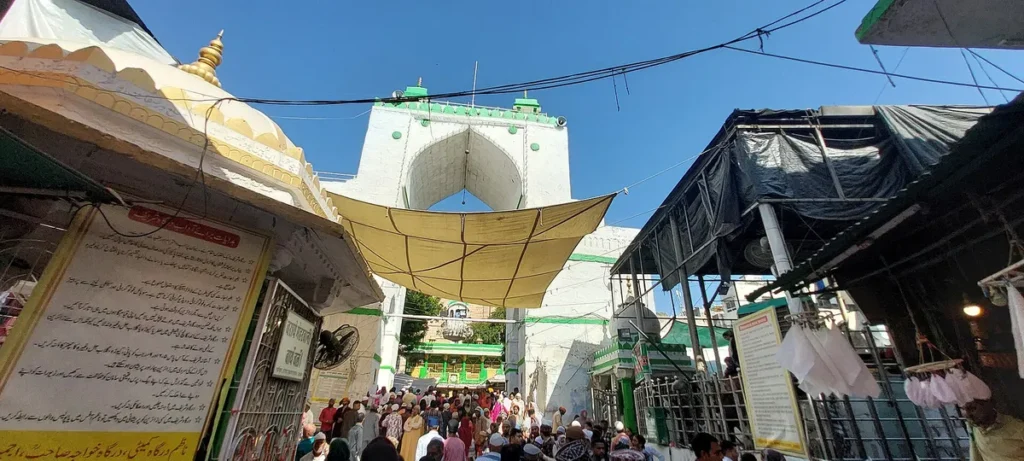
Sufi life centred on the khanqah, where the pir taught, disciples served and travellers were fed in the langar, the common kitchen. Zikr, the repeated remembrance of God’s names, and sama, listening to music and poetry to induce ecstasy, were key practices of some orders. The tomb of a saint, the dargah, became a place of pilgrimage, and the death anniversary, the urs, symbolised the saint’s union with God. Pilgrims of all faiths visited dargahs such as Ajmer and Nizamuddin, seeking blessings, or barakat. Akbar walked to Ajmer several times. Sufi poets used local languages: Amir Khusrau wrote in Persian and Hindavi, Baba Farid in Punjabi, and later poets in Sindhi, Kashmiri and Deccani, making mystical ideas accessible to ordinary people.
Sufi and Bhakti movements compared
| Point | Sufi | Bhakti |
|---|---|---|
| Religious base | Islam | Hinduism |
| Path | Love of God through a pir | Devotion to a personal or formless God through a guru |
| Institution | Khanqah, dargah, silsila | Mathas, sants and panths |
| Language | Persian and regional languages | Regional languages |
| Common ground | Rejection of ritualism and hierarchy, music and poetry, inner devotion, appeal to the poor | |
The meeting of these traditions shaped figures such as Kabir and Guru Nanak and gave north India a shared vocabulary of devotion that cut across religious lines.
Sufism in the Deccan and Kashmir
Sufism spread beyond Delhi. In the Deccan, Chishti saints such as Gesu Daraz settled at Gulbarga in the fourteenth century, and Deccani Sufi writings contributed to the growth of Dakhani Urdu. In Kashmir, the Rishi order of Nund Rishi (Shaikh Nuruddin) blended Sufi ideas with local traditions and the teachings of the woman mystic Lal Ded, producing a distinctive culture of tolerance. In Bengal, Sufis helped clear forests and settle agriculture, which some historians link to the spread of Islam among peasants there.
Chishti saints in sequence
| Saint | Centre | Remembered for |
|---|---|---|
| Khwaja Muinuddin Chishti | Ajmer | Founded the order in India; Gharib Nawaz |
| Qutbuddin Bakhtiyar Kaki | Delhi | Respected by Iltutmish; Qutb Minar named after him by tradition |
| Fariduddin Ganj-i-Shakar (Baba Farid) | Ajodhan (Pakpattan) | Punjabi verses |
| Nizamuddin Auliya | Delhi | Mass following; teacher of Amir Khusrau |
| Nasiruddin Chiragh-i-Delhi | Delhi | Last great Chishti of Delhi |
| Salim Chishti | Fatehpur Sikri | Blessed Akbar with a son, Jahangir (Salim) |
Impact on Indian society
Sufis helped make Islam a religion of the people in India rather than only of rulers. Their khanqahs welcomed all, fed the poor and offered a message of love and equality that appealed to artisans and peasants. They contributed to Indian music through qawwali and ragas adapted by Amir Khusrau, to literature in Hindavi, Punjabi and Deccani, and to a culture of shared pilgrimage that continues at dargahs today. At the same time, the relation with power varied: some Sufis kept away from courts, others served the state, and orthodox orders such as the Naqshbandis pressed for a stricter religious line. A balanced answer notes this diversity rather than treating Sufism as one uniform movement.
Key terms to remember
| Term | Meaning |
|---|---|
| Khanqah | Hospice where the pir lived and taught |
| Wali | Friend of God; a saint |
| Fana | Annihilation of the self in God |
| Wahdat-ul-Wujud | Unity of Being, idea of Ibn Arabi |
| Wahdat-ul-Shuhud | Unity of Appearance, Ahmad Sirhindi’s reply |
| Futuh | Unasked-for gifts on which Chishtis lived |
| Wilayat | Spiritual territory of a saint |
The debate between Wahdat-ul-Wujud and Wahdat-ul-Shuhud is a favourite for Prelims and for Mains questions on religious thought in the Mughal age. The first, popular among Chishtis, saw all creation as a manifestation of one divine reality, which made it easier to accept other faiths. The second, put forward by the Naqshbandi Ahmad Sirhindi, held that creation only reflects God and is not identical with Him, which supported a stricter separation of Islam from other traditions.
Sufism today remains a living tradition. Urs festivals at Ajmer, Nizamuddin and Gulbarga draw pilgrims of all faiths, and qawwali has become part of India’s popular culture. For essays and ethics answers, Sufi teachings on compassion, service to the poor and humility offer useful examples of tolerance drawn from India’s own past. Nizamuddin Auliya’s saying that the highest form of devotion is to relieve the misery of the distressed, feed the hungry and help the helpless is often quoted, and it shows why the Sufi message found such a wide audience among ordinary people, whatever their faith, caste or station in life.
Sufi Movement: UPSC angle
For UPSC CSE
Prelims: silsila and founder pairs, terms (khanqah, sama, wahdat-al-wujud), saint and place. Mains GS-I: Bhakti and Sufi movements and composite culture.
Sufi Movement UPSC PYQs (Prelims)
Questions UPSC has actually asked, from the official papers. Pick an option to check yourself.
With reference to the religious history of medieval India, the Sufi mystics were known to pursue which of the following practices?
– 1. Meditation and control of breath
– 2. Severe ascetic exercises in a lonely place
– 3. Recitation of holy songs to arouse a state of ecstasy in their audience
Select the correct answer using the codes given below :
Sufis practised zikr (repeating God’s name with breath control), chilla (40 days of lonely austerity) and sama (devotional music like qawwali to reach a state of ecstasy). All three are correct. Answer as per the official UPSC key · Battle IAS PYQ bankAnswer (d) & why
Mains PYQs on this topic
No UPSC Mains question from 2023-2026 is directly on this topic. Older papers (2013-2022) will be added as the Mains bank grows.
Quick quiz
The Chishti order in India was founded by
At Ajmer.Answer (b)
Which order was known for accepting royal patronage?
Multan centred.Answer (b)
Shaikh Ahmad Sirhindi belonged to the
He opposed Akbar’s religious ideas.Answer (b)
FAQs
What is a silsila?
A chain of spiritual succession from master to disciple, forming a Sufi order.
What is sama?
Devotional music and recitation used by orders such as the Chishtis to reach spiritual ecstasy.
Whose verses are in the Guru Granth Sahib?
Baba Farid’s, among others including Kabir and Ravidas.
Which Mughal prince followed the Qadiri order?
Dara Shikoh.
Who was called the Chiragh-i-Delhi?
Shaikh Nasiruddin, the successor of Nizamuddin Auliya.
What is a dargah?
The tomb-shrine of a Sufi saint, which became a centre of pilgrimage for people of many faiths.
Which order was linked to Ahmad Sirhindi?
The Naqshbandi order, which took an orthodox stand and opposed Akbar’s religious policies.
Spotted an error? Tell us. We correct within 48 hours.
Image: Pinakpani, Wikimedia Commons, CC BY 4.0
How to use this in Mains
If asked: Discuss the contribution of the Sufi movement to Indian society and culture. (GS-I)
Quote: “Sufis helped make Islam a religion of the people in India rather than only of rulers.”
Use it: A crisp concluding line on Sufi impact.
In the news

Pollen study links Harappan decline to weak monsoon (5100–4000 BP)
A pollen study by the Birbal Sahni Institute of Palaeosciences links the shrinking of the Harappan Civilization to a weak Indian Summer Monsoon between about 5100 and 4000 years before present, the Science Ministry said on 29 July 2026. Sediments from Deoria Tal in the Garhwal Himalaya show an abrupt dry spell, the "4.2 ka event".
29 Jul 2026
Sarnath inscribed as India’s 45th UNESCO World Heritage Site
On 25 July 2026 the 48th World Heritage Committee in Busan inscribed the "Ancient Buddhist Site of Sarnath" on the UNESCO World Heritage List. It is India's 45th property. The serial site in Varanasi covers Chaukhandi Stupa and the Archaeological Remains of Sarnath, where the Buddha gave his first sermon.
25 Jul 2026
Rakhigarhi skeletal remains handed to Anthropological Survey of India
ASI handed human skeletal remains from Rakhigarhi, Haryana, to the Anthropological Survey of India under a new MoU, the Culture Ministry said on 22 June 2026. The 2025-26 dig at Mound No. 7 found eight burials; three complete skeletons plus fragments went to AnSI's Kolkata repository. Planned work includes aDNA, isotopes and palaeopathology with partner labs.
22 Jun 2026
Relics of the Buddha’s chief disciples enshrined for exposition in Mongolia
The holy relics of Arhat Sariputra and Arhat Mahamoggallana, the Buddha's two chief disciples, were ceremonially enshrined at Gandantegchenling Monastery in Ulaanbaatar on Buddha Purnima (Vesak) 2026. Brought from India for a ten-day exposition from 31 May to 10 June 2026, they arrived on a special IAF IL-76 aircraft and had travelled abroad only once before, to Thailand in 2024.
31 May 2026