
UP farm fires halve: 134 stubble-burning cases till 15 October against 271 last year
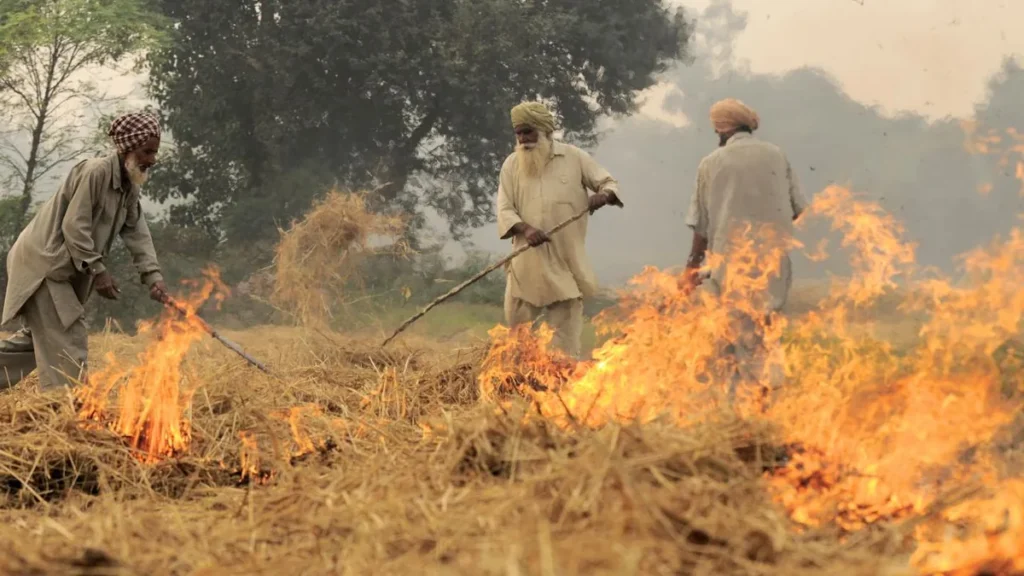
Satellite data from IARI show 134 paddy stubble-burning incidents in Uttar Pradesh between 15 September and 15 October 2026, down from 271 in the same period last year. Nationally the count rose to 793 from 724, led by Madhya Pradesh. The fall in UP is welcome, but part of it comes from a harvest delayed by September rains and floods. The real test comes after Diwali on 8 November, when harvesting peaks and the gap before wheat sowing is short.
- UP fires
- 134 (271 last year)
- Period
- 15 Sep – 15 Oct 2026
- India total
- 793 (724)
- Data
- IARI CREAMS
UP stubble burning: what happened?
Every October, a farmer in western or central UP faces the same sum. The paddy is cut, the field must be ready for wheat in two or three weeks, and clearing the straw by hand or machine costs money. A matchstick costs nothing. That is why each fire counted from space tells us something about policy on the ground.
- IARI’s Consortium for Research on Agroecosystem Monitoring and Modeling from Space (CREAMS), which tracks residue burning daily till 30 November, counted 134 incidents in UP from 15 September to 15 October 2026, against 271 a year earlier (BusinessLine).
- Across India the count was 793 against 724. Madhya Pradesh led with 350 (138 last year); Punjab had 185 (176); Rajasthan 99 (75); Haryana 8 (25); Uttarakhand 16 (36).
- Paddy harvest in parts of UP is late this year because of September rains and floods, so experts warn against reading too much into a year-on-year comparison.
- 13 Oct 2026: the Union Agriculture and Environment Ministers told States that even those with fewer fires must not relax, as much of the harvest is still pending.
Why do farmers burn stubble?
- Combine harvesters leave tall paddy stalks. Clearing them costs labour or machinery, and the window before wheat sowing in early November is tight.
- Long-duration paddy varieties such as Pusa-44 shrink that window further. The Centre is pushing short-duration varieties like Pusa 2090 and PR126.
- The smoke adds to PM2.5 over the Indo-Gangetic plain just as winter inversion traps pollutants near the ground.
- Burning also kills soil micro-organisms and destroys nutrients that the straw would return to the soil.
How does UP compare with other States?
| State | 15 Sep–15 Oct 2026 | Same period 2025 |
|---|---|---|
| Madhya Pradesh | 350 | 138 |
| Punjab | 185 | 176 |
| Uttar Pradesh | 134 | 271 |
| Rajasthan | 99 | 75 |
| Uttarakhand | 16 | 36 |
| Haryana | 8 | 25 |
Which constitutional and legal provisions apply?
- Article 21 (right to life, read to include a clean environment), Article 48A (DPSP) and Article 51A(g) (Fundamental Duty).
- State List Entry 14: agriculture is a State subject, so UP runs field enforcement and farmer support.
- Commission for Air Quality Management in NCR and Adjoining Areas Act, 2021: CAQM can issue binding directions in NCR and adjoining areas, which include UP’s NCR districts. Farmers who burn stubble pay environmental compensation; they are not jailed.
- Air (Prevention and Control of Pollution) Act, 1981: the general law on air pollution, enforced by the UP Pollution Control Board.
How is crop residue managed?
Three ways to handle paddy straw
- In-situ: mix straw into soil with Happy Seeder, Super Seeder or mulchers
- Bio-decomposer: spray microbial solution so straw rots in the field
- Ex-situ: bale straw for biomass power, biogas, ethanol or fodder
- Monitor: satellite counts by CREAMS; checks by district teams
- Penalise: environmental compensation for burning
Which numbers should you remember?
| Number | What it means |
|---|---|
| 134 vs 271 | UP fire count, 15 Sep–15 Oct, 2026 vs 2025 |
| 3.54 lakh+ | Crop residue management machines given to States, incl. 26,109 new this year |
| ₹430.87 crore | Released of ₹592.57 crore allocated under the CRM scheme, 2026–27 |
| 8 Nov 2026 | Diwali; harvest and burning usually peak after it |
The counts are satellite detections of active fires. Clouds, small fires and late-afternoon burning can be missed, so treat them as a trend, not a full census.
Why does this matter for UPPCS?
| Angle | What to note |
|---|---|
| Agriculture | Paddy–wheat cycle and the short sowing window in UP. |
| Environment | PM2.5, winter smog in NCR and the Indo-Gangetic plain. |
| Governance | CAQM, UP Pollution Control Board and district administration. |
| Economy | Straw as fuel for biomass, biogas and compressed biogas plants. |
What are the challenges?
- This year’s drop may partly reflect a late harvest, not a change in behaviour.
- Small and marginal farmers, who dominate UP, struggle to hire machines at the right time.
- Ex-situ use needs buyers close by; without them, baled straw has no market.
- Satellite counts can miss small or evening fires, which can hide the true picture.
What should be done next?
- Keep vigilance high through November, when most of UP’s paddy is cut.
- Run custom hiring centres so small farmers get machines on time and at low rent.
- Link straw to compressed biogas, ethanol and biomass plants in UP’s sugar and paddy belts.
- Shift to short-duration paddy varieties to widen the gap before wheat sowing.
What can Prelims ask on stubble burning?
- CREAMS: IARI’s satellite-based residue-burning monitoring, daily from 15 September to 30 November.
- UP: 134 incidents (15 Sep–15 Oct 2026) vs 271 a year earlier.
- Highest in 2026 so far: Madhya Pradesh (350).
- CAQM was set up under a 2021 Act for NCR and adjoining areas.
- In-situ machines: Happy Seeder, Super Seeder, mulcher; bio-decomposer by IARI.
- Short-duration paddy: Pusa 2090, PR126; long-duration: Pusa-44.
How to write about stubble burning in Mains
Practice question (UPPCS, 8 marks, 125 words): Why does stubble burning persist in north India despite many schemes? Suggest measures with reference to Uttar Pradesh.
- Intro: UP fires down to 134 (15 Sep–15 Oct 2026) from 271; national total up.
- Causes: short sowing window, machine cost, long-duration varieties.
- Measures so far: CRM machines, bio-decomposer, CAQM, compensation.
- Way forward: custom hiring, straw markets, short-duration paddy.
- Conclusion: make the straw worth more than the matchstick.
Image: Neil Palmer (CIAT), Wikimedia Commons, CC BY-SA 2.0
Read all of October 2026 in the monthly UP current affairs compilation →
How to use this in Mains
If asked: Examine the causes of stubble burning in Uttar Pradesh and suggest a sustainable solution. (UPPCS GS-VI)
Quote: “Paddy harvest is delayed this year in some parts of Uttar Pradesh due to rains received in September and also subsequent floods.”
Use it: Use this to add nuance: lower fire counts do not prove the problem is solved. Examiners like answers that read data with care.
If asked: Discuss the role of technology in tackling crop residue burning. (GS-III)
Quote: “The Centre has so far provided states with more than 3.54 lakh crop residue management machines, including 26,109 new machines during current fiscal.”
Use it: Put it in your ‘measures taken’ paragraph, then argue that access for small farmers matters more than the total number of machines.
Exam angle
GS-VI: UP agriculture and environment; crop residue management; CAQM and UP Pollution Control Board.
Practice MCQs
Original practice questions (not PYQs).
With reference to stubble burning data for 15 September to 15 October 2026, consider the following statements:
1. Uttar Pradesh reported fewer incidents than in the same period of 2025.
2. Punjab reported the highest number of incidents in the country.
Which of the statements given above is/are correct?
Answer (a) & explanation
UP: 134 vs 271. Madhya Pradesh (350), not Punjab (185), had the most incidents (IARI CREAMS via BusinessLine).
CREAMS, which monitors crop residue burning in India using satellites, is run by
Answer (c) & explanation
CREAMS is IARI’s Consortium for Research on Agroecosystem Monitoring and Modeling from Space.
Which of the following is an in-situ method of managing paddy straw?
Answer (b) & explanation
In-situ means managing the straw in the field itself; the other options remove the straw (ex-situ).
Questions students ask about this
How many stubble fires did UP report this season so far?
134 between 15 September and 15 October 2026, against 271 a year earlier.
Is the fall a sure sign of success?
Not yet. Harvest is late in parts of UP because of September rains and floods, and burning usually peaks after Diwali.
Which State has the most fires now?
Madhya Pradesh, with 350 incidents.
Who counts the fires?
IARI’s CREAMS, using satellite data, every day from 15 September to 30 November.
Keep studying
Go deeper
Official source: PIB, 17 Oct 2026: CAQM reviews paddy stubble management measures in Firozpur and Faridkot
facts from cited sources only; cross-checked; faculty review pending