
Writs in the Indian Constitution: Habeas Corpus, Mandamus, Prohibition, Certiorari, Quo Warranto (UPSC Notes + PYQs)
UPSC has already asked about this. Read the story with these questions in mind.
Background: from English prerogative writs
Writs began in medieval England as orders issued in the King’s name, and the “prerogative writs” became a way for courts to keep officials within the law. In British India, the Supreme Courts at the presidency towns (Calcutta, Madras, Bombay) and later the chartered High Courts could issue some of them, but only within limited territory. The Constitution made these remedies nationwide and tied them to Fundamental Rights. Article 32 lets a person go straight to the Supreme Court, and Ambedkar called it “the very soul of the Constitution and the very heart of it”.
Why writs matter
Ambedkar called Article 32 the “heart and soul” of the Constitution. A right without a remedy is only a promise; writs are the remedy. They came from English common law, where the King’s courts used “prerogative writs” to keep officials within the law.
The five writs at a glance
| Writ | Literal meaning | What it does | Against whom |
|---|---|---|---|
| Habeas corpus | “You may have the body” | Orders a detained person to be produced; frees if detention is illegal | Public authorities and private persons |
| Mandamus | “We command” | Orders a public official or body to perform a public duty | Not against the President/Governor, a private person (without public duty), or a Chief Justice acting judicially |
| Prohibition | “To forbid” | Stops a lower court or tribunal from exceeding jurisdiction while a case is pending | Judicial and quasi-judicial bodies only |
| Certiorari | “To be certified” | Quashes an order already passed without jurisdiction or with error of law | Judicial and quasi-judicial bodies; since 1991 also administrative bodies affecting rights |
| Quo warranto | “By what authority” | Asks a person to show the right to hold a public office | Holders of substantive public offices created by statute or the Constitution |
- Habeas corpusProduce the detained person
- MandamusPerform a public duty
- ProhibitionStop excess of jurisdiction
- CertiorariQuash an order already passed
- Quo warrantoChallenge right to public office
Article 32 vs Article 226
| Point | Article 32 (Supreme Court) | Article 226 (High Courts) |
|---|---|---|
| Scope | Only Fundamental Rights | Fundamental Rights and “for any other purpose” |
| Nature | Itself a Fundamental Right | A constitutional, discretionary power |
| Territory | All of India | Within the State, or where the cause of action arose |
| Suspension | Can be suspended during a national emergency (Article 359) | Same restriction on enforcing suspended rights |
So the High Court’s writ jurisdiction is wider. In L. Chandra Kumar (1997) the Supreme Court held that judicial review under Articles 32 and 226 is part of the basic structure.
- Only for Fundamental Rights
- Itself a Fundamental Right
- Court cannot refuse in principle
- Whole of India
- Fundamental Rights and other legal rights
- Constitutional, not fundamental, right
- Discretionary
- Territorial jurisdiction of the High Court
Locus standi and PIL
Normally only the aggrieved person can seek a writ. Habeas corpus and quo warranto are exceptions: anyone may apply. Public Interest Litigation from the 1980s (S.P. Gupta, 1981; Bandhua Mukti Morcha, 1984) relaxed standing further, so letters from prisoners or journalists were treated as petitions.
Traps examiners like
- Prohibition is preventive (case pending); certiorari is corrective (order already passed).
- Mandamus does not lie against a private company unless it performs a public duty (Praga Tools, 1966).
- Parliament can empower other courts to issue writs (Article 32(3)), but has not done so.
The five writs compared
| Writ | Meaning | Issued against | Not available against |
|---|---|---|---|
| Habeas corpus | “To have the body” | Public authorities and private persons | Lawful detention; person outside jurisdiction |
| Mandamus | “We command” | Public officials, bodies, lower courts | Private persons; President and Governors |
| Prohibition | Stop proceedings | Judicial and quasi-judicial bodies | Administrative and legislative bodies |
| Certiorari | “To be certified” | Judicial, quasi-judicial and administrative bodies | Legislatures and private bodies |
| Quo warranto | “By what authority” | Holder of a substantive public office | Private and ministerial offices |
How PIL changed the use of writs
From the late 1970s, judges such as P.N. Bhagwati and V.R. Krishna Iyer relaxed the rule that only an aggrieved person could approach the court. In S.P. Gupta (1981) the Supreme Court accepted that any public-spirited person can file for those who cannot. Letters were treated as petitions (epistolary jurisdiction), as in Sunil Batra on prison conditions. Hussainara Khatoon (1979) used habeas corpus to free thousands of undertrials. PIL brought environmental, bonded-labour and prison issues to court, but critics point to frivolous petitions and judicial overreach, and courts now insist on bona fides.
Alternative remedy and other limits
Writ jurisdiction is discretionary. High Courts usually decline a writ when an effective alternative remedy exists, such as an appeal under a statute, but they will still step in where a Fundamental Right is violated, natural justice has been ignored, or an order is without jurisdiction (Whirlpool Corporation, 1998). Delay and laches can defeat a petition. Parliament can empower other courts to issue writs under Article 32(3), but no such law has been made.
Writs: UPSC angle
For UPSC CSE
Prelims: which writ against whom, preventive vs corrective, Article 32 vs 226. Mains GS-II: writ jurisdiction and access to justice, PIL and judicial activism.
Writs UPSC PYQs (Prelims)
Questions UPSC has actually asked, from the official papers. Pick an option to check yourself.
With reference to the writs issued by the Courts in India, consider the following statements :
– 1. Mandamus will not lie against a private organisation unless it is entrusted with a public duty.
– 2. Mandamus will not lie against a Company even though it may be a Government Company.
– 3. Any public minded person can be a petitioner to move the Court to obtain the writ of Quo Warranto.
Which of the statements given above are correct?
Mandamus enforces a public duty. So it does not issue against a private body without one. In Praga Tools (1966) the Supreme Court held that it does not lie against a company, even a government company, unless a public duty is involved. For quo warranto, the petitioner need not be personally affected; any member of the public can apply. Answer as per the official UPSC key · Battle IAS PYQ bankAnswer (d) & why
A Writ of Prohibition is an order issued by the Supreme Court or High Courts to :
Prohibition is issued by a higher court to a lower court or tribunal, telling it to stop a case it has no power to hear. It is issued only to judicial and quasi-judicial bodies, never to an officer or a legislature. Think of it as “stop before you decide”. Certiorari is “your decision is quashed”. Answer as per the official UPSC key · Battle IAS PYQ bankAnswer (c) & why
Mains PYQs on this topic
Questions from the official UPSC Mains papers (2023-2026 in the Battle IAS Mains bank), newest first. Each links to a model answer.
- UPSC Mains 2024 · GS Paper II · Q14 · 15 marks
Explain the reasons for the growth of public interest litigation in India. As a result of it, has the Indian Supreme Court emerged as the world’s most powerful judiciary?
Quick quiz
Which writ can be issued against a private person as well as a public authority?
Habeas corpus lies against anyone who detains a person illegally.Answer (b)
Which writ is issued when a case is still pending before a lower court acting beyond its jurisdiction?
Prohibition is preventive; certiorari quashes an order already passed.Answer (b)
The High Court’s writ jurisdiction is wider than the Supreme Court’s because
Article 226 allows writs “for any other purpose”.Answer (b)
FAQs
How many types of writs are there in the Indian Constitution?
Five: habeas corpus, mandamus, prohibition, certiorari and quo warranto.
What is the difference between Article 32 and Article 226?
Article 32 is a Fundamental Right to approach the Supreme Court for Fundamental Rights only. Article 226 lets High Courts issue writs for Fundamental Rights and other legal rights.
Can mandamus be issued against the President?
No. Mandamus does not lie against the President or Governors for their official acts.
Who can file a writ of habeas corpus?
The detained person or anyone on their behalf, including a relative or a public-spirited person.
Is the right to constitutional remedies suspended during an emergency?
During a national emergency, the President can suspend enforcement of specified Fundamental Rights under Article 359, except Articles 20 and 21 after the 44th Amendment.
Which writ can be filed by any person, not just the aggrieved one?
Quo warranto, and in practice habeas corpus, which can be filed by a friend or relative.
What is the difference between prohibition and certiorari?
Prohibition stops a lower court before it decides; certiorari quashes an order already passed.
Spotted an error? Tell us. We correct within 48 hours.
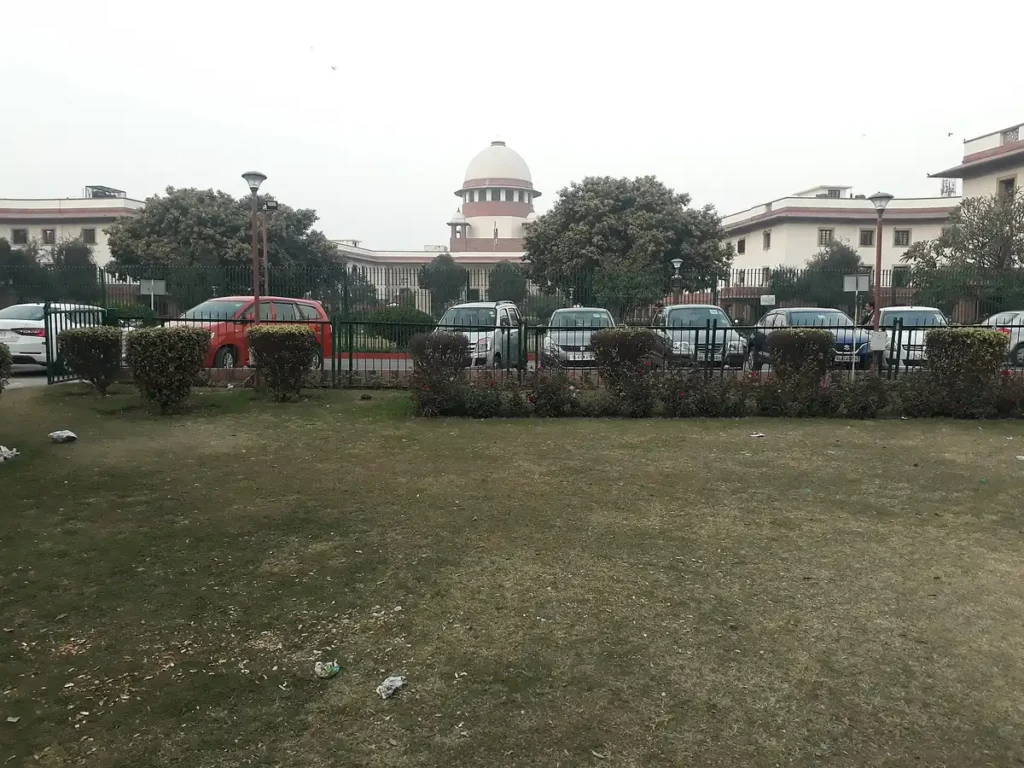
Image: Pinakpani, Wikimedia Commons, CC BY-SA 4.0
How to use this in Mains
If asked: UPSC Mains 2024, GS-II: Explain the reasons for the growth of public interest litigation in India. As a result of it, has the Indian Supreme Court emerged as the world’s most powerful judiciary?
Quote: “Ambedkar called Article 32 the “heart and soul” of the Constitution.”
Use it: A strong opener on the importance of writs.
In the news

Supreme Court: no prior approval under Section 17A needed to probe a bribe demand
In a judgment of 16 October 2026, a Supreme Court Bench of Justices S.V.N. Bhatti and N.V. Anjaria held that investigating a bribe demand by a public servant does not need prior approval under Section 17A of the Prevention of Corruption Act. Asking for a bribe, the court said, is not part of discharging official duties.
19 Oct 2026
CCPA acts against online sale of explosives: 3,940 sellers delisted from seven platforms
The Central Consumer Protection Authority (CCPA) said on 19 October 2026 that 3,940 sellers of regulated explosives such as ammonium nitrate, picric acid and PETN have been delisted from seven online platforms after its action. It has fined Dial4Trade and ExportersIndia ₹10 lakh per order, and other cases are under hearing or investigation.
19 Oct 2026
India to host 61st CIML meeting on legal metrology in New Delhi, 26–28 October
India will host the 61st meeting of the International Committee of Legal Metrology (CIML) for the first time, in New Delhi from 26 to 28 October 2026. The Department of Consumer Affairs is organising it with the International Organization of Legal Metrology (OIML), and more than 100 delegates are expected, PIB said on 19 October.
19 Oct 2026
NMC withdraws MSMER-2023: medical colleges lose the fixed penalty rulebook, annual disclosure stays
The National Medical Commission (NMC) has de-notified the Maintenance of Standards of Medical Education Regulations, 2023 (MSMER-2023) by a notification dated 14 October 2026, published in the Gazette on 16 October. Its fixed penalties, including seat cuts and fines of up to ₹5 lakh for false records, go with it. The Annual Disclosure Report stays.
19 Oct 2026